
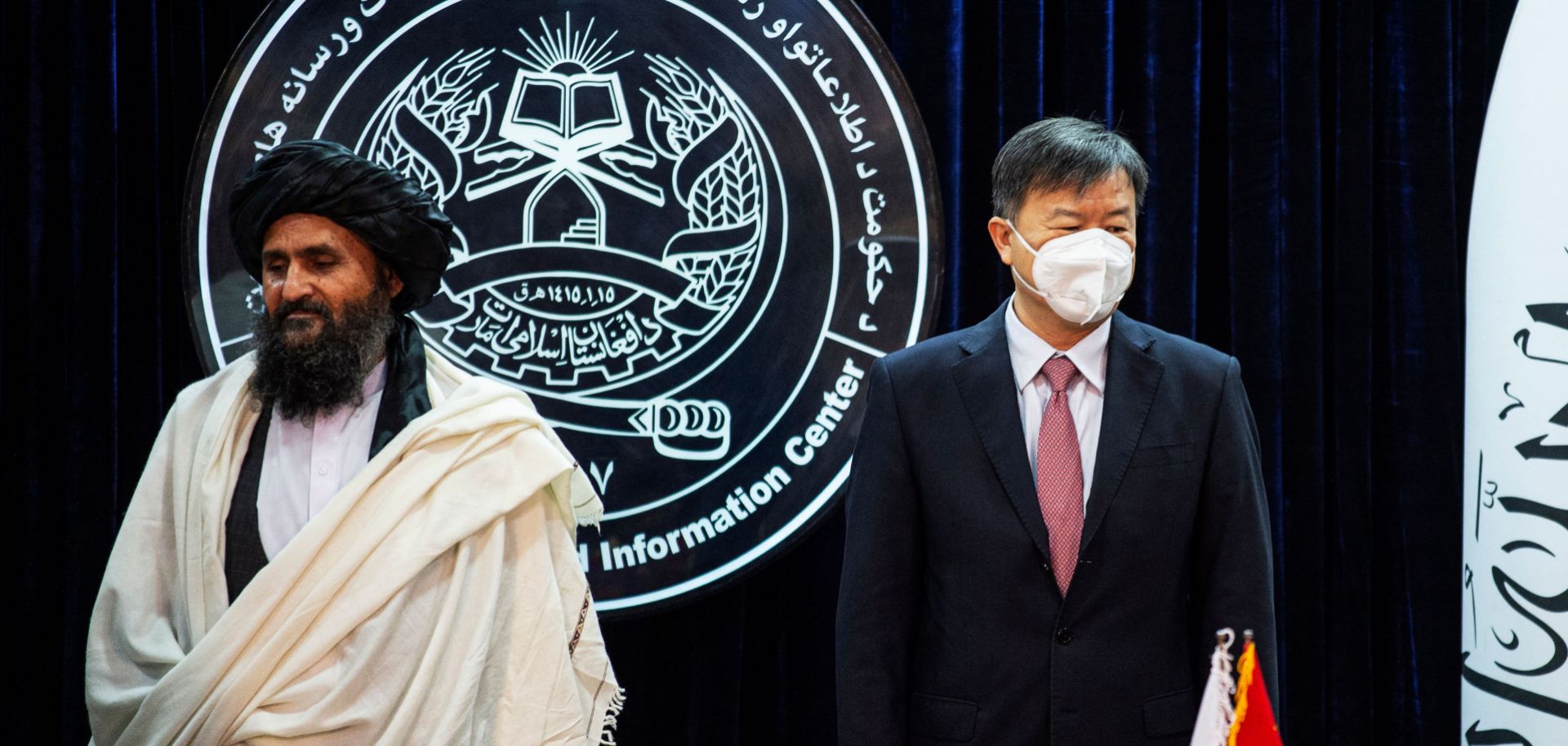
Afghanistan's acting Deputy Prime Minister, Abdul Mullah Abdul Ghani Baradar, (L) and China's Ambassador to Afghanistan, Wang Yu, (R) attend a press conference to announce an oil extraction contract with a Chinese company in Kabul, Afghanistan, on Jan. 5, 2023.
China will explore low-risk economic opportunities in Afghanistan in the short-to-medium term, providing modest economic and humanitarian relief for the Taliban-led government. On Jan. 5, the Taliban-led government in Afghanistan announced the signing of an oil extraction deal with a Chinese company in the presence of the Chinese Ambassador to Afghanistan, Wang Yu, and Afghanistan's acting Minister of Mines and Petroleum, Shahbuddin Dilawa. Under the deal, Xinjiang Central Asia Petroleum and Gas Co. (CAPEIC) will extract oil from the Amu Darya basin in the northern provinces of Afghanistan. This is the first major investment in Afghanistan since the Taliban takeover in 2021, and it highlights China's economic interests in the country as the West continues to isolate Kabul in response to the Taliban's hardline policies, particularly with respect to women.
- The deal will remain in place for 25 years and involves up to $540 million in Chinese investment. The first three years will be an exploration phase, but other logistics and timelines are unknown. Reportedly, China will build a refinery to process the oil in Afghanistan.
- Afghanistan's three northern provinces of Sar-e-Pol, Jowzjan and Faryab will be part of the project. According to the Taliban-led government, the project will create 3,000 jobs in the region.
While the deal in itself is not a significant undertaking from an economic point of view, it highlights China's importance to Afghanistan. The oil extraction deal is a small project compared with other large oil extraction projects in other parts of the world, and it is a resumption of a previous undertaking by another Chinese company. Additionally, the extraction site is close to Afghanistan's borders with Turkmenistan and Uzbekistan, which means that any infrastructure building and supply chain establishment will be less cumbersome undertakings than they would be in other regions in Afghanistan. Despite being a minor investment from China, the deal is an important accomplishment for the Taliban government's diplomatic efforts to engage with its neighbors and reduce its international isolation. The Taliban will use the signing of this deal with an economic powerhouse like China to try to convince other countries to invest in Afghanistan's ailing economy.
- The oil reserves in the Amu Darya river basin are estimated at 87 million barrels of crude, which is low compared with those of major oil fields in other parts of the world.
- Chinese state-owned company China National Petroleum Corp. (CNPC) signed a similar deal with the previous Afghan government, which was backed by the West, in 2011. The project never fully took off due to unresolved security and logistics issues. For example, the previous Afghan government could not finalize the transit deal with Uzbekistan, which led to cost overruns for Chinese investors that tanked the deal around 2013.
China is engaging with Afghanistan to attain potentially critical economic opportunities and to further its own influence in the broader region. Afghanistan sits on significant mineral wealth that remains unexplored due to persistent security challenges and political instability. China has been particularly interested in minerals like copper, iron ore and lithium that have critical applications in clean energy transition systems like storage batteries and electric vehicles. Additionally, Afghanistan forms an important node connecting West Asia, Central Asia and South Asia, regions in which China has invested in infrastructure and development projects under its strategic Belt and Road Initiative (BRI), through which Beijing aims to increase its economic and political influence over neighboring countries. These pull factors mean that China may wish to expand its BRI investments in Afghanistan, even if security risks remain, especially since the U.S. withdrawal from Afghanistan in 2021 left a power vacuum in the region that China may try to fill. China is the sole contender for investment in Afghanistan due to its economic capabilities and similar experiences in other developing countries, particularly in the global south, and this unique positioning may enable Chinese firms to make profitable deals with leaders in Afghanistan's minerals sector in the future.
- According to a report released by Afghanistan's former government in 2019, the country has a mineral wealth of about $1 trillion due to deposits of iron ore, copper, lithium, gold, gemstones and hydrocarbon resources. Afghanistan's lithium reserves are reportedly larger than those in Bolivia, which currently holds the world's largest reserves.
- Pakistan and China have reportedly discussed Afghanistan's potential entry into the China-Pakistan Economic Corridor, which is the BRI's flagship project.
- China has expressed support for the implementation of the Trans-Afghan railway project that would run through Uzbekistan, Afghanistan and Pakistan. China could use the route to transport copper and other goods from Afghanistan to China via Pakistan, which already has transport infrastructure built through China's BRI.
- China Metallurgical Group Corp. (MCC) secured rights to mine copper in Afghanistan's Logar province, which is located just 30 kilometers (19 miles) south of Kabul, in 2008 from the previous government, but the project has been stalled due to security and logistical constraints.
China's pragmatic engagement with all of Afghanistan's governments has positioned it as a crucial economic partner, especially amid Western sanctions against Taliban leaders. The Chinese government's courtship of Afghanistan has remained constant since before the previous U.S.-backed Afghan government fell in August 2021. Unlike the West, which has reduced humanitarian aid to Afghanistan as it demands specific policies relating to women's rights, the Chinese relationship is far more pragmatic, as Beijing is not critical of Kabul's domestic policies and human rights issues. As a result, China has emerged as the most important potential economic partner for Afghanistan in the region. The Taliban expects China to revive old projects, as well as increase investment in the country's critical infrastructure, which will help create jobs amid Afghanistan's economic crisis. China, in exchange, primarily demands security guarantees from the Taliban for future Chinese investment and nationals, as well as help preventing the spread of extremism from Afghanistan into China and the greater region.
- In July 2021, a month before the Taliban completed its takeover of Afghanistan, then-Chinese Foreign Minister Wang Yi hosted a Taliban delegation. At the meeting, a Taliban spokesperson stated that the group considered China a friendly state and would welcome its help in developing and reconstructing Afghanistan. China has hosted and participated in multiple regional conferences about Afghanistan in recent years.
- In December 2022, it was reported that about 500 Chinese business people had made trips to Kabul to scout for various economic opportunities, but no significant pledges or deals have been made so far.
- In September 2022, China and Afghanistan finalized a deal to operationalize a multimodal land corridor — consisting of both railway and road routes — through Kyrgyzstan and Uzbekistan to reduce the time required to transfer goods between the two. A successful trial run was completed from Sept. 13-23.
- The Taliban-led government in Afghanistan banned women from working in international nongovernmental organizations (NGOs) on Dec. 24, 2022, and the United States and the United Nations subsequently suspended humanitarian aid to the country.
Despite China and Afghanistan's shared interests, security issues in Afghanistan will prevent large-scale Chinese investment in the short-to-medium term. The security situation in Afghanistan remains volatile due to the prevalence of multiple militant groups that frequently attack different parts of the country. Groups like Islamic State Khorasan Province (ISKP) have emerged as the biggest challenge for Kabul, as ISKP attacks have continued throughout 2022, and recent attacks have indicated that the group may have increased its capabilities. Another potential threat to Chinese investment could stem from groups like the National Resistance Front, which is composed of loose alliances of ethnic minorities in northern regions of the country that are fighting for a democratic and decentralized Afghanistan. Critical economic projects for the Taliban (like the oil extraction deal with China) could become prime targets of these groups as they seek to undermine the Taliban-led government. There is also the risk that an emerging Uyghur extremism movement could target Chinese investments or nationals in Afghanistan in retaliation for Beijing's treatment of Uyghur people in its Xinjiang province. All of these threats may lead to cost overruns and losses for Chinese companies that discourage large-scale investment in Afghanistan.
- On Dec. 12, ISKP militants claimed an attack on a hotel in Kabul frequented by Chinese nationals. The attack injured five people and was intended to scare away foreign investments in Afghanistan and jeopardize the Taliban's efforts to rule the country. Several Chinese projects have suffered delays and disruptions in Pakistan due to similar threats from militant groups.
- National Resistance Front fighters have been known to operate in the Afghan regions of Baghlan, Panjshir, Wardak and Parwan, which are near the three northern provinces that are part of the new deal's oil extraction site.
- Frequent clashes that cause border closures between Afghanistan and Pakistan have also complicated security for land transport operations.
Besides security, logistical issues will also prevent large-scale Chinese investment in Afghanistan in the short term. Afghanistan is a landlocked country with a difficult topography, and there is no railway system in the country besides a small section of functional railway line in Mazar-e-Sharif, Balkh province, near the Afghanistan-Uzbekistan border. The country also does not have power plants, and it is almost completely dependent on electricity imports from neighboring countries. Thus, economic projects like mining that require the transportation of minerals and other goods will be significant undertakings that generally take a long time to develop.
Because of these constraints, China will weigh the risks associated with economic investments in Afghanistan and likely avoid committing human and monetary resources on a large scale. In the short term, China will likely invest in smaller, low-risk projects to study the feasibility of investing in Afghanistan on a larger scale. In a very low-probability scenario, China could opt to send security personnel, mostly private security, to protect Chinese nationals and projects in Afghanistan in line with its actions in Pakistan. However, this option is unlikely because it would heighten threats to China from various militant groups, as well as potentially from factions of the Taliban that are radically national. Nevertheless, China's interest in investing in even low-risk projects is Afghanistan's best bet to alleviate some of its economic problems. And the onset of Chinese investment could prompt regional countries to work together on connectivity projects through Afghanistan, especially if Kabul manages to reduce security risks. The transit fees other countries would have to pay once such projects are completed could eventually bolster the Taliban's finances enough to enable the government to undertake other developmental projects in the country. Economic investment in Afghanistan from China and other neighbors thus would help the Taliban consolidate its rule, which, in the long run, could strengthen the government's bid for international recognition.
