
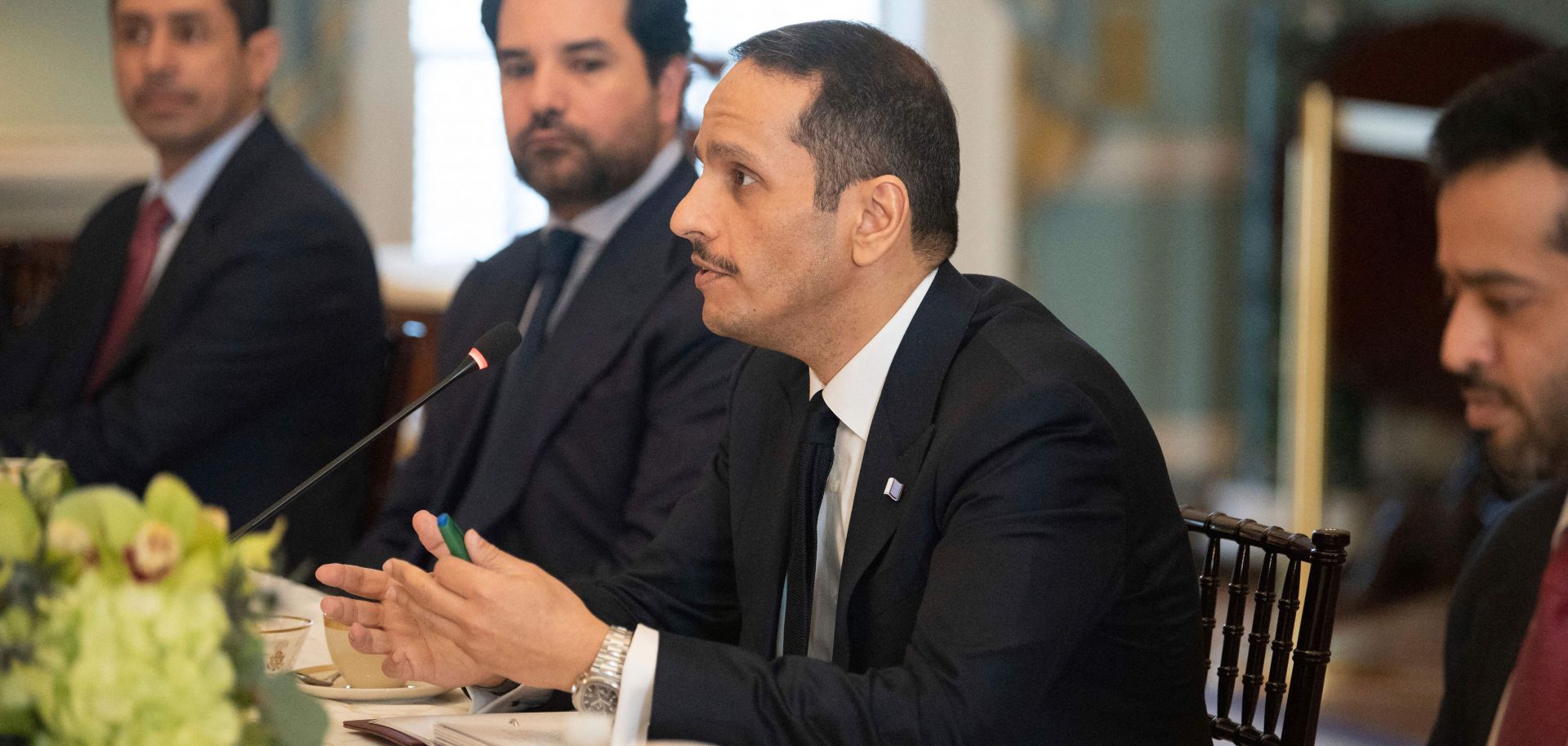
Qatar's then deputy prime minister and foreign minister, Mohammed bin Abdulrahman Al Thani (center), speaks during a meeting with U.S. Secretary of State Antony Blinken, in Washington D.C. on Feb. 10, 2023.
Reported talks between the Taliban's reclusive supreme leader and Qatar could bring small changes to Afghanistan, but in the near term, the Taliban remain unlikely to significantly moderate the hard-line domestic policies fueling their international isolation. According to a May 31 Reuters report, Qatari Prime Minister Mohammed bin Abdulrahman Al Thani secretly met with the supreme leader of the Taliban, Haibatullah Akhunzada, in the southern Afghan city of Kandahar on May 12 to discuss resolving tensions and key disputes between the Taliban and the international community. The United States is reportedly ''coordinating on all issues discussed'' and is continuing efforts to encourage further talks with the Taliban. The two sides reportedly discussed various issues of concern for the international community and particularly the West, including the Taliban's ban on older girls' education, restrictions on women's employment, and countering violent extremist groups in Afghanistan. The meeting is the first to have been publicly reported between Akhundzada and a foreign leader.
- Qatar played a key role in the U.S.-Taliban negotiations that ultimately led to the U.S. withdrawal from Afghanistan in 2021. Prior to those negotiations, Doha hosted an informal Taliban office in one of the few overseas representations of the movement after the U.S. invasion in 2001.
- Maintaining ties with the Taliban fits into Qatar's wider soft power strategy of being seen as a mediator and facilitator of humanitarian interests in the region. Qatar also has diplomatic and humanitarian connections to other otherwise isolated hard-line groups, like Hamas in the Gaza Strip, where Qatar works with Israel to both de-escalate conflicts with Hamas and supply humanitarian aid to the Palestinian militant group.
As supreme leader, Akhunzada continues to drive the Taliban's hard-line governance in Afghanistan, though the group has shown some willingness to compromise on certain social restrictions. Akhundzada's status as supreme leader affords him ultimate authority and policymaking power within the Taliban, which seized Afghanistan in August 2021. He has a reputation for being consistently hard-line and infrequently compromising, which has reportedly seen him clash with and overrule more pragmatic Taliban leaders. This was particularly evident in March 2022, when the Taliban abruptly reversed a pledge issued by the group's education ministry days prior that they would reopen secondary schools to all students, including girls; the last-minute decision to bar girls from returning to school has since been attributed to Akhundzada. Over the past year, the group has also banned women from both attending universities, as well as from working for aid organizations and the United Nations — policies that Akhundzada is believed to have backed. In November 2022, Akhundzada ordered the full implementation and enforcement of a hard-line interpretation of Islamic law as well, including ancient Islamic punishments. Some of these hard-line edicts and policies — particularly the restrictions on women and girls — have garnered rare public criticism from more pragmatic leaders in the Taliban, and have more broadly sustained internal discord over the group's domestic policies. That said, the Taliban have demonstrated some willingness to compromise on enforcing certain policies, such as their ban on women working for aid organizations. Several aid groups have reported that since the ban was announced in December 2022, the Taliban have generally allowed women aid employees to continue working in health, education, and office-support roles.
- Further illustrating the Taliban's willingness to be somewhat flexible with certain social restrictions, the secretary general of the Norwegian Refugee Council reported that in a May meeting with the group in Kabul, the Taliban agreed ''to start immediate talks on a temporary arrangement'' that would allow his organization's female employees to resume work in Kandahar. The Norwegian Refugee Council chief further stated that if his aid organization was eventually able to secure a provincial exemption in Kandahar, the Taliban's spiritual home and political center, ''we should be able to replicate it elsewhere.''
- On May 18, several days after Akhunzada reportedly held talks with Qatar's prime minister, the Taliban appointed Maulvi Abdul Kabir as Afghanistan's “caretaker” prime minister, temporarily replacing 78-year-old hard-liner Mullah Mohammad Hasan Akhund. The Taliban have officially stated the appointment is on an interim basis and a result of former Prime Minister Akhund being in poor health. But some observers have speculated it was instead due to internal rifts in the Taliban, and that the move to replace a hard-liner with Kabir — who played a notable role in negotiating the 2020 Doha Agreement with the United States — may also signal a shift toward greater openness. That said, Kabir’s position as caretaker prime minister in the Taliban-led Afghan government holds little meaningful policy influence. This is particularly because as supreme leader, Akhundzada remains the ultimate authority over the Taliban's decisions, so Kabir's appointment alone is unlikely to bring significant changes to the group's policies.
- Qatar's state-sponsored religion is hard-line Salafism, which is not heavily enforced in the country but gives Doha a religious connection to the Taliban that might facilitate discussions for easing away from hard-line interpretations of Islam to earn limited amounts of humanitarian relief. Qatar may also point to Hamas' governing model, which is reliant on United Nations and international aid to maintain basic living conditions, in the course of such discussions with the Taliban.
The reported talks with Qatar indicate that the Taliban's leader is willing to discuss key issues and potentially consider marginal reforms, but Akhundzada remains unlikely to make major compromises on a strictly hard-line domestic policy anytime soon. Akhundzada has generally demonstrated little regard for the fact that the Taliban's hard-line policies in Afghanistan have come at the cost of international criticism, isolation and sanctions. Akhundzada has consistently stressed that he will not allow foreign countries to influence or interfere with the group's policies and governance, and that he will continue to prioritize implementing and enforcing a strict interpretation of Islam, which he and other hard-liners believe is in Afghans' best interest. Akhundzada and like-minded Taliban members have also appeared resilient to criticism and pressure from more pragmatic leaders in the group; indeed, observers have often viewed Akhundzada’s issuing of strict edicts as attempts to emphatically assert hard-line dominance, particularly in the face of such internal pushback. Nevertheless, the Taliban have shown some flexibility, albeit narrow, on certain policies, such as its ban on women working for aid organizations; this suggests Akhundzada may be willing to consider limited compromise on certain other issues and hard-line social restrictions as well. Increased pressure from the Taliban's more pragmatic leaders and a consequent worsening of internal disputes may also push Akhundzada to consider some concessions in order to limit the unmitigated deterioration of the group's unity — especially if meetings with Qatar yield offers for things like increased humanitarian or economic aid in exchange for moderation.
- While Akhundzada has issued statements that the Taliban seek positive relations with foreign countries, he has also stressed that the group would only conduct such outreach if it is in line with his interpretation of Islamic law. In August 2022, for example, Akhundzada stated that the Taliban would strictly ''deal with the international community as per [Sharia law].''
- In July 2022, Afghanistan's state-run Bakhtar News Agency reported Akhundzada gave a speech to Islamic clerics in which he stated that foreigners ''should not give us orders, it is our system, and we have our own decisions.'' Further illustrating the Taliban chief's general intransigence, Akhundzada reportedly stated in an April 2023 speech that he had ''promised Allah [that] not a single law of infidelity will find a place in Afghanistan,'' and that he would forbid ''any action that threatens or negates Islam and is against Islamic principles.''
