
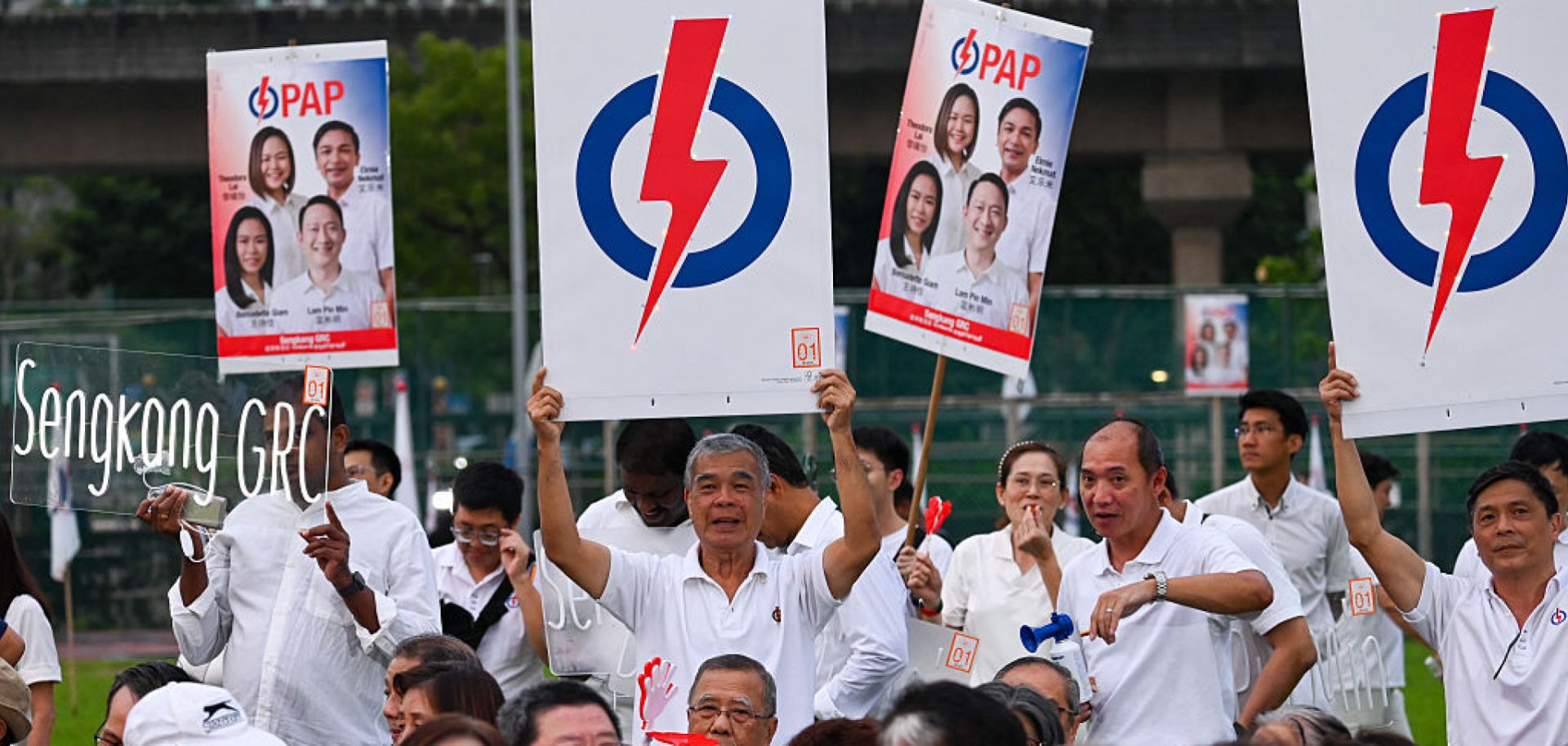
Singapore's election will determine whether Prime Minister Lawrence Wong can secure a strong enough mandate to preserve the People's Action Party's political dominance, respond to economic and social pressures at home, and sustain the city-state's diplomatic agility abroad amid escalating great power rivalry and trade tensions. Singapore will hold a general election on May 3, with all 97 elected parliamentary seats contested across the city-state's 33 constituencies. This will be the first general election held under Prime Minister Lawrence Wong, who formally succeeded Lee Hsien Loong in a planned handover in May 2024, marking a generational shift in the ruling People's Action Party, or PAP, after over two decades of Lee's leadership. The PAP, in power continuously since Singapore achieved self-governance under British oversight in 1959, is fielding candidates for the election in every constituency, while the main opposition reformist Workers' Party, or WP, is contesting 26 seats, primarily in urban heartland districts where it has gained traction in recent elections. Candidates' campaigns have primarily focused on the rising cost of living, housing affordability, wage growth, and Singapore's role in an increasingly unstable global economy amid intensifying trade uncertainty and great power rivalry in its broader region.
- The PAP has historically dominated Singapore's politics, but recent elections have signaled a growing appetite for political plurality among voters. In the city-state's last general election in 2020, the PAP retained 83 of the parliament's 93 seats, but it only won 61% of the popular vote, its second-lowest result. The WP, meanwhile, gained an unprecedented 10 seats, marking the largest opposition presence in the legislature since independence in 1965.
- Singapore's parliament expanded from 93 to 97 elected seats for the 2025 general election following electoral boundary revisions in 2025 to reflect population changes.
The election will be a referendum not only on the PAP's continued governance, but on whether the electorate wants a stronger parliamentary counterweight to the only ruling party the country has known. Singapore faces domestic pressure over real wage stagnation, sharp increases in housing and utility costs, and concerns among younger Singaporeans over upward mobility and national identity. Externally, the city-state is navigating a complicated foreign policy balancing act as strategic competition between the United States and China intensifies, with the consequent disruptions to global trade affecting Singapore's export-heavy economy. The transition from Lee to Wong has been smooth from an administrative standpoint, but Wong's ability to lead the PAP into a new era with sustained legitimacy will be tested by this election. The WP and other minor parties have sharpened their critiques of perceived elitism inherent to the PAP's historical political domination, as well as attendant lack of government transparency and constrained political competition. Though no opposition bloc is positioned to form a government, the erosion of the PAP's historical supermajority since 2011, when it received its lowest ever popular vote tally, has given rise to a more pluralistic political climate.
- According to Singapore's Ministry of Industry and Trade, in 2024, Singapore exported $94.4 billion worth of goods to China, making China its top export destination. The United States is second, purchasing $69.9 billion worth of Singaporean goods in 2024.
- Under U.S. President Donald Trump's reciprocal tariff initiative, Singapore is subject to the baseline 10% tariff rate on all exports to the United States. While still having a negative economic impact, this rate is advantageous relative to other Southeast Asian countries that will be subject to up to 49% tariff rates once the 90-day suspension expires in July.
- Structural and institutional constraints on political competition in Singapore have helped keep the PAP in power over the past 60 years. These include short campaign periods, media and public assembly restrictions, and an electoral system that inhibits opposition parties from challenging the ruling party on an equal footing.
The election will determine whether Wong can govern with a strong enough mandate to navigate economic headwinds and rising public demands for policy reform. The PAP will almost certainly maintain a parliamentary majority, potentially around or above two-thirds, with the opposition likely to gain marginal ground. The next government's capacity to respond to emerging challenges at home and abroad, however, will hinge on the ruling party's margin of victory. A strong electoral showing for the PAP would enable Wong to pursue his Forward Singapore agenda centered on more widespread social safety nets, wage support and digital innovation, without facing major internal resistance. It would also reinforce the PAP's ability to respond proactively to external economic shocks and sustain investor confidence by enabling the government to better withstand domestic political blowback in the event Singapore makes unpopular concessions in trade negotiations. If, however, the PAP suffers even minor losses in popular vote or loses more seats to the opposition, it would signal a continued albeit slow weakening of the party's historic dominance, especially if turnout reflects youth disengagement or opposition consolidation. Such a weakened mandate would likely pressure the PAP to shift away from more moderate and controlled fiscal expansion toward more aggressive, broader-based spending, for example, by increasing the supply of public housing for young buyers and offering more generous support through voucher and assurance package schemes. It would also compel the ruling party to make a greater effort to listen to public feedback, especially to regain trust among younger, middle-class voters in areas where the opposition is gaining ground. Additionally, with a weaker mandate, pressure could mount for more open discourse and incremental political pluralism, translating to a gradual increase in influence for the WP and potentially other smaller parties. The government would have a weaker hand in trade diplomacy as well, including in negotiations over semiconductor access and green tech standards, because the political consequences for unpopular concessions would be greater.
- The Monetary Authority of Singapore has downgraded growth projections and eased monetary policy in response to anticipated shocks brought on by U.S. tariffs.
The election will also determine whether Singapore can sustain its strategic neutrality and diplomatic clout amid intensifying great power rivalry and economic fragmentation. The outcome of the election will shape Singapore's foreign policy posture at a time of escalating regional and global uncertainty, particularly in the South China Sea, Taiwan Strait and broader Asia-Pacific. This is because Singapore's ability to maintain neutrality and influence in these theaters will depend on cohesion and its capacity to stand up to larger powers, which would weaken if the PAP wins by a smaller margin. Small and trade-dependent, Singapore has long pursued neutrality grounded in regionalism, international law and strong bilateral ties with both the United States and China. But the growing U.S.-China rivalry and the derisking and decoupling of semiconductor and critical technology supply chains, along with the erosion of multilateral norms, have made Singapore's balancing act more complex and fragile. At the same time, Singapore is recalibrating its economic strategy to attract diversified investment in green energy, digital infrastructure and advanced manufacturing, sectors directly affected by the emerging tariff landscape. Against this backdrop, a strong domestic mandate for the PAP would enhance Wong's ability to present Singapore as a stable, credible actor and continue high-level functioning as a broker and intermediary in regional and international affairs. It would also ease his government's efforts to deepen strategic ties with partners (like Japan, Australia and the European Union) and reinforce Singapore's participation in multilateral trade frameworks (like the Comprehensive and Progressive Agreement for Trans-Pacific Partnership and the Regional Comprehensive Economic Partnership). Additionally, Wong's government would be better positioned to maintain roughly equidistant relations with the United States and China, as each increases pressure on the city-state to pick a side in the two countries' escalating great power competition. Conversely, a reduced PAP mandate could weaken Singapore's diplomatic leverage and increase risks with respect to pressure from major powers. Beijing, for example, wants stronger Singaporean alignment on issues like Taiwan and South China Sea maritime claims, while Washington wants stronger alignment on technology supply chains and standards, as well as sustained military access. While a unified PAP government would be largely able to withstand such pressures and maintain neutrality, a less cohesive government that is more prone to domestic distractions would face greater challenges in doing so. This reduced capacity to enforce neutrality in regional affairs and stand up to bigger powers would also have implications for multinationals that rely on Singapore's policy predictability and geopolitical insulation to make business decisions. Thus, while Singapore's political stability is not under threat given the PAP's almost certain victory in the upcoming election, investors and regional partners will still be watching for signs of greater policy reactivity under Wong, especially if his party wins by a smaller margin.
- In July 2024, the European Union and Singapore signed a digital trade agreement that expanded on their free trade agreement to include cross-border data flows, digital trust services and AI cooperation, positioning Singapore as a key EU partner in shaping digital standards.
- In April 2024, Singapore and Japan institutionalized a 2+2 defense and foreign affairs dialogue, reflecting deepening strategic alignment.
- In December 2023, Singapore and Australia agreed to expand mutual access to defense facilities, enhancing interoperability under their comprehensive strategic partnership, and reaffirming cooperation in regional security and infrastructure.
- The growing trend of so-called Singapore-washing — where companies or governments route sensitive trade, investment or data flows (like restricted semiconductor technology) through Singapore to mask their origin — risks complicating U.S.-Singapore ties by drawing scrutiny over sanctions enforcement and export controls. The practice could also test Singapore's balancing act between Washington and Beijing if the city-state is perceived as a conduit for circumventing trade restrictions. The government is cracking down on such activities, which would strengthen if Wong comes away from the election with a robust mandate.
