
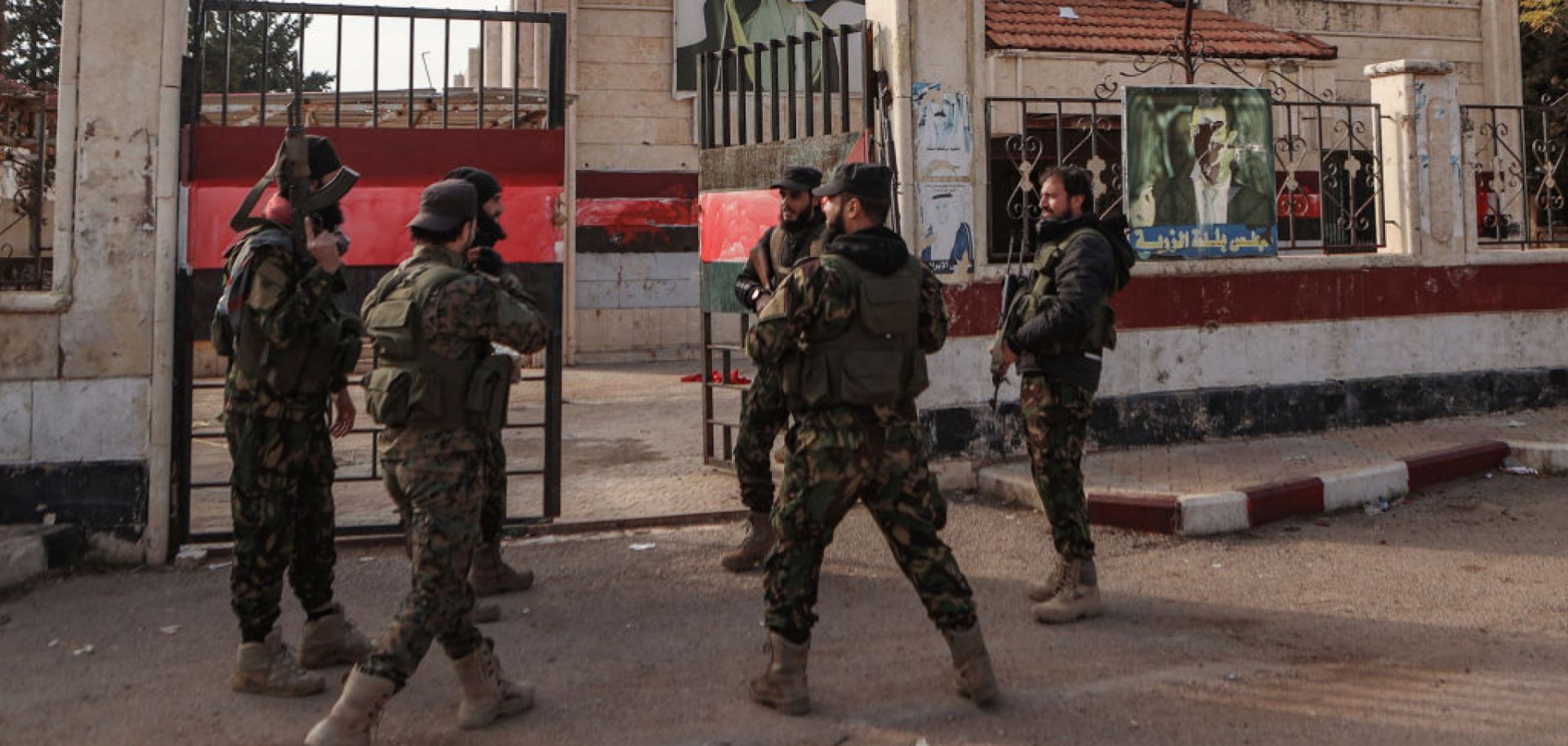
Israel and Turkey will seek to avoid direct conflict in Syria, but their expanding military presence in the country — combined with their contrasting ambitions and backing of different armed groups — could still lead to limited clashes. In recent weeks, Israeli and Turkish delegations have held technical talks to establish a deconfliction mechanism in Syria, where both countries have expanded their military presence following the Dec. 8 collapse of Bashar al Assad's regime. In an April 9 interview with CNN Turk, Turkish Foreign Minister Hakan Fidan said that "there are technical contacts to prevent combat elements from misunderstanding each other," which would contact each other "when needed" to prevent clashes between the two countries, whose relations have soured since the start of the Hamas-Israel war in October 2023. Since al Assad's fall, both the Turkish and Israeli governments have levied accusations against each other regarding their respective operations in Syria. Turkey's foreign ministry has alleged that Israel is "undermining efforts to establish stability in Syria," while Israel claimed that Turkey is establishing a "protectorate" in Syria. Israel has also paired its rhetoric with limited use of force: in early April, Israel conducted airstrikes on Syria's Hama and Tiyas air bases, where Turkey has reportedly planned to deploy air defense systems, as well as surveillance and strike drones.
- Russia and the United States also have troops stationed in Syria. During the country's civil war, which broke out in 2011, Russia launched an intervention in support of the former al Assad regime and, in turn, reached an agreement to establish military bases in Syria. Separately, the United States deployed troops to northeastern Syria to back Kurdish forces in their fight against Islamic State militants in the country. In response, Turkey established deconfliction mechanisms with Russia and the United States to prevent accidental clashes.
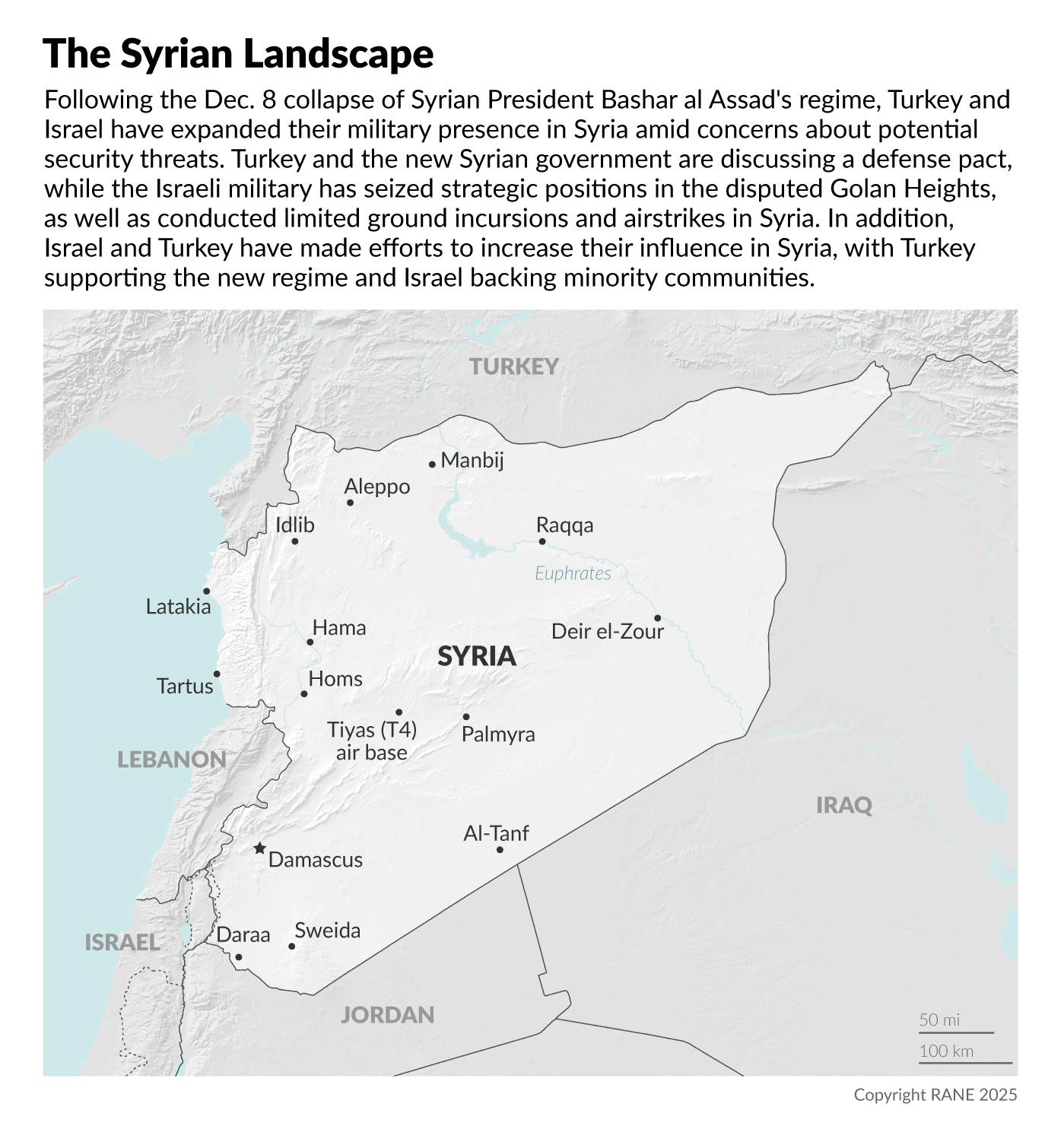
- Following al Assad's fall, the Israel Defense Forces, or IDF, crossed the buffer zone in the disputed Golan Heights territory, with Israeli Defense Minister Israel Katz saying the troops will remain there for an "unlimited amount of time" to defend Israel's national security interests. Israel has also called for the demilitarization of southern Syria, in the Quneitra, Deraa and Suweida provinces.
- The Turkish government and the new Syrian one led by Hayat Tahrir al-Sham, or HTS, have been engaged in ongoing discussions for a defense pact in which Turkey would establish air bases within Syria, be able to use Syrian airspace for military purposes, and conduct training for the Syrian army.
Both Israel and Turkey have expanded their military presence in post-Assad Syria, capitalizing on the power vacuum to advance their own security and political interests. The collapse of the al Assad regime fueled regional concerns about instability in Syria that, among other things, could lead to the resurgence of jihadist groups, including the Islamic State, amid the country's transition to an HTS-led interim government. This concern was particularly acute among Israeli security officials and politicians, who worried that nearby instability and the new Syrian government could threaten Israel's national security. To prevent the new HTS-led government from obtaining the remnants of al Assad's arsenal, Israel conducted airstrikes to degrade Syrian air defense systems, chemical weapons stockpiles, arms caches and naval assets. Furthermore, Israel expanded its buffer along the Syrian border by seizing key strategic positions, which the new Syrian government could only rhetorically oppose due to its military and political weakness. Following al Assad's collapse, Russia and Iran also withdrew their forces from Syria as both countries had backed the former president — creating a sudden vacuum of external influence that other regional countries have sought to fill. Turkey, in particular, has had success in making early inroads with the new government in Damascus, thanks to its preexisting ties with HTS from when the group governed Syria's Idlib province. With key European countries and the United States offering only limited sanctions relief (largely due to HTS' past links to al Qaeda), the HTS-led government has welcomed Turkish offers for military assistance, technical expertise sharing (such as efforts to restore the Damascus airport), electricity provision and humanitarian assistance. This has, in turn, positioned Ankara to expand its foothold within Syria. It has also positioned Turkey to exert influence over the Syrian government to achieve its political goals, such as preventing Kurdish attacks from Syria, increasing energy exports to become a regional power hub, and projecting power southward by expanding its military presence in Syria.
- A Jan. 6 report by Israel's Nagel Committee, which advises on the IDF's long-term strategic and budgetary needs, warned that "the threat from Syria could evolve into something even more dangerous than the Iranian threat."
- The HTS has governed Syria's Idlib province since 2017, and Turkey has provided electricity to the region to ease power shortages since 2021. HTS' supply lines also run through Turkey, giving Ankara further leverage over the Syrian militant group.
- While Russia still maintains some military bases in Syria and is in discussions with the new government to provide military and reconstruction support, Russia's influence has waned in the wake of the al Assad regime's collapse. Al Assad's overthrow has also significantly decreased Iran's influence in Syria by forcing Iranian military officers to withdraw and disrupting supply routes that Iran previously used to send weapons to Hezbollah in Lebanon.
Israel will likely back minority groups in Syria, such as the Kurds and Druze, to weaken Syria's central government and reduce long-term security threats to Israel. Despite interim Syrian President Ahmad al-Sharaa's rhetorical willingness to normalize relations with Israel under the "right conditions," Israel will likely continue to regard Syria's government as a potential threat due to HTS' former ties to al Qaeda, the government's Islamist policies and the porous Syria-Israel border. Therefore, Israel will likely take steps to weaken the HTS-led government and force it to focus on maintaining domestic stability, rather than turning to foreign affairs. To this end, Israel will likely increase its support for minority groups within Syria, including the Druze and the Kurds, to strengthen groups opposed to the central government, especially since some Druze leaders have sought international protection against Damascus. For instance, Israel could conduct ground incursions and additional limited airstrikes against threats to the Druze in southern Syria, where Syrian Druze are concentrated. Israel will likely also facilitate Druze religious visits to Israel and provide aid to Druze-majority areas in southern Syria. Additionally, Israel could provide intelligence on Turkish-backed forces to Kurdish groups in the northeast and might even conduct limited airstrikes in the area, particularly if the United States draws down more troops in Syria. Moreover, in a scenario in which the Turkish-Kurdish peace process collapses and/or the Kurds conduct major cross-border attacks into Turkey, Israel could use its deconfliction mechanism with Turkey to buy time for Kurdish forces to flee Turkish-targeted positions. Regardless, Israeli backing will give Kurdish and Druze communities more flexibility to resist the central government's conditions to integrate, thereby keeping the HTS-led government weaker and focused on domestic matters, unless HTS makes unexpected, significant concessions to ethnoreligious minorities.
- Extensive Israeli airstrikes on weapons caches, storage facilities and remnants of al Assad military bases have degraded the new Syrian government's military capabilities, which will take years to rebuild. This, coupled with domestic fragmentation within the new government by minority groups and militias unwilling to integrate into the central government, has weakened HTS' kinetic capabilities and forced it to focus more on domestic matters. As such, over the next several years, Syria is unlikely to pose a significant threat to Israeli security.
- Some minority groups, such as the U.S.-backed, Kurdish-led Syrian Democratic Forces, or SDF, have agreed to integrate their military and governing institutions into the HTS-led government. However, progress has been slow, and disagreements have arisen. For instance, the SDF has advocated for a decentralized, democratic state with equal rights and full participation of minority groups in the government, but al-Sharaa rejected calls for a federalist Syria without a national consensus, and Turkey has also dismissed these ambitions. By contrast, other groups, including Druze militias, have outright rejected Damascus' calls to integrate into the Syrian military.
- In April, Israel suspended a program that would have enabled Syrian Druze to work in the disputed Golan Heights' agricultural and construction sectors after security concerns arose. This suspension suggests that, despite support for the Druze communities within Syria, Israel's domestic security concerns will trump Israeli-Druze coordination, at least in some cases.
- Following the April 29-30 sectarian clashes between Druze and Sunni Syrians near Damascus, Israel conducted a "warning" airstrike against "extremists" planning to attack Druze-majority communities.
By contrast, Turkey will likely boost military and humanitarian support to Damascus to strengthen the central government, reduce the risk of cross-border attacks and increase influence in Syria. Turkey will likely try to improve the domestic legitimacy of the Syrian government by increasing Syria's standard of living via increased humanitarian aid and electricity deliveries. Ankara will also strive to help stabilize Syria's security environment by supplying military aid, training and weapons to the new Syrian regime, whose military capacity plummeted following recent Israeli airstrikes. Turkish military aid would enable the Syrian government to better defend itself from foreign adversaries and domestic jihadist groups, decreasing the risk of an Islamic State resurgence that could conduct attacks on Turkish soil. A stronger Syrian military would also incentivize reluctant Kurdish groups like the SDF to integrate into the central government, which would constrain these groups' ability to attack Turkish targets. The combination of military and humanitarian support, as well as the potential for increased economic ties in the case of further international sanctions relief, would increase Syrian reliance on Turkey and thereby increase Turkish influence in Syria. This influence will be particularly strong due to Turkey's ideological backing of political Islamist movements, geographic proximity and military expertise, advantages that Syria's other potential partners — including Israel, Russia and Gulf states — do not all enjoy.
- The SDF's integration into the central government would become increasingly likely if the United States announces a further troop drawdown in Syria, as a reduced U.S. presence would weaken the U.S. buffer between the SDF and Turkey. If the SDF successfully integrates into the central government, some hardline militants may splinter off and continue attacking Turkey. However, these splinter groups would have fewer numbers and resources, limiting the sophistication of their attacks. Therefore, any Turkish military operations to combat them would likely be limited in scope, preventing tensions from rising significantly in Kurdish-majority areas.
- Gulf Arab states are also seeking to bolster Syrian stability, with many countries providing humanitarian aid, despite differing perspectives on the political leanings of the new Syrian government. In particular, Qatar has pledged to provide electricity to Syria and pay public sector salaries, although logistical constraints and concerns about U.S. sanctions have hampered Qatar's ability to follow through. Still, Qatar and Saudi Arabia agreed to pay off Syria's $15 million World Bank debt in an attempt to open the door to resumed World Bank support and Syrian access to reconstruction funds.
- On Jan. 6, the U.S. Treasury Department issued a six-month general sanctions waiver to enable the inflow of humanitarian aid and basic necessities, including water and electricity, to Syria. Since then, the Trump administration has offered to extend the waiver for at least two years if the interim Syrian government destroys chemical weapons stockpiles and excludes foreign fighters from senior government positions, among other conditions. According to an April 26 Reuters report, Syria responded that the government had made progress on many of the U.S. conditions for extended sanctions relief, but others required a "mutual understanding." If the waiver expires, Turkey may reduce support to Syria amid concerns about U.S. sanctions.
Turkey and Israel will seek to avoid direct conflict in Syria amid U.S. pressure to de-escalate tensions, but their competing military presence and elevated risk tolerances leave the door open to miscalculations and limited clashes. The United States, a key ally of both Turkey and Israel, has pressured both countries to de-escalate tensions in Syria. This pressure, in addition to Turkey and Israel's own desire to avoid sparking a major conflict with each other, makes a direct clash between Israeli and Turkish forces in Syria unlikely. Still, increasing Turkish influence in Syria would likely concern the Israeli far-right, which, over time, could increase Israel's domestic imperatives to take more assertive military operations against Turkey or Turkish-backed forces in Syria. This is particularly possible considering that Israel has demonstrated a high risk tolerance in its recent operations against Hamas, Hezbollah and Iran. Thus, even with a deconfliction mechanism in place, ongoing Israeli and Turkish military operations in Syria risk a miscalculation that leads to at least limited military clashes, especially if Turkey installs advanced air defense and drone systems and uses them to encroach on Israeli-controlled airspace. Additionally, if U.S. forces further withdraw from Syria, Turkish risk tolerance would also likely increase, though Ankara would remain cautious of triggering U.S. economic and political repercussions that would likely follow a conflict with Israel.
- A clash between Turkish and Israeli forces would not necessarily mark a prelude to a larger war. Instead, space for de-escalation would remain, such as via economic or diplomatic consequences. For example, in 2015, Turkish forces shot down a Russian Su-24 fighter jet for allegedly crossing the Syrian border into Turkish territory, though Russia refuted the claims. Although Ankara and Moscow agreed not to escalate tensions that otherwise could have led to a larger confrontation, Russia suspended its participation in joint Black Sea military drills and imposed economic sanctions on Turkey.
- The United States is expected to withdraw around 600 troops currently stationed in Syria to combat the Islamic State, which will leave fewer than 1,000 U.S. troops in the country. The U.S. military presence has not only supported Kurdish-led anti-Islamic State efforts but also constrained Turkish military operations against the Kurds by acting as a buffer amid concerns that Turkish operations could result in U.S. collateral damage. A further U.S. drawdown would decrease U.S. deterrence against a more assertive Turkey.
