
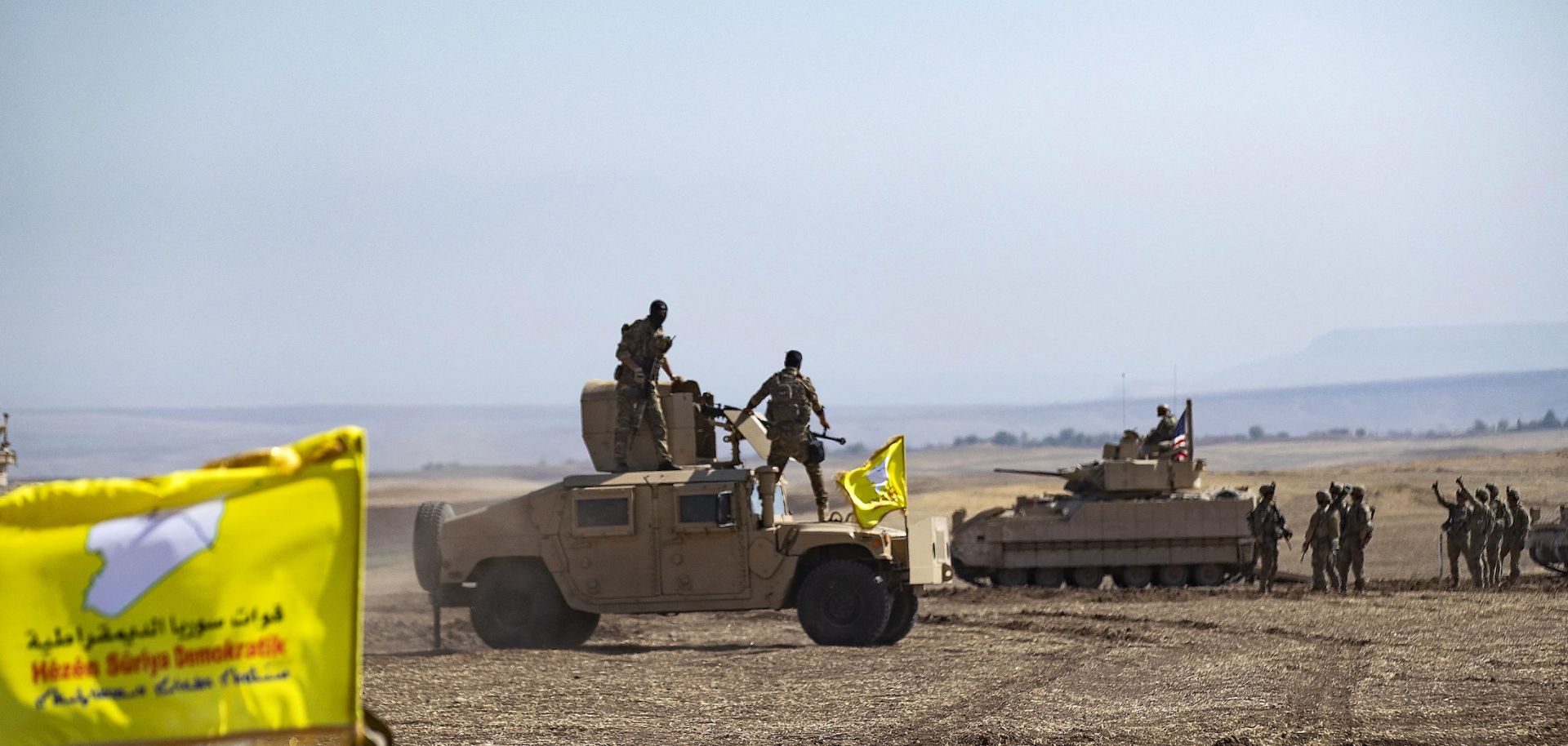
In Syria, the threat of an intensive Turkish military offensive and uncertainty over continued U.S. support will likely increase pressure on the Kurdish Syrian Democratic Forces to reach an agreement with the new Syrian government in exchange for some cultural and political concessions, but such an agreement will likely be unstable due to broader Kurdish autonomy aspirations. As Syria's transitional government takes steps toward integrating many of Syria's rival militant factions into the new government, the future of the U.S.-backed Kurdish Syrian Democratic Forces, or SDF, is in limbo. On Dec. 27, the commander of the SDF expressed the group's willingness to integrate into the new Syrian government but warned that this could only be done through a negotiated process with Damascus, which has already begun. Thus far, the SDF proposed that the group integrate into the Syrian Ministry of Defense as a ''military bloc,'' requiring a decentralized administration that would preserve some degree of institutional autonomy within the Kurdish northeast. Syria's defense minister and former Hayat Tahrir al-Sham (HTS) fighter, Murhaf Abu Qasra, rejected the SDF proposal, stating that it was ''not right'' for the group ''to remain a military bloc within the Defence Ministry.'' However, after a Feb. 3 car bomb explosion in northern Syria killed more than 20 agricultural workers — for which no group has claimed responsibility — negotiations between the government and the SDF have reportedly stalled, though it is unclear if the stall is temporary or permanent.
- The SDF controls around a quarter of Syrian territory in the country's Kurdish-majority northeast. The group has been a key U.S. partner in combatting the Islamic State in Syria; over the years, the United States has provided the SDF with small arms and intelligence. Nevertheless, the Turkish government regards the People's Defense Units, or YPG — which is the primary militant wing of the SDF and the Syrian arm of the Kurdistan Workers' Party, or PKK — as a terrorist organization.
- On Dec. 22, Ahmad al-Sharaa, the head of HTS and the interim president of the new Syrian government, said that all weapons in the country should come under state control, including those held by the SDF. On Dec. 24, some leaders of rival militant groups in Syria agreed to dissolve their groups and integrate themselves under the defense ministry. While it is unclear what specific groups agreed to integrate into the government, the ones that did are likely weaker groups with limited weapons arsenal that operated in HTS-controlled territory. Moreover, neither the SDF nor the Turkish-backed Syrian National Army, or SNA, were among the groups that reached the agreement.
SDF negotiations with the new government come amid uncertainty over the future of the U.S. military presence and funding support for the group, as well as growing Turkish rhetoric to end the PKK/YPG. Since the collapse of Bashar al Assad's regime on Dec. 8, Turkey has increasingly developed diplomatic and economic ties with the new government all the while calling for an ''imminent'' end to the PKK and YPG. In addition, clashes between the Turkish-backed SNA and the SDF have persisted in northern Syria where there is little central government presence. This comes amid growing speculation fueled by Turkey's pro-Kurdish Peoples' Equality and Democracy Party that the PKK's imprisoned leader, Abdullah Ocalan, will call for the PKK to disarm following reconciliation efforts between Ankara and Turkish Kurds. Furthermore, the future of the United States' military presence in Syria remains unclear under President Donald Trump. Currently, the United States has around 2,000 troops deployed in northern Syria to prevent a resurgence of the Islamic State amid the ongoing uncertainty and instability within Syria. However, Trump has repeatedly promised to reduce the U.S. military's presence abroad and made remarks in late January that fueled speculation about potential troop withdrawals. U.S. media sources, citing Pentagon officials, claimed the U.S. Department of Defense was drafting 30-day, 60-day and 90-day plans to withdraw all troops from Syria, though the SDF claims it has not been informed of a U.S. withdrawal. Furthermore, the Trump administration's 90-day freeze on foreign aid has halted some of the U.S. State Department's administrative and security support to Kurdish fighters staffing Islamic State prisons in Syria. Although the SDF remains relatively powerful due to its arsenal and territorial control in northeastern Syria, increased Turkish prioritization to end the PKK and decreasing U.S. support for the SDF risk weakening the Kurdish group over time, which will increasingly pressure the SDF to reach a negotiated agreement with the Syrian government while it still has this leverage.
- In a Jan. 7 interview with CNN Turk, Turkish Foreign Minister Hakan Fidan threatened that Turkey could launch a military operation against the YPG in northern Syria if the militant group did not accept Ankara's demands for a ''bloodless''
- transition, which involves the departure of international fighters backing the YPG, including those from Turkey, Iran and Iraq.
- Following the 90-day funding freeze, the U.S. State Department has issued time-restricted waivers for some organizations operating and managing the al-Hol camp in northeastern Syria, which houses thousands of Islamic State fighters and their family members. Still, ongoing uncertainty over future U.S. funding under Trump risks significantly reducing support and rehabilitation efforts in these camps, thereby increasing long-term risks of extremism in the camps. More broadly, cuts to U.S. support for the SDF may weaken the group in the long term and erode the security of Kurdish-majority territories in Syria.
The prospect of a U.S. military drawdown from Syria, along with the imprisoned PKK leader's potential call for the group's disbandment, will increase pressure on the SDF to reach a political agreement with the new Syrian government. If the United States withdraws a significant number of troops from northeastern Syria (which seems increasingly likely given the Pentagon is drafting withdrawal plans), Turkey will likely become increasingly emboldened to launch a more extensive military operation against the SDF near the Syria-Turkey border. The U.S. military has previously constrained Turkish military operations against the SDF for fear that Turkish-backed attacks could result in collateral damage against U.S. troops. However, with a potential drawdown of U.S. forces, and Trump's broader disinterest in Syrian affairs, Turkey will have fewer political obstacles in Syria to conduct a more aggressive campaign against the SDF. In addition, if imprisoned PKK leader Ocalan also calls for the group to disband in the coming months, as speculated, it would likely result in some fragmentation among the PKK/YPG, which Turkey would very likely seek to exploit by targeting the remaining factions still pursuing Kurdish autonomy. That said, the YPG would be unlikely to heed a call from Ocalan to disarm, due to the group's stated goal of maintaining a Kurdish ''military bloc'' in Syria. As such, Turkey will likely increasingly and more intensely target the YPG and SDF. Furthermore, without the guaranteed support of the United States, an expanded Turkish military operation could be more politically and militarily costly to the group. This threat could, in turn, drive the SDF to reach a political agreement with the Syrian central government, in order to ensure the group's long-term sustainability.
- During his first term in 2019, Trump announced plans to withdraw U.S. troops from positions in northeastern Syria, which Turkey promptly capitalized on to conduct a military offensive in the region. If the United States withdraws from buffer positions in Syria during Trump's second term, Turkey will likely again be emboldened to take more aggressive military action against the SDF.
Both the SDF and the Syrian government could benefit from an agreement in which the central government makes some Kurdish cultural and political concessions; however, the SDF's lingering military autonomy aspirations and concerns about a future Turkish military operation would likely destabilize such a deal. Although the SDF has indicated a willingness to integrate with the Syrian government ''on principle,'' the Syrian government will be unwilling to let the group maintain the military autonomy the SDF-led plan suggests, as this would set a precedent for decentralization and embolden rival militant groups within Syria to make similar demands. Nevertheless, even if the government rejects the SDF's maximalist demands, the group's integration within the Syrian government would likely still provide some protection from a Turkish offensive, since an attack on the integrated SDF would be an attack on the new Syrian government. Similarly, the Syrian government would likely reap some benefits from this agreement. For one, the Syrian military does not have the strength with its limited arsenal to enter into a conflict with the SDF. Furthermore, integrating a large, rival militant group into its ranks would boost the new government's international legitimacy, though this would also make the composition of the government more heterogeneous and fragmented. As such, the Syrian government may be willing to make some concessions to the SDF, such as reserving some mayoral positions or legislative posts for Kurdish representation in addition to preserving some Kurdish language rights. But in exchange, Damascus will also require the group to make some military concessions, such as formally giving up its efforts for military autonomy and integrating into the Ministry of Defense alongside other militant groups. Although Turkey will likely oppose these efforts to maintain some degree of autonomy, the SDF making military concessions would likely appease Ankara's security concerns in the short term. Nevertheless, any agreement would likely be unstable since there remains a high likelihood of ethnic fragmentation within post-Assad Syria. And even if it agrees to such a deal, the SDF may not necessarily fully abandon its larger aspirations for more political and military autonomy, which — combined with the SDF's concern over a future Turkish offensive, would likely threaten the agreement's long-term sustainability.
- During its decades-long reign, the Assad regime denied many Kurds in northeastern Syria citizenship and mischaracterized them as Arabs. However, under the SDF rule during Syria's civil war, Kurdish minorities gained cultural rights, including the ability to name their children Kurdish names and have them be taught the Kurdish language in schools. Syrian Kurds will likely seek to enshrine these cultural rights under the new government to prevent backsliding.
- The new Syrian government would likely be incentivized to grant some minority rights to the SDF and Kurdish majority northeast, not only to reach an agreement with the SDF, but also to show the international community that it has taken concrete steps to protect minority rights within the new government — one of the West's major conditions for sanctions relief.
