
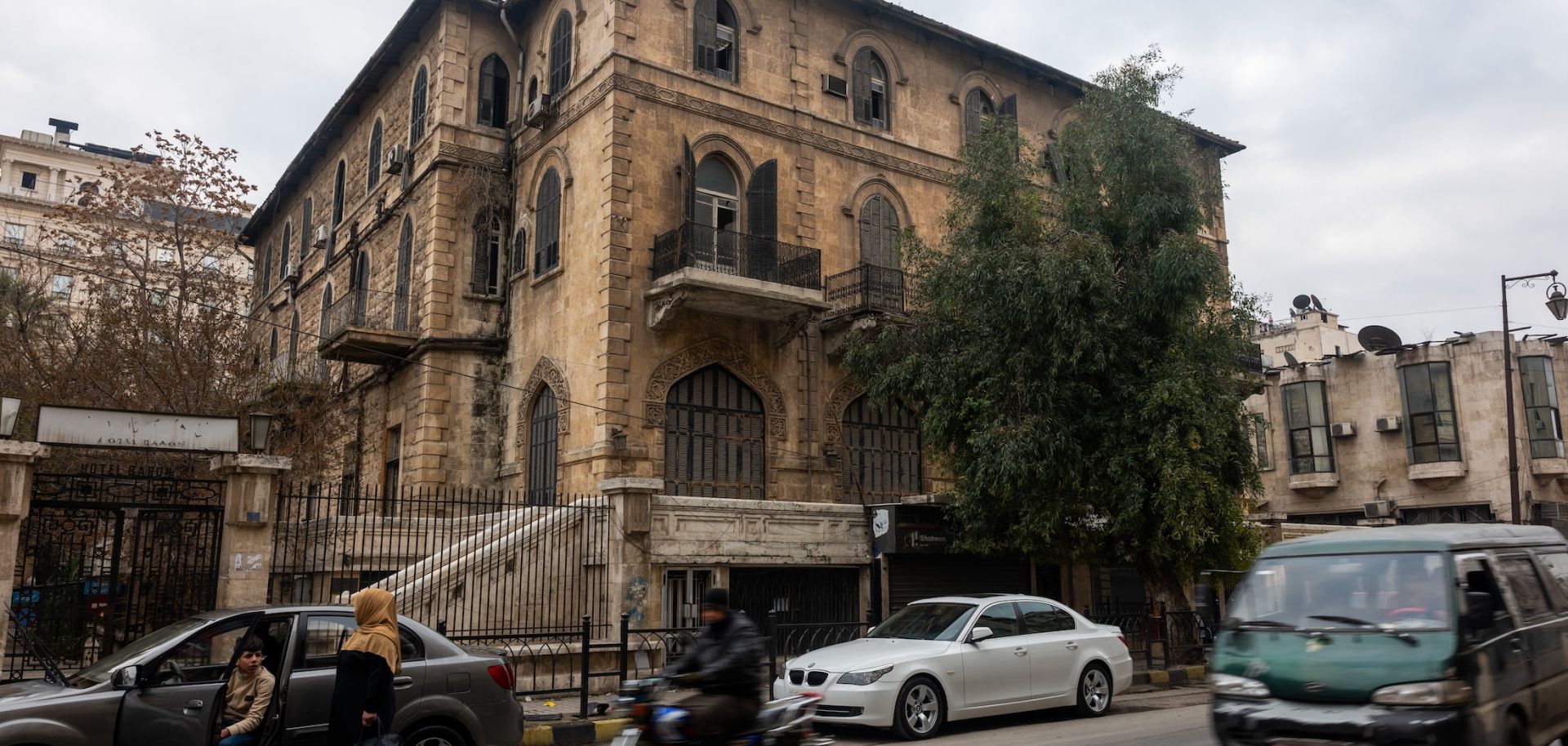
To secure sanctions relief from the West, Syria's new leaders will likely initially take some symbolic steps toward forming an inclusive democratic government, but they will struggle to complete this process and may be unwilling to relinquish power, which could eventually see those sanctions be re-imposed. On Jan. 27, the European Union agreed to a roadmap to ease sanctions on Syria at a foreign ministerial meeting in Brussels, Belgium. However, member countries still need to agree on technical details before the European Union can legally adopt the suspension. The same day, the French foreign minister said that the European Union would lift sanctions on Syria's energy and transport sectors, as well as on the country's financial institutions to facilitate financial inflows into Syria. Since Hayat Tahrir al-Sham, or HTS, overthrew Bashar al Assad's regime on Dec. 8, countries have increasingly considered removing sanctions on HTS, which the European Union and the United States designate as a terrorist organization due to the group's jihadist origins, to facilitate humanitarian inflows into Syria and stabilize the country during its post-Assad political transition. The European Union's decision to ease sanctions comes weeks after the U.S. Treasury Department announced on Jan. 6 a six-month general license for Syria that facilitates humanitarian aid inflows into the country and allows waivers for companies to supply necessities like electricity and water without the threat of U.S. sanctions. However, the United States did not remove the sanctions that it had imposed on HTS.
- The United States, the United Nations, the European Union and Turkey have designated HTS as a terrorist organization. The group was established following the 2016 schism between its jihadist precursor, the al-Nusra Front, and al Qaeda. The al-Nusra Front then merged with Syrian anti-Assad rebel groups to form HTS.
- In late December, Germany submitted two documents to EU countries that proposed easing restrictions on Syria's banking sector to enable funds to enter the country, and on Syria's energy sector, which has been afflicted by power outages. The proposals would also reduce sanctions on air transport as well as restrictions on the movement of private assets, such as cars, for Syrians living abroad returning to Syria. Though specific details of the European roadmap are unclear, a final agreement would likely use the German proposals as a framework.
The West is calling for a democratic and inclusive government in Syria, but the country's new rulers will struggle to meet these requests because of internal fragmentation and significant economic problems. Western countries have called on Syria's new HTS leaders to form an inclusive government with protections for women and ethnic and religious minorities. Many, including the United States and EU member countries, want to see concrete progress made toward these issues before considering removing HTS's terrorism designation and additional sanctions associated with it. But while Syria's new leaders have publicly committed to taking such steps, they have also noted it could take up to four years to hold elections, partially due to the need to conduct a new census in the multi-ethnic country, which has seen significant demographic changes following the 13-year civil war. Indeed, the war has left Syria severely fragmented and rife with various militant factions that often have divergent political beliefs, which will hamper efforts to centralize power. In addition, HTS has inherited a very weak Syrian economy, decimated by over a decade of war that caused hyperinflation and drove over 6 million Syrians to leave the country. This has left the government cash-strapped and unable to provide significant economic incentives to rival factions within Syria to win their support. Despite Western pressure, Syria's HTS leaders will thus struggle to quickly form a united government and stabilize the country.
- According to the United Nations, the nearly 14-year civil war has internally displaced over 7.4 million Syrians; 70% of Syrians also require humanitarian aid assistance, while 90% live below the poverty line.
- Prior to overthrowing the Assad government, HTS had controlled and governed Syria's northern Idlib province. Local reports noted the HTS-led government initially imposed some religious laws (including banning alcohol), but as the group moderated its tone it relaxed some of its restrictions, such as dress codes for women and a ban on music in school. In addition, revenue collected from taxing businesses and farmers enabled HTS to provide public services in Idlib, including supplying water and electricity, paving roads and collecting trash. The HTS-led government in Idlib also allowed some protests against its tax policy, implying that some freedom of expression was permitted. HTS's policies in Idlib indicate the framework under which the organization will likely govern Syria: providing necessary public services and allowing some freedoms under Islamist interpretations of the law.
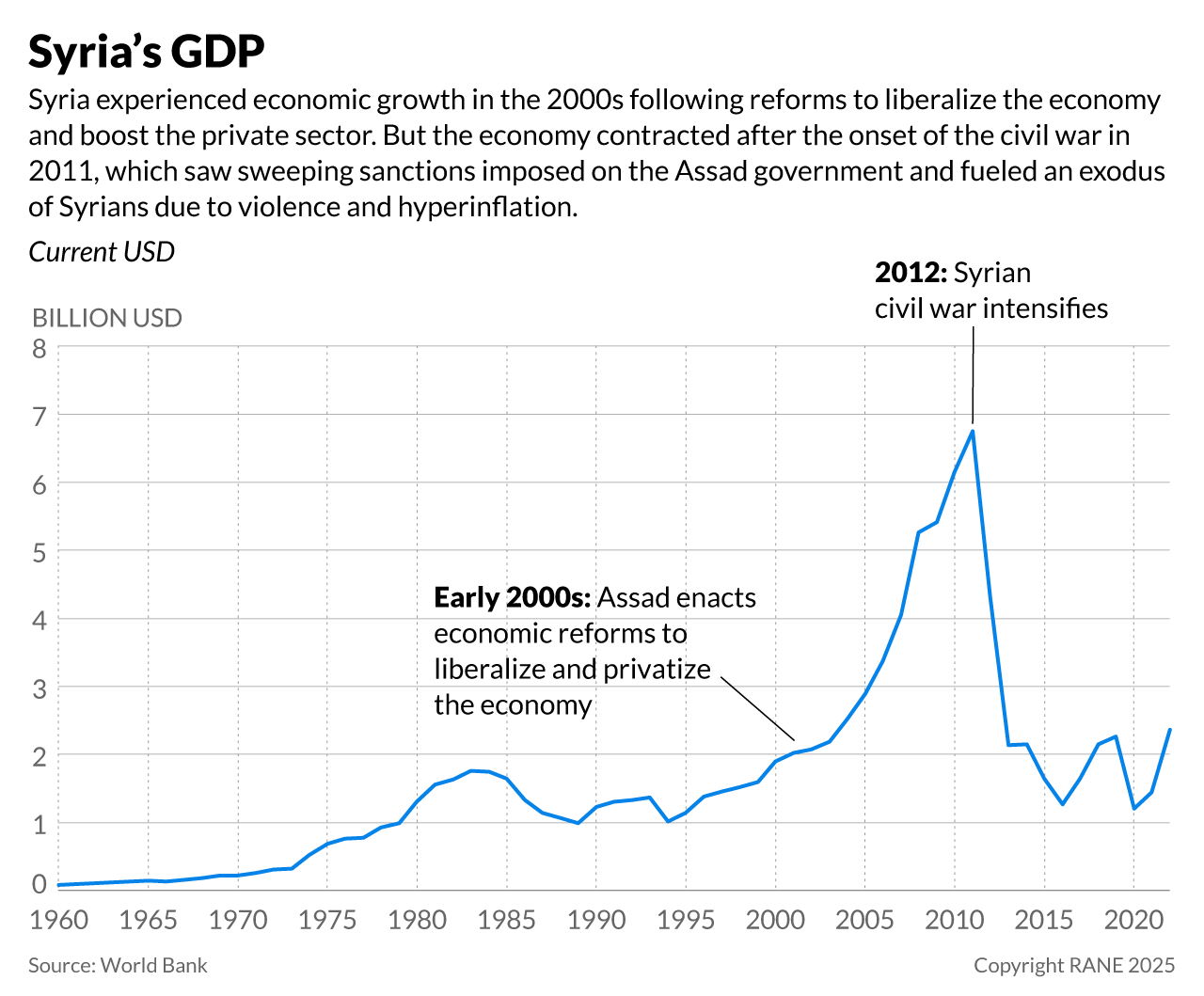
The United States and the European Union will likely lift some sanctions to improve the humanitarian situation in Syria, but they are also likely to leverage sanctions relief to pressure Damascus to make meaningful reforms. The United States's six-month general license and the European Union's easing of sanctions will focus on increasing humanitarian aid inflows and facilitating the provision of basic necessities, including electricity and water that will increase the standard of living for many Syrians. The reliable provision of public services — and, in some cases, the expansion of such services — will likely increase the domestic political legitimacy of the new Syrian government. While the lifting of sanctions on Syria's transportation, electricity, water and banking sectors will likely prevent a worsening humanitarian aid crisis, broader sanctions relief that unlocks major reconstruction aid is needed to more fully restabilize the war-torn country. However, HTS's jihad origins and the uncertainty of the Syrian government's future means that Western governments will remain reluctant to completely eliminate sanctions and/or remove HTS's terrorism designation. This is because Western countries would risk facing significant domestic backlash if they strongly support HTS now, only for the group to go on to embrace more of its jihadist roots and install another repressive regime. Therefore, Western governments will likely use the potential for more sanctions relief and the eventual removal of HTS's terrorism designation as leverage over HTS to ensure it continues to take concrete steps toward forming an inclusive government. There will likely be some tolerance for delayed elections, especially if Syria remains relatively stable. However, if HTS eventually rejects the democratic process entirely and/or begins to oppress minority groups, the West will become increasingly likely to reimpose sanctions.
- U.S. President Donald Trump will likely continue to enable humanitarian aid inflows into Syria, which is supported by some Democrats and Republicans in Congress due to shared humanitarian concerns.
- Due to Syria's long-term isolation from the international community, estimated reconstruction costs range from $250 billion to up to $1 trillion. The true cost is likely closer to upward estimates after more than a decade of conflict.
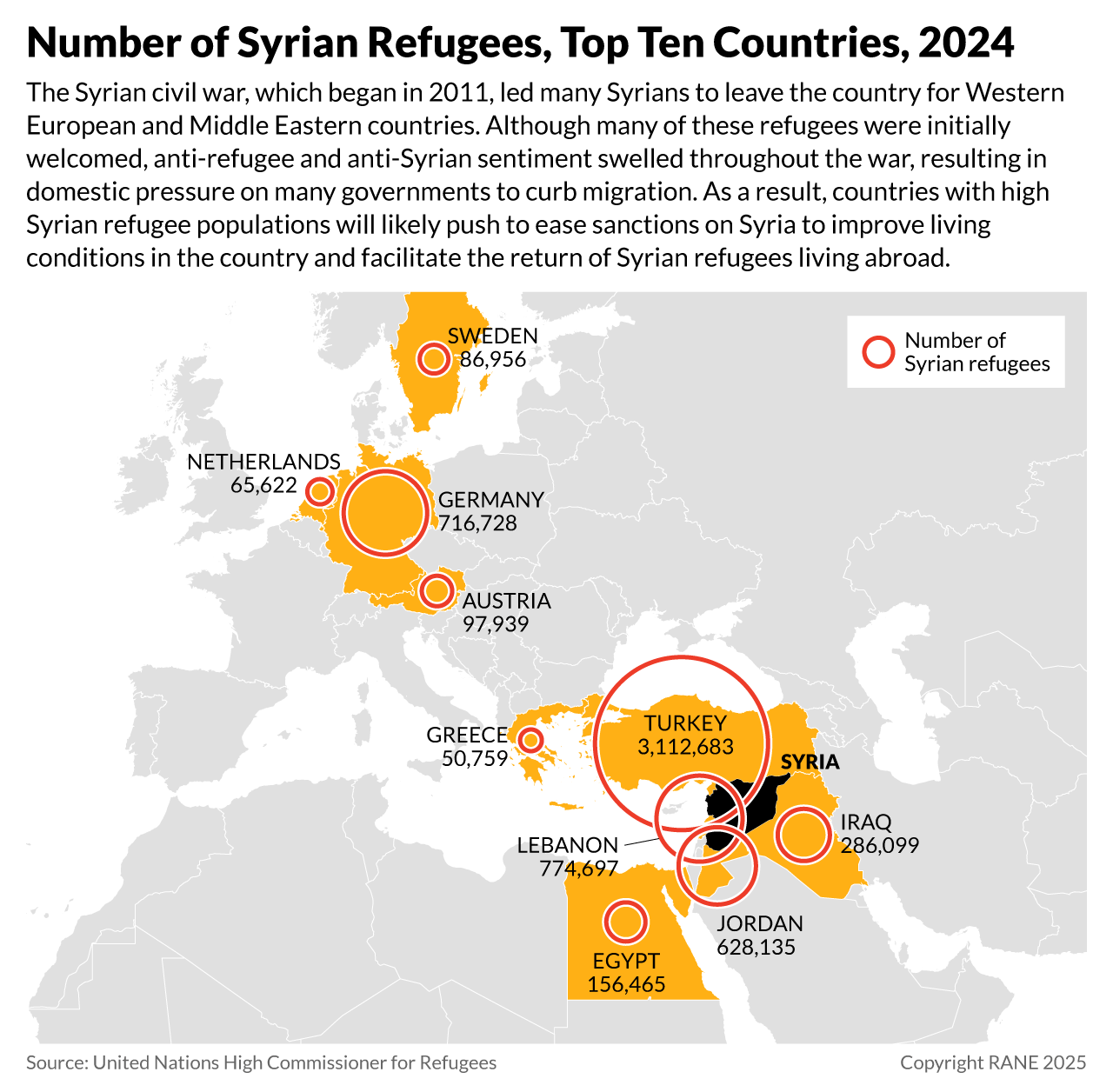
European countries with large Syrian refugee populations, such as Germany and Austria, will likely advocate for greater sanctions relief than the United States to incentivize Syrian refugees to return. Many Western European countries initially welcomed Syrian refugees after the war broke out in 2011. However, subsequent waves of refugees, rising nationalist sentiment in Europe, and reports of violent incidents involving refugees in recent years have increased anti-Syrian and anti-refugee sentiment across Europe. Although the United States also accepted a limited number of Syrian refugees over the course of the war, the vast majority of Syrian refugees ended up in European countries and neighboring Middle Eastern countries. As a result, the pressure to encourage Syrians living abroad to return home will be significantly stronger in Europe than in the United States. This means European countries will likely also be more willing to expand the Syrian government's access to aid, even if HTS does not fully align with the West's conditions, in the hopes of stabilizing the country to the point where refugees feel safe enough to return home. To that end, the European Union and individual member states — particularly Germany and Austria, which have among the largest Syrian refugee populations in the bloc — will likely provide more sanctions relief aimed at improving the quality of life in Syria. To make it easier for refugees to move back, Brussels and EU governments will likely also lift restrictions on the movement of people and assets to Syria. For the refugees who want to return home, these measures may incentivize them to finally take the leap. However, for many Syrian refugees living abroad, the standard of living in their host countries will remain higher than that of Syria, which — coupled with Syria's still-uncertain political, social and economic future — will likely compel the majority to stay where they are.
- Turkey is the largest host of Syrian refugees, with over 3 million refugees living in its territory. Europe has accepted around 1.3 million Syrian refugees, with Germany, Greece, Sweden, Austria and the Netherlands having the largest refugee populations.
- To prevent additional Syrian refugee inflows into Europe via Turkey, in 2016, the European Union and the Turkish government reached an agreement that allowed Greece to return irregular migrants to Turkey, increased Turkish border security, and provided financial aid to Turkey to support Syrian refugees in the country.
The new Syrian government will likely take some symbolic steps toward forming an inclusive government in the short term to get additional sanctions relief, but any relief may prove temporary if Damascus diverges from its democratic promises. In the nearly two months since the Assad regime was overthrown, HTS leader and Syria's interim president Ahmed al-Sharaa has mostly rhetorically aligned with Western demands for the country's political future. Al-Sharaa will likely keep promising to hold elections and install an inclusive government, which, in the short term, will probably appease Western pressure since such a political transition will be a multi-year endeavor. Furthermore, HTS will likely continue to meet with rival factions to signal its commitment to centralizing power and increasing stability in the fragmented country. Al-Sharaa has also promised to hold a National Dialogue Conference, which aims to bring together various elements of Syrian society, including representatives from different governorates and ethnic communities, to discuss the country's political future. The event was initially scheduled for early January but has since been delayed, though is now expected to occur before March 1. If, however, the conference is held and there are optimistic signs of a roadmap to a permanent government, it would increase the transitional government's international legitimacy and the likelihood of additional aid and sanctions relief from the West. Nevertheless, there is a strong likelihood that discussions of an inclusive process at the conference are only symbolic, as al-Sharaa and HTS may ultimately be unwilling to engage in a democratic transition that could force them to relinquish power to an elected president in the long term. If HTS eventually begins to obstruct Syria's democratic transition, the West would become increasingly likely to reimpose sanctions to pressure the government to return to diplomatic dialogue. Furthermore, HTS's Islamist leanings will likely remain an obstacle in Syria's relations with the West. Though the transitional government appointed some women to high positions, such as the head of Syria's central bank, Islamist interpretations of gender roles in other aspects of life are unlikely to meet Western expectations for gender equality.
- On Jan. 29, al-Sharaa formally dissolved remnants of the Assad government, including the Ba'ath Party and Assad-era security agencies. He also suspended the country's existing constitution and reiterated plans to draft a new charter in the coming years, granting al-Sharra to form a temporary legislative council in the interim. However, concern remains over al-Sharaa's willingness to relinquish power in the long term and the feasibility of uniting rival militant groups under a central government. Furthermore, if al-Sharaa packs the temporary legislative council with HTS members and staunch supporters, it will signal a decreasing likelihood of forming an inclusive government.
- The National Dialogue Conference is expected to be held before March 1. The conference was scheduled to be held on Jan. 4-5 but was postponed, reportedly due to logistical and technical issues requiring more time for consultations. However, an official date has not been set and opposition groups have reportedly not received invitations to the conference, raising concerns if the event will even occur.
- To distance himself from his jihadist image, al-Sharaa has relinquished his nom de guerre and has worn Western-style clothing in official settings. Nevertheless, the appointments of former jihadists to positions in al-Sharaa's transitional government, including Murhaf Abu Qasra as defense minister, have raised concern that HTS may eventually return to its jihadist roots amid internal pressure from hardliners. Concerns in the West over the unequal treatment of women under the new Syrian government were also heightened after al-Shaara refused to shake hands with German Foreign Minister Annalena Baerbock. However, on Jan. 3, the French foreign minister wrote on X that he and Baerbock had received ''assurances from the new Syrian authorities that there will be broad participation — particularly by women — in the political transition.''
