
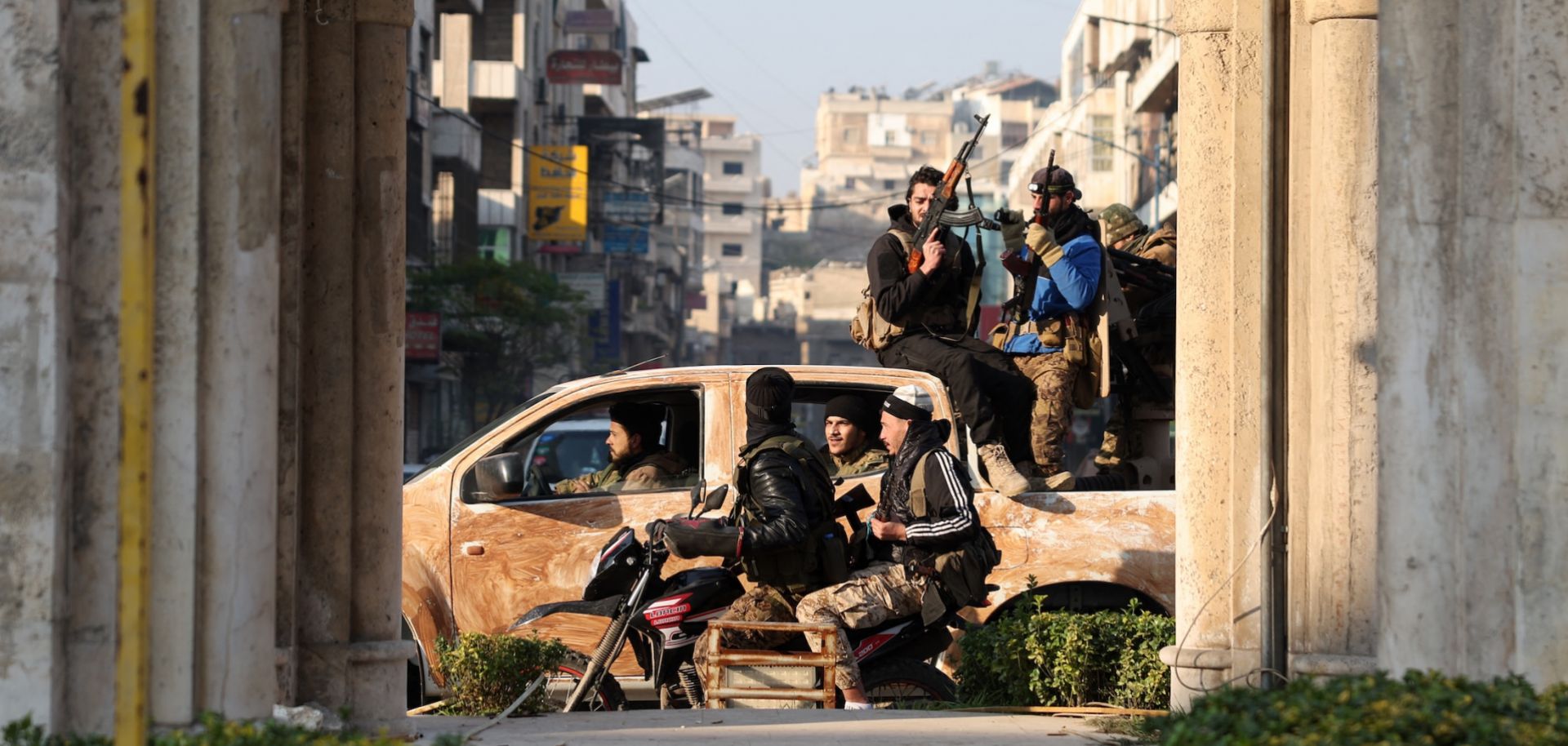
As President Bashar al-Assad's regime collapses, Syria will fragment into factional territories under a weakened rebel leadership, with increased Turkish military action, a diminished Iranian presence, expanded Gulf Arab influence and a revived Islamic State threat. The Syrian government's military position has continued to rapidly deteriorate in recent days after Hayat Tahir as-Shams (HTS) rebels seized the city of Aleppo on Nov. 30. As of Dec. 6, HTS fighters were marching along the vital M5 highway, toward the key city of Homs, a vital corridor not only for Syria but for Iran's land route to Hezbollah in Lebanon. According to unconfirmed reports published on Dec. 6, the Syrian Arab Army (SAA), the government's official armed forces, was in the process of withdrawing from Homs toward Damascus in an effort to reposition the SAA's remnants around the capital city, which is located some 163 kilometers south of Homs; as part of that effort, the SAA also reportedly handed over the key Euphrates River city of Deir el-Zour to the U.S.-backed Syrian Democratic Forces (SDF) the same day. Meanwhile, on Dec. 5-6, rebel forces around Deraa in southern Syria began seizing government checkpoints and equipment, and overrunning poorly defended government positions, opening a new front against the al Assad regime. Near the Lebanese border, Israel has also kept up strikes on Hezbollah, a key ally of the Syrian government. Finally, on Dec. 5, the Islamic State of Iraq and Syria (ISIS) announced new operations in Syria as well, with the jihadist group reportedly taking territory in a town abandoned by the SAA along the Euphrates River.
- Bloomberg, citing a Kremlin source, said that Russia, already stretched thin by Ukraine, has no plan to intervene in Syria to aid its ally al Assad, despite the mounting threats to his regime. Israeli intelligence also noted that the Syrian government's positions were collapsing much faster than they anticipated.
- HTS is an al Qaeda offshoot that has rebranded itself as a nationalist jihadist organization. Numbering around 10-30,000 fighters, it seeks to overthrow the al Assad government, but has so far not pledged to resume al Qaeda's brand of transnational jihadism.
- In a Dec. 5 speech, Hezbollah's Secretary General Naim Qassem said the Lebanese group would aid the Syrian government as much as it could without going into further detail. But Hezbollah likely has a limited ability to help the al Assad regime, as the group has been severely weakened and degraded in its conflict with Israel that significantly escalated in late September.
The HTS offensive that began in late November rapidly overran Aleppo as evidence mounted that the Syrian government and its allies were incapable of a sustained defense of the country. Various factors have weakened the Syrian government's military capabilities in recent years, including dire domestic economic conditions, ongoing Israeli strikes, and waning support from al Assad's Iranian and Russian allies, with Hezbollah withdrawing troops from Syria due to the war with Israel in Lebanon, and Russia distracted with its war in Ukraine. Long plagued with so-called ''ghost soldiers'' (i.e. those whose names appear in military records but are not actually in service), the SAA's capabilities have also been deeply undermined by years of corruption, sanctions, casualty-heavy battles and defections. Against this backdrop, the rebels assessed it was an opportune time to launch an offensive against the regime. And their assessment appears to have been correct, as the rebels were able to seize Aleppo, Syria's second-largest city, on Nov. 30 just a day after they entered the city, with government forces quickly proving unable to contain their advances. The dissolution of the SAA has since only accelerated, with media reporting withdrawals and abandoned equipment along the frontlines and even deep in loyalist territory in southern Syria.
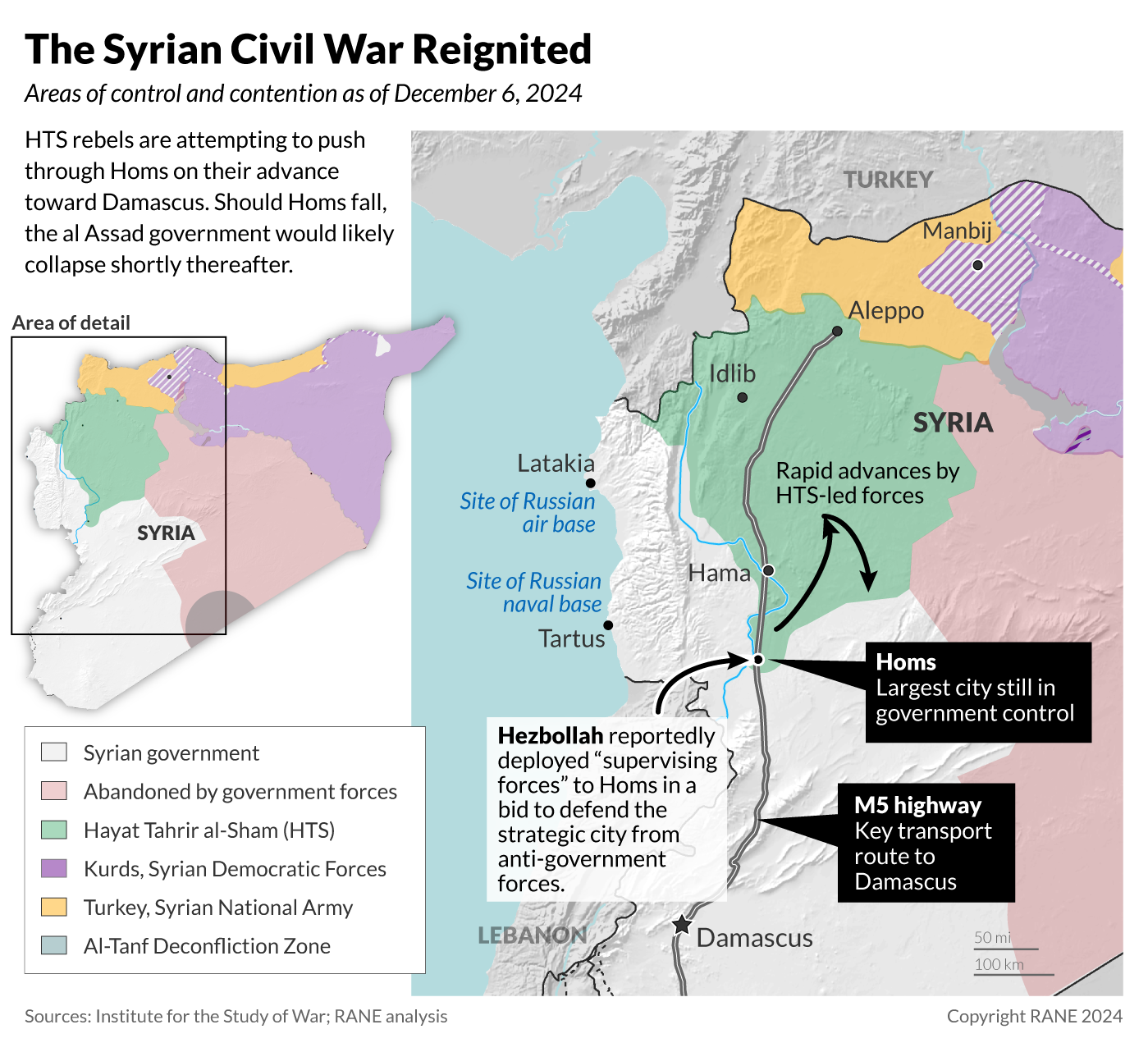
Though currently unlikely, a last-minute diplomatic solution could still halt HTS rebels' march toward Damascus, leaving the al Assad government a rump state in a frozen conflict. After the fall of Homs, HTS rebels' supply lines will be stretched from their base in Idlib. During this time, their ally Turkey will slow the rebels' advance to give diplomacy a chance to potentially end this phase of fighting, with a smaller territory under al Assad's control. Such a diplomatic solution would likely involve Russia and Iran forcing al Assad to seek a reconciliation process with the rebellion, and a possible handover of power to a new government with expanded executive powers. This would lead to a halt in overall fighting by ending the HTS military advances and allowing for a Russian- and Iranian-influenced political transition to unfold, in which the al Assad government would likely be allowed to take part. But this is only possible if al Assad himself — long averse to any concession or reconciliation — suddenly changes his tune under this immense military pressure. A peace process would also be susceptible to violations by rebels now emboldened by the collapse of the SAA's military power, and even if HTS agrees to it, other factions might not, which could see other Syrian rebels race to fill the power vacuum in Damascus.
- Using its diplomatic heft, Russia has successfully intervened multiple times to shore up al Assad, including in 2012 when U.S. airstrikes seemed imminent after Syria used chemical weapons. Russia, Turkey and Iran continue to have the Astana process to formulate a currently largely defunct peace process for Syria.
- Al Assad's government is highly centralized and authoritarian, making it hard to offer concessions that do not also weaken it. Since Syria's civil war began in 2011, Al Assad himself has shown virtually no interest in diplomacy and insisted on a maximalist vision for victory in Syria's civil war.
As a negotiated end to the conflict is unlikely, HTS will likely take control of Damascus formally overthrowing al Assad and triggering a tumultuous political transition that would lead to new internal splits that benefit ISIS. Given HTS's current military trajectory, the insufficient rate of foreign support for al Assad, and the inability of the SAA to hold territory, it appears increasingly likely that HTS will move on Damascus in the coming weeks, which would formally signal the end of the al Assad government and likely presage the surrender and/or flight of most government officials. HTS would then become the de facto government of the territory it conquered and begin replacing the al Assad government with an Islamist authority. It is unclear if HTS would call for new elections or formally impose a religious state with a centralized authority led by the group's leader, Abu Mohammed al-Julani, and its hierarchy. If HTS does call elections, the vote would likely forestall splits between the Syrian rebellion's many factions, including the SDF, the Free Syrian Army and the Syrian National Army, until after the electoral process plays out. If HTS decides not to hold an election and takes over the government without including other factions, rival rebel groups would likely push back and resume fighting. In either scenario, Iran and Russia would lose virtually all influence in an HTS-dominated Syria; Russia's naval base at Tartus would likely be abandoned, while Iran's land corridor to Lebanon would be permanently cut. Iran might use its militias to hold towns in eastern Syria, like Bukamal, where it has built up infrastructure over the years, to preserve some influence in the country and prepare for the next phase of conflict in a post-al Assad Syria. Meanwhile, in the era of new splits, ISIS will have a chance to steadily rebuild itself in the region, exploiting power vacuums to restore its lost caliphate.
- HTS controls only a part of the country, while the rest of Syria is split between Kurdish, Sunni, jihadist and Alawite forces.
Should the al Assad regime survive, Turkey will leverage recent rebel advances in Syria to push al Assad into concessions on normalization and political reforms, while Damascus will seek to deepen ties with Gulf states. Even if the al Assad regime survives, rebel gains on the battlefield would likely strain it, forcing the government to address key Turkish demands, such as refugee repatriation and limiting the influence of Kurdish militias. Simultaneously, the Syrian government, weakened by ongoing losses, reduced Iranian support, and Israeli strikes against proxies, would likely seek Gulf Arab support to stabilize its position. Gulf states like Saudi Arabia and the United Arab Emirates would likely strengthen ties with Syria, offering aid and economic initiatives to curb both Tehran's and Turkey's influence. These states could provide humanitarian assistance, trade opportunities in non-sanctioned goods and reconstruction projects to reduce Iran's foothold while avoiding measures that reignite sectarian tensions. Over time, the interplay of Gulf aid and al Assad's outreach to Arab neighbors could significantly shift Syria's geopolitical alignment, further reducing Iranian dominance while complicating Turkey's regional ambitions. Finally, the United States under incoming President Donald Trump would likely withdraw its remaining forces from Syria, leaving a power vacuum that extremists could exploit.
- Syria's gradual normalization of relations with the region, which began with the reopening of the UAE embassy in 2018 and Syria's readmission to the Arab League in 2023, reflects a Gulf strategy to stabilize the region and counter jihadist threats that could destabilize neighboring states or inspire domestic extremism.
