
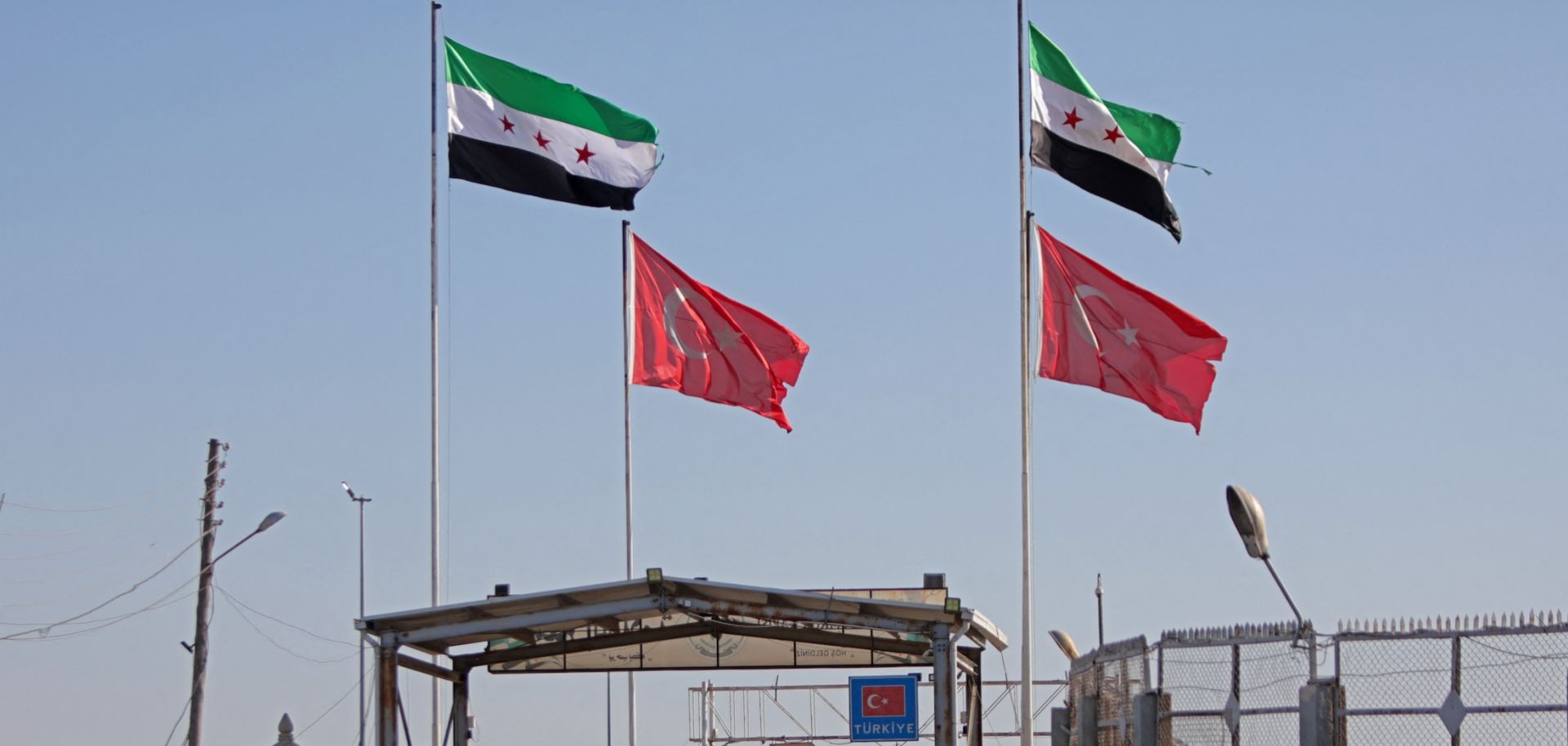
Turkey and Syria will make progress toward restoring their diplomatic and economic ties in the near term, but competing security imperatives will make full-scale normalization difficult, leaving lingering tensions between the two countries that might flare into violence. Turkey and Syria are showing a willingness to reestablish diplomatic relations, indicating they will soon join the broader regional trend of normalizing ties in the wake of Syria's civil war. On July 7, Turkish President Recep Tayyip Erdogan said Turkey might soon extend an invitation to Syrian President Bashar al Assad to visit Turkey, which would be the first such visit since the civil war began in 2011, during which Turkey supported rebels set on overthrowing al Assad's government. Erdogan emphasized that such a visit would have wider aims and that Turkey hoped to restore ties with Syria to levels seen before the war. Meanwhile, al Assad said on July 15 that he might be open to meeting with Erdogan, though, in an acknowledgment of constraints, he emphasized that he would only do so if ''core'' issues were discussed, such as the presence of Turkish forces in Syria and its support for rebels still in the north and northwest of the country. In July, the Iraqi government also offered to host a meeting between Erdogan and al Assad as regional diplomatic momentum swung to support the possibility of normalization.
- In April 2023, Turkey, Syria, Russia and Iran made similar efforts in a quadrilateral meeting in Moscow, where discussions centered on taking ''concrete steps'' to normalize Turkish-Syrian relations. The parties involved also addressed strategies for combating terrorist organizations and extremist groups within Syrian territory. Additionally, the meeting highlighted efforts to facilitate the return of Syrian refugees to their country as a key agenda item.
- In 2011, Turkey backed the uprising against al Assad, eventually occupying much of northern Syria in operations designed to support its proxies in the civil war, ensure a buffer zone for security at home, and combat Kurdish militants based in Syria. However, since 2020, major confrontations between Syrian and Turkish forces have become rare, though clashes continue between Turkish-backed rebels and Syrian, Russian and Iranian forces, mostly in Syria's northwestern provinces of Idlib and Aleppo.
- Regionally, Syria has had notable diplomatic success normalizing with former rivals like the United Arab Emirates and Saudi Arabia. The Arab League also readmitted Syria in 2023 after expelling the country for its violent crackdown against rebels in 2012. However, this diplomatic normalization has brought only limited economic gains to Syria due to expansive U.S. sanctions against the war-torn country.
Both sides have political, security and economic incentives to normalize relations, as Syria's government has proven it will not be overthrown militarily after 13 years of civil war. For Turkey, normalization opens up a path to potentially repatriate the over a million Syrian refugees living within its borders, which has become an increasing problem for Ankara amid growing anti-Syrian refugee sentiment among Turks. Additionally, Turkey has sought to secure itself against the Kurdistan Workers' Party militant group, or PKK, whose fighters are also active in northern Syria under the name People's Protection Units, or YPG. Ankara may see cooperation with Damascus as a way to address these security needs, for instance through coordinated action against the PKK/YPG or as part of a more comprehensive deal that would integrate the YPG into the Syrian government's security forces. Meanwhile, Turkey's economy would benefit from resumed trade ties with its southern neighbor; normalizing ties with Syria would also enable Turkey to reduce the risk of escalation with al Assad's backers, Russia and Iran. For Syria, normalization with Turkey, once the most substantial material backer of the rebellion, would put a definitive end to an acute security threat to the government's survival, reopen much-needed trade routes north, and act as a major diplomatic victory in ending Syria's civil war-era isolation. Normalization might also open a pathway to a final surrender of remaining rebel forces and the full withdrawal of Turkish troops, effectively ending the 13-year civil war in a victory for the al Assad government.
- Turkey and Syria agreed to coordinate against Kurdish militants based in Syria in the 1998 Adana agreement, which gave Turkey the right to carry out incursions up to 5 kilometers (about 3 miles) deep into Syrian territory should Syria fail to combat the PKK. However, the agreement collapsed when the Syrian civil war began in 2011, and Syria's Kurdish forces organized under the YPG into a self-governing entity known as Rojava. Syria's government largely abandoned its positions in Rojava in 2012-13 to focus on the more politically important cities in the country's heartland, like Aleppo, Homs and Damascus.
Turkey and Syria will likely first focus on normalizing their economic and diplomatic ties, leaving security challenges for later stages of talks should they progress. Though it is unclear whether Erdogan and al Assad will meet in the near term, Turkish and Syrian diplomats will likely continue to discuss the prospect of easing tensions and reestablishing diplomatic relations. Some of these meetings may result in the partial reopening of closed trade routes between the two countries, similar to the reopening of crossings between Jordan and Syria in the south. U.S. sanctions prohibit trade and aid that enables the Syrian government to fight the civil war, but they allow agricultural, humanitarian and other basic trade that primarily benefits civilians. However, the two countries are less likely to make substantial progress on security challenges. Turkey is unlikely to abandon its buffer zones inside Syria without a full-scale resolution to the PKK challenge or a clear path for Syrian refugees to return to government-controlled territory. Turkey is also unlikely to leave its rebel proxies without protection in Idlib for fear that a Syrian government offensive could cause another large wave of refugees to enter Turkey from there. Syria will not abandon its military campaign to reclaim all Syrian territory either, leaving Syrian forces facing Turkish forces and occasionally skirmishing with Turkish-backed rebels. Another major obstacle to full-scale normalization is the United States, which continues to protect the YPG in northeast Syria from both Turkish and Syrian military and political pressure. With U.S. forces there, the YPG is unlikely to feel compelled to fold itself into the Syrian security state, and Turkey will remain unable to launch an offensive to remove YPG militants from the area. The United States and YPG also control Syria's small oil reserves, depriving Damascus of vital income and harming the Syrian economy, which further weakens the prospects of Turko-Syrian trade. Finally, U.S. sanctions make it difficult for Syria to acquire the international aid needed to rebuild its destroyed infrastructure, further hampering the prospects of trade and mitigating Turkish interest in rebuilding Syria.
- Jordan resumed trade with Syria in late 2021, though trade volumes between the two countries remain well below their levels before the Syrian civil war. In 2022, Jordan and Syria traded around $130 million worth of goods and services, well below the over $800 million last reported in 2010, in large part because of Syria's depopulation and destroyed infrastructure.
- YPG officials have been meeting with Syrian ones openly for years, as they, as part of the Syrian Democratic Forces, or SDF, prepare for the possibility of a U.S. withdrawal from Syria. In 2019, then-U.S. President Donald Trump attempted to abruptly draw down troops from the country, but widespread political outrage caused him to quickly reverse this policy.
- Syrian refugees are reluctant to return home for a variety of reasons, ranging from the fear of conscription and arrest, to the lack of opportunity back in Syria after years of war. Lebanon has attempted to deport some of its 1 million Syrian refugees, but has failed to convince more than a few hundred to return to Syria. Turkey, for its part, has been unwilling to use force to deport its Syrian refugee population for fear of sparking refugee unrest and a security crisis.
Without a resolution to their security challenges, both sides will remain on largely frozen frontlines, where hostilities could flare up quickly and upend normalization. The Turkish government remains under pressure to return Syrian refugees, and Ankara has hinted repeatedly that it might conduct further military operations in Syria designed to create locations where refugees might be resettled should Turko-Syrian normalization not provide a peaceful path forward. Syria would oppose such operations, potentially trying to block them and sparking skirmishes. Meanwhile, Syria's government will continue to exert military pressure on Turkish-aligned proxies in Idlib and Aleppo to compel some rebel forces to defect, surrender or agree to exile, as Damascus remains focused on recovering all territory lost during the civil war. This military pressure could accidentally pull Turkish forces, some of whom remain in these provinces, into another round of confrontation. Meanwhile, the United States may still withdraw from Syria, especially under a potential future Trump administration, which could enable Turkey and Syria to reshape the dynamics of the northeast in their favor. However, this might also create clashes between Ankara and Damascus, particularly in the unlikely event that the YPG/SDF joins the al Assad government without a pledge to cut their ties to the PKK. In that case, Turkish operations would be designed to clear the YPG/SDF even if the Kurdish militants were serving with Syrian government forces.
- In 2020, a Syrian airstrike killed dozens of Turkish troops in Idlib as part of Syrian military operations to steadily erode rebel territory there. The incident sparked major fighting between Turkish and Syrian forces, alongside Russian and Iranian forces, before the situation de-escalated.
- During their time in office, members of the Trump administration pushed to withdraw U.S. troops from Syria on the grounds that the Islamic State had been driven underground and that Syria, Russia, Iran and Turkey could manage the threat posed by the jihadist group. Should Trump return to power, White House officials would likely make these arguments again.
