
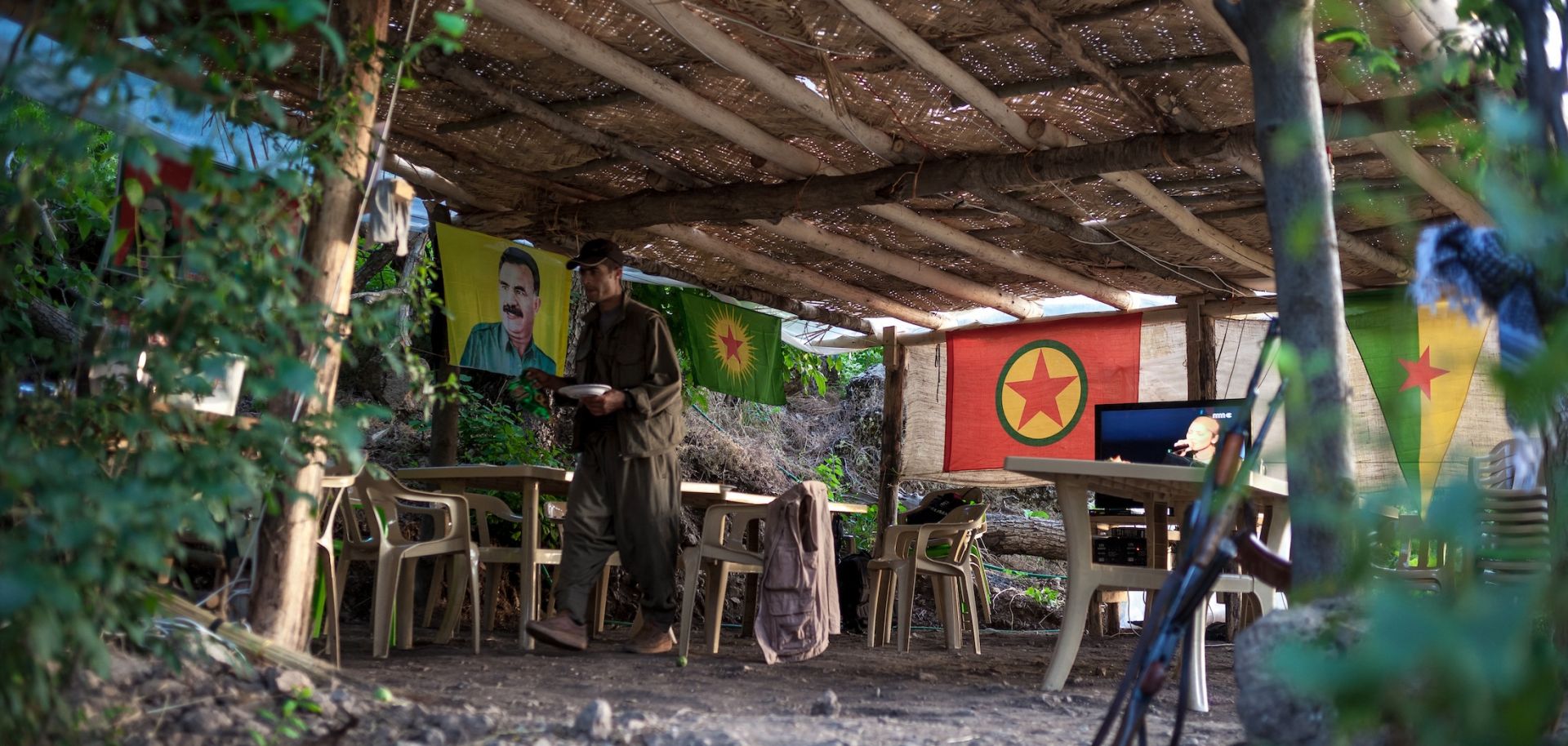
Turkey's limited military offensive in northern Iraq will seek to eliminate the threat posed by Kurdistan Workers' Party (PKK) militants in and around the Gara Mountains, but in the near term, fears of international backlash will deter Turkey from expanding its offensive into other nearby Iraqi provinces or Syria, meaning Ankara's overall objective to cut PKK supply lines into Turkey will likely remain incomplete. Beginning in June 2024, Turkey reportedly started military ground and air incursions deeper into Iraq's northern Duhok province against PKK targets. As the operation started to make headlines, Iraqi authorities strongly criticized Turkey on July 10 for resuming ground military operations, calling on Ankara to instead address its security concerns through diplomatic channels. Since 2022, Turkey has primarily used airstrikes in Iraq's Kurdistan region against the PKK, which is labeled as a ''terrorist'' group by Ankara and several Western entities (including the United States and the European Union). But Turkey has also long expressed its intentions to launch a wider military operation to eliminate PKK strongholds in northern Iraq. Against this backdrop, Turkish Defense Minister Yasar Guler announced plans on July 10 to establish a security corridor extending 30-40 kilometers deep along these borders to fully clear the region of the PKK and its affiliates.
- According to the Community Peacemaker Teams, an international organization monitoring the conflict in northern Iraq, the Turkish army conducted at least 1076 air and artillery strikes between January and July 2024, with almost half of these occurring in Iraq's Duhok province. Community Peacemaker Teams also reported that since the start of the June 2024 military ground operations, the Turkish military has conducted 238 bombardments primarily in Duhok, resulting in the destruction of large swaths of agricultural lands. Additionally, residents of villages in the Duhok province reportedly claimed that the Turkish military advanced into their villages, setting patrols and checkpoints.
- In recent months, Turkish officials, including President Recep Tayyip Erdogan himself, have repeatedly threatened the PKK with an expanded military offensive in the summer to root the group out from northern Iraq.
- On July 14, Erdogan reportedly said that military operations in northern Iraq and Syria were coming to an end soon, without specifying a date.
Turkey's offensive is motivated by long-standing security concerns linked to the PKK's presence in Iraq and Syria, as well as by Ankara's aspirations to advance economic projects passing through PKK-held areas of northern Iraq. Turkey has launched numerous military operations and air campaigns against the PKK in northern Iraq since the 1990s, as well as the Syria-based People's Defense Units (YPG) since the start of the Syrian civil war in 2011. Turkey fears that these Kurdish militant groups' unchecked presence along its borders offers them bases to launch and coordinate attacks within the Turkish territory. Turkey's latest ground incursion in northern Iraq, in particular, is a continuation of Operation Claw-Lock launched in 2022, which aimed to establish a buffer zone in northern Iraq. Additionally, security is a prerequisite for economic development projects between Turkey and the Iraqi government passing through Iraq's Kurdistan area, making this another driver for the Turkish military to secure lands in northern Iraq where the PKK is highly active. Given the Iraqi government's limited military capabilities to counter the PKK in the area, this provides Ankara with an additional motive and justification for direct military intervention in Duhok.
- Erdogan's April 2024 visit to Iraq culminated in the signing of a quadrilateral memorandum of understanding involving Turkey, Iraq, Qatar and the United Arab Emirates to advance Iraq's $17 billion Development Road project, which passes through northern Iraq.
- In March 2024, the Iraqi government designated the PKK as a ''banned organization,'' a decision welcomed by Turkey that showcases Baghdad and Ankara's growing convergences on security issues, especially those regarding the PKK.
- The People's Defense Units (YPG) is a Kurdish militant group present in northern and northeastern Syria, and is allied with the PKK.
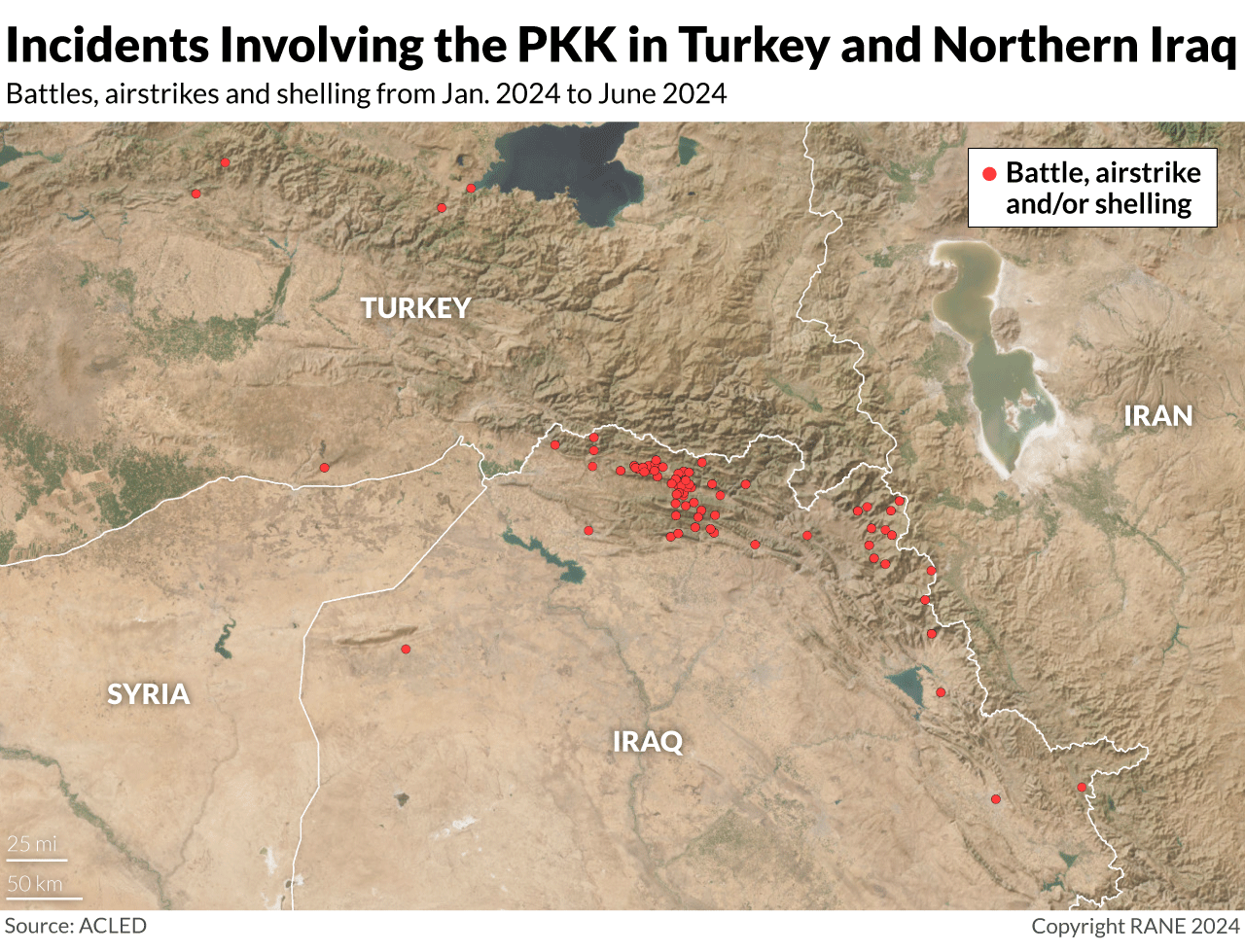
Turkey will likely gradually expand its military operations in Duhok to attempt to drive the PKK out of the heavily fortified Gara mountain range, which could prompt the PKK to conduct reprisal attacks on Turkish military positions in northern Iraq as well as inside Turkish major cities. With the goal of reducing the PKK's ability to launch attacks within Turkey, renewed Turkish military operations will likely seek to establish a militarized buffer zone in the Duhok province akin to the one Turkey established in northern Syria. In addition to ground incursions, Turkish air and drone strikes will likely intensify against PKK military targets in northern Iraq, including potentially around major Kurdish cities like Sulaymaniyah and Erbil, where PKK operatives are known to either operate or seek refuge. However, Turkey's ground operations will likely face staunch resistance and a rugged terrain (like in the Gara Mountains), which would present logistical challenges, potentially hindering Turkey's ability to fully achieve its objectives. In response, the PKK will likely increase its own attacks on Turkish military positions in northern Iraq, as well as potentially in Turkey's east where there is a large Kurdish population. Finally, there will be an elevated risk of PKK reprisal attacks inside of Turkey itself in major cities such as Istanbul or Ankara. Despite robust security forces and intense counterterrorism efforts in Turkey, the PKK was able to launch several substantial attacks in Turkish cities in recent years, such as the October 2023 bombing attack in Ankara. The current expansion of Turkish military operations could encourage the group to attempt something similar in the near term.
- The Gara Mountains is a strategic location used by the PKK located between the Qandil Mountains — another reported PKK headquarters in Iraq's east — and YPG areas of northeastern Syria. Logistical challenges and significant resistance to ground operations in the Gara Mountains mean Turkey will likely increasingly rely on drone attacks and airstrikes against PKK positions in the area.
- On the recent sidelines of the NATO summit in Washington D.C., Turkey's defense minister informed Turkish state news outlet Daily Sabah that the army would eliminate the PKK's presence in the Gara region by November as part of Operation Claw-Lock that Turkey launched in 2022.
Turkey is unlikely to expand its operations into Syria in the near term or other provinces of northern Iraq, which will leave it short of establishing a full buffer zone, thus enabling the PKK to continue supplying its militants inside Turkey itself. Turkey's wider plan is to establish a security corridor that encompasses areas currently under the control of both the PKK and YPG in Iraq and Syria, respectively. However, its ongoing military operations are unlikely to expand beyond northern Iraq to also include Syrian territories in the near term. Turkey's renewed interest in improving ties with Syrian President Bashar al Assad's regime is partially rooted in hopes that a normalization deal with Damascus would involve a resolution to the YPG's position in the northeast (either through a military crackdown of YPG militias or through their absorption into the Syrian system), as well as establish a Syrian-Turkish cooperation framework to prevent future Kurdish militant attacks inside of Turkey. Meanwhile, in Iraq, should ongoing Turkish military operations expand toward other northern provinces such as Erbil or Nineveh, Ankara would likely face substantial international criticism (including from the United States) and potentially escalate tensions with Iran (especially if the Turkish military operates near Iran's borders with Iraqi Kurdistan). This would increase pressure on Turkey to limit — or even halt — operations, particularly if its relations with regional and international actors become significantly strained. Against this backdrop, Turkey will likely continue its military operations in the Duhok area around the Gara mountains with a slow and steady expansion that largely seeks to remain under the radar and avoid international backlash and diplomatic rows with its neighbors. This, however, will likely leave large swaths of the border open to PKK transit, meaning that Turkey's renewed military efforts will ultimately prove unsuccessful in fully breaking the links between the PKK's territorial presence in Iraq and Syria and its operatives in Turkey.
- During much of the Syrian civil war, Turkey-backed rebels tried to overthrow the Assad regime. But since 2020, these rebels have taken a more passive role in the conflict, and have increasingly shifted their focus on the threat posed by YPG and PKK militants in Syria. Both Turkey and Syria are awaiting the impending withdrawal of U.S. troops from YPG/PKK territory.
- Iraq's Kurdistan Regional Government (KRG) would likely oppose Turkish operations that go too deep into Iraqi Kurdistan, and the KRG's peshmerga forces would be more notable obstacles for Turkey's military. Meanwhile, the United States would also oppose Turkish operations that undermine the KRG, one of the region's more reliably pro-U.S. political entities.
