
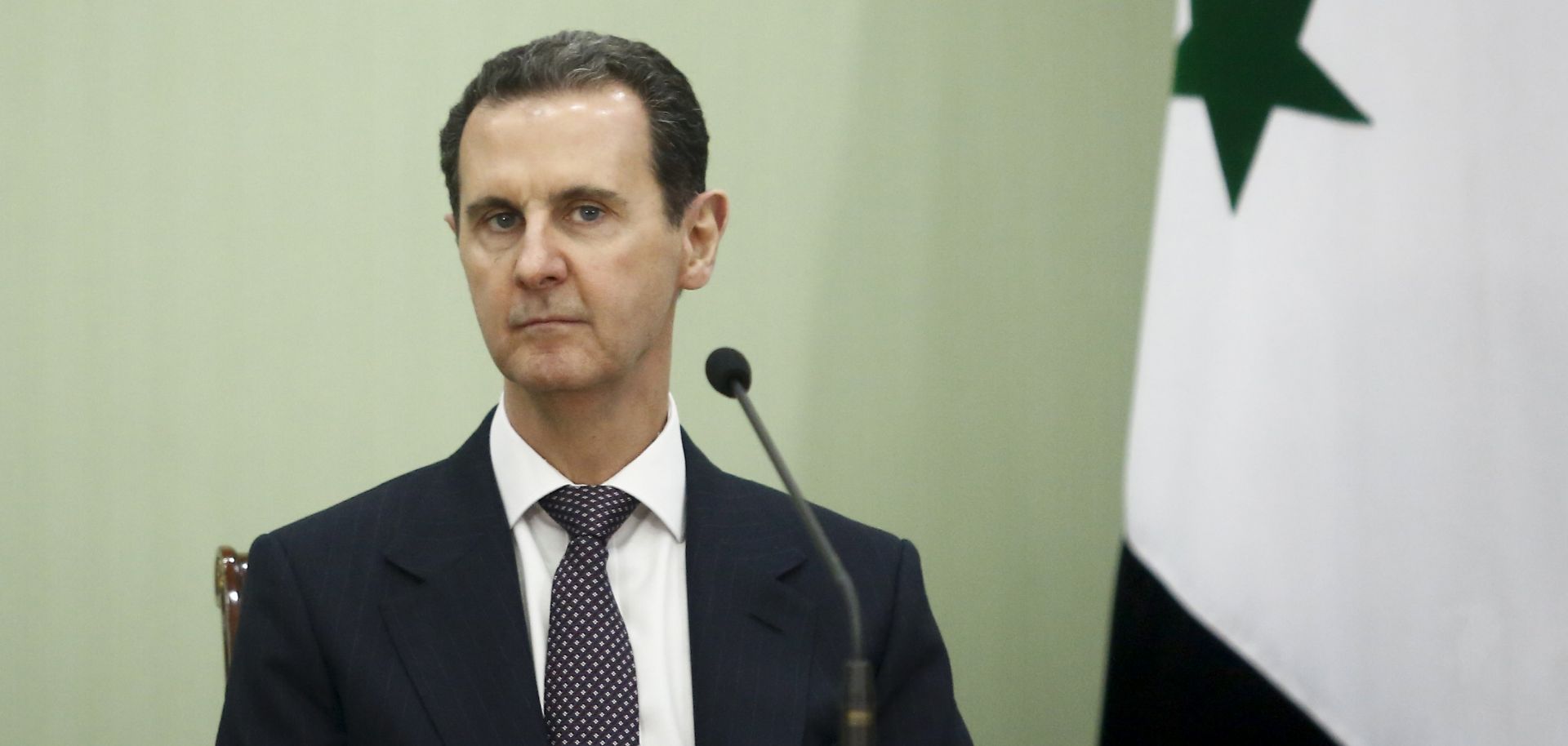
Syrian President Bashar al Assad is seen in Damascus, Syria, on May 3, 2023.
The Arab world is offering Syria an opportunity to re-establish itself in the international community. But for President Bashar al Assad, that offer may come with a poisoned chalice.
On May 19, Assad visited Saudi Arabia for the first time since his country's civil war broke out in 2011, marking a notable diplomatic breakthrough in the Syrian leader's diplomatic relations with an Arab world that once backed the rebellion against him. During his trip, Assad attended the annual Arab League summit as part of an overall normalization process that has seen the bloc's members offer to restore diplomatic ties with Syria in exchange for cooperation on drug exports, refugees and terrorism. There are hopes this normalization push could pave the way for more reconstruction aid to the war-torn country and even sanctions relief, as the Arab world seeks to pry Damascus out from under Iran's influence by restoring its economic and diplomatic independence.
But Syria's addiction to warlordism will be a key obstacle to this process. After over a decade of brutal conflict, Syria's political model under Assad has devolved from a Soviet-inspired authoritarian system based on ideology and nationalism, to what is now effectively a feudal system where power is drawn from kinship, ethnicity and a carving up of the formal and informal economy by key Assad supporters. For Syria, the side effects of this shift have included a booming drug market, mass political violence, a vast outflow of refugees, and a government reliant on external states like Iran that want to use the country as a bastion of their influence rather than return it to its pre-war sovereignty. These are the very problems that Arab nations are hoping to address by restoring their ties with Syria and reducing its international isolation. But in doing so, they're also pressuring the Syrian government to undermine the very model that helped it survive the civil war, which will be a tough sell — especially without the West easing its sanctions campaign.
Syria's Transformation Into a Warlord State
Before the civil war, Syria's political model was similar to that of Hosni Mubarak's Egypt or Saddam Hussein's Iraq. It used Soviet-style police state tactics to keep a tab on dissent while staffing its armed forces with ideologues and nationalists loyal both to the Assad family and to the idea of a sovereign Syrian state. Though much of daily life was controlled by the government, the state was nevertheless staffed with non-sectarian technocrats and educated professionals. But the civil war split the country into multiple competing factions, and many Syrian nationalists, particularly Sunni ones, saw the Assad family's monopolization of power as inimical to the interests of a sovereign Syrian nation. Entire units of Syrian soldiers defected to the rebellion, while former officials and technocrats swelled the ranks of the opposition, leaving the government with a much-reduced state and a base of supporters that aligned with Assad on ethnic, religious or kinship lines rather than nationalist or ideological ones.
This transformed Syria into a warlord state. Gone were the professional soldiers and military units, replaced by sectarian militias run by powerful personalities, some of which were sponsored by foreign powers like Iran and Russia. These militias proved loyal but also corrupt: in exchange for their support, they demanded control of large swathes of the economy, especially the black market, as they turned to sell drugs like captagon to bypass international sanctions. Meanwhile, loyalty to the state was reframed from ideological and nationalist terms to sectarian and ethnoreligious ones: Alawites, the religious sect of the Assad family, were seen as the most loyal (and given the best government posts and often private sector jobs), followed by Christians, Shiite and, at the bottom, some secular Sunnis. Religious Sunnis, the bulk of Syria's pre-war population, were largely excluded from both the political system and the economy.
This system staved off the Syrian government's total collapse during the peak of the civil war. But it came at a cost: the ruthless new ethno-sectarian political hierarchy made enemies of the Sunni population who were steadily displaced and depopulated by advancing regime militias. But those days are mostly past: now reconstruction looms as an imperative, particularly for those living in long-secured cities like Damascus, Homs, Aleppo and Deraa.
Steering Syria Away From the Warlord Model
Now that the civil war is largely over, the Arab world hopes that it can entice Syria to move away from its warlord model, particularly in ways that affect them. Syria's reliance on captagon exports has flooded neighboring countries like Saudi Arabia, where social liberalization policies are already creating an environment of permissiveness, increasing the demand for drugs. Turkey, Jordan and Lebanon continue to host millions of Syrian refugees, a burden they cannot sustain indefinitely. These countries are reluctant to return the refugees to Syria by force, worried about possible mass unrest and political backlash for trying to return fellow Arabs and Muslims to Syria at bayonet point, while refugees themselves are concerned about being jailed or forced into the Syrian military. Meanwhile, the involvement of Iran and its militias in Syria poses the risk of dragging the country into a wider Israeli- and/or U.S.-Iran conflict, potentially leading to another surge in refugee flows. Additionally, key Arab states, notably Saudi Arabia and the United Arab Emirates, see playing a peacemaking role in places like Syria as an opportunity to enhance their dovish international reputation, which plays into their wider development goals that seek to paint them as pacific countries in which to invest, live and work.
Diplomatic reengagement is just the first step toward addressing these challenges. If Arab nations' recent normalization efforts can convince the Assad government that there is a path to reconstruction aid and even ending sanctions, then Syria might crack down on drug exports and engage more seriously in reconciliation agreements to repatriate refugees. The easing of the country's economic isolation could also
Syria may also reduce internal tensions inside Syria that currently require support from Iran and Russia for security in order to meet both the Arab world and the West's demands that would enable sanctions relief and vast amounts of reconstruction aid. Many Syrians, particularly those in the business community and major cities like Damascus and Aleppo, strongly support such engagement to restore essential services like electricity and rebuild the war-torn areas.
Resistance From the Assad Government
However, this is asking the Syrian government to reshape its very warlord political model in ways that could open up internal divisions, threaten the Assad family's hold on power, and rekindle civil violence. While diplomatic support from the Arab world is a breakthrough, it does not replace the warlord political model that has kept the Syrian government in control of the country. For starters, the warlord model — through its militias and connections to Russia and Iran — provides the core security guarantees that the government desires. It provides the government with hard-line, loyal militias to face off against Turkish-backed rebels in the north, and who are willing to pressure U.S.-backed rebels in the northeast to reconcile with the government. Syria's current warlord model also balances internal competitors, who the Assad government can play off one another, relying at times on Iran and Russia to aid in this process to ensure no internal challenger can emerge to the Assad family.
Meanwhile, captagon drug exports help fuel this political system, giving the Assad government crucial access to hard cash that it can dole out to supporters and militias to retain their loyalty. To undermine captagon exports would be to deprive Syria, whose GDP is only around 4-5% of its pre-war value, of a sizable part of its remaining foreign trade. Such a cut-off would rapidly precipitate a major currency crisis, make already expensive imports even more unaffordable, and likely trigger widespread civil and political violence even in loyal regimes. Formerly loyal militias might well turn on the government in the event of such a cut-off.
To soften the economic blow of ending Syria's booming captagon business, Arab officials hope to convince the West to eventually lift its crushing sanctions on Damascus. But the West is not sanctioning Syria solely because of its drug trade, which affects the Middle East much more than it does the United States and Europe. Rather, the West is demanding that the Assad government reconcile with rebels and engage in a political process that allows refugees to return home and incorporates the political demands of U.S. allies like the Syrian Democratic Forces (SDF) in the northeast.
This again runs into the Assad government's imperatives. If they do begin a serious reconciliation process with rebel groups, the first issue is deciding which rebels would meet Western demands: the rebels of Idlib, which include al-Qaeda-linked Hayat Tahir as-Shams? Turkish-backed Syrian National Army forces? The U.S.-backed SDF? All of the above?
But beyond those practicalities are what concessions could the Assad government offer that appease the West and yet retain the Syrian government's monopoly on power that it fought a brutal civil war over. Some rebel groups, like the SDF, might accept relatively minor changes in the country's political system; others, like Hayat Tahir as-Shams, will still demand revolutionary change. All political change will alter the very delicate internal balance of power between militias and the state, potentially leading some militias to use their influence to violently push back against political change agreed to by the government. Meanwhile, Russia and especially Iran will not support any political changes that might weaken their influence and the power of their militia allies, leading them to also oppose such a reconciliation process.
These Syrian imperatives leave the prospect of lifting Western-led sanctions a dead letter. Damascus will be unable to meet Western demands, sanctions will remain in place, and Syria will remain wedded to the black market flooding the region with captagon to make ends meet.
Meanwhile, there is also hope that normalization with Syria could bring some refugees home. But this again hinges on the near-impossible prospect of political moderation from Syria. Assuring refugees that they'd be safe upon returning home would again require Damascus to rein in the power of its militias — the source of much of its human rights abuses — in a way that could invite violent pushback from loyalists. The government would also have to rein in the loyalist population that doesn't necessarily welcome the return of refugees they see as disloyal, or whose properties they have appropriated for themselves, once more risking backlash from the ethnoreligious supporters that are now the backbone of support for the state.
Diplomatic Ties But Little Else
Syria's continued need to maintain a warlord-style political system will mean that, for the time being, normalization will wholly be diplomatic with little headway made toward unlocking more economic or reconstruction aid. Though the country will still receive pledges and occasional humanitarian aid, such support will hardly make a dent in the estimated $500 billion reconstruction that still awaits. Meanwhile, Arab states' efforts to address captagon, refugees, terrorism and Iranian influence in Syria will find themselves stymied by Western sanctions that will be lifted under conditions Syria cannot accept. So while Assad's government may be welcomed back in many Arab capitals, it will be a long time before Arab capital can once more flow into Syria's economy.
