
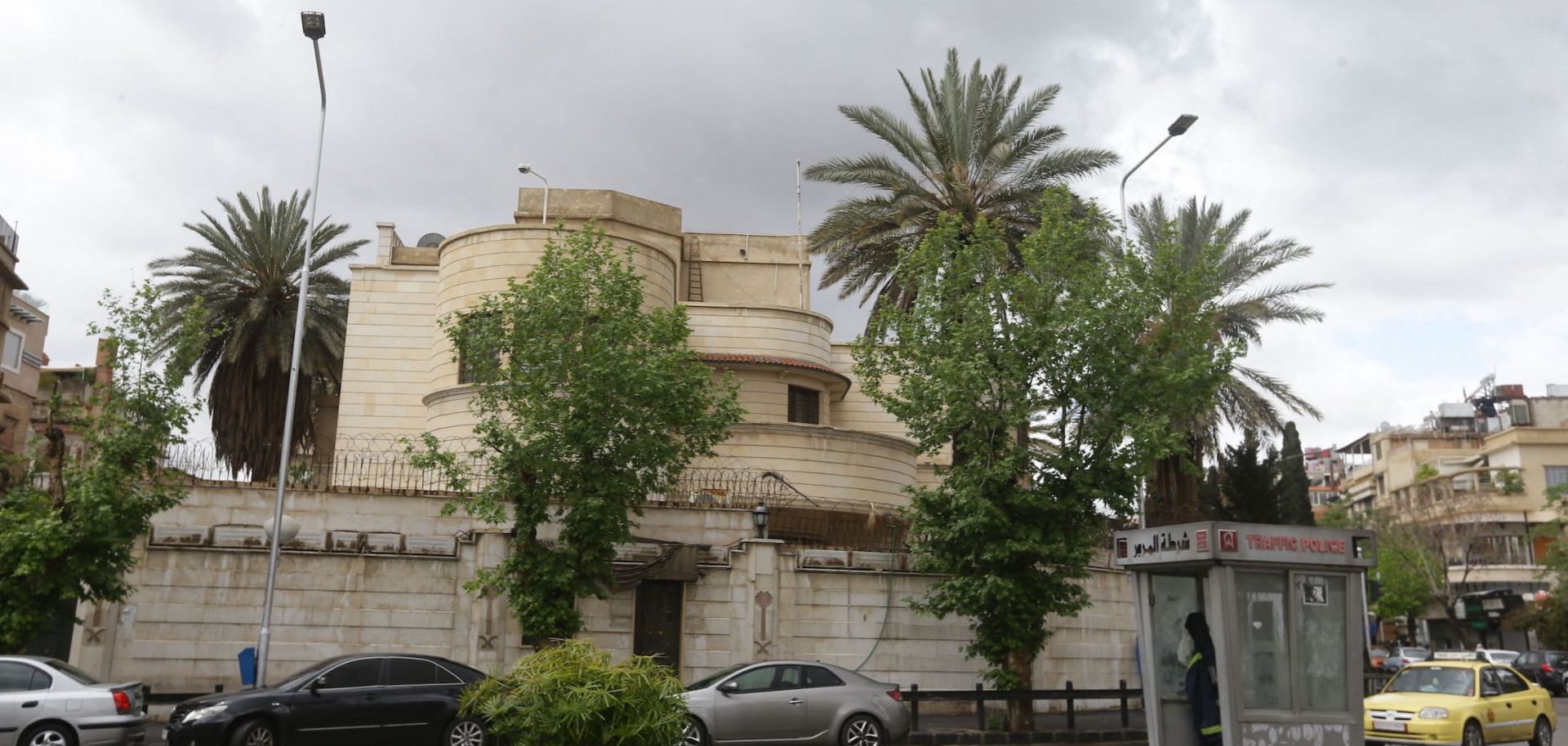
A picture shows the Saudi Embassy in the Syrian capital of Damascus on April 13, 2023.
Despite recent progress toward Syria's regional normalization, President Bashar Assad's own intransigence, along with internal splits in the Arab world and U.S. opposition, will prevent a full-scale economic and diplomatic rehabilitation of Damascus in the short-to-medium term. On April 18, the Kurdish-dominated Autonomous Administration in North and East Syria (AANES) made a nine-point declaration for its terms to restore Damascus' authority over Kurdish-held territory, which included demands for political and democratic reforms through negotiations and an offer to host some of the millions of Syrian refugees now living in Jordan, Turkey and Lebanon. The plan proposed by the Kurdish-led authority, which has ruled over northeast Syria since 2012, marks the latest attempt to resolve the political conflict at the heart of the country's 12-year civil war. It also comes amid a growing acknowledgment among Syria's internal and external stakeholders that the Assad regime appears poised to win that war, and that the United States will eventually withdraw its remaining troops from the country. Against this backdrop, Arab states have recently been pushing to ease the Syrian government's diplomatic isolation in a bid to weaken Iranian influence and increase humanitarian aid to the country.
- Saudi Arabian Foreign Minister Faisal bin Farhan Al Saud met with Syrian President Bashar Assad in Damascus on April 18, marking the highest-level official Saudi visit to Syria since the civil war began in 2011. Saudi Arabia's foreign ministry said the visit was designed to find a political solution to Syria's civil war that would ensure Syria's ''Arab identity and return it to its Arab surroundings.''
- Saudi Arabia is the latest in a growing list of Arab countries that have begun rekindling relations with the Syrian government after a decade of civil conflict and failed attempts to oust Assad's regime. The devastating earthquakes that rocked northern Syria (and southern Turkey) in February have only accelerated this trend, as nearby countries like Egypt, the United Arab Emirates, Saudi Arabia and Oman rushed to send emergency aid to Syria.
Regional efforts have continued to establish the terms of Syria's diplomatic and economic rehabilitation now that the civil war has largely stabilized in Damascus's favor. The frontlines of Syria's civil war have largely been frozen since the last major round of fighting broke out between Turkish troops and the Syrian government in 2020. The Assad government now controls all major cities in the country, with only a handful of rebels holding Idlib province in the northwest, U.S.-backed Syrian Democratic Forces (SDF) controlling the northeast, and Turkish-backed forces and formal military units holding portions of the Syrian-Turkish border. With Damascus poised to emerge as the undisputed victor of the war, Arab states have recently sought to restore diplomatic relations with Assad's regime as a means to return refugees, rebuild Syria's economy and undermine Iranian interests. Countries including Egypt, Bahrain, Oman and the United Arab Emirates have argued that Syria's former seat in the Arab League should be restored when the bloc holds its next summit in May. But they've encountered pushback from other Arab League members that want Damascus to carry out political concessions to rebels and opposition groups before full-scale normalization. Qatar has been the most vocal opponent of normalizing relations without the Assad regime first agreeing to some kind of political reconciliation process, as Doha seeks to defend its diplomatic reputation as a peace broker in the region. But Jordan has expressed similar concerns, driven by fears that the 1.3 million Syrian refugees living in Jordan won't return home without a resolution to the political conflict that has fueled years of bloody conflict in the country.
Meanwhile, Syria's Kurds and Russia are posturing to set the conditions for Syria's normalization, as they expect an eventual U.S. withdrawal from the country. The United States is widely expected to withdraw its remaining troops from Syria amid its wider retrenchment from the region, as Washington turns its focus toward threats from Russia and China. This may not happen under U.S. President Joe Biden, but increasing calls in Congress for a full drawdown from Syria means a White House critical of the mission will eventually come to power. With their principal security guarantors poised to leave in the next few years, Syrian Kurds are trying to retain some of the autonomy won over the civil war by preserving their language and at least some of the Kurdish economic and political structures in the northeast. Russia, for its part, is also trying to secure the influence it's garnered through its intervention in the Syrian civil war by negotiating the final status for the AANES, and by serving as a mediator between the Assad regime and Turkey. In addition, Moscow is hoping to avoid another flare-up of major fighting in Syria that would force it to deploy the military power Russia needs to maintain its ongoing war in Ukraine.
- Hundreds of U.S. troops remain deployed in Syria on a formal counterterrorism mission to fight Islamic State militants. Over the past seven years, Iranian-backed forces have occasionally attacked those troops, fueling criticism among lawmakers in Washington over why the U.S. military retains a presence in Syria — especially now that the Islamic State has been pushed underground in the country. Some U.S. critics also hope to see the completion of the abortive withdrawal from Syria in 2019.
- The SDF is the AANES' main security force and a key ally of U.S. counterterrorism operations in Syria. The AANES has maintained a working relationship with the Assad regime since taking control of the northeast after Syrian forces largely withdrew from the region in 2012. But recently, Syrian Kurds have been deepening their relations with Damascus to ensure access to alternative military support in case U.S. forces withdraw. After the abortive U.S. withdrawal attempt in October 2019, the SDF invited Russian and Syrian forces to fill the void in order to prevent a full-scale invasion by Turkey, which has accused the SDF of aiding its arch-rival, the Kurdistan Workers Party, inside Turkey.
The Syrian regime is unlikely to make the concessions needed for full-scale diplomatic normalization, meaning U.S. sanctions will probably remain in place even after U.S. forces withdraw. The Assad regime also remains under expansive U.S. sanctions via the Caesar Civilian Protection Act, which requires political reconciliation before the sanctions can be lifted. Even as the United States will pull troops from the country in the coming years, this sanctions law will make it difficult for a future U.S. president to justify ending the sanctions regime without seeing Syria's political rivals first reach a broader political settlement. Such a settlement, however, remains unlikely in the short-to-medium term. Assad has fought a brutal civil war for more than a decade that has displaced about half of Syria's population, all in the name of securing his family's place at the core of the country's power structure. And he has shown little sign he'd be willing to make any concessions that could threaten that goal — especially with victory now in sight. Though Russia will likely pressure Syria to ease its strict control of the political system, Damascus has little incentive to do so in the near term, worried that a fresh reconciliation process could reveal internal splits in loyalist territories and presage new unrest and fighting. The Syrian government is thus all but certain to oppose AANES' new demands for political autonomy on the grounds that it will weaken the Assad family's hold on state power, and is also unlikely to take up a broader political reconciliation effort that appeases both U.S. and Arab skeptics of normalization. Moreover, the Syrian regime's close ties with Russia in the wake of the Ukraine invasion will likely only add to the growing U.S. perception that Damascus needs to remain economically isolated. And this, combined with Assad's refusal to concede power, will further dim the prospects of Syria securing sanctions relief.
- Multiple international attempts, including an Arab League plan and peace talks at Geneva, have failed to convince the Syrian government to provide concessions over the course of the 12-year war, even during the early years of the conflict when the Assad regime was militarily struggling against the rebellion.
- Within the Syrian government, loyalists have competed over resources and power, sometimes leading to violent clashes between rivals in otherwise secure places like Latakia. This suggests the Assad government could fracture again, despite its military victories.
