
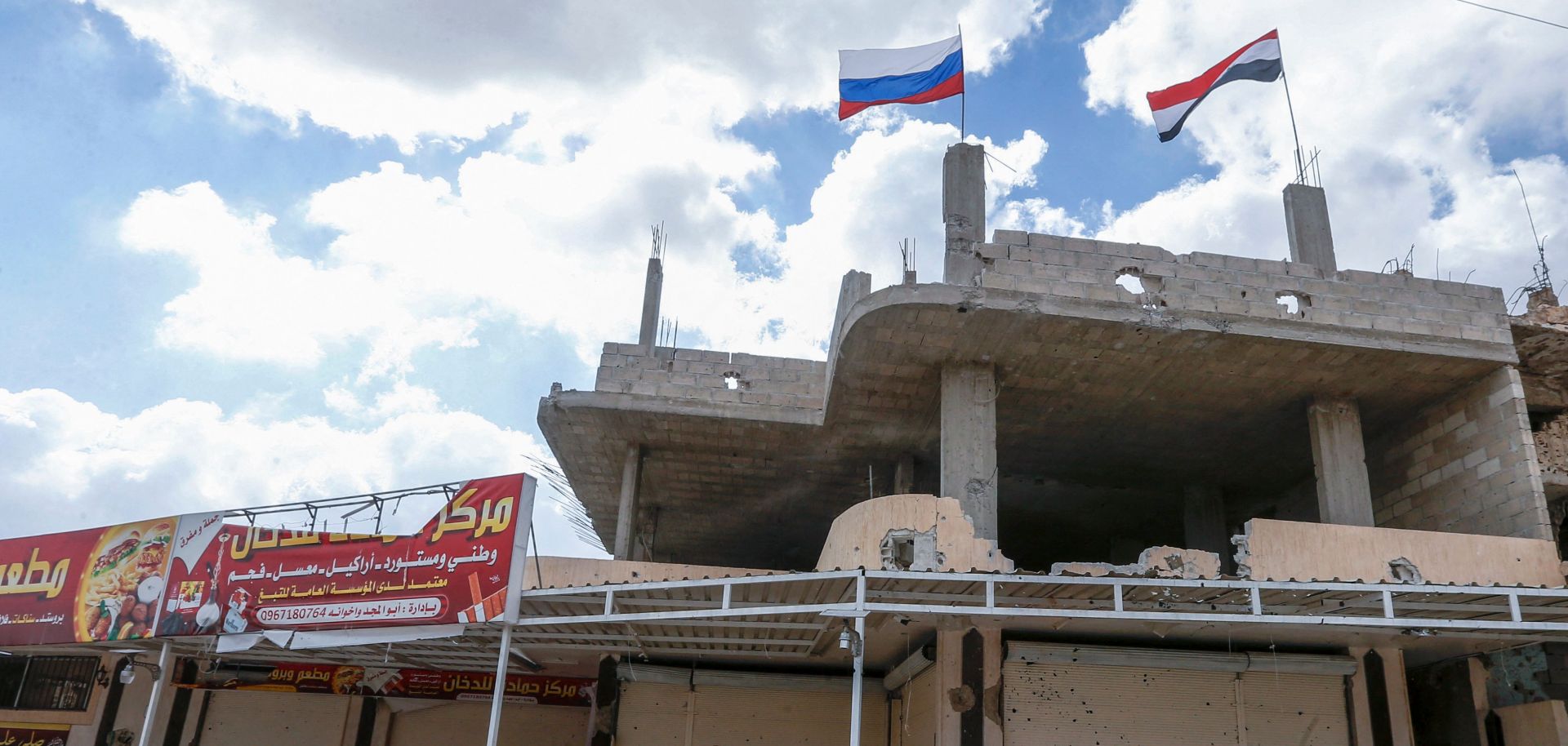
Russian and Syrian flags wave above a damaged building in Syria's southern city of Daraa on Sept. 12, 2021.
In Syria, Russia is signaling a new willingness to bring the war-torn out from international isolation by leveraging its close relationship with President Bashar al Assad’s regime. But doing so will likely require getting more deeply involved in manipulating and managing Syrian politics, putting Moscow's reputational and strategic gains from the civil war at risk. Western diplomats have accredited Russia for getting al Assad’s regime to agree to its first-ever face-to-face meeting with rebel negotiators to start drafting constitutional reforms. The U.N.-led drafting sessions, which formally began on Oct. 18, also ended nine-month hiatus of peace talks between the rival factions in Syria’s civil war. By helping convince Syria to take the U.N.-led constitutional reform process more seriously, Moscow is signaling it will be more assertive in pushing Damascus to take the steps needed to finally restore some of the trade links and economic activity that would rebuild Syria, improve the country’s humanitarian crisis, and ultimately secure Russia’s gains from the civil war.
- The Syrian Constitutional Committee was created under U.N. auspices in late 2019 after years of negotiations, and is designed to negotiate a final political solution to the civil war. The committee is composed of Syrian loyalists, rebels and U.N.-appointed negotiators meant to represent the interests of Syrian civilians.
- In the past, Russia has avoided pressuring Damascus into negotiations with rebels abroad, preferring to support Syria’s primary strategy of retaking territory. But now that the remaining rebel territory is either Turkish- or U.S.-protected, there are few opportunities left for the Syrian regime to defeat the rebellion militarily — forcing Moscow to alter its strategy.
Russia’s attempts to mend Syria’s ties with the international community come amid recent signs of improvement in Demascus’ ties with its Arab Gulf neighbors and the United States. Syria’s current international isolation can largely be traced back to the al Assad regime’s violent crackdown on Arab Spring protesters, which led to its suspension from the Arab League in 2011 and ultimately lit the fuse for the country’s ongoing civil conflict. The Syrian government’s poor human rights record during the past 10 years of war has left it under crippling international sanctions and only a handful of allies. But there are signs this may be beginning to change, with the Arab League openly debating whether to end Syria’s suspension from the bloc. Individual Arab Gulf countries have also begun slowly rebuilding bilateral ties with the al Assad regime in the hopes of undermining Iranian influence in Syria, as well as ending the humanitarian crisis that has been a source of regional instability and terrorism. And the United States, for its part, has begun easing some of its sanctions on Syria to increase regional stability as well.
- Syria is under strict international sanctions, including U.S. ones. But the U.S. Ceasar Syria Civilian Protection Act allows the U.S. president to ease sanctions if Syria makes substantial political reforms.
- Oman, the United Arab Emirates and Bahrain recently reopened their embassies in Syria. In September, the United States supported a plan to send Egyptian gas through Jordan and Syria to Lebanon, which is grappling with massive fuel shortages. Jordan’s move to reopen its border with Syria last month didn't trigger any threats of U.S. sanctions as well.
To improve Syria’s international reputation and chip away at the country’s isolation, Russia will likely remain primarily focused on ensuring al Assad’s regime remains engaged in U.N.-led negotiations, even if doing so incites some pushback from Damascus. Previous rounds of conflict mediation talks largely failed over the Syrian government’s unwillingness to dilute power or offer concessions to any of the opposition groups. But Russia’s intervention in Syria’s decade-long civil war has earned it enough influence with Syrian insiders to convince them to remain in a negotiation process. Al Assad and his hard-liner loyalists, however, are still likely to resist making substantial concessions to the opposition, limiting how much Syria can break out of isolation — even with Russia’s help.
- Syria’s government remains dominated by hard-liners who have gained notable power and wealth during the civil war. However, some pushback, especially in the Alawite community — the core religious sect that supports the government — has emerged in reaction to the country’s increasingly dire economic conditions.
- Russia has built up influence in Syria through its intervention, which has included training elite Syrian military units, providing critical air cover during major campaigns, supplying the Syrian military with equipment, giving the country diplomatic cover from U.N. resolutions, and blocking U.S. and Israeli military action.
To increase the Syrian government’s openness to making the kinds of changes the international community wants to see, Russia may also try to manipulate the political balance in Damascus by bringing more moderates into the fold. This, however, would likely alienate Syrian hard-liners, which could either jeopardize Moscow’s position in the country or undermine Russia’s reputation as a reliable ally gained by its intervention in the civil war. Russia could use its close ties with the Syrian military to counterbalance hard-liners. Moscow could also threaten to ease its diplomatic shielding of Damascus from U.N. condemnation or international diplomatic pressure if Syrian hard-liners continue to leave Syria in an isolated position. However, Russia’s political interference would not be welcomed by these hard-line nationalists, who may attempt to turn to Iran, which has a deeper ideological attachment to the al Assad government, to offset Russian military support. This could, in turn, jeopardize Russia’s military position in the country if Damascus eases off the use of Russian forces. Additionally, the more Russia becomes involved in Syrian politics, the more Russia’s reputation as a reliable ally could be eroded as it looks like Moscow is undermining Syria’s sovereignty.
- Russia launched its Syria intervention in 2015, marking Moscow’s first extra-regional military mission since the fall of the Soviet Union. Over the past six years, Russia has developed a reputation as an ally to Damascus that would respect a state’s sovereignty in a boost for its diplomatic propaganda campaigns.
