
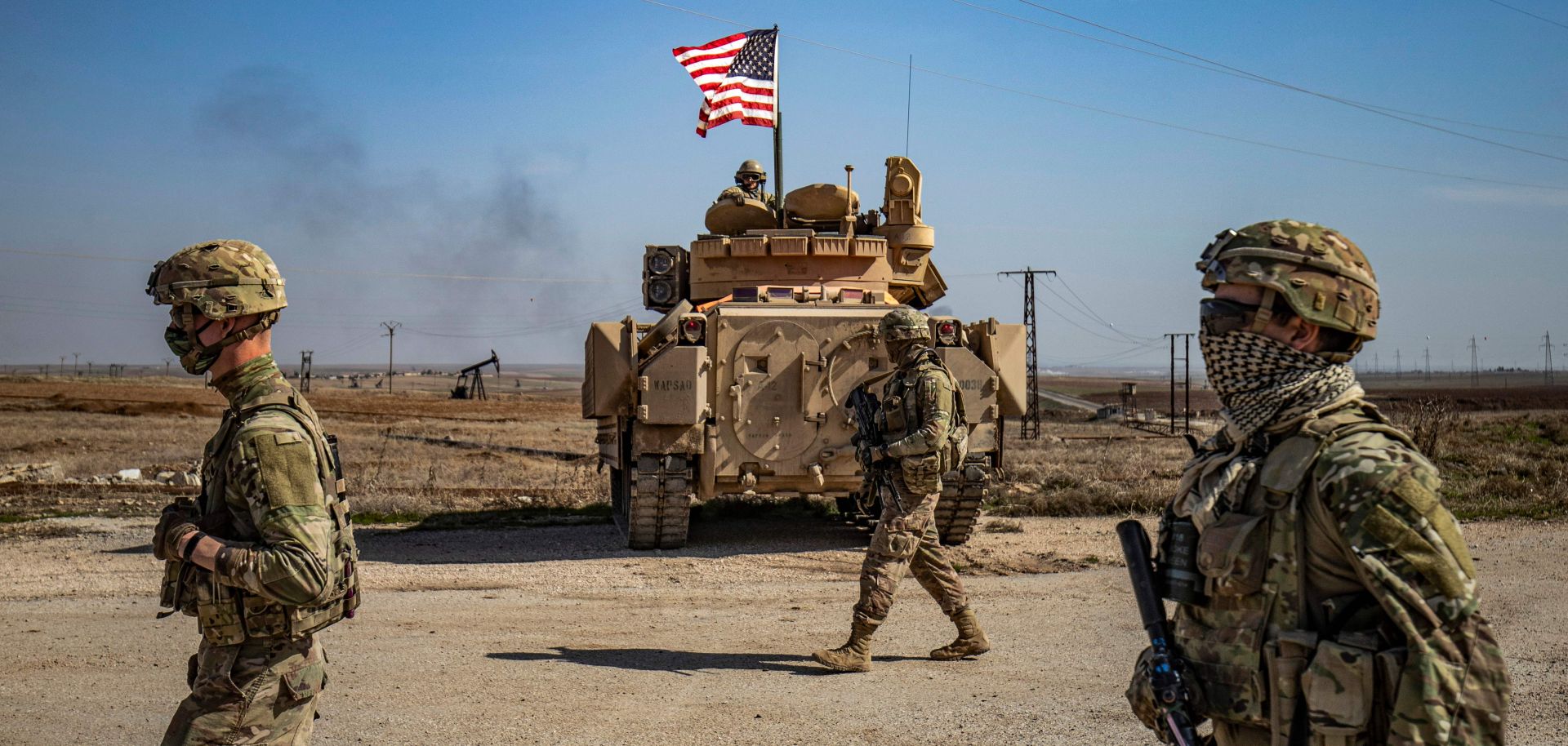
U.S. soldiers patrol oil fields in northeast Syria on Feb. 13, 2021.
Controversial U.S. airstrikes against Iranian-linked targets in Syria will not help Washington facilitate peace talks with Damascus and will instead increase domestic pressure to restrain and even end U.S. operations in the war-torn country. The administration of U.S. President Joe Biden made no pledge to withdraw from Syria on the campaign trail. But the new White House’s apparent lack of a viable exit strategy, however, will likely reinforce existing anti-intervention sentiment in the United States, which re-surfaced for the first time under Biden after the U.S. military bombed Iranian-backed Iraqi militias on the Iraqi-Syrian border at Abukamal on Feb. 26. Unlike his predecessor, Biden’s mission in Syria no longer appears set on a sudden withdrawal of U.S. troops. But despite U.S. Secretary of State Anthony Blinken and other high-ranking officials suggesting that the White House might become more involved in diplomacy to try to end the Syrian civil war, the Biden administration has yet to introduce a clear policy that would create conditions for a sustained U.S. withdrawal by reinvigorating the negotiation process between the Syrian rebels and Damascus. This, combined with the fact that the Biden administration has not assigned a special envoy for Syria, signals that the country will remain on the back burner of Washington’s Middle Eastern policies.
- The administration of former U.S. President Donald Trump attempted sudden withdrawal of troops from Syria in December 2018, and again in October 2019. But each time, widespread public and political backlash prompted the White House to keep U.S. forces in the county for fear of creating a power vacuum that would enable the Islamic State to resurge, while strengthening the positions of Russia, the Syrian government and Turkey against the U.S.-supported Syrian Democratic Forces (SDF).
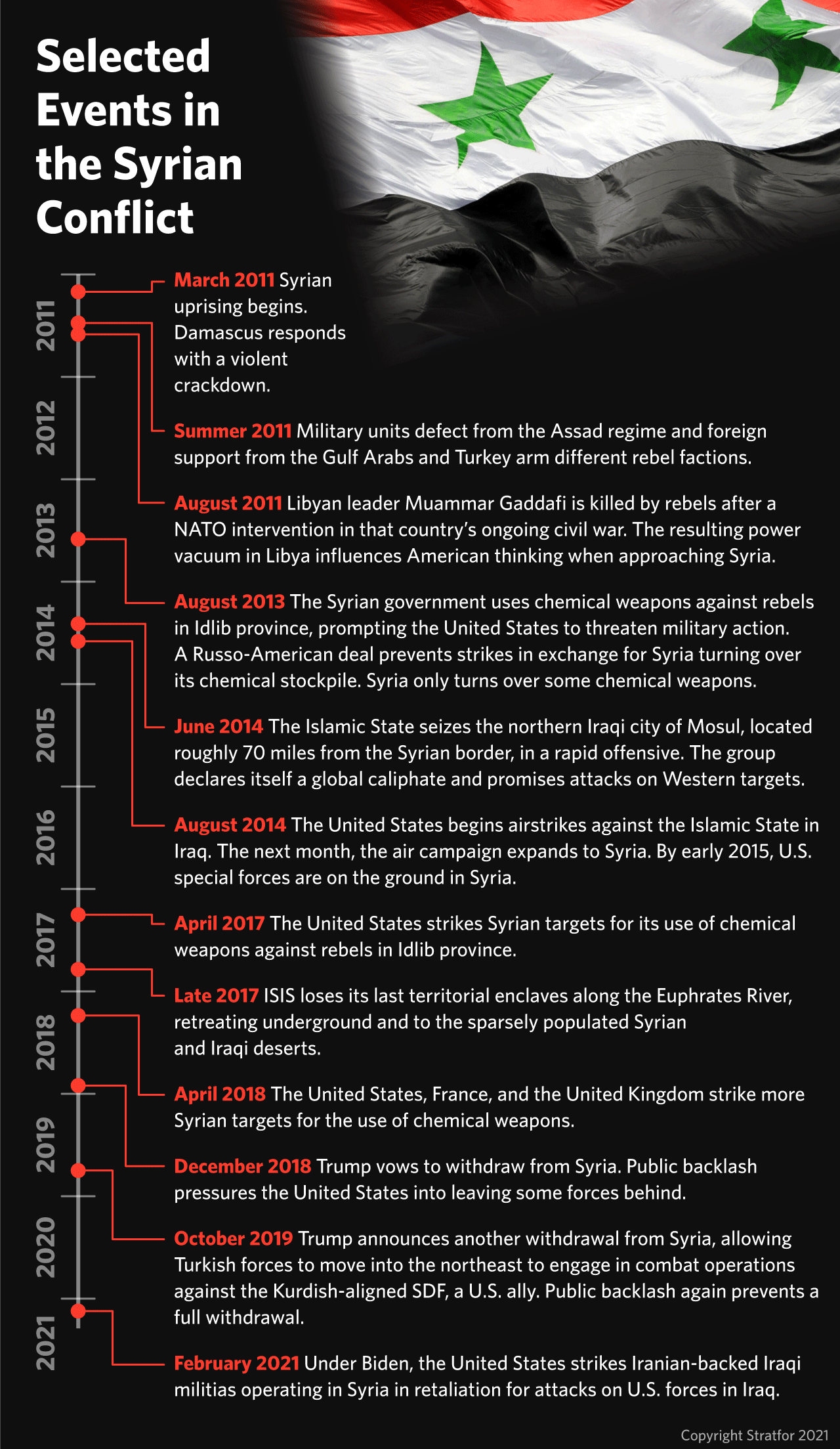
The United States will struggle to find an exit strategy from Syria through negotiation as the divided rebel factions and President Bashar Assad’s government remain locked in a military confrontation. The White House’s strategy in Syria is still focused on an unlikely path of negotiation and national reconciliation aimed at preventing an Islamic State resurgence, while also securing the human and political rights of U.S. allies like the SDF. The Assad regime, however, has shown no interest in holding ongoing negotiations with rebel factions, including the SDF, that would dilute its heavily centralized power.
- In 2019, the Trump administration imposed sanctions under the new U.S. Caesar Syria Civilian Protection Act, targeting those who committed alleged war crimes by supporting the Syrian government’s military efforts. Biden could offer to lift these sanctions if Damascus engages in meaningful negotiations with the opposition.
- The Assad government has a long history of making and breaking temporary deals with rebel factions as it pursues a restoration of its control over the country. While Damascus has been willing to sign deals that disarm rebels or allow them to withdraw from other parts of the country to fight later, it has steadfastly refused to share power. This raises the risk that the Syrian government may again carry out widespread human rights abuses against factions like the SDF if the group disarmed without a viable political agreement to protect their interests.
- Other rebel groups, like al Qaeda offshoot Hayat Tahrir al-Sham, in Idlib province, have also refused to negotiate with the Assad government, preferring armed conflict as the solution to the civil war. The Syrian rebel movement is splintered between hardline Salafist rebels, Turkish-backed proxies and the SDF, further undermining the negotiation process.
Without a negotiated exit or a new national security imperative, the U.S. mission in Syria will stagnate, fueling calls for either a drawdown or full withdrawal of U.S. troops from American lawmakers and voters interested in ending their country’s long-running wars in the Middle East. The Feb. 26 airstrikes in Syria have since renewed congressional pressure to revisit the 2002 Authorization for the Use of Military Force, the post-9/11 law that gives the executive far-reaching counterterrorism war powers. Biden has said he was open to discussing revising the law, suggesting that the White House is not only open to reshaping its own war-making powers but is sensitive to the anti-intervention sentiment in the United States. Moreover, without a direct national security threat like Islamic State or a viable negotiation path between the Syrian government and the rebels, concern about being dragged into the civil war may eventually outweigh worry about creating new power vacuums with a U.S. withdrawal.
- Russia and the Syrian government have harassed U.S. forces in northeast Syria, where the zones of control are complex and often unclear, in an attempt to constrain the movement of U.S. troops and convince the United States that its position in Syria risks clashes with Moscow and Damascus that could draw Washington into another unpopular war.
