
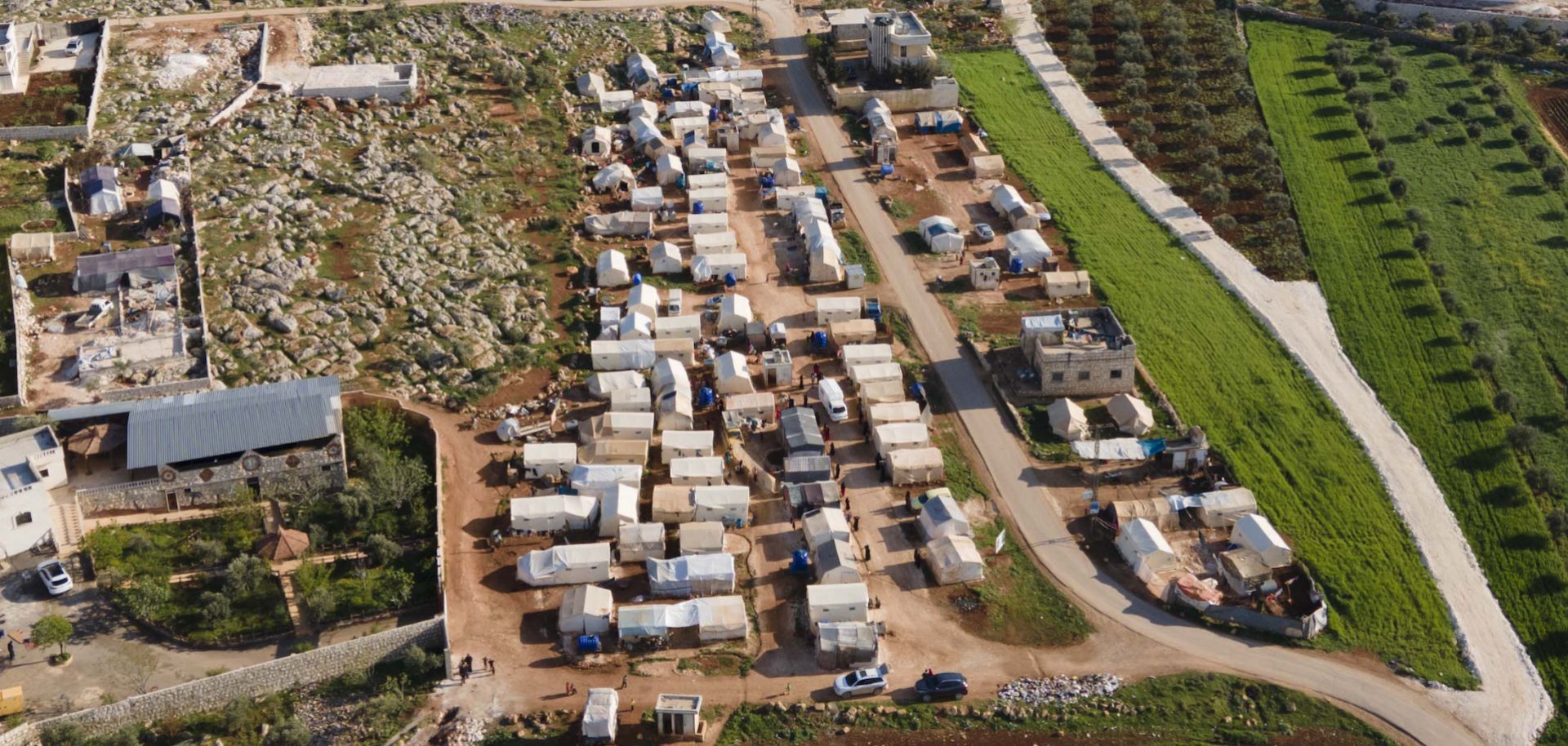
An ariel view shows a camp in Idlib for people displaced by Syria's ongoing civil war on April 13, 2021.
The Syrian government’s need to maintain legitimacy amid growing economic challenges may leave it little choice but to tap into the United Arab Emirates’ humanitarian lifelines. But by cozying up with a rival of its longtime ally Iran, Damascus could find itself lodged in a battle for influence between Abu Dhabi and Tehran. Syria’s war-torn economy is in crisis, worsened by the COVID-19 pandemic, the collapse of key trading partner Lebanon’s own economy, and a lack of reconstruction aid to restore its war-shattered infrastructure. On April 15, President Bashar al Assad’s government devalued the Syrian pound in a bid to support the beleaguered currency, just two days after firing the head of the country’s central bank. Meanwhile, constraints on its primary oil provider, Iran, have exacerbated Syria’s long-standing fuel crisis. The Suez Canal blockage in late March coincided with the launch of a more aggressive Israeli campaign to interdict oil supplies to Syria. The Syrian Democratic Forces, who control the country’s native oil supply, also reportedly stopped selling fuel amid U.S. pressure last month. With supplies short, the United Arab Emirates sent a planeload of food and medicine to Syria on April 8 through its Red Crescent agency, which is exempt from the otherwise heavy international sanctions on Syrian trade. The move appeared to be part of an attempt to build influence in Syria following the reopening of the UAE embassy in Damascus in 2018.
- Syria’s fuel crisis has sparked recurrent protests even in loyalist territories, which Damascus has struggled to alleviate.
- In an attempt to find funds for state spending, the Syrian government took the unprecedented step to seize the assets of the country’s richest man and former regime insider, Rami Maklouf, in May 2020.
- The United Arab Emirates has been pursuing a more diplomatic approach to Syria after initially supporting rebel forces. In March 2021, Abu Dhabi and its ally Egypt called for Syria to be reinstated in the Arab League, a symbolic move aimed at easing the country’s isolation.
As battlefield victories in the country’s ongoing civil war become scarce, the Syrian regime’s biggest focus has shifted from retaking territory to shoring up the economy. Following the early 2020 Russo-Turkish crisis in Idlib, the frontlines on Syria’s Turkish-protected northwest and its U.S.-protected northeast have largely stabilized. COVID-19 introduced a new uncertain element for operations and sparked lockdowns undermining the Syrian government’s willingness to spend scarce security resources on military operations. The United States also changed administrations, with the new Biden administration notably lacking a pledge to withdraw from Syria. Finally, Tensions between Russia and Turkey in Syria have also eased as both countries seek to uphold their March 2020 cease-fire agreement to prevent another major confrontation.
- Syria relies on Russian support for most of its major military operations. But Russia has only been willing to engage in limited proxy scale conflicts in Idlib (where it has conducted airstrikes on humanitarian corridors) and around the city of Ain Issa (resulting in clashes with Turkish militias).
- COVID-19 has hit Syria’s already overstretched hospital system hard. The government has officially reported only 1,400 virus-related deaths. The actual death toll, however, is suspected to be much higher, as there are signs the virus is continuing to rapidly spread across Syria, with both al Assad and his wife suffering a mild case of COVID-19 last month.
Amid growing concerns about its economic legitimacy, Damascus is seeking deeper and broader ties with the United Arab Emirates to secure needed humanitarian aid supplies. Syria’s U.N.-estimated $500 billion reconstruction bill cannot be filled by Iran or Russia alone, with the price tag being almost a third of Russia’s annual GDP alone and larger than Iran’s whole economy. The need to alleviate its pandemic- and civil war-induced humanitarian crisis has increased the Syrian regime’s willingness to accept support from the United Arab Emirates — a former foe of Damascus and a current foe of Syria-allied Iran. Sanctions-exempt humanitarian aid is one of the few ways Syria can seek improved relations with economic powers like Abu Dhabi that could provide deeper reconstruction in the future. The United Arab Emirates is likely seeking to use its humanitarian aid to increase its influence in Syria and offset Iranian aid projects designed to entrench Iranian power in Syria’s society.
- Iran’s widespread security presence is only part of Tehran’s strategy to entrench itself in Syria for the long term. It has also been using economic and humanitarian means to convince Sunni Syrians to convert to Shia Islam in a bid to tie them religiously to Tehran. But U.S.-led sanctions and the COVID-19 pandemic have affected Iran’s ability to influence Syria through these tactics.
- Damascus has been desperate enough for aid during COVID-19 that it reportedly leveraged a prisoner swap with Israel to force Israel to foot the bill for vaccine shipments to Syria in February 2021. Al Assad’s government pursued this deal, despite Israel’s covert war against Iranian forces in Syria that has caused numerous Syrian casualties.
Increased Emirati humanitarian efforts could prompt Iran to more directly interfere in Syrian internal politics. The United Arab Emirates is best positioned to improve Syrian hospitals, as well as providing food and COVID-19 vaccines. This will likely improve Syrians’ opinions of Emiratis, thus reducing opportunities for the Iranians to fill the broken Syrian social contract with their own humanitarian aid programs. Tehran may respond to the loss of influence by ramping up efforts to secure its political position in Syria. This could include more aggressively recruiting Syrians for Iran-backed militias, as well as deepening Shia Islam in the country by building mosques and converting Syrians. Such measures could spark concerns over Syria’s sovereignty from some Syrian insiders, exacerbating internal regime factionalism.
- Iran’s humanitarian powers are limited, with its own large-scale COVID-19 crisis creating an urgent need for vaccines at home. But through its vast network of militias, pilgrimage sites, mosques and imams, Iran can still exert its ideological and religious influence inside Syria, which is less resource-constrained.
