
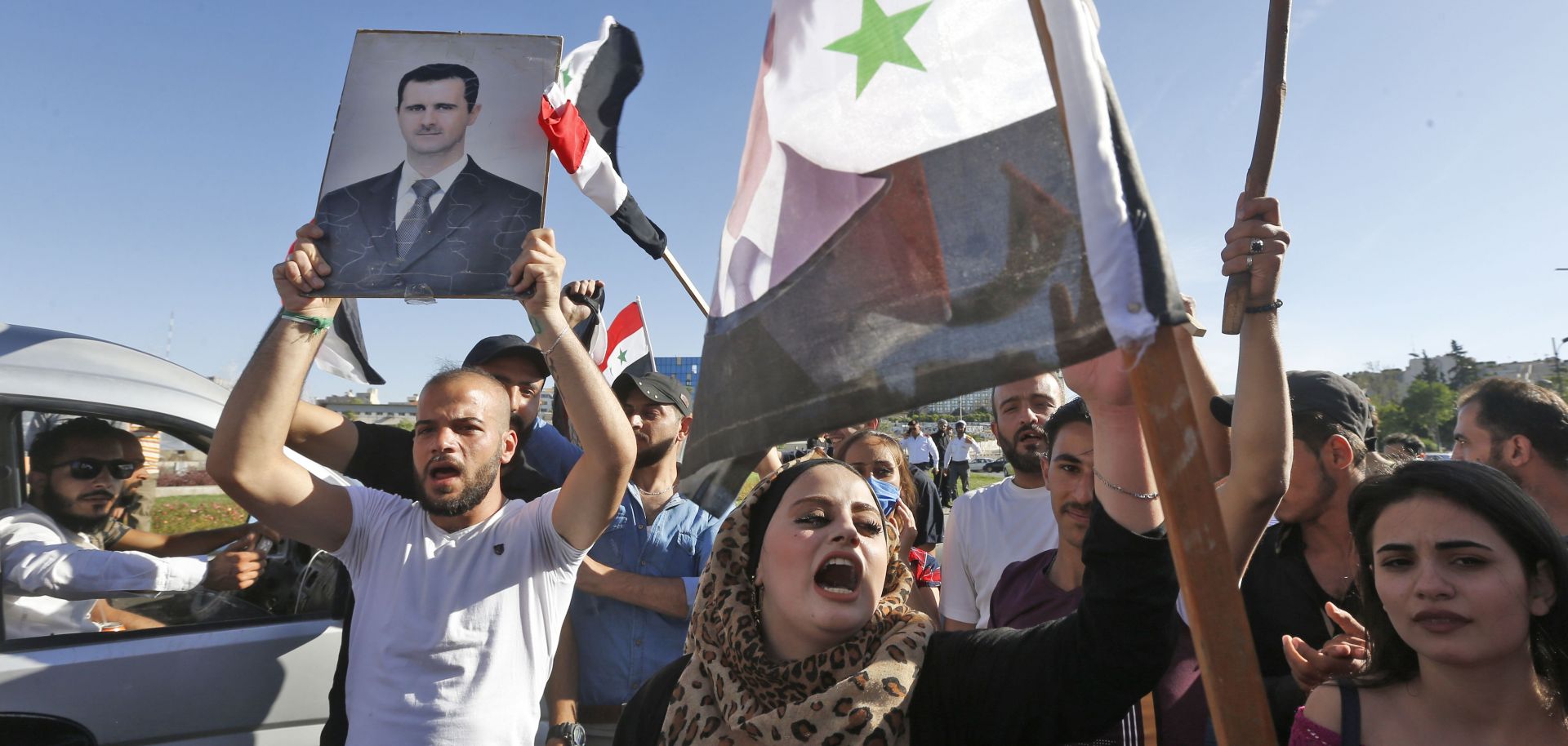
A rally in support of Syrian President Bashar al-Assad on June 11, 2020, at Umayyad Square in Damascus, Syria.
Economic and health crises have undercut Damascus' appetite for new major military offensives by creating dissent in previously secure territory. This suggests the al Assad government will attempt to consolidate power within loyalist territories before renewing efforts to eliminate Turkish and American influence. In the near term, this will give Turkey an opportunity to further entrench itself in Syria's north and northeast and help stabilize the rebel Syrian Democratic Forces' balance between its ally the United States and its rival, Damascus.
Syria's increasingly fragile economic situation is creating dissent in places that Damascus used to consider secure, undercutting the political and security resources needed to deploy against Syria's foreign rivals. Lebanon, Syria's primary remaining trade partner, is in the throes of an economic crisis. This means Syria's access to dollars, typically through Lebanese banks, has dramatically declined.
- Caused in part by Lebanon's economic crisis, Syria's pound has slipped in value. Before the civil war, it had an exchange rate of 50 to the dollar, but it is now closer to 3,500 — driving up the cost of everyday goods already difficult to obtain because of Syria's international isolation. Existing high unemployment of 40 percent has increased because of lockdowns related to COVID-19 as well, particularly in Damascus.
- Anti-regime protests occurred in June in Daraa, a reconquered province, and in the Druze stronghold of Sweida, which has previously been neutral to regime actions. In Sweida, activists focused heavily on the economic crisis.
- To shore up the country's finances, the regime has targeted a once untouchable insider, Rami Makhlouf. The regime loyalist and Alawite tycoon has found himself the subject of an increasingly targeted campaign to bring his wealth under state control. Makhlouf has gone public with his grievances, creating a new precedent for protest against the government's economic record and forcing Damascus to focus on reorganizing its internal power structures rather than pivoting to confront the United States or Turkey.
To maintain regime stability, Syria will focus on suppressing protests, reshuffling loyalists inside the government and shoring up its relationship with Moscow, leading it to defer new offensives against Turkey or the United States in the near term.
- In Sweida, reports have emerged that the government is already arresting some activist leaders, though it has so far refrained from the wide-scale security measures previously seen against other protest sites. These forces will reduce the manpower Syria has to engage in provocations against Turkey or the United States.
- The government will consolidate internal political support by considering reshuffling its Cabinet and moving around other key insider figures to smooth the path for President Bashar al Assad's reelection in 2021; already, Damascus has replaced the prime minister. Syria has historically used Cabinet reshuffles to deflect public pressure and secure loyalist support, doing so recurrently in 2011 and 2012 during the early days of the civil war. During these reshuffles, Syria is unlikely to take military risks that could damage the credibility of the government if the offensives were to go poorly.
- Damascus will also try to shore up its relations with Moscow following Russian displeasure with Syrian operations against Turkey in Idlib this February. In part, this is because Russia retains substantial influence with the Syrian military, a key pillar of regime power. To do so, Syria will probably hold off on major provocations against Turkey and the United States, since Moscow — still conducting joint patrols with Turkey and keeping its deescalation line open with the United States — does not want to escalate against either power in Syria at this time.
Damascus' strategy will probably give Turkey time to entrench itself in northern and northeastern Syria while reducing Syrian pressure on the primary U.S. ally in Syria, the Syrian Democratic Forces, to grow closer to Damascus.
- Turkey can use the lull in Syrian military action to deepen its influence along the border. Turkey is already encouraging the northwest to use its lira over the Syrian pound in an attempt to strengthen its economic links with its buffer zones. It may also expand the number of Turkish passports it hands out to Syrians in these zones as it tries to undermine the influence of the Kurdistan Workers' Party, or PKK, in the same areas. Meanwhile, Turkey will also have more time to construct more institutions, from hospitals to universities and schools to security forces, that provide public services to Syrians in the buffer zones but rely on Turkish funding to function.
- The Syrian Democratic Forces has been building up relations with Damascus as a backup to the United States should Washington follow through with its oft-repeated threat to withdraw. But the SDF prefers partnership with the United States, which allows it political autonomy, over ties with Syria, which is likely to reassert extreme political centralization over the northeast given the opportunity. With the Syrian government focused on internal stability, the SDF is unlikely to face substantial political pressure from Damascus to move away from the United States.
- As it bolsters its relationship with Russia, the Syrian regime will also be unlikely to carry out a major provocation against U.S. forces designed to undermine U.S. influence in the northeast and convince the United States to withdraw. With its economy in crisis, Syria also has fewer tangible economic benefits to offer the SDF, undercutting any drive toward expanded links between the two.
