
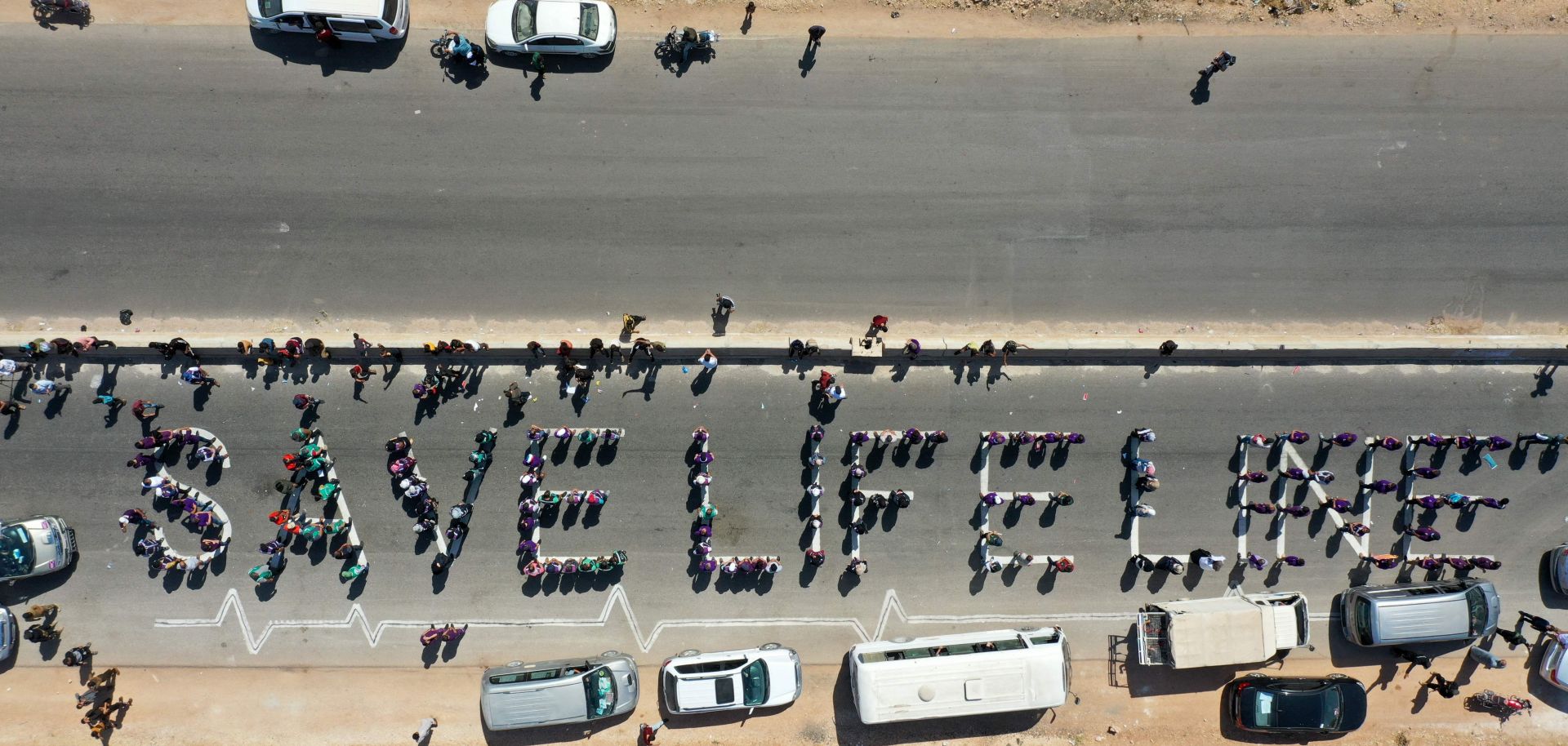
Civilians and humanitarian workers form a human chain near Syria’s Bab al-Hawa border crossing calling for the continuation of U.N.-authorized aid from Turkey.
Russia's push to erode humanitarian conditions in Syria's Idlib province could trigger retaliatory attacks from Turkish forces and local militant groups, raising the risk of another major Russo-Turkish military confrontation and a new refugee surge into Turkey. Since the beginning of the year, Russia has been squeezing humanitarian corridors that lead into the still rebel-held province, which hosts around 2 million internally displaced Syrians. In February 2021, Russian warplanes struck logistics centers associated with the Bab al-Hawa crossing on the Syria-Turkey border, where U.N.-authorized humanitarian aid flows into Idlib. Then, through the spring, Moscow signaled it might block the re-authorization of the crucial crossing, which is the only one still operating under a 2014 U.N. mandate that allows aid through Turkey. On July 9, Russia voted to re-authorize the Bab al-Hawa post, but only under the condition that it remain the sole crossing and would be subject to greater scrutiny.
- In February 2020, a Russian airstrike killed 33 Turkish soldiers in Idlib, sparking a major military confrontation between the two that both Moscow and Ankara were eager to de-escalate through a cease-fire the following month.
- Before the last major round of fighting in Idlib province, Russian-backed Syrian forces had been attempting to undermine Turkey’s control of Idlib by attacking small slices of territory and surrounding Turkish-manned observation posts designed to prevent incursions.
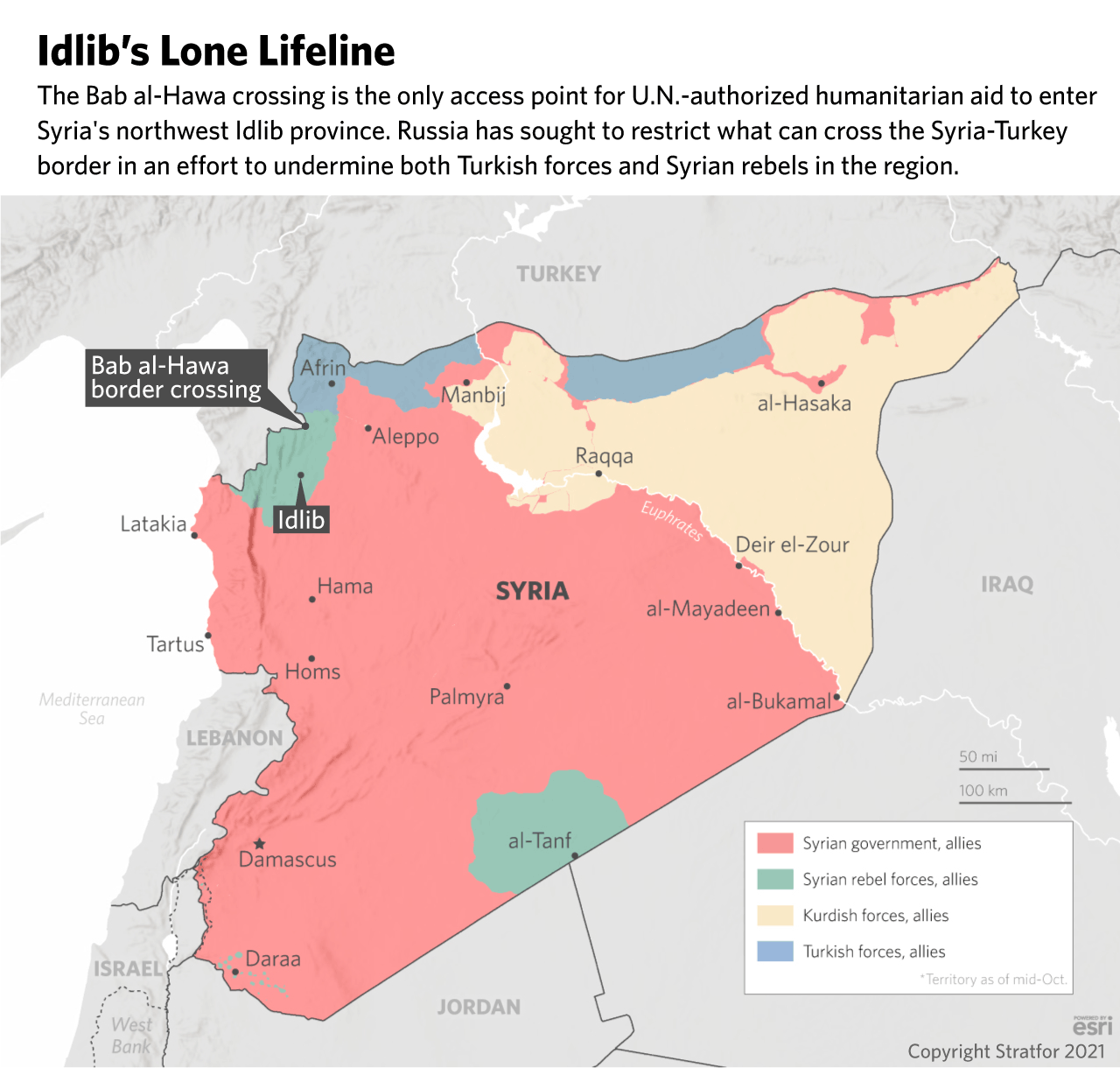
By controlling the flow of aid from Turkey, Russia and its allies in the Syrian government are hoping to influence the behavior of militants in Idlib and create leverage to cut deals with rebel groups to surrender. Damascus and its allies will be able to cut off aid in reaction to militant attacks or offensives, and may also seek to direct aid to certain groups that agree to surrender. Such efforts, however, will risk exacerbating the already dire humanitarian crisis in northwest Syria.
- Syria’s economy in both Idlib remains deeply damaged, with basic goods and services scarce, including gas, bread and electricity. The inflow of humanitarian aid is crucial to maintaining livable conditions at refugee camps in Idlib.
- The United Nations has warned that without aid deliveries into the province, Idlib’s 3.4 million people — 2 million of whom are refugees — would face imminent hunger.
In retaliation, Turkey and militant groups in Idlib are likely to attack Syria and its allies to pressure them to regrant access to aid without restrictions. Turkey, its proxies, and more independent militant groups can threaten the fragile cease-fire in the province and escalate their attacks on the Syrian-aligned forces along the current frontlines, including by targeting Russian forces in the more distant Latakia province with drones and artillery. Turkey can also use its physical control of the Idlib border to re-open humanitarian corridors without U.N. authorization, but that unilateral decision would worsen Turkey-Russia relations and also potentially lead to Russian sabotage efforts against new crossings. Militants not under Turkish influence could inflict casualties on Syrian or Russian forces, sparking a major Syrian-led counterattack on Idlib. Conversely, Syrian and Russian forces, responding to Turkish or militant harassment designed to loosen aid restrictions, might inflict heavy losses on Turkish forces, compelling Turkey to militarily respond.
A larger military conflict would likely push more Syrian migrants into Turkey. A surge of displaced Syrians to Turkey’s borders would further fuel anti-Syrian sentiment from Turks concerned that their country’s limited financial resources are being used on refugees. But another major Russo-Turkish confrontation would likely produce a new wave of refugees into Turkey, especially as further Syrian-led advances will cut down on the already limited territory still under rebel control.
