
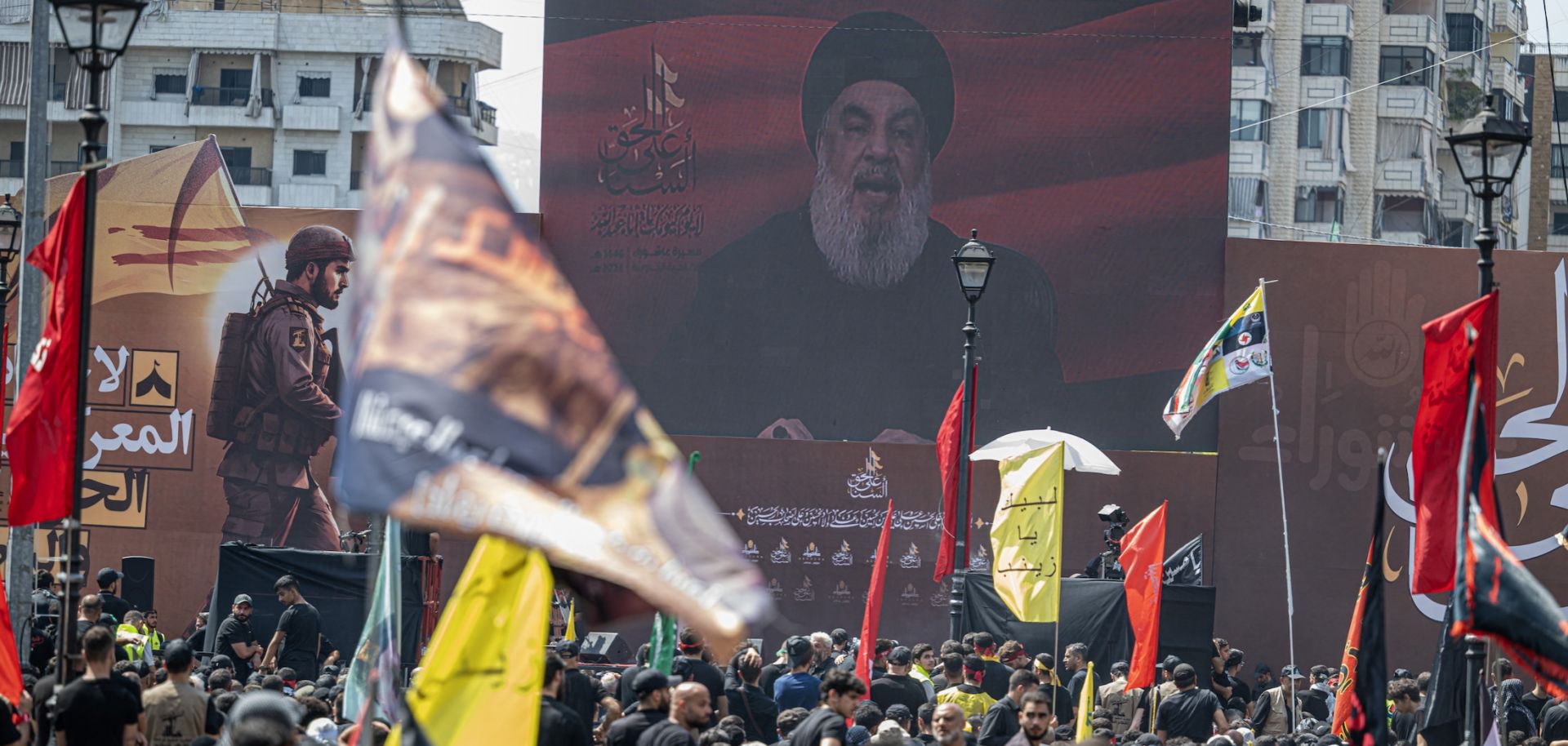
Despite their unified strategic vision, groups in the Iranian-led Axis of Resistance are unlikely to sacrifice self-preservation for one another, limiting their strategic coherence and emboldening Israel and its allies to target them individually. Following the Lebanese militant group Hezbollah's Aug. 26 mass strike against Israel, Hezbollah leader Hassan Nasrallah addressed the reasoning behind the group's decision to attack Israel unilaterally rather than alongside the rest of the Iranian-led "Axis of Resistance." Nasrallah noted that lengthy negotiations between the axis' members over whether to respond together or alone partially motivated the decision, and he added, "We decided to respond individually for reasons that will become apparent over time." Iran and this informal network of Iranian-backed militant groups — including Hezbollah, Iraqi militias and the Houthis in Yemen — have been mulling how to respond to Israel's July 30 assassination of Hezbollah's chief military advisor in Beirut, July 31 assassination of Hamas' political leader in Tehran, and July 20 airstrikes against the port of Hodeidah in Houthi-controlled Yemen. While Hezbollah's retaliation has now taken place, Iran, Iraqi militias and the Houthis are still deciding when and how to conduct reprisal attacks against Israel.
- On Aug. 26, Hezbollah launched a barrage of more than 300 rockets and dozens of drones toward Israeli military installments in northern Israel and sensitive Israeli military sites near Tel Aviv, claiming this was its response to the Israeli assassination of the group's chief military advisor in Beirut on July 30.
- Since Hamas' surprise attack on Israel on Oct. 7, 2023, the groups that comprise the Axis of Resistance have participated in what they label a support front for Hamas. This support has involved attacks on Israel, its interests and its allies in the region (including the United States) with rockets, missiles and drones.
Hezbollah's unilateral response reflects the differing strategic and operational imperatives of groups in the Axis of Resistance, including Iran, despite their unified regional strategic vision of combatting Israel. Iran and its proxies have all engaged in military action against Israel or its allies in the region, albeit in different ways and with varying degrees of intensity. Most notably, Hezbollah has conducted almost daily cross-border clashes with Israeli forces since Oct. 8, 2023, and both sides have periodically escalated these clashes to strikes on major cities, most recently Beirut and Tel Aviv. For their part, the Houthis have imposed an informal blockade on the Red Sea maritime shipping lane since November 2023, attacking alleged Israeli-linked ships. Meanwhile, Iranian-backed Iraqi militias have attacked U.S. troops and bases in Iraq and Syria, as well as sporadically carried out largely symbolic attacks against Israel that thus far have caused little damage and few casualties. Finally, Iran has offered diplomatic and logistical support for Hamas, Hezbollah and other groups, while directly attacking Israel on one occasion in retaliation for Israel's strike on the Iranian consulate in Damascus in April. However, the differing priorities and calculations of each group have led to selective and limited engagement in the ongoing conflict. This is most clearly seen in Hezbollah's unilateral Aug. 26 attacks, which the group carried out due to its unique calculations that preferred a faster response to try to reestablish deterrence, even if that meant other Axis of Resistance partners did not take part. To this end, Iran and the Houthis are still mulling how to respond to Israel's attacks, with neither entity's strategic imperatives aligning with the other's, nor with those of Hezbollah; Iran is a nation-state that must weigh the risk of an all-out war with Israel that could lead to further Israeli attacks on its nuclear program, whereas the Houthis are primarily focused on controlling Yemen and have less intent and capability to attack Israel directly. These varying calculations highlight how diverging strategic imperatives within the main actors of the Axis of Resistance shape their decisions and sometimes force them to act unilaterally.
- It is widely believed that Hamas initiated the surprise attack on Israel on Oct. 7, 2023, without the prior knowledge of Iran or the other groups in the Axis of Resistance. This is another possible reason these groups did not fully engage in the conflict, further highlighting limits to coordination within the axis.
- The Houthis have not responded to Israel's July 20 attack on Hodeidah, despite the rebels' leader repeatedly stating that a reprisal is forthcoming. Part of this postponement is due to difficult calculations about how to inflict damage on Israel in a way that prevents another major Israeli strike on Hodeidah, which is a key port used for humanitarian purposes, as Yemen continues to struggle economically.
Despite its claimed unity and strategic coordination, the differing imperatives among the groups comprising the Axis of Resistance mean they are unlikely to engage in a full-scale conflict against Israel that would sacrifice their own military capabilities and distract from their primary goals. The members of the Axis of Resistance will continue to engage in some degree of coordination as part of their "unity of the fronts" strategy, but their actions will mainly consist of rhetorical threats, diplomatic backing and occasional, largely symbolic attacks against Israel and its regional allies. Additionally, the capabilities acquired by these groups differ from one another, with Hezbollah having a larger arsenal of advanced drones and missiles than militias in Iraq or even the Houthis. This adds another layer of limitation on how extensively these groups can engage in military actions against Israel and its allies, as each group aims to conserve its limited capabilities to prioritize its own domestic objectives and protect against more immediate, local threats to its activities. Likewise, geographic constraints will limit further unity, as Hezbollah can harass Israel from Lebanon and Syria much more easily than Iran, Iraqi militias and the Houthis. These trends suggest that a desire for self-preservation, combined with different domestic and strategic imperatives of Hezbollah, Iraqi militias, the Houthis and Iran, will continue to drive their divergent approaches to conflicts, such as the current one with Israel. Hezbollah will likely maintain its strategy of limited engagement, acting as a secondary front without triggering a full-scale war that could threaten its survival and years of built-up capabilities. This approach may transform the conflict in Israel's north into a war of attrition, punctuated by episodic escalations that risk a broader war. For their part, Iraqi militias are likely to persist in offering symbolic support rather than substantive military involvement. This is guided by Iran's desire to avoid provoking a broader conflict and by the militias' fears that successful attacks on Israel and U.S. assets in Iraq will prompt occasional degradation strikes and high-profile assassinations that both the Iraqi militias and Iran want to avoid to preserve their capabilities. For its part, Iran's strategy will likely remain focused on preserving its regional influence while avoiding actions that could draw severe retaliation from Israel or its allies. Iran will likely assess that the preservation of its proxies is critical to the stability of the Iranian regime at home and key to protecting Iran from Israel and the United States as a frontal defensive position in the case of a wider regional war. Finally, despite their geographic distance to Israel, the Houthis would likely prefer to avoid more Israeli strikes, such as the July 15 strikes on the Hodeidah port, in addition to U.S. and U.K. degradation strikes, so they can sustain their military and political pressure in the Yemeni civil war. These indicators suggest that while these groups may continue to offer rhetorical support to Hamas, their actions are likely to be limited, prioritizing their own security over coordinated, large-scale military operations.
- The Axis of Resistance coined the "unity of the fronts" strategy to strengthen operational coordination between the different groups and Iran. However, in many cases, axis members have not acted in coordination. For instance, while Iraqi militias and the Houthis participated in Iran's launch of hundreds of missiles and drones toward Israel on April 13, these were their only large and significant attacks since the start of the Israel-Hamas war. Additionally, Hezbollah provided only symbolic attacks rather than large-scale ones, aiming to avoid harsh Israeli reprisals that could have dragged the group into a wider war.
Sensing the limits within the Axis of Resistance and its individual members' hesitance to engage in a full-fledged conflict, Israel and its allies will likely become more emboldened to degrade the groups' capabilities when opportunities arise or in retaliation for high-profile attacks. Israel is likely to leverage the strategic limitations exposed within the Axis of Resistance to systematically weaken these groups whenever the opportunity arises to do so. The Axis of Resistance's hesitation to more substantially engage in military action against Israel is likely to embolden the Israelis, reducing their threshold for preemptive strikes and periodic degradation attacks or high-profile assassinations against these groups, particularly Hezbollah and Iran's Islamic Revolutionary Guard Corps (IRGC) forces in Syria. Israel is likely to adopt a strategy of isolating and targeting these entities individually, capitalizing on their reluctance to escalate beyond symbolic support. These attacks are likely to occur as preemptive measures by Israel if intelligence indicates a credible, imminent large-scale assault on the country or as retaliatory strikes against the groups' capabilities, launchers, or weapon depots. They may also include high-profile assassinations of key commanders, particularly following a significant or damaging attack. A prolonged war of attrition against Hezbollah will be a key Israeli focus, as Israel seeks to degrade its military capabilities without provoking a broader regional conflict, as Hezbollah represents one of the most acute threats to Israel's security. Given the geographical constraints and the cautious posture of Iran and its allies, their ability to provide substantial support for Hezbollah will be limited, focusing primarily on arms supplies and potentially small contingents of troops. However, these efforts are unlikely to suffice in shifting the balance of power in favor of these groups, especially as Israel grows emboldened and undeterred even by the groups' mostly symbolic attacks. This strategic environment suggests that Israel's growing confidence will almost certainly lead to more aggressive and frequent operations against these groups, further eroding their capacity to threaten Israeli security and diminishing the effectiveness of their broader network.
- Given Hezbollah's hesitance to provoke Israel into a full-fledged war, the Israelis have continued to expand their attacks against the group in Lebanon and Syria, widening the geographic scope of targeting to the Bekaa, Beirut and Syria.
