
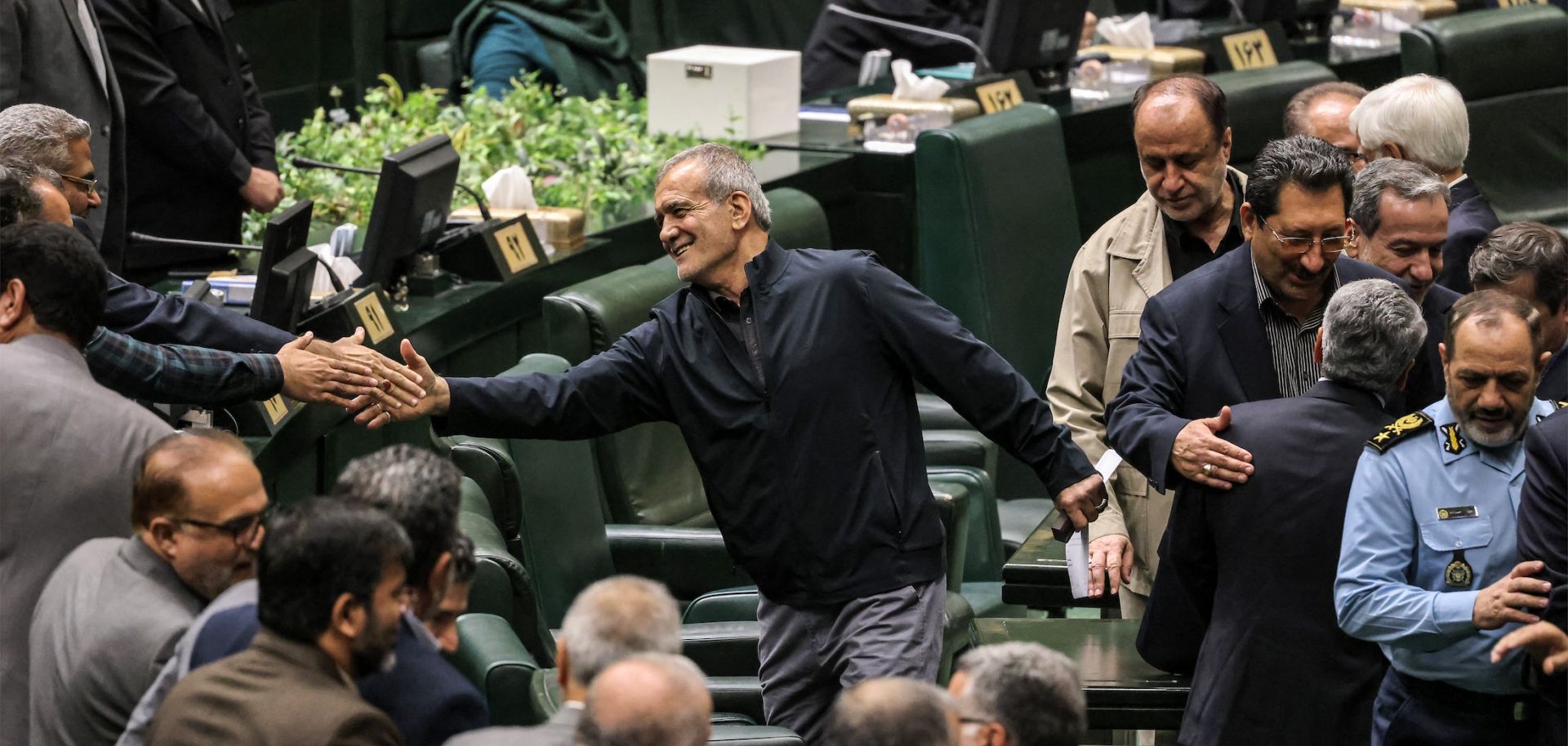
With his new Cabinet, Iran's president appears to be prioritizing economic reform at the expense of social reform to elicit support from Iran's conservatives, but any new support will likely fade if he is unable to deliver on economic promises and nuclear talks with the West. Iran's parliament approved reformist President Masoud Pezeshkian's nominees for Cabinet positions on Aug. 20 — marking the first time in over two decades that an Iranian president has pushed all of his nominees through the confirmation process. Nevertheless, since submitting his nominations list on Aug. 11, Pezeshkian has faced criticism for abandoning some of his campaign pledges in favor of conforming his presidency to the limits of what Iran's other institutions — including Supreme Leader Ayatollah Ali Khamenei — will allow. Pezeshkian's Cabinet largely abandons his campaign pledge to run a government that was far more inclusive than that of ultra-hardline conservative President Ebrahim Raisi, who died in a helicopter crash in May. For instance, the Cabinet only included one woman and just two people under the age of 50, and his Cabinet is mostly devoid of reformists aside from First Vice President Mohammad Reza Aref. The Cabinet also included a number of controversial conservative appointees, including Raisi's Intelligence Minister Esmail Khatib and Justice Minister Amin Hossein Rahimi. The appointment of Khatib and Eskandar Momeni — a former Islamic Revolutionary Guard Corps (IRGC) commander and Law Enforcement Forces deputy chief associated publicly with enforcing Iran's compulsory hijab law — are particularly controversial due to their role in the violent crackdown on the 2021 Mahsa Amini protests. Soon after Pezeshkian's Cabinet submission, Mohammad Javad Zarif, Iran's lead negotiator for the 2015 nuclear deal with the West who is closely associated with Iran's moderate and reformist camps, announced his resignation less than two weeks after Pezeshkian appointed him vice president for strategic affairs (a non-Cabinet advisory position). Zarif reportedly resigned over disagreements about the transition process and those whom Pezeshkian was considering for Cabinet positions, though Zarif publicly denied the connection.
- Pezeshkian's Cabinet does include several moderate and/or technocratic appointees from former President Hassan Rouhani's administration, including Abbas Salehi as culture minister and Abdolnaser Hemmati as economy minister.
- Pezehkian won Iran's July 5 runoff election, beating hardline conservative politician Saeed Jalili with 54.8% of the vote.
Pezeshkian's choice of Cabinet appointees appears to be a concession to Iran's conservative-dominated parliament and reflects a desire to minimize political disruptions as he takes office as Iran's first reformist president in nearly two decades. Khatib and Momeni, as well as former Iranian air force commander Aziz Nasirzadeh, whom Pezeshkian appointed defense minister, are aligned with Iran's conservative camp. As Iran's parliament must approve all Cabinet nominees, their selection — especially for such sensitive ministries — appears to have been designed to reduce tension between Pezeshkian and the parliament, which is headed by conservative Speaker Mohammad Bagher Ghalibaf, who finished third in the presidential election, and to help ease the approval of other nominations. Pezeshkian's choice to forgo the selection of controversial Cabinet figures to head other ministries demonstrates that the Iranian president is choosing to conform his presidency to the rest of the conservative-dominated political establishment instead of appointing controversial figures and slogging through a contentious fight with parliament to get them approved, which would have required a high degree of political capital. This strategy led Iran's parliament to approve the less controversial and more technocratic Cabinet list with relative ease. Pezeskhkian's Cabinet also reflects why the president is one of the few reformists whom Khamenei and the other powerbrokers in Iran's political system tolerate, as Pezeshkian has typically not backed significant political reform that threatens other factions' interests. In this way, he is similar to former President Hassan Rouhani, the moderate long-time regime insider who remained in office from 2013 to 2021.
Pezeshkian's technocratic, moderate Cabinet suggests that, at least initially, he will focus on improving Iran's economy instead of on significantly challenging other bases of power within the Iranian political system, such as the IRGC, or pushing aggressively for more controversial social reform. Pezeshkian's victory was due in large part to the stagnant economic performance of Iran under Raisi, who doubled down on Supreme Leader Khamenei's "resistance economy" approach while facing Western sanctions, contributing to high inflation. Pezeshkian's economic platform during his campaign promised to secure sanctions relief, boost domestic production and exports, reduce inflation and the government budget, improve economic equality, pursue anti-corruption and transparency reforms, and improve overall economic governance. In practice, some of these goals will be difficult to achieve, like anti-corruption investigations and transparency reforms that may implicate powerful political rivals or face opposition from the IRGC, but given Iran's economic woes, the Iranian political system appears likely to rally behind his economic platform. With such a focus on the economy, Pezeshkian's social agenda appears to be a second priority, particularly considering his Cabinet, as the Iranian political establishment is far less likely to support his controversial social agenda.
- During Raisi's presidency, inflation peaked above 50% in early 2023 — the highest level since the mid-1990s — and consistently breached 30% compared with single-digit levels in 2016 and 2017, when the Joint Comprehensive Plan of Action (JCPOA) nuclear deal with the West was in force.
- The Iranian rial hovered around 600,000 to the dollar on unofficial markets during Raisi's final year in office, compared with around 260,000 to the dollar when he took office.
Pezeshkian will likely pursue the same technocratic economic strategy as former President Rouhani, but the lack of a nuclear deal with the West will likely constrain his success. Abdolnaser Hemmati's selection as economy minister is one signal that Pezeshkian will copy Rouhani's economic strategy, as Hemmati was central bank governor when Iran was implementing significant governance and liberalization reforms that the International Monetary Fund supported, including the authorization of the central bank to engage on open market operations. Pezeshkian is also likely to seek ways to trim the federal government's budget to curb inflation that has risen through fiscal expansion. Additionally, the president will likely back more policies to reduce the state's influence in the economy, including through some privatization, though he will face an uphill battle since privatization in Iran typically has benefited quasi-parastatal companies linked to various Iranian political power bases. However, Pezeshkian will need to secure sanctions relief from the United States in order to achieve his economic goals, and sanctions relief is unlikely to occur quickly if Vice President Kamala Harris wins the 2024 U.S. presidential election in November or at all if former President Donald Trump wins. Without sanctions relief, Pezeshkian will be unable to achieve his goals of boosting oil exports, which is needed to secure foreign currency and reduce pressure on the rial; increasing foreign direct investment into the economy, which is needed to help raise domestic manufacturing activity and create jobs; and reintegrating Iran into the international financial system, which is needed to help facilitate international transactions and payments with Europe and even India.
- The Israel-Hamas war will likely prevent Pezeshkian from reaching his goal of implementing the anti-money laundering and counterterrorism financing reforms desired by the Paris-based Financial Action Task Force, as many of Iran's national security-focused bodies view those reforms as hurting Iran's ability to support allied militias regionally, many of which some Western governments have labeled terrorist organizations.
The ambitious part of Pezeshkian's platform — his social reforms and the more controversial transparency and economic reforms weakening the IRGC — will hinge on whether or not he can overcome major constraints to secure sanctions relief and significantly improve the economy. Pezeshkian's political strength will likely be proportionally linked to his ability to secure sanctions relief from the West and improve the economy. If he succeeds on both counts, Pezeshkian's popularity among most normal Iranians would likely increase, giving him political ammunition to pursue more controversial reforms. Potential reforms would include social and traditional media liberalization, more inclusive governance that brings in minority groups and women, and social liberalization on issues like the compulsory hijab law. Pezeshkian would also be better positioned to push for the Financial Action Task Force's reforms around financial transparency and changes to the IRGC's role in Iranian society. When he was in office, Rouhani made progress on many of these issues, including curbing the influence of the IRGC, soon after making progress in diplomatic talks with the West, but the 2018 U.S. withdrawal from the JCPOA and the return of sanctions on Iran virtually halted Rouhani's entire domestic agenda. Pezeshkian will face even more constraints than Rouhani, as Iranian hardliners will likely view any new nuclear deal as temporary and potentially reversible should Republicans return to power in the United States, reducing their willingness to accept reforms that could hurt Iran's ability to withstand the reintroduction of sanctions and higher tension with the United States.
- From 2013 to 2017, Rouhani had significant success in curbing the IRGC's role in the economy, including through the seizure and detention of IRGC-connected businesspeople.
Should Pezeshkian fail to secure sanctions relief and tensions with the United States escalate significantly — most likely under a second Trump administration — the Iranian president's political strength and domestic agenda would evaporate. If Pezeshkian's economic strategy fails to curb inflation significantly, sanctions relief remains elusive, and tensions with the United States and Israel remain high, Iran's hardliners in most institutions would have little reason to continue working with the president. Instead, those institutions would likely oppose virtually all of Pezeshkian's moves and potentially take steps to strip him and some of his Cabinet members of their authority, including through impeachment. Iran's judiciary would likely also try to investigate alleged corrupt activities between high-ranking Cabinet members and/or their families or close allies. This would herald a return to Raisi's "resistance economy" policies, including shunning economic relationships with most foreign countries, trying to reduce imports significantly, and inflationary spending through subsidies for poor and middle-class Iranians. The second half of Rouhani's time in office when Iran's hardliners seized parliament in 2020 offers a cautionary tale for Pezeshkian on how his government could go if he does not make progress on the economy or talks with the West.
- After the United States left the JCPOA in May 2018 and snapped sanctions back on Iran, Rouhani's political strength weakened significantly as many foreign companies exited potential investment deals, Iran's oil exports fell and inflation ramped back up. Iran's IRGC and its proxies also became far more assertive regionally against the interests of the United States and its partners, most notably in the September 2019 attack on Saudi Arabia's Abqaiq oil processing facility, one of the most critical nodes in the global oil industry.
- If Pezeshkian's diplomatic efforts fail, Iran would be more likely to eventually escalate against the West with its nuclear program, including by carrying out more research on potential weaponization and/or increasing enrichment.
Finally, Pezeshkian's term will significantly influence Iran's eventual supreme leader succession process, with any failures of his administration increasing the likelihood of an even more hardline figure becoming Iran's next leader. Pezeshkian's presidency, especially if he wins reelection in 2028, comes as Iran is likely to pick a new supreme leader over the next decade, as Ali Khamenei is now aged 85. Amid this forthcoming transition, Pezeshkian's popularity, as well as tensions with the West and Israel, will likely be key variables of the succession process. If Pezeshkian's economic reform agenda fails, especially if Iran is facing significant foreign pressure, a figure who represents Iran's hardline establishment (as opposed to Khamenei, who represents Iran's conservative or right-wing establishment) would be more likely to win and less likely to take into account views like Pezeshkian's. Such a supreme leader would also increase the likelihood of Iran eventually developing a nuclear weapon. However, if Pezeshkian stabilizes Iran economically and geopolitically, Iran's next supreme leader would be more likely to mirror Khamenei or even be more pro-reform. Such a figure may be more willing to eventually weaken the country's aggressive rhetoric against the West and some of its neighbors, though it is unlikely that any Iranian leader for the foreseeable future will do the same against Israel. A moderate supreme leader would also be far more willing to offer long-term concessions to the United States and pursue normalization, though these processes would likely play out over decades.
- When Raisi died, he not only created a void in the presidency but also on the short list of potential clerics to succeed Khamenei. Many of the other figures long viewed as potential successors — like former President Akbar Hashemi Rafsanjani, Rouhani and influential cleric Ayatollah Mahmoud Hashemi Shahroudi — have either died or been marginalized politically for various reasons. As a result, only a few figures remain as potential replacements, including Khamenei's son Mojtaba Khamenei and hardline cleric Alireza Arafi.
- Iran's only supreme leader transition occurred in 1989, and that process was deeply affected by Iran's domestic political squabbles and rebellions between Iranian leftists (like the communist Tudeh party) and Iran's right wing, represented by figures like Khamenei and eventual President Rafsanjani. Iran's right-wing conservatives largely won that political fight domestically, culminating in mass executions in 1988 and constitutional reforms removing the prime minister position. These forces directly helped Khamenei become supreme leader after he served as the country's president from 1981 to 1988, despite being by all accounts a mid-level cleric at the time instead of the powerful cleric that former Supreme Leader Ayatollah Ruhollah Khomeini was.
