
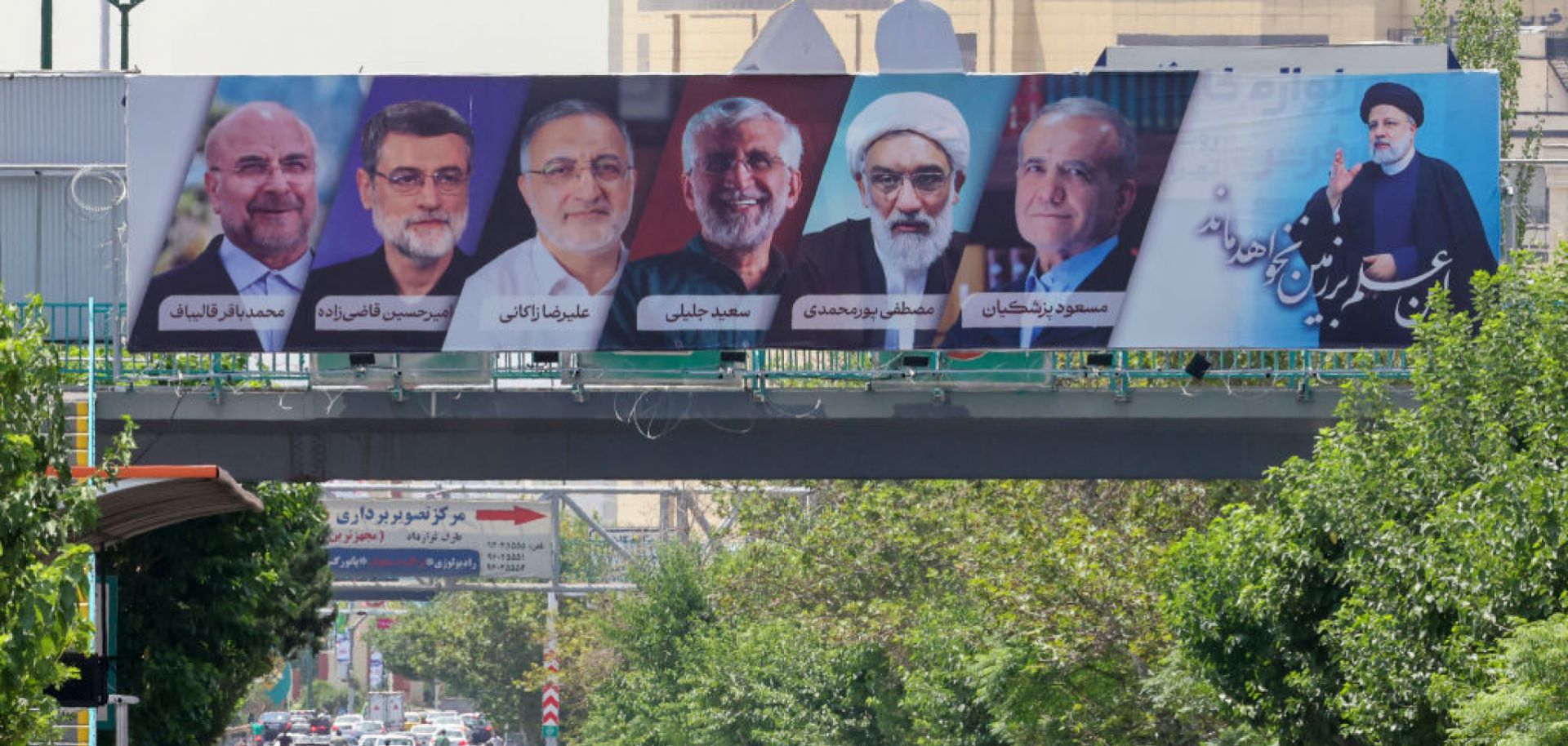
Iranian President-elect Masoud Pezeshkian will attempt to improve relations with the West, including the United States, but he is unlikely to impact Iran's regional strategy significantly and is likely to face considerable domestic constraints. The reformist president-elect defeated hard-line conservative challenger Saeed Jalili 53.6% to 44.3% in Iran's July 5 runoff election. The victory caps a surprising path to the presidency for Pezeshkian after Iran's Guardian Council, which oversees the election process, approved his presidency in what was widely believed to be an attempt by the Iranian establishment to approve a reformist candidate in an effort to boost election turnout and boost the Islamic republic's legitimacy. During his campaign, Pezeshkian said he intended to improve Iran's economy through reviving a nuclear deal with the West and securing the lifting of economic sanctions on Iran.
- Pezeshkian will become Iran's first reformist president since Mohammad Khatami's 1997-2005 presidency, and is even further from Iran's mainstream political current than was moderate former president Hassan Rouhani, who was president when Iran negotiated the 2015 nuclear deal with the West known as the Joint Comprehensive Plan of Action.
- Pezeshkian called for improving relations with the West and securing sanctions relief in talks with the United States and other participants in the JCPOA.
- Pezeshkian is critical of the government's recent hard-line social policies, including the restrictive law requiring women to wear headscarves that was a key part of the widespread 2022 Mahsa Amini protests, and has called for equality for women.
Despite Pezeshkian's rhetoric, significant roadblocks remain in both the United States and Iran in the path to a revived or new nuclear deal. In the United States, the Republican presidential candidate — and current leader in polling ahead of the November presidential election — Donald Trump withdrew from the JCPOA in 2018, which means that the U.S. under a second Trump administration is unlikely to be interested in resurrecting the deal. In the meantime, President Joe Biden – who may not even be running for the presidency by the time that Pezeshkian is sworn in and has Cabinet members appointed — is not in a strong political position to pursue a new deal with Iran ahead of the election, though if he or a different Democrat candidate were to win, a deal would become more likely. If Trump wins the election, a deal would be unlikely given the lack of trust Iran would have for Trump in talks. Trump's previous strong support for Israel, which opposed the JCPOA, also suggests it is unlikely that Trump would ever offer the concessions necessary to seal a deal. In a June interview, Trump hinted that he only opposed Iran having a nuclear program (a program Iran is unlikely to give up) and thought he could reach a deal with Iran, even going so far as to say he thought Iran could sign an Abraham Accords-style agreement with Israel. While the latter is certainly not going to happen barring a major political shift — e.g., regime change — in Iran anytime soon, Trump's remarks demonstrate that talks could at least occur during his presidency, even if they are highly unlikely to bear fruit. While Pezeshkian is likely to be vocal on the need to offer some concessions to the United States and the West to secure a deal, the decision does not solely reside with him, as Iran's national security strategy is set by the Supreme National Security Council, a body that includes the president and Cabinet members, but also representatives of the supreme leader, the head of Iran's parliament, and the heads of several different branches of the Iranian military, including the Islamic Revolutionary Guard Corps, all of which are unlikely to support negotiations with the United States that include significant Iranian concessions. Even if Pezeshkian wants to secure a deal, Iran is unlikely to accept the same structure of the JCPOA, and would instead want more guarantees should the United States leave the deal again.
- As president, Pezeshkian is likely to bring in many of Iran's moderate and reformist foreign policy figures who were involved in and/or led negotiations with the West during the Rouhani presidency, potentially even including former lead nuclear negotiator and foreign minister Javad Zarif, in an effort to jump-start talks when he takes office.
- The 2015 JCPOA was not designed to handle what would happen if the United States left the deal, as its enforcement mechanism was designed with Iran violating the deal in mind, not the United States doing so. The U.S. exit in 2018 gives Iran an incentive to demand weaker constraints on its nuclear program, such as not dismantling and pouring concrete into all of its advanced centrifuges, in case the United States leaves again.
- Iran's parliament is also likely to be a major roadblock to a deal. Iran's March 2024 parliamentary election resulted in a legislature dominated by conservatives and hard-liners and led by Mohammed Bagher Qalibaf, who finished third in the presidential election's first round. Under Qalibaf's speakership, Iran's parliament passed a law in 2020 that restricted Rouhani from negotiating a quick resumption of the JCPOA with then-incoming U.S. President Joe Biden. In Iran's political system, the president does not approve laws or veto them, a responsibility that belongs instead to the hardline-led Guardian Council.
Pezeshkian is unlikely to have a significant impact on Iran's regional strategy, including relations with Israel and the rising risk of conflict between Israel and Iranian-backed Lebanese militia Hezbollah. Iran's regional strategy is dominated by the IRGC and specifically the Quds Force responsible for extraterritorial operations. As a result, Iran will continue to support regional militias, including the transfer of advanced weapons to allies like Hezbollah and Yemen's Houthis, the latter of which has disrupted global shipping routes through the Red Sea. The support of these militias is crucial to Iran's asymmetric national security strategy, giving it the ability to strike with greater plausible deniability at Israel and other regional allies and partners of the United States, such as Saudi Arabia and the United Arab Emirates. Indeed, in the immediate aftermath of the collapse of the nuclear deal in 2018, Iranian proxy activity targeting Gulf oil production ramped up and briefly boosted oil prices, a politically sensitive price point for U.S. presidents. Despite Pezeshkian's limited impact on Iran's regional support for militias, his election will provide a further boost to improving relations between Iran and its Gulf neighbors, including Saudi Arabia and Bahrain.
- Since 2023 Iran's ties with most Gulf Cooperation Council countries have improved. Most notably, this occurred with the March 2023 China-brokered deal between Iran and Saudi Arabia to restore diplomatic ties. Most recently, Bahrain and Iran announced in June that they had agreed to hold normalization talks.
Domestically, Iran's hard-line conservatives are likely to try to stifle Pezeshkian's agenda, setting up a likely turbulent relationship between Pezeshkian and most other Iranian institutions that hard-liners dominate, including the military, judiciary and the Iranian parliament. While Iran's president has more influence on domestic policy than he does on international policy, he will find few reformist or even moderate allies in the rest of the Iranian political system to support his agenda. After the collapse of the JCPOA in 2018, Iran's hard-liners and conservatives built up their strength in virtually every center of power in Iran's political system, which they will use to limit Pezeshkian's ability to make meaningful reforms on controversial issues such as social reform. In fact, some may actively seek to undermine his agenda entirely. Though Rouhani faced similar pushback from Iran's unelected institutions, like the judiciary and the Guardian Council, Rouhani's moderate-reformist coalition won control of Iran's parliament in 2013, giving him allies in the parliament to pass laws to implement his agenda instead of solely relying on executive action and Cabinet appointees. Under Rouhani, for example, parliament passed reforms opening up the country's strategic oil sector to foreign investment. Pezeshkian will not have such support, as the hard-line parliament just began its four-year term May 27 — meaning Pezeshkian's first term will almost entirely coincide with a parliament opposing his policies. While Supreme Leader Ali Khamenei can weigh in and help steer Iran's institutions to support certain aspects of Pezeshkian's domestic agenda — particularly on less controversial aspects like economic policies instead of social policies — Pezeshkian is likely to enter office as a very weak president, even by Iranian standards. How far Khamenei shields Pezeshkian will likely ultimately come down to Khamenei and his close allies' interpretation of the election results.
