
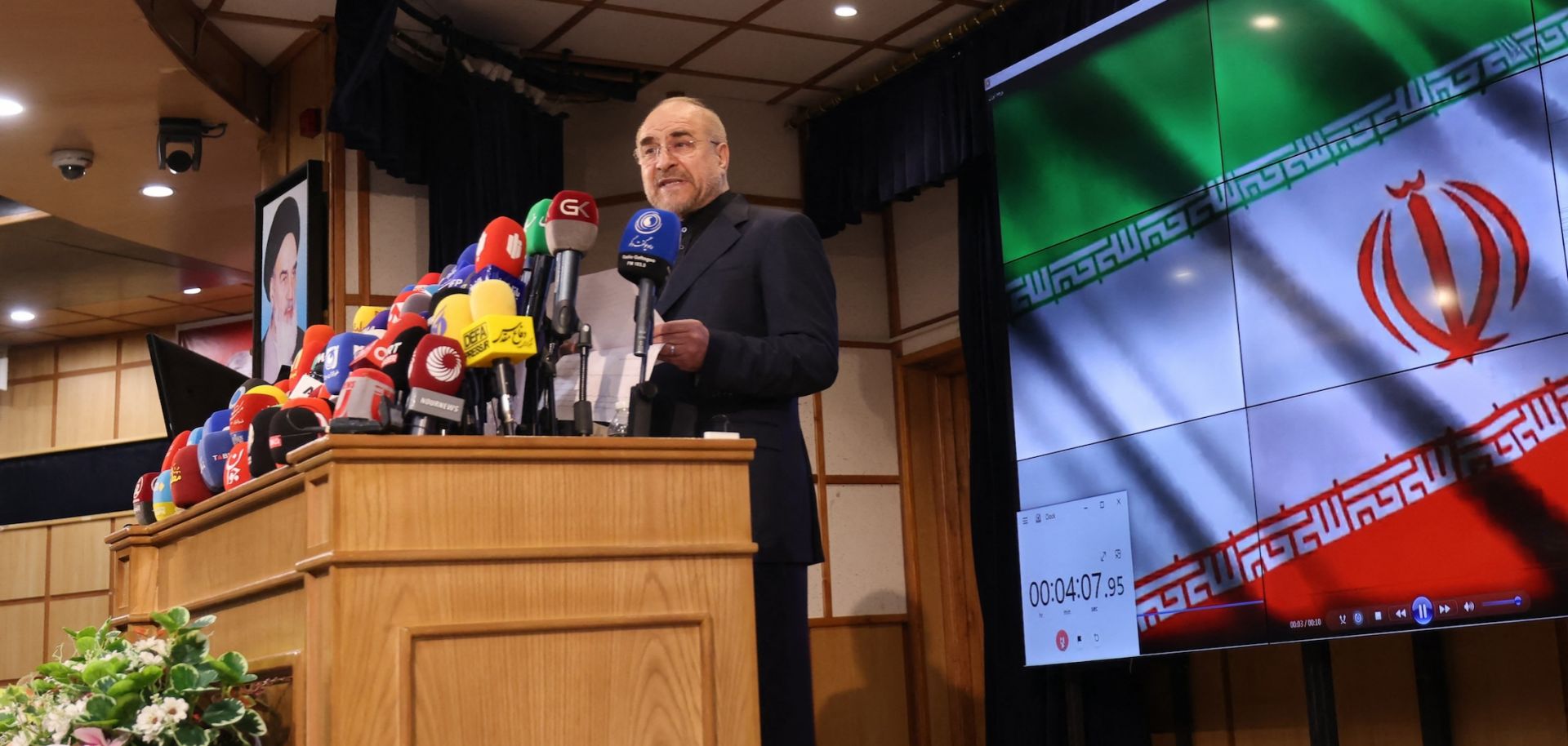
Iran's approved list of presidential candidates likely ensures that another regime-approved hard-liner will win the June 28 election, ushering in few changes to the country's foreign and domestic policies. On June 9, Iran's Guardian Council approved six candidates to run in the country's presidential election later this month after a helicopter crash killed President Ebrahim Raisi on May 19. The candidates include Parliament Speaker Mohammad Bagher Qalibaf, former chief nuclear negotiator Saeed Jalili, Tehran mayor Alireza Zakani, former interior minister Mostafa Pourmohammadi, Foundation of Martyrs and Veterans Affairs head Amir-Hossein Ghazizadeh Hashemi, and reformist lawmaker Masoud Pezeshkian. With the exception of Pezeshkian and traditional conservative Pourmohammadi, the approved candidates are all hard-line conservatives to varying degrees. Notably, the Guardian Council disqualified former Speaker of the Parliament Ali Larijani and former President Mahmoud Ahmadinejad from running in the race. While Ahmadinejad's rejection was widely expected due to his antagonization of the Iranian leadership in recent years, Larijani was viewed as a relatively moderate conservative candidate who could be allowed to run if Supreme Leader Ali Khamenei wanted to pivot away from hard-liners' domination of the Iranian political system since the now-deceased Raisi took office in 2021.
- Under Iran's constitution, the winning presidential candidate must win a majority of the vote. If no candidate wins a majority in the June 28 ballot, then a run-off election will be held the following week between the two top vote-getters. If one of the top two candidates drops out of the election before the runoff, the next highest vote-getter will compete in the runoff.
- Although Raisi died with more than a year left in his term, Iran's next president will serve a full, four-year term in office, and not just the remainder of Raisi's term.
While any of the approved hard-line candidates could feasibly win the election, Qalibaf appears to be the favorite, with Jalili also being a strong contender, though both have political baggage. While tightly managed, Iran's presidential elections are not a foregone conclusion and do not always boil down to a single regime-approved candidate winning. Nonetheless, the disqualification of Larijani — a figure who, as president, may have been able to unite Iran's moderates, conservatives and even some reformists the same way that former President Hassan Rouhani did in 2013 — and the concurrent approval of several prominent hard-line conservatives suggests the Guardian Council, supported by Khamenei, is seeking to ensure that Iran's next president is another hard-line conservative. But the fact that several hard-liners have been approved to run, instead of just one, also indicates that the council is allowing factions within the hard-line conservative camp to compete in an effort to drum up popular support for the government and voter turnout. Jalili and Qalibaf are the two favorites due to their prominence and experience, but both also have a significant degree of political baggage and opponents among Iran's hard-liners. Jalili, who served as Iran's chief nuclear negotiator from 2007-2013, is an extreme hard-liner who has staunchly opposed talks with the West on Iran's nuclear program. He is also supported by the Steadfast Front political group, one of Iran's most fundamentalist political associations. Current parliament speaker Qalibaf, on the other hand — who finished second to Rouhani in the 2013 election — is a former Tehran mayor with an extensive background in many parts of the Islamic Republic. Before he entered politics, Qalibaf served as the chief of the Islamic Revolutionary Guard Corps' Air Force in the late 1990s and as head of the IRGC's engineering firm Khatam al-Anbiya Construction Headquarters in the mid-1990s. However, Qalibaf has been linked to corruption scandals during both his time as Tehran mayor (2005-2017) and time as parliament speaker (a position he has held since 2020). In fact, earlier this year, Iran's ultra-hardline conservatives in parliament — many of whom are allies of Jalili — had also tried to remove him as speaker. But compared with Jalili, Qalibaf still appears to be the favorite as he comfortably secured another term as parliament speaker on May 28 by winning 198 of the 287 votes for the position, showcasing his ability to push back against Jalili's allies and his wider appeal than the more hard-line candidates.
- Iran's reformist vote is likely to unify around Pezeshkian, even if some of Iran's moderates favor him, as demonstrated by Pezeshkian quickly securing the endorsement of former Foreign Minister Javad Zarif, who served under former President Rouhini. The Guardian Council likely approved Pezeshkian's candidacy in the hopes that it would compel more Iranians to participate in the presidential election after Iran's March 1 parliamentary elections generated record low turnout. But the hard-liners in control of Iran's political system are unlikely to let Pezeshkian win due to the threat he and other reformists would pose to establishment interests like the IRGC. If Pezeshkian is unexpectedly able to captivate the Iranian electorate and the hard-line conservative vote is split among the numerous approved candidates, Iran's ruling elite would likely ensure the final vote count goes against him and launch a crackdown on his supporters, akin to the crackdown it launched against the supporters of reformist presidential candidate Mir-Hossein Mousavi, who came in second place in Iran's 2009 presidential election amid a high degree of voting irregularities.
- It is common for Iranian presidential candidates with virtually no chance of winning to drop out of the race at the last minute, in an effort to unify the vote around a single candidate more aligned with their views. This means that some of the newly approved candidates are likely to drop out before the June 28 presidential election, but Qalibaf, Jalili and Pezeshkian are the least likely to do so as they each represent various factions within Iran.
A victory by any of the conservative figures will result in virtually no changes to Iran's foreign policy and national security strategy. In deliberations in Iran's Supreme National Security Council, none of the approved hard-line candidates would likely offer counterpoints to the aggressive views suggested by Iran's unelected leaders, who continue to back a confrontational stance toward the West. As such, barring an unexpected victory by Pezeshkian, Iran will maintain its policy of supporting regional militias (like Hamas in Gaza, Hezbollah in Lebanon, and the Houthis in Yemen), and their attacks on U.S. and Israeli interests. Iran will also likely continue to occasionally engage in direct confrontations with the United States and Israel, as well as sustain its hard-line demands in nuclear talks with Washington. Domestically, another hard-line president would also likely back the further curtailment of social freedoms in Iran and the government's aggressive response to the resulting backlash, including the 2022-23 crackdown on protests against compulsory hijab laws.
- Iran's foreign policy and national security strategy are driven by the Supreme National Security Council, which is composed of appointees picked by the president, supreme leader, and the heads of various branches of Iran's military and IRGC. This limits the Iranian president's ability to shape security strategies independent of the views of Iran's non-elected leaders.
- As president, Jalili may be more vocal on foreign policy due to his background in the area, but he would only offer hard-line anti-Western views or back only limited or superficial concessions in nuclear negotiations. While Jalili was Iran's lead nuclear negotiator between 2012-13, little progress was made toward reaching a nuclear deal with the West, with Iran offering virtually no significant concessions. When Rouhani was elected and nuclear negotiations with the West began in earnest, Jalili was replaced.
Given all of the candidates' lack of economic experience and the political limits on negotiating with the West for sanctions relief, significant reforms to improve Iran's embattled economy also remain unlikely. The most pressing matter that Iran's next president will face — and the one where he will have more space to have an impact — will be the country's economic crisis, which only worsened under Raisi. All of the approved candidates have broadly pledged to continue Raisi and Khamenei's efforts to build a more self-sufficient ''resistance economy'' by reducing Iran's reliance on foreign trade, boosting domestic manufacturing and production, and offering subsidies to poorer Iranians. In the coming weeks, the candidates will likely discuss and propose plans that further detail how, exactly, they would do this. However, none of the candidates has a strong background in economics or economic liberalization, suggesting that wholesale economic reform, which Rouhani backed as president in addition to talks with the West, is unlikely. And for Iran, this — combined with the U.S. sanctions choking the country's access to the international market and limiting oil sales — will likely result in continued economic malaise, high inflation and an ever-weakening currency.
- Iran's annual inflation rate has soared above 40% each of the last three years after being under 10% as recently as 2017. The Iranian rial also remains weak after the currency's unofficial exchange rate hit a record low of more than 700,000 rials to the U.S. dollar in April, compared with around 240,000 to the dollar three years ago.
