
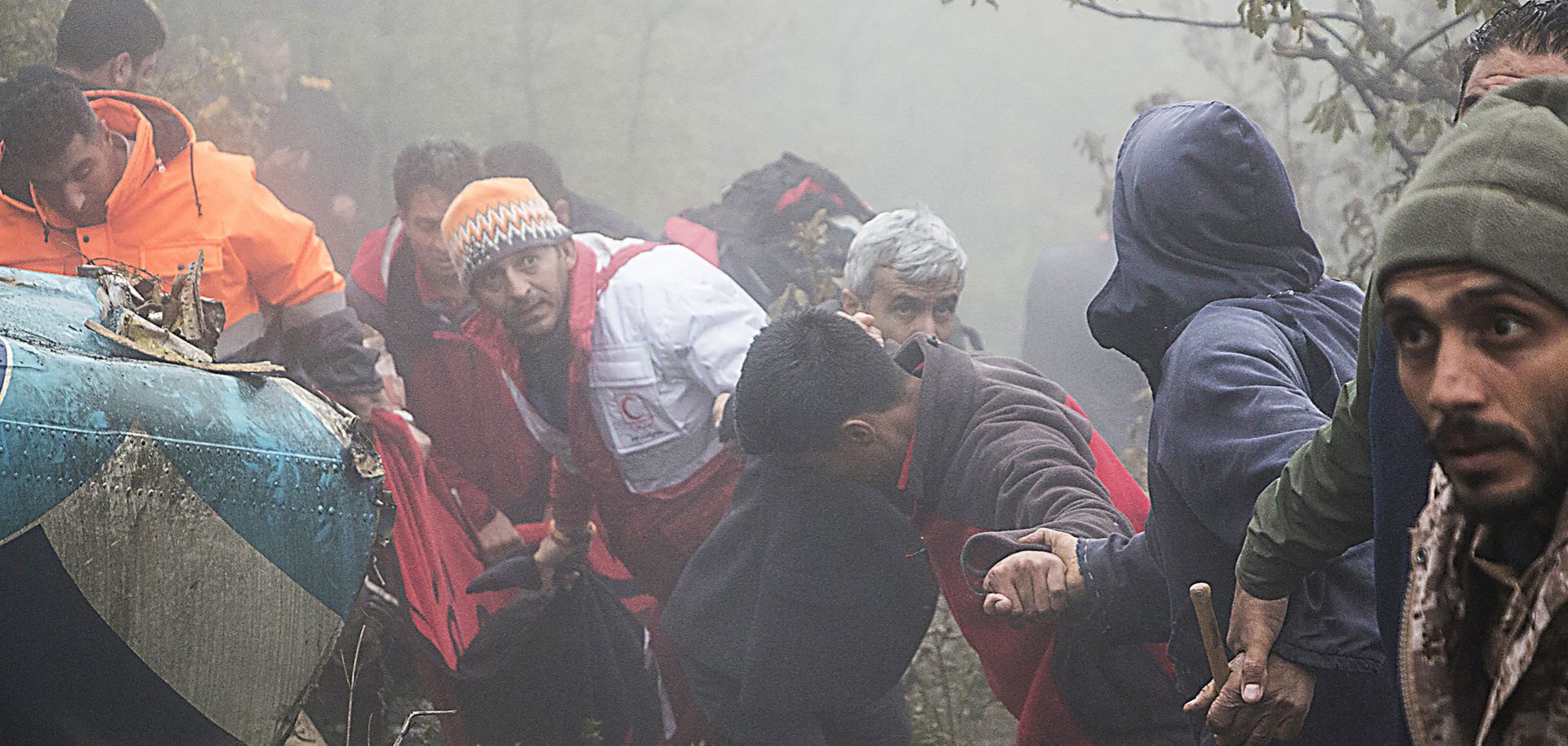
The death of the Iranian president will not significantly impact Iran's regional strategy, but will increase uncertainty surrounding the country's looming supreme leader succession — something that could result in a more durable hard-line domestic and foreign policy shift. Iranian President Ebrahim Raisi was killed May 19 when a helicopter carrying him and eight other people crashed in Iran's remote northwestern East Azerbaijan province in what strongly appears to have been an accident amid bad weather. Iranian Foreign Minister Hossein Amirabdollahian also died in the incident. Iran's Supreme Leader Ali Khamenei announced on May 20 five days of mourning following Raisi's death and appointed First Vice President Mohammad Mokhber acting president. Under the Iranian Constitution, Mokhber will organize a new presidential election within 50 days. Deputy Foreign Minister Ali Bagheri Kani, who had previously led negotiations with the West over Iran's nuclear program, was appointed acting foreign minister.
- A spokesman for Iran's Guardian Council, the 12-member body that oversees the election process and the approval and disqualification of election candidates, said that the winner of the upcoming presidential election will serve a full four-year term. Raisi's first term in office had been due to end in 2025.
- Mokhber is a regime insider with close ties to Khamenei and the Islamic Revolutionary Guard Corps. Prior to becoming first president in 2021, Mokhber headed the Execution of Imam Khomeini's Order, aka Setad, a parastatal conglomerate with total holdings worth tens of billions of dollars. Prior to his work at Setad, he served as deputy of the IRGC-linked Mostazafan Foundation, another conglomerate with tens of billions of dollars in holdings. During the 1980s, Mokhber served as a medic in the IRGC.
Raisi's death will negligibly impact domestic or foreign policy, as his successor will be another conservative regime insider. In Iran's political system, the president has limited power, particularly with regard to foreign policy, as the Supreme Leader and the Supreme National Security Council — a 23-seat body that includes appointments by both the president and supreme leader — drives the country's national security strategy and foreign policy. Even with these limitations in mind, Raisi was arguably Iran's least consequential president in the last four decades. A conservative regime insider close to Khamenei, he declined to press for significant changes in Iran's domestic or foreign policies in contrast to his immediate predecessors, Hassan Rouhani, who negotiated the Joint Comprehensive Plan of Action, with the West, and Mahmoud Ahmadinejad, who sought to operate as independently as possible from the supreme leader. Iran's Guardian Council has already increasingly stacked the deck in Iran's conservatives' favor, disqualifying most reformists from running in recent elections and even disqualifying highly respected regime insider moderates like Rouhani who was barred from this year's Assembly of Experts election in March. The Guardian Council will control the election process even more tightly than usual, ensuring the elevation of another conservative figure who shares the same view of regional national security held by Raisi.
- Although unlikely, should Iran seek to boost the legitimacy of the elections through higher turnout, it could allow for moderate or moderate-leaning conservatives like Rouhani or long-time Speaker Ali Larijani to run.
Despite the minimal impact on policy, Raisi's death raises questions about Khamenei's succession and is likely to deepen infighting within the regime. Khamenei, who is 85, hand-picked and groomed Raisi to become president and perhaps even supreme leader. His death creates a void at the upper echelons of Iran's political elite that Khamenei and Iran's political elite — even if all adhere to a similar brand of ultrahard-line conservatism — will fight to fill. For Iran's hard-liners, this election will be crucial, as whoever wins will likely oversee the transition from Khamenei to a new supreme leader. While it is early to speculate regarding Khamenei's replacement, the ambitious Parliamentary Speaker Mohammad Bagher Ghalibaf — who withdrew from elections in 2017 and 2021 in favor of Raisi — had reportedly been gearing up to challenge Raisi in the 2025 elections. Ghalibaf himself, however, has been embroiled in a leadership challenge in parliament in the wake of March's parliamentary elections. That vote saw Ghalibaf fall to fourth in the Tehran constituency, behind three ultrahard-line conservative politicians from Iran's Steadfast Front who wanted to push him out as speaker. The trio ahead of him included Hamid Rasaee, who has publicly criticized Ghalibaf. Mojtaba Khamenei, Ali Khamenei's son, is another leading contender due to his own religious credentials and the view that he would largely represent strong policy continuity with his father. Mojtaba's selection, however, would trigger concerns about the Islamic Republic becoming a hereditary system despite Ayatollah Ruhollah Khomeini's criticism of the Pahlavi dynasty and having called monarchical systems ''sinister'' and ''evil.'' Ali Reza Arafi is also seen as a potential candidate.
Raisi's death increases the possibility that Khamenei's successor will be weak, which would open the door to a greater role of the hard-line IRCC in Iran's national security strategy. Raisi was the only figure in Iran who had overseen multiple branches of the government — e.g., the presidency and the judiciary — in a way that would have given him significant political strength in his own right as supreme leader. His death makes it far more likely that Khamenei's successor will be relatively weak, enabling the IRGC — which will likely play an influential role in the succession process — to exert even more control over Iran's national security strategy once Khamenei dies. While Khamenei is viewed as an ultraconservative leader, he has on many occasions intervened against Iran's hard-liner camp to support more moderate or moderate-leaning conservatives against hard-liner criticism, most notably when he backed Rouhani's rise to the presidency in 2013 and embraced negotiations with the United States over Iran's nuclear program. A politically weaker supreme leader would not enjoy the same gravitas that would permit such a bold move, which would reinforce Iran's shift in the last seven years to a more aggressive regional foreign policy increasingly driven by the IRGC. The latter's leadership is far more comfortable with worsening relations with the West and aggressively supporting regional militant groups' operations against Israel and the United States.
