
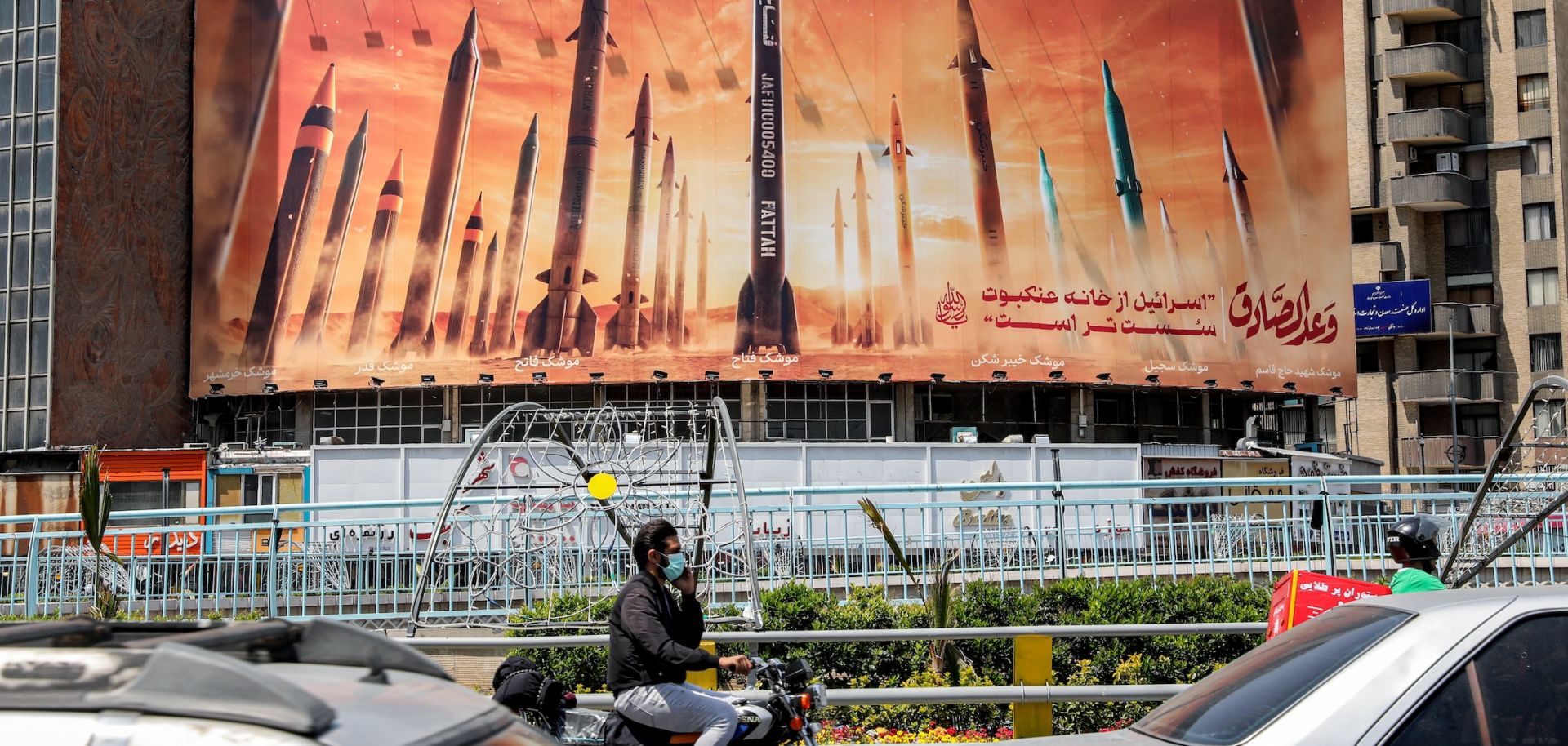
Iran's attack against Israel and Israel's possible retaliation will increase the likelihood that Tehran will accelerate the development of nuclear weapons, which in turn would launch a regionwide nuclear race. As Israel's war Cabinet discusses options for responding to Iran's April 13 attack, it will consider an overt military strike on Iranian nuclear facilities designed to disrupt Iran's nuclear program either as a standalone option or as a target within a broader strike against Iran's drone and missile program. Since Hamas' Oct. 7 attack on Israel, the status of Iran's nuclear program has receded in importance for the United States and Israel as Israel's quest to dismantle Hamas and the U.S. push to limit Houthi attacks on commercial shipping have risen in importance. Perhaps in an attempt to reduce the risk of regional escalation that could provoke a war, Iran slowed enrichment amid the crisis between Tehran and Washington after the Jan. 28 Iranian-backed Iraqi militia attack in Jordan that killed three Americans. Nevertheless, Iran's stockpiling of enriched uranium continues to rise. In its latest quarterly report on the status of Iran's nuclear program, the International Atomic Energy Agency found as of Feb. 10 that Iran had 5,525.5 kilograms of total enriched uranium, including about 123.5 kilograms of uranium enriched up to 60%. This gives Iran enough fissile material for three nuclear bombs, though it would need to further enrich its uranium to 90% weapons-grade and develop a weapon. The Israeli government, and particularly Prime Minister Benjamin Netanyahu, views the prospect of an Iranian nuclear weapon as an existential threat given Israel's small geographic size and the concentration of its population in a few large cities.
- On April 13, Iran and its allies launched 160 drones, 30 cruise missiles (none of which entered Israeli territory) and at least 110 ballistic missiles, a few of which reached Israel, according to the Israel Defense Forces. Israel and a cohort of its partners including France, Jordan, the United Kingdom and the United States shot down more than 99% of the drones and missiles fired at Israel.
- Israel's three-person war Cabinet has not made a decision on a response. It is reportedly leaning toward some form of retaliation, though its members disagree over the timing and scale of retaliation. Meanwhile, U.S. President Joe Biden quickly spoke to Netanyahu after Iran's strike, saying the United States would not participate in an offensive strike on Iranian territory and cautioning the Israeli prime minister to avoid escalation. Other Western leaders have made similar calls upon Israel.
Iran's decision to directly attack Israel for the first time will increase Israel's focus on Iran's nuclear program. Through the attack, Tehran demonstrated that it was willing to risk a full-blown military confrontation with Israel and the United States by carrying out an overt military strike on Israeli soil. Even though the strike failed to achieve its tactical objectives of inflicting severe damage, it breached existing rules of engagement that only Iran's proxies would directly target Israel. Iran's actions showed Israel a newly increased risk tolerance that could later extend to Tehran's nuclear program, giving Israel's war Cabinet greater incentive to disrupt the program. Moreover, Iran's inability to inflict damage on Israel using conventional weapons (e.g., drones and missiles) may lead Israeli leaders to conclude that Iran's threat via missiles is more limited than realized. If Israel's leaders more strongly believe they can withstand an Iranian conventional military response, they might become more likely to consider military action against Iran's nuclear, drone and missile programs even after the current crisis resolves.
- Roughly half of the Iranian ballistic missiles either failed to launch or crashed before reaching their target, according to U.S. officials.
Israel's attack on Iran's consular building in Damascus, Israel's potential military response to Iran's strike on Israel and Iran's failure to get past Israel's air defense systems — and those of its foreign supporters — give Iran a greater incentive to accelerate its nuclear program and eventually develop a weapon. Iranian military strategists will likely assess that Iran's ability to respond to Israeli action is somewhat limited due to the failure to inflict damage on Israel, even if Iranian leaders publicly say they achieved their objective. Still, the operation may not have been a total failure in that Iran may learn more about Israel's defense system capabilities from information collected during the attack. Many of Iran's missiles reportedly failed to launch, demonstrating limitations to Iran's much-vaunted missile capacity, at least with regard to the systems fired at Israel. If Israel follows up with its own overt military strike on Iranian soil, the perception in Tehran that Iran has only limited deterrence against Israeli attacks other than its proxies will increase, and direct strikes on each other will become normalized. In this scenario, Tehran will likely realize that it will be easier for future Israeli leaders to greenlight follow-up military strikes on Iranian missile, drone and nuclear facilities. This will reinforce Tehran's drive to reestablish stronger deterrence, including through nuclear weapons, though possession of nuclear weapons offers only limited deterrence to conventional military action. An Israeli strike on Iranian soil might also force Tehran to respond with its own follow-up action. Tehran will likely continue to avoid a broader regional war, which would threaten regime stability. Should Iran still wish to escalate against Israel and the United States without triggering a cycle of tit-for-tat strikes or open warfare, escalating its nuclear program such as boosting its uranium enrichment is an option.
- In the past, Iran has demonstrated a willingness to respond to Israeli (and U.S.) provocations by enriching uranium to higher levels and stockpiling more uranium. Indeed, Iran responded to the 2020 suspected Israeli assassination of nuclear physicist Mohsen Fakhrizadeh by resuming enriching uranium to 20% U-235, and responded to a 2021 suspected Israeli attack on the Natanz nuclear facility by enriching uranium to 60% U-235.
- The failure to inflict damage on Israel also reinforces Iran's willingness to support allied militias in Iraq, Syria and elsewhere. Iran's drones, which are notoriously slow and loud, had to travel hundreds of miles to reach Iranian territory, leaving them highly exposed to aircraft and other defense platforms. Drones fired by Iranian proxies closer to Iraq would not need to travel as far, making them more likely to make it to Israel and at least tax Israel's layered aerial defense systems. Transferring more advanced drones, ballistic and cruise missiles to these proxies would achieve the same end. By the same token, such transfers would expose Iran's arsenal to more Israeli preemptive airstrikes, as Israel has demonstrated a high willingness to carry out frequent airstrikes on Iran's missile, rocket and drone supply chain to proxies near Israel.
Any Iranian acceleration of its nuclear program, and especially Iran's development of nuclear weapons, would reverberate across the Middle East. It would increase the risk of future conflict, particularly as Iran has demonstrated it will strike Israeli soil and Israel may soon do the same to Iran. In addition to leading Israel to quickly declare itself a nuclear power, Iran's development of nuclear weapons would lead Saudi Arabia and Turkey to consider developing their own nuclear capabilities. This is particularly true of Saudi Arabia, which unlike Turkey is not under NATO's nuclear umbrella. As the United States is likely to oppose Saudi Arabia's development of its own nuclear arsenal, Riyadh may instead push for the United States to bring the country — and the rest of the Gulf Cooperation Council — under the U.S. nuclear umbrella, and may be forced to accept normalization with Israel in return. Iran's development of nuclear weapons would also make it virtually impossible for the United States and Iran to resume nuclear negotiations or any other path designed to reduce tension between the two barring regime change in Iran. Any Iranian pursuit of nuclear weapons would also alienate China, which may respond prior to the development of weapons by siding more closely with the United States against Iran and its supporter, Russia, on the matter. Beijing could even become more willing to stop circumventing U.S. sanctions on Iranian oil exports to pressure Tehran to change course. A win by former U.S. President Donald Trump in the 2024 U.S. presidential elections would also have major implications for how events unfold should Iran accelerate its nuclear program. While Trump is likely to try to avoid a war with Iran, his close relationship with Israel during his first term may give Netanyahu enough confidence to strike Iran's nuclear program. A new Trump administration could also prove more willing than a Biden administration to authorize a U.S. strike against Iran during a period of escalation, such as one involving more U.S. deaths in Iraq.
- Although it has not declared itself a nuclear power, Israel is broadly understood to possess nuclear weapons. Should Iran develop a weapon, Israel is likely to declare itself a nuclear power to eliminate any ambiguity about its deterrence capabilities.
- Trump demonstrated a high risk tolerance as president when he greenlighted the 2020 U.S. assassination of Gen. Qassem Soleimani, the long-time head of the Islamic Revolutionary Guard Corps Quds Force.
- China joined the United States in backing sanctions on Iran between 2006-13 in connection to Iran's nuclear program. China likely does not want to see another global nuclear power, particularly one in the Middle East that would lead to nuclear proliferation risks in the part of the world China depends on for oil and natural gas imports. A nuclear Iran would also complicate China's strategy in Central Asia, as it would introduce four nuclear powers directly bordering the region: Pakistan, China, Russia and Iran.
