
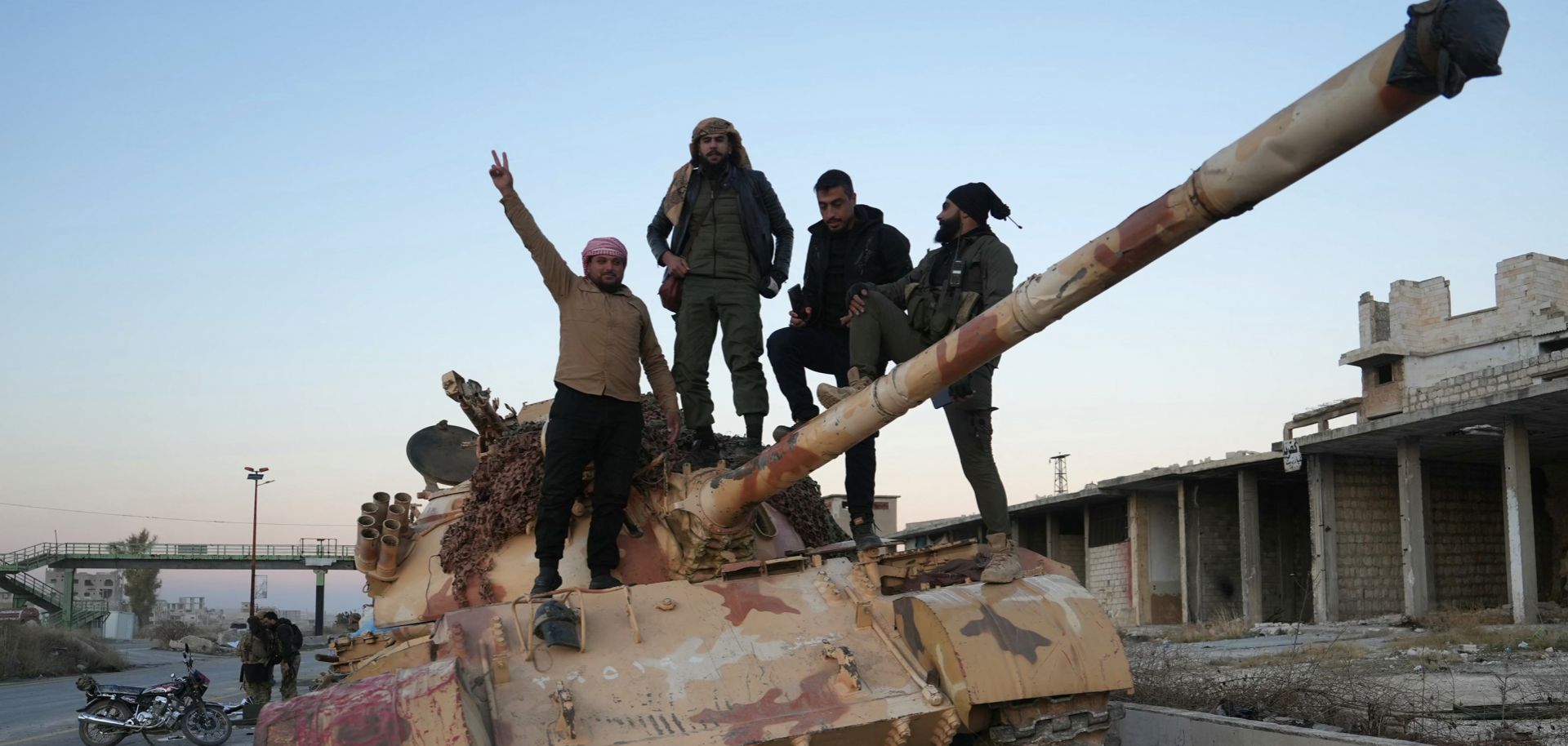
Rapid rebel advances in northern Syria will expand the civil war into further factionalism, threaten Iranian supply lines to Lebanon, and eventually destabilize the Syrian government by exacerbating its economic and security challenges. On Nov. 30, the Syrian rebel group Hayat Tahrir al-Sham claimed control of Syria's second-largest city, Aleppo, in a lightning advance against Syrian government forces. The insurgents and other associated militias continued their advance southward toward the Syrian city of Hama while also consolidating control of much of northern Syria, including taking territories previously held by Kurdish forces as part of the Syrian Democratic Forces. By Dec. 2, Syrian forces had dug in around Hama in an attempt to halt further rebel advances. Meanwhile, Russia increased the scale of its air campaign against Hayat Tahrir al-Sham fighters now entrenched in Aleppo. Fighting also broke out elsewhere in the country, including in Damascus and Suwayda, though as of Dec. 2, no territory appeared to have changed hands in these southern regions. The Syrian government vowed to hold its ground and called on its Russian and Iranian to step in and ensure the Syrian Arab Army could maintain security.
- Syrian rebels attempted to take control of Aleppo from 2012 until 2016, when a Russian military intervention helped turn the tide of the long-running battle there. Rebel forces were expelled in 2016 to Idlib province and, until recently, had failed to re-threaten Aleppo, which was seen as the Syrian government's and its foreign backers' largest military accomplishment.
- Hayat Tahrir al-Sham is an al Qaeda offshoot that has rebranded itself as a comparatively moderate jihadist outfit seeking to establish an Islamist state to replace the current government of Syrian President Bashar al-Assad. The Syrian rebel group is considered a terrorist organization by the United States and many regional powers.
- Despite controlling Idlib province for years, Hayat Tahrir al-Sham had previously appeared to be largely in a passive position. The rebel group has enjoyed the protection of Turkey's military, which sees Idlib as critical for hosting up to a million Syrian refugees who may otherwise seek to flee to Turkey or Europe instead.
The Evolution of Syria's Civil War
Syria's Arab Spring uprising in 2011 quickly transformed into a civil war after the government began brutally cracking down on protesters. Rebel forces were organized under the umbrella of the Free Syrian Army but were often led by local warlords rather than a unified command. This lack of unity was what largely enabled the Syrian government to steadily retake lost territory in Damascus suburbs, southern Syria, and central and northern regions, particularly after the Russian intervention of 2015. The last major military campaign occurred in February 2020, as Syrian government forces, backed by Russia and Iran, attacked Idlib province, then held by Hayat Tahrir al-Sham and Turkey. This campaign inflicted significant casualties on Syrian forces but eroded rebel control of the province. Since then, the conflict has been at a stalemate, with intermittent Russian air raids and rebel attacks across the Idlib frontier.
Hayat Tahrir al-Sham appears to have taken advantage of the Syrian government's weakness following years of economic crisis, internal strife, and weakening support from Russia and Iran. Before the recent assault, the al-Assad regime's strategy in Idlib focused on weaponizing aid and containing rebel forces to weaken their independence and force negotiations leading to surrender after the 2020 campaign. However, Hayat Tahrir al-Sham and its associated rebels, likely with Turkish backing, seem to have concluded that the government was in a weakened position after years of economic crisis and waning support from its foreign backers Russia and Iran, with the former redeploying forces from Syria to Ukraine and the latter becoming embroiled in the fallout from the Israel-Hamas war. Though the exact number is unknown, estimates suggest 15,000 to 20,000 militants are currently operating in northern Syria — a figure still dwarfed by the Syrian government's conventional military forces, which remain in the tens of thousands despite over 15 years of civil war, and which suggests that Syria's reorganized army is not functioning at full force given how the outnumbered rebels were able to advance so quickly. Indeed, the rapid dissolution of government forces around Aleppo likely resulted from operational complacency, Hayat Tahrir al-Sham's superior intelligence, and Russia and Iran's drawdown of forces amid the two countries' focus on other major crises.
- Hayat Tahrir al-Sham and associated militants, like the Syrian National Army, are irregular forces with captured Syrian government equipment and some armored vehicles supplied by Turkey. In the past, they struggled to hold ground against determined Syrian and foreign attacks due to this equipment disadvantage. This suggests that Hayat Tahrir al-Sham exploited unique weak points in the Syrian military's positioning for the rebels' rapid advance.
The fall of Aleppo and further rebel advances in southern Syria will threaten Iran's supply lines to Hezbollah in neighboring Lebanon and complicate Tehran's greater regional strategy. While routes running through Damascus remain operational, Aleppo's proximity to Lebanon and its international airport have made it a key corridor for Iran to resupply Hezbollah. But with Aleppo now under rebel control, Iran will need to reroute supplies further south, likely along the Euphrates River and through areas infiltrated by Islamic State militants in Syria, to avoid rebel-held territories. Hama, sitting on the vital M5 highway linking Turkey to Jordan, will become critical for maintaining these supply routes. If Hama also falls, Iran's ability to resupply Hezbollah will face further challenges. Meanwhile, insurgents led by Hayat Tahrir al-Sham will also slowly push along the Euphrates Rivers, threatening other key routes like Deir Ez Zour and, in a more distant campaign, the key Iraqi-Syrian city of Al Bukamala, where Iran stores weapons and uses as a major supply hub.
- On Nov. 27, Israel and Hezbollah agreed to a 60-day cease-fire after 13 months of fighting. Iran is eager to rebuild its Lebanese proxy after over a year of brutal combat, but Tehran relies on air and overland routes through Syria to do so.
- The Islamic State, which continues to operate underground cells in Euphrates towns and the Syrian desert, remains hostile to Iran and has attacked its forces in the region.
Hayat Tahrir al-Sham's resurgence may eventually lead to clashes with U.S.-backed Kurdish troops for control of northeastern Syria. The Kurdish-dominated Syrian Democratic Forces, backed by the United States as a legacy of its campaign against the Islamic State, has largely withdrawn from territories being taken by Hayat Tahrir al-Sham and other Turkish-backed rebel groups in the northwest, like the city of Tal Rifaat. However, the Syrian Democratic Forces will likely hold its line near the Euphrates River and in Kurdish-majority towns, which could lead to clashes with Hayat Tahrir al-Sham and its affiliates as they advance along the Euphrates River valley, and as Turkey pushes the insurgents to strike positions held by the Syrian Democratic Forces. For the Syrian Democratic Forces, such clashes would distract from its campaign against the Islamic State and push it closer to the Syrian government, which has pledged to protect the Kurdish-dominated alliance from Turkish invasion, while also potentially pulling the U.S. forces still stationed in northeastern Syria into combat with pro-Turkey rebels.
- Turkey will likely continue pushing for operations against the Syrian Democratic Forces as part of its broader strategy to undermine Kurdish autonomy, which Turkey fears could inspire Kurdish uprisings within its own borders. Turkey has long sought to dismantle the Syrian Democratic Forces and establish a buffer zone in northern Syria to prevent Kurdish fighters from launching cross-border attacks into Turkey.
- The Syrian government largely abandoned the northeast in 2011-2012, ceding control to Kurdish militias that sought autonomy rather than overthrowing al-Assad.
- The Syrian Democratic Forces have clashed with Turkish forces and Hayat Tahrir al-Sham rebels in the past. Then-U.S. President Donald Trump's move to suddenly withdraw American troops from Syria in October 2019 prompted Turkey to invade territories held by the Syrian Democratic Forces, under the belief the group no longer had U.S. protection. While that withdrawal was ultimately abandoned by Trump, there are emerging signs Trump will again try to pull out of Syria after he returns to the White House in January.
The loss of Aleppo will serve a significant political, security and economic blow to the Syrian government and could eventually lead to its unraveling. Many of the Syrian government's military units are undermanned, under-equipped, or assigned to internal security rather than frontline combat. With this limited manpower, the al-Assad regime will not be able to quickly retake Aleppo, especially as the rebels begin to entrench themselves in the city of 2 million people. With the government focused on maintaining security behind the front lines and preventing further militant infiltration, Hayat Tahrir al-Sham and allied militants will likely establish governance and security structures in Aleppo to solidify their control as they set up a rival government and prepare for long-term campaigns to seize government-controlled territory in the rest of the country. Losing Aleppo, a commercial hub, will be a major economic setback for the Syrian government, depriving it of critical tax revenue and trade. This will deepen the economic crisis in loyalist-held territories, while weakening the loyalty of warlords and military units. Additionally, losing Syria's second-largest city in such a sudden defeat will be a political legitimacy crisis for both the Syrian military and President al-Assad. Al-Assad has built his political strategy on surviving the civil war and projecting eventual victory, but this loss will undermine confidence in his leadership and inspire possible internal challengers. As a result of this pressure, the al-Assad clique at the center of government may decide to open negotiations with rebel groups to stabilize the frontlines and earn Western sanctions relief, turning to a reconciliation process to save their government. But given their past history, the president and his inner circle are more likely to resort to repression against internal challengers, which would further demoralize key supporters, create internal splits, and might eventually result in deepened factionalism in the Syrian government that leads to its dissolution.
- Syria is grappling with a severe economic crisis caused by the civil war and Western sanctions. The World Bank estimates that 27% of the population now lives in extreme poverty, up from negligible levels before the war in 2009. The United Nations estimates rebuilding the country could cost up to $500 billion. Losing Aleppo, a key economic center, will exacerbate this crisis for loyalist territories.
- Many of Syria's political and military elites remain loyal to President al-Assad due to familial and economic ties, but the loss of Aleppo may strain these relationships, particularly as economic hardships worsen.
- Other regional autocrats have faced similar downfalls after failing to win the peace. For example, Sudan's former authoritarian leader Omar al-Bashir was overthrown in 2019 despite surviving multiple civil wars and rebellions, as insiders grew tired of the international isolation he brought upon the country.
