
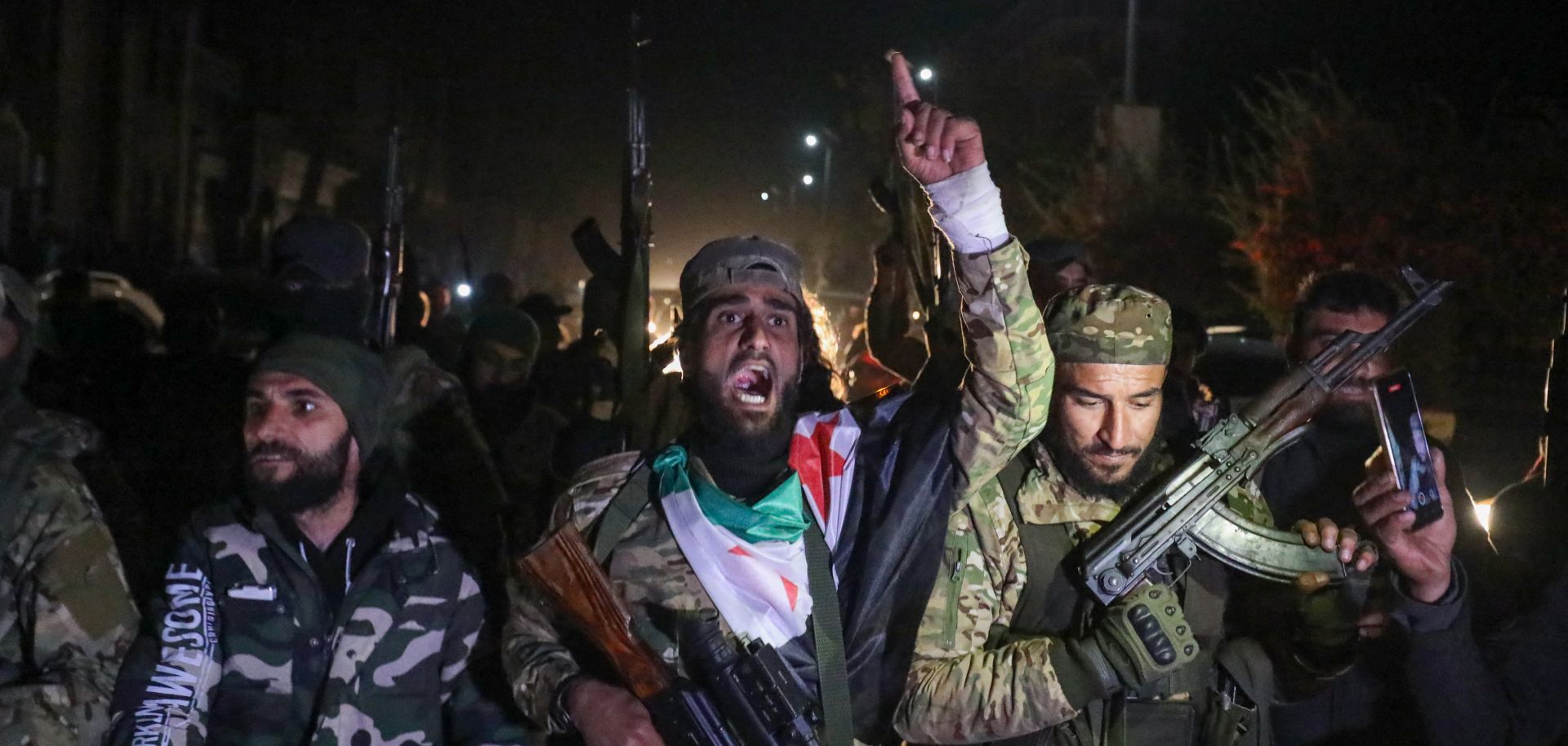
Slowly and then all at once. That was the take I saw again and again on what happened with the rapid collapse of Bashar al Assad's regime in Syria. In a stunning 12-day campaign, the Syrian government almost uniformly surrendered its positions and dissolved itself. At the end of a nearly 14-year-long civil war that saw at least half a million people killed and up to half the Syrian population displaced, including some 6 million who had to flee to Turkey and Europe, the collapse of the Assad regime has upended the regional strategies of virtually every major power in the Middle East and beyond, requiring rapid strategic adjustments for each of these countries. But how they adjust will not be entirely theirs to decide: Syria, the geopolitical proving ground for so many of these powers, may be hobbled and damaged, but it still gets a vote in its destiny.
Shocked and Awed
After the Hamas attack on Israel on Oct. 7, 2023, our team of analysts quickly concluded that the Syrian government was in no position to join the multi-front assault on Israel as part of Iran's so-called Axis of Resistance. That had largely to do with the fact that the Syrian military had been hollowed out by over a decade of civil war, corruption and increasingly rusted Soviet-era equipment. We concluded that if Assad had joined the war against Israel, Israel could have conducted enough counter-strikes on Syria to overcome the stalemate within the country's then-frozen civil war.
And so, to an extent, it is not surprising that the Syrian Arab Army (SAA) rapidly dissolved in the face of a numerically smaller and under-equipped rebel force like Hayat Tahir as-Shams (HTS). Nevertheless, the rapid dissolution — a mere 12 days — was stunning.
When rebel movements were detected in Syria's Idlib province, it appeared to be yet another phase of the civil war that might see HTS push back the frontier toward Idlib's provincial borders against sustained Syrian and eventually Iranian and Russian resistance. We had seen this dynamic multiple times before, including most recently in February 2020, when Syria, backed by Russia and Iran, had managed to claw a few bloody square miles from HTS and Turkey. We did not expect that HTS could simply waltz over these defensive positions into Syria's second-largest city of Aleppo in two days. We knew that the Syrian military was weak, but we had no idea that its morale had essentially evaporated and that the Syrian government's willingness to resist had, for reasons not yet clear, completely collapsed.
To gauge whether Aleppo had been a fluke born of bad leadership and temporary weakness, we then looked southward to see if Hama, another critical Syrian city, could also fall. In this, we wondered whether Aleppo's fall was another version of the Islamic State's blitz into northern Iraq and rapid seizure of Mosul, despite the city being defended by so many. If so, Aleppo's capture would mark a failure by local government commanders to keep HTS from infiltrating the city, but it would not necessarily presage a total national collapse. In other words, we assessed that the Assad government would eventually hold Hama, a city large enough to fortify and hold out against HTS's few thousand fighters. Iranian and Russian reinforcements could then surge in and begin the slow, painful crawl back toward the north to an inevitable bloody siege of Aleppo.
But that, of course, did not happen. Even with the clear shock of the loss of Aleppo, the Syrian government could find neither the manpower nor political will to hold onto Hama; the city fell on Dec. 5. Assad did not appear on television to rally the nation to another phase of civil war against the ever-feared jihadists. Syrian state media denied that any of this was happening at all. SAA simply gave up their positions, dropped their weapons and fled.
After the scorched earth campaign, the Syrian government could find no one to hold its torches. We still don't know exactly what led to this paralysis, though it likely came from the top of Assad's highly centralized regime. Did Assad give up after Aleppo fell? Or before? It will be time before we know. The final outcome, however, is clear.
Syria and Its Troubled Neighborhood Models
Syria is now in the midst of a political and strategic transition, the direction of which will affect all the countries within the region that have stakes in the war-torn nation, as well as the extra-regional powers like the United States and Russia that continue to see Syria as a place where they have vital interests. We know about the transitions of other post-Arab Spring states, none of which have emerged into liberal democracies. Some countries reverted to authoritarianism, like Tunisia and Egypt. Others split into civil wars, like Yemen and Libya. And other regional models, like Iraq and Lebanon, developed into frail, if unstable, political systems in which non-state actors and individual political parties and factions are sometimes stronger than the state itself.
This will not be a smooth journey, and won't cleanly follow the experiences of other countries; Syria will be Syria, after all. Syria lacks a civil society that would give it a class of bureaucrats, officials and politicians capable of stage-managing a relatively smooth and peaceful transfer of power from dictatorship to democracy. This is an important distinction in understanding the revolutionary behavior of states. For example, the Eastern European and Soviet countries in the Warsaw Pact had vital, if suppressed, civil societies able to quickly replace the Communist regimes as they fell in the late 1980s; by contrast, countries in post-colonial Africa were deliberately or implicitly denied such civil societies, making independence and revolution much more unstable and susceptible to factionalism and violence.
Syria's civil society never was able to develop due to dictatorship and then the civil war. Therefore, its new officials, like HTS leader Abu Mohammed al-Jolani, are more or less learning as they go. They will inevitably make policy mistakes due to inexperience, but their agency as individuals and leaders is also important: if their overall intent is toward centralization and authoritarianism with an ideological goal in mind, this increases the likelihood of future violence and another phase of the civil war.
As these local actors decide how they will govern a multi-ethnic and geographically diverse country like Syria in the post-Assad era, another driver of instability will be that of foreign actors.
Israel's Aims to Defang Post-Assad Syria
In the wake of Assad's fall, the Israelis have already asserted themselves in Syria, where they are attempting to destroy the capabilities of the remnants of the Syrian military and establish territorial control that would grant Israel a buffer zone should a hostile government emerge from Syria's post-war political transition. As a result, the Israelis are unlikely to remain purely security-focused and will eventually develop a political angle in their approach to Syria's post-war political transition. To prevent the rise of a hostile state along its northern border, Israel may back factions like the Derra Military Council in southern Syria, which Israel implicitly cooperated with during the Syrian civil war. The Israelis may also reach out to other local factions, like U.S.-backed Kurdish forces under the Syrian Democratic Forces (SDF) in the far northeast, in part because of Israel's relatively warm relations with Iraqi Kurdistan and with Kurds in general, whom Israel sees as pragmatic partners to counterbalance Islamists and Iranian power.
But this strategy will have limits. Israel has a poor track record of building up effective proxies, with its biggest proxy project, the Southern Lebanese Army, collapsing almost as soon as Israel withdrew from Lebanon in 2000. Israel will become a greater player in Syria's post-war transition, but whether that is expressed through military force, diplomatic statecraft or covert action will hinge on political developments within Damascus.
Turkey Tries to Return Refugees, Prevent a Kurdish State
Turkey also has its own plans for Syria. It wants the country stable enough that it can send back the 3.5 million Syrian refugees in Turkey who have become a notable political problem for the government. It also wants to prevent the emergence of a Kurdish state on its border.
These two goals are contradictory in a certain sense. On the one hand, Turkey has every incentive to back a stable and predictable political transition in Damascus that allows the government to create the security conditions to effectively return refugees. But on the other hand, such a transition implies that it will have to allow representation for the Kurds in the northeast in such a way that the Kurds may develop the very autonomy that Turkey opposes. While improbable, a deal between the Kurds and Damascus that assuages Turkey's concerns (e.g., by granting Kurds cultural and social rights but not security ones) is not impossible. Nevertheless, Turkey will favor disorder in Syria over an order that overtly favors the Kurds, even if this comes at the expense of being able to rapidly return refugees to their homeland.
America, the Bystander
The United States will remain involved in Syria for at least until U.S. President-elect Donald Trump retakes power in January. Trump seems likely to attempt another troop withdrawal from Syria, though events on the ground may strain his commitment to this task, namely the resurgence of militant groups like the Islamic State, which Trump claimed to defeat during his first term. So long as the United States retains a presence in Syria, its local ally, the Syrian Democratic Forces, will have a counterweight to Turkey. And this counterweight might encourage Turkey to accept a less-than-perfect deal between the Kurds and Damascus that produces a more unified and coherent Syrian state. But if Turkey believes the United States is on its way out, Ankara is more likely to try to sabotage such reconciliation efforts and encourage Damascus to take hard lines towards Kurdish autonomy.
The United States is unlikely to develop a coherent and long-term strategy for Syria, given both its marginal importance to American politics and its relatively minor importance to Washington's overall strategy in the Middle East, which is increasingly focused on narrow U.S. security, trade and energy interests, rather than defeating terrorists or reframing the balance of power in the region to favor the United States and its allies. As a result, it seems likely that while the United States may focus on a handful of counterterrorism campaigns in Syria, it will await political decisions in Washington in deciding whether to leave the country.
For the Defeated, Adaptation
After backing the Assad regime for years, Iran and Russia are now facing significant strategic setbacks that will force them to adapt their Syria strategies to the new reality on the ground.
Iran is already showing some pragmatism by dropping its accusation that the HTS-led rebellion is fueled entirely by terrorism and has been seeking assurances from Syria's new militant leaders that they will not violate Shiite shrines and holy places in the country. Iran will try to find ways to infiltrate the Syrian political transition process to develop influence that would allow it to informally restore its now-cut land corridor to Hezbollah in Lebanon. This sort of influence will try to make common cause with the transitional government against Israel, which is, after all, now occupying Syrian territory and destroying Syrian military equipment that nominally belongs to the transitional government. But this is likely to run into rebel obstinacy, not only due to Iran's yearslong service as an enforcer of the brutality of the Assad regime but also for strategic rationale. So long as the transitional process is unfolding, Damascus will be too weak to resist Israeli military power and diplomatic and covert influence. Pragmatic post-Assad rebels will point out that Israel will be more than capable of destabilizing the country significantly and assassinating the leadership of the transitional government should they get too close to Iran.
Russia, for its part, will also be looking to salvage what remains of its tattered Syria policy. This could see Russia try to mediate between regime elements and the transitional government going forward. It is also possible that Moscow's hosting of Assad, who arrived in the Russian city on Dec. 8 after fleeing Syria, eventually becomes a factor in Syrian-Russian diplomatic relations going forward, particularly if the new Syrian transitional government makes accountability and justice an essential policy and seeks the extradition of Assad from Russia. In that case, it seems likely that Moscow and the new Syrian leadership will be at loggerheads, and that Russia's influence in the country will diminish if not entirely vanish.
Finally, the United Arab Emirates will likely oppose any transitional government that gives too much power to an Islamist group like HTS, although this opposition won't be purely limited to HTS, as elements like the Muslim Brotherhood will also start to reorganize and reassert themselves in post-Assad Syria. The Emiratis will use cash and potentially diplomatic and covert influence to shape Syria's political transition away from these forces. They will also likely try to build up proxies within Syria itself as informal, non-state counterweights to a centralized government that might be controlled or influenced by such Islamists. A weak and divided Syria will overall serve UAE interests, unless the political trend turns firmly against Islamists. For that matter, in general, the Emiratis are unlikely to favor a successful democratic transition in Syria, regardless, as they oppose political liberalization across the board.
The Agency of the Locals
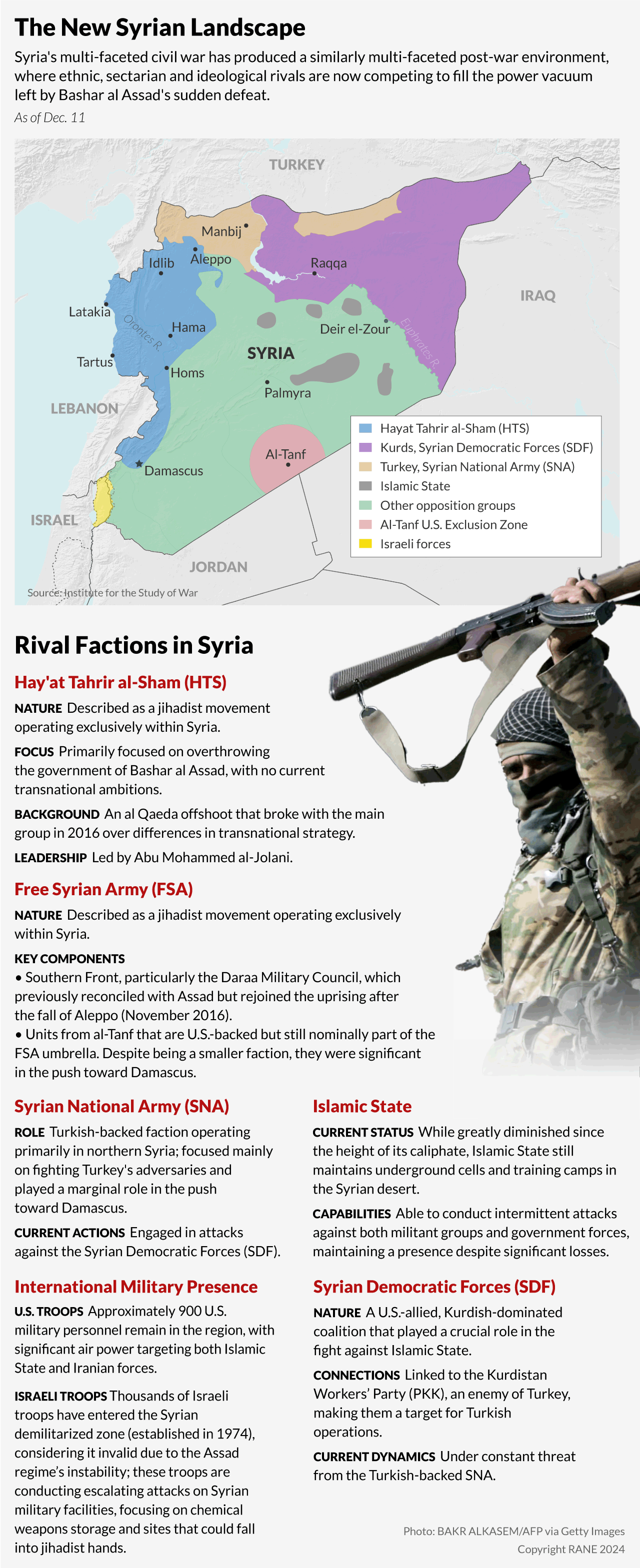
But, of course, all of this relies on the agency of Syrians themselves. HTS, the rebel group that overthrew Assad, is a jihadist outfit, but it has shown remarkable governing pragmatism in Idlib to maintain power. HTS also witnessed what happened to the Islamic State, which picked too many enemies and expanded too quickly to be strategically sustainable. Additionally, HTS is ideologically wedded to the narrative of revolution against the brutal autocrat that was Bashar al Assad; adopting a governing strategy similar to his too quickly would thus likely evaporate the group's currently relatively strong public support.
HTS is not alone, however. The Free Syrian Army's various factions, including those backed by the United States, are formidable military counterweights to HTS fighters. The Syrian Democratic Forces, although under attack by Turkey's proxies, will also remain a notable military check on HTS's attempts to centralize and control the country. And while Assad's Syrian Arab Army may no longer formally exist on paper, its soldiers can still be rapidly reorganized into militias, particularly in Alawite Latakia and more secular locations in the country like Damascus itself.
All of this may point to a future where Syria ends up fractured and split. But given the exhaustion these factions have all experienced after nearly 14 years of civil war, it seems likely that at least in the near term, most will avoid direct and sustained confrontation and will instead try to steer the political process in favor of their interests. It is entirely possible that this process is relatively peaceful compared to the fighting that characterized the civil war itself, but it will certainly not be bloodless, particularly as security vacuums will favor attacks by militants like the Islamic State, Israel could continue its military operations it tries to turn Syria into a front against Hezbollah, and as individuals take revenge against regime officials found wandering the streets of towns and cities across the country.
An Uncertain Future
For Syria, it is possible to see a few futures unfold over the next year. There is that of the unstable political transition, in which the honeymoon period of post-revolutionary Syria is enough to establish a fragile, if workable, consensus that limits the influence of militants and in which foreign powers are, for now, disinterested in fully upending. This would follow the pattern of many Arab states, which had substantial honeymoon periods after the Arab Spring revolutions of 2011, even as they eventually collapsed backward toward the status quo ante.
Then, there is the less optimal outcome, particularly for the West, in which militant groups can radicalize Syrian factions and citizens by conducting attacks and stoking conflict. This is more or less what happened in Iraq, in which regime holdouts and insurgents eventually radicalized the country enough to allow the surge of Islamic State activity in 2014.
And finally, there is the scenario where Syria is informally carved up by foreign powers, with Turkey dominating the north and much of the heartland, Jordan and Arab partners like the United Arab Emirates carving out influence in southern Lebanon and southern Syria, and former regime elements holding out in places like Latakia, where they might still yet allow Russia and Iran to maintain a degree of influence. This, to an extent, would mimic Libya, where multiple rival governments maintain a balance of unsteady power and create uncertainty in a country that is informally split but formally unwilling to admit its division.
At the center of these developments will be the Syrians themselves, who will have the agency to react to foreign machinations in ways that fit their interests. They have all seen the failures of the other post-Arab Spring states, and faction leaders are aware of the foreign interests that would manipulate their political transition. Their lack of experience will leave them without the political acumen to combat these constraints in the near term, but Syrians may yet still establish enough of a consensus to prevent the most unstable outcomes from taking place in the country. In post-Assad Syria, there is little appetite for more open-ended war, but whether there's an appetite for a consensus that would prevent another civil war remains to be seen.
