
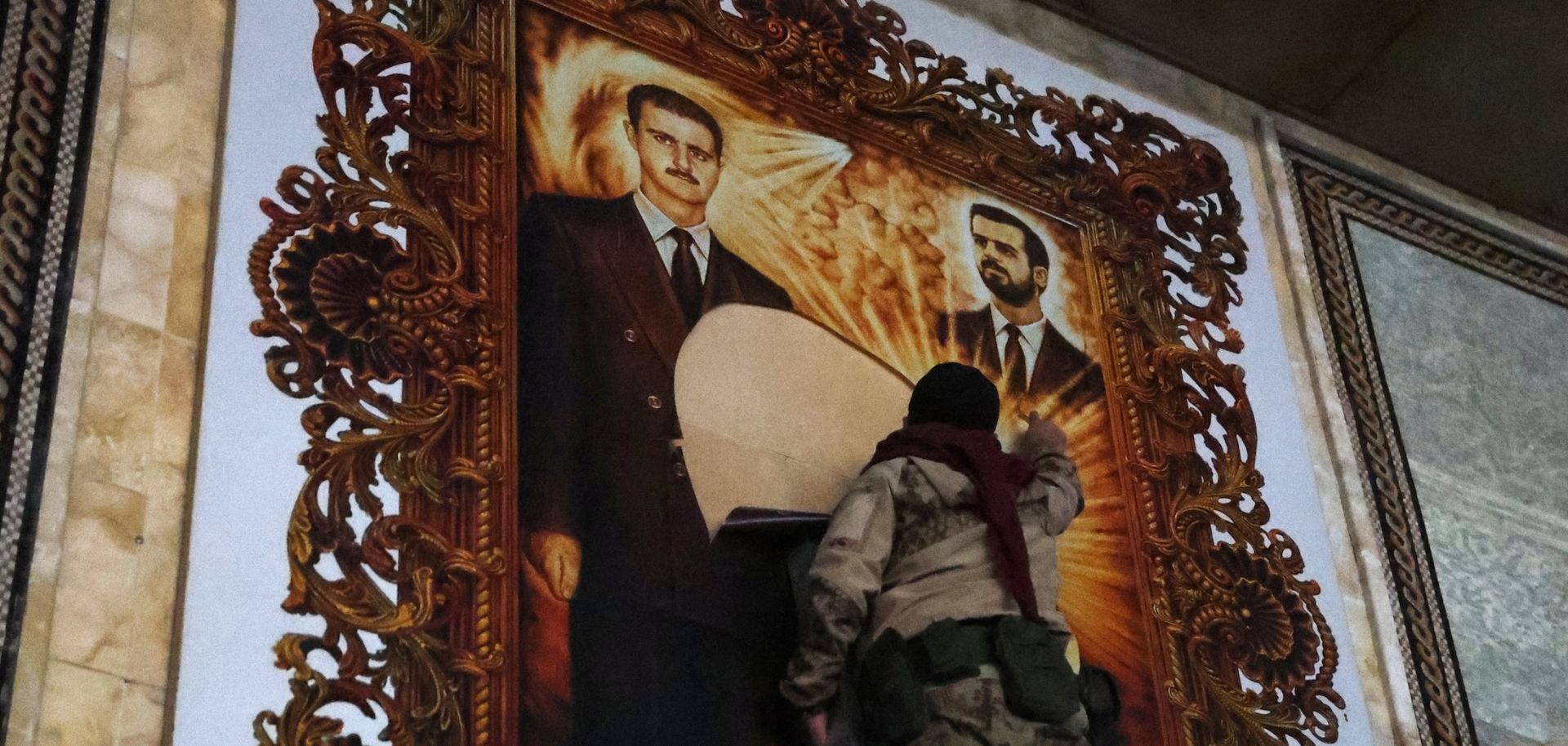
Iran will likely respond pragmatically to the fall of Syrian President Bashar al Assad's regime by seeking talks with the United States and regional allies, but the weakening of its regional proxy network will likely also make Tehran more willing to pursue nuclear weapons to bolster its security. The Dec. 6 fall of the Assad government is the latest major blow to Iran's so-called ''Axis of Resistance'' deterrence strategy against Israel and the United States, following Israel's decimation of Hamas in Gaza and its significant degradation of Hezbollah in Lebanon. The Syrian rebel group Hayat Tahrir al-Sham, or HTS, and its allies' seizure of Syria is particularly problematic for Tehran because it severs the land corridor between Iran and Lebanon, making it far more difficult for Iran to send weapons and fighters to Lebanon to support Hezbollah and help rebuild the Shiite militia's capabilities.
Assad's fall will reinforce Iran's interest in launching nuclear talks with the incoming administration of U.S. President-elect Donald Trump to reduce tensions with the United States in the short term. Iran's response to the weakening of its Axis of Resistance since the Gaza war broke out in October 2023 has so far been pragmatic, and there is little indication this will change following Iran's latest setback in Syria. In the lead-up to Assad's collapse, there was intense debate in Tehran on whether Iran should step in to aid its Syrian ally, with President Masoud Pezeshkian pushing back against intervention and key leaders of Iran's Islamic Revolutionary Guard Corps, or IRGC, pushing for it. But since Assad's fall, Iranian officials have turned to criticizing the deposed president's failure to hold talks with the Syrian opposition, and also claim to have been in contact with HTS rebels over the protection of Shiite shrines and the Iranian embassy in Syria, demonstrating that Tehran is trying to find ways to work with the new Syrian leadership, despite their ideological differences. Against this backdrop, President Pezeshkian will likely keep pushing for Iran to engage in new nuclear talks with the United States, in the hopes of diffusing some of the economic pressure on Iran that is set to intensify once Trump retakes office, given his pledges to increase U.S. sanctions enforcement. Supreme Leader Ali Khamenei and even the IRGC will likely support these efforts because outreach to the United States would buy much-needed time for Hezbollah to rebuild itself, and for Iran to figure out new ways to support its Lebanese proxy without the Syrian land corridor. Restarting nuclear talks could also prompt the United States to rein in Israel's aggressive strategy against Iran, including covert action against Iran's military and nuclear installations. Additionally, Iran will likely double down on its efforts to improve relations with nearby Gulf monarchies like Saudi Arabia and the United Arab Emirates, some of which are similarly wary of Trump's return to power and are likely also concerned about the events in Syria, where a long-standing dictatorship was just toppled and replaced with another Islamist government; this could see Gulf countries back new talks between Washington and Tehran, and potentially moderate the U.S. position.
- Iran's leadership is still somewhat reeling from Pezeshkian's victory in the presidential election earlier this year, where Iranians voted against the economic malaise experienced under the country's hard-line conservative President Ebrahim Raisi.
However, any new talks with the United States would likely fail to yield progress, as Iran's weakened deterrence strategy will reduce its willingness to make concessions on its nuclear program. The further weakening of its Axis of Resistance hits at the core of Iran's deterrence strategy, with a new government more sympathetic to Turkey now in power in Syria. With its proxy network weakened, developing nuclear weapons will become a more attractive option for Iran as it tries to rebuild deterrence against Israel and the United States. Indeed, even before Assad's fall, some Iranian hard-liners had been openly talking about how Supreme Leader Khamenei's fatwa, or edict, against nuclear weapons could be modified based on the threats Iran faces. This will reduce space for concessions in nuclear talks with the United States, as Iran will be wary of agreeing to any U.S. demands that would limit its ability to develop nuclear weapons in the future, thereby reducing the likelihood of a deal. But even if negotiations fail, Iran remains unlikely to pursue nuclear weapons anytime soon due to its currently weakened ability to deter the attacks Israel would inevitably carry out against Iran's nuclear program if Tehran appeared to be making serious efforts toward weaponization.
- If the Trump administration shows little willingness to engage in talks with Iran and instead supports a more aggressive Israeli strategy against Iran, Tehran may have little choice but to conduct more aggressive direct action against the United States and Israel, including missile strikes on Israeli territory and attacks against U.S. military assets in the Gulf.
- Iran may be willing to offer more concrete concessions to the United States as a part of a formal peace treaty that gives Iran enough security assurances so that it does not need to pursue nuclear weapons. Such a treaty, however, would likely require significant Iranian concessions on a host of long-standing issues with the United States and potentially even Israel, making it difficult to be negotiated without more confidence-building measures being put into place first, like an interim U.S.-Iran nuclear deal.
Iran is unlikely to abandon its proxy strategy altogether, but for now, the regional threat posed by Iranian-backed groups surrounding Israel has been neutered. Iranian-backed militias in Iraq and the Houthi militant group in Yemen are two branches of the Axis of Resistance that have not yet been significantly weakened. These Iraqi and Yemeni proxies are thus now even more important for Iran, especially as they have shown a willingness and capability to carry out missile and drone attacks targeting Israel directly, and have also previously targeted Gulf countries. However, Iran's unwillingness to intervene to support Assad against HTS rebels in Syria, or meaningfully support Hezbollah against Israel's invasion of Lebanon in September, will likely demonstrate to other Iranian proxies that Tehran ultimately views them as somewhat expendable. This is likely to be most problematic for Iran's relationship with the Houthis in Yemen, as the group's geographical, ideological and cultural connections to the Islamic Republic are relatively weak. Meanwhile, Iraq's fractious Shiite community is already split between pro-Iranian and nationalist currents, which will only deepen if Iran increases support for its Shiite allies in the country — especially if it does so during Iraq's parliamentary elections next year and the likely contentious government formation process afterward, in an effort to strong-arm the country into a very pro-Iran government. Finally, Iran will also have no choice but to deepen its defense and economic ties with Russia and China as these outside powers can help Iran withstand Israeli and U.S. military and economic power through higher-end military technology acquisition, particularly more advanced conventional arms and missile technology.
- Iraq is by far the most important country in the region for Iran. This is because southern Iraq lies adjacent to Iran's oil-producing Khuzestan region, which lies outside of the Zagros mountains that fortify Iran from outside threats, making control of Iraq's southern Shiite heartland of crucial importance to Iran.
- Iran will try to find ways to work with the new Syrian leadership, despite their ideological differences. Indeed, much of the new government's backers have ties to Iranian rival Turkey; HTS has also long opposed Iran due to Tehran's support of Assad. But Iran has long proven that its ideology is malleable, as evidenced by its support for other Salafist-jihadist groups in the past, like Hamas in Gaza. Moreover, HTS and its leader Mohammed al-Jolani are sanctioned by many Western countries due to the group's previous ties to al Qaeda. If the West is unwilling to lift these sanctions, the new Syrian government may be forced to work with governments that would overlook such concerns, like Iran. However, Turkey will also likely try to deepen its ties with the new Syrian government in the hopes of effectively turning it into a more pro-Turkey client state, which will significantly impede Iran's ability to build a working relationship with HTS, especially if Turkey uses an ally in Damascus to challenge Iran's interests in Iraq and Lebanon.
