
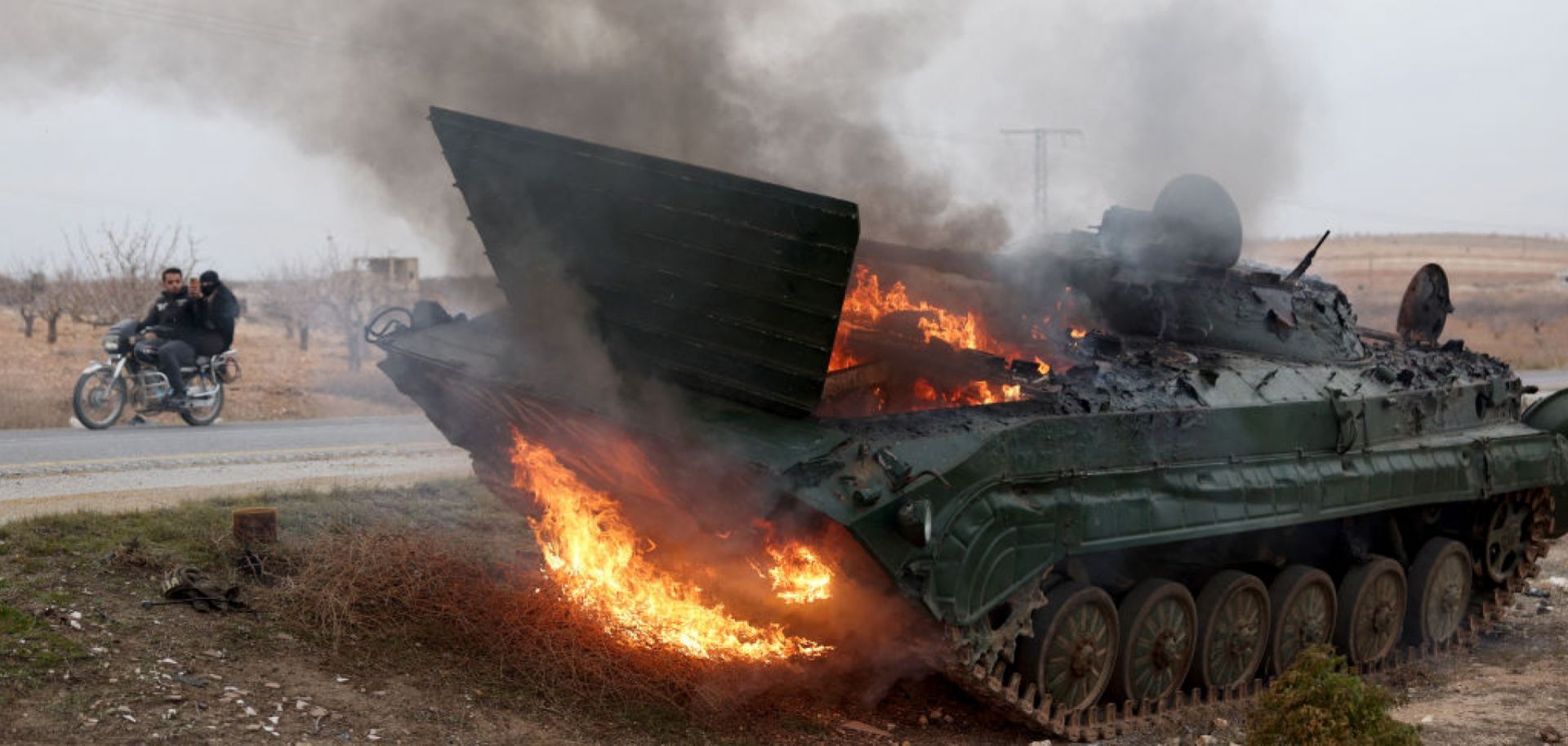
The imminent capture of Damascus means the fall of the Syrian regime, which will trigger a contested political process among competing rebel factions to create a provisional government. This will likely be a slow process prone to violence as foreign actors try to shape the postwar balance of power, making an unstable and fragmented Syria the most likely outcome. On Dec. 7, rebel forces entered the suburbs of Damascus nearly 14 years after Syria's Civil War began, indicating the end of over 50 years of rule by the Assad family. The first rebel forces to enter Damascus came from the south near Deraa, where the uprising of 2011 initially began, and which the Assad government had managed to suppress through reconciliation agreements in 2018-19. These forces, nominally under the Free Syrian Army umbrella, quickly reorganized as it became clear another rebel faction, the jihadist Hayat Tahir as-Shams, was marching on Damascus after a lightning campaign in the north against Aleppo, Hama and Homs. Syrian government forces reportedly threw down their arms and uniforms, with some escaping to Iraq, as the Syrian military melted away in the face of rapid rebel advances and takeovers of cities across the south. FSA forces also liberated prisoners from across the country's vast prison network and took over police stations, ministries, arsenals and airports, as government authority evaporated.
- The Deraa Military Council was one of the earliest rebel factions to form on a regional basis during the revolution of 2011. They fought against the government until the military tide turned in the Assad regime's favor in 2016 with the recapture of Aleppo. Deraa's rebels accepted Russian-backed mediation agreements to lay down their heavy weapons and formally end their resistance through a series of agreements in 2018-19 in exchange for amnesty, and were not part of the HTS campaign that began on Nov. 27. But as government authority collapsed in the north, rebel groups rapidly reformed.
- The foreign ministers of Iran, Turkey, and Russia met Dec. 7 in Doha under the Astana diplomatic framework. They reemphasized the return to the political process under U.N. Security Council Resolution 2254 on ending the Syrian conflict and achieving a political transition.
- The Free Syrian Army is a coalition of opposition groups in southern Syria primarily emanating from Daraa and Quneitra provinces. These groups were backed by various Arab states including Jordan and Saudi Arabia, and by the United States.
- Assad's whereabouts are unclear. CNN reported he was not in Damascus, and a flight associated with the government left for the United Arab Emirates hours before, but whether he was onboard was not confirmed.
In recent weeks, Syria's political and military landscape has shifted dramatically, highlighting the collapse of President Bashar al-Assad's regime. Over the past 10 days, organized rebel groups led by Turkey-backed HTS have launched a coordinated offensive from multiple axes, capturing numerous towns and cities including Aleppo, Daraa, Hama and Sweida, finally pushing towards Damascus to ensure the fall of Assad regime. Compounding this, key allies such as Iran, Russia and Hezbollah are increasingly constrained — weakened by internal and regional challenges — and were unwilling or unable to commit significant resources or deploy proxies to bolster Assad's position. Meanwhile, the regime's official military force, the Syrian Arab Army — already in bad shape due to years of dire economic conditions — has been collapsing on all fronts. Widespread low morale has led to minimal resistance or outright inaction by many of its fighters, with thousands reportedly laying down their arms and fleeing toward neighboring countries. All of these factors have allowed the rebels to swiftly capture major cities, making the Syrian regime's collapse imminent.
- The Iraqi News Agency has reported that at least 1,000 Syrian soldiers have fled the fighting, crossing the eastern borders into Iraq.
- Turkey has reportedly reached out to the Assad regime multiple times in the past few months to start a political process and a smooth transition of power, though Assad's maximalist conditions hindered such an opportunity.
- Assad's maximalist conditions included preconditions to any potential negotiations with Turkey such as the disarmament of all Turkey-backed rebels and groups positioned in the north, and the withdrawal of all Turkish forces from Syrian territory.
The collapse of the Syrian regime means a contested political process among the multiple rebel factions will start, though as they have competing territorial and political interests, this process will lead to factionalism and likely further instability. While the complete control of Damascus may take several days due to resistance from remaining regime-aligned militias and SAA remnants, it will likely mark the beginning of a political transition. While the situation is very fluid, there may be clashes among competing groups, but ultimately, the faction that captures Damascus first will dictate terms. New elections as part of the transition period are likely, which would postpone any potential fighting, but no rebel group has made its post-Assad plans clear. This provisional period would likely also see rebel factions carve up the rest of the country, with the U.S.-backed Kurdish group known as the Syrian Democratic Forces controlling the Euphrates River Valley, northeast, and Iraqi-Syrian border; the FSA holding the south and potentially Damascus itself; and HTS holding Idlib, Aleppo, Hama, and Homs. Latakia, the former regime stronghold, would remain a government remnant or emerge headed by a new Alawite-led faction. While this process takes place, factions are likely to cooperate on the formation of a post-Assad government nominally, but negotiations over the final form of the government and its postwar constitution will be slow and will be influenced by foreign actors, particularly Turkey, which will oppose any constitution that might grant autonomy to the northeast's Kurds. Meanwhile, the Islamic State will exploit any security vacuums to retake territory.
- In the near term, Turkish-backed HTS may shift its focus eastward to confront the SDF, particularly if Kurdish forces refuse to disarm or integrate into a new political framework. Tensions are further heightened by the SDF's anti-Islamic State operations in Raqqa, which HTS views as territorial opportunism. Turkey's proxy, the Syrian National Army, has already clashed with the SDF around Manbij in the north.
- There is no consensus yet among the rebel factions as to what kind of state will replace the Baathist one, but HTS leader Abu Mohammed al-Jolani said in an interview with CNN that he preferred a consensus-based council-style approach. FSA factions have long favored a democratic system, while the SDF has sought democratic rights and Kurdish autonomy. HTS and its jihadist predecessors have often aimed to replace the secular authoritarian republic of the Baathists with an Islamist government, with some preferring a nondemocratic regime.
There is an unlikely scenario in which a diplomatic breakthrough, led by Turkey and Gulf Arab states, coupled with militias' war weariness, could lead to a smoother transitional period that results in elections, a fresh government and relative stability in Syria in the near term. While warring factions will likely initially prefer to maximize their influence in any postwar Syria political system to advance their interests and bolster their domestic position in any upcoming government, international pressure and eventual war-weariness could lead to a breakthrough. This would see the factions, largely unable to dramatically change the situation on the ground and drag the war on, opt to enter a political process where intense negotiations will likely take place based on U.N. Security Council Resolution 2254. The rebels could then aim for elections in the next few years to kick-start the formation of a post-Assad government, during which they will also lobby the international community for reconstruction aid and investment. This process would further incentivize them to avoid major struggles to restart Syria's heavily damaged economy and allow the return of millions of refugees from abroad. After a new government emerges from elections, this could ultimately lead to the formation of a new Syrian constitution that would emphasize the factions' broad autonomy and participation in a national unity government.
- U.N. Security Council Resolution 2254, adopted unanimously Dec. 18, 2015, provides a framework for a political solution to the Syrian conflict. It outlines the need to end hostilities, transitional governance, constitutional reforms and elections.
In the longer run, there is a much greater probability that the fall of the Assad regime will result in a fragmented and unstable Syria, particularly as foreign states, including Turkey and the Gulf Arabs, interfere with the transition. HTS, the FSA, the SDF and Turkish-backed proxies are unlikely to find a political compromise for a constitution that meets all of their ideological and political requirements. The situation on the ground suggests the process will be drawn out, or, if a constitution is agreed upon, it will be deliberately weak enough to perverse the autonomy of the rebel factions. Meanwhile, Alawite and other Shiite militias are likely to continue fighting to safeguard their political status in any post-Assad order, complicating efforts to establish stability and potentially leading to violence led by regime holdouts and survivors. In the north, Turkey will oppose any political process that strengthens the autonomy of the Kurds, and may even launch military operations directly to sabotage such a process and expand its buffer zone, particularly if the U.S. withdraws, further fueling instability. Gulf Arab states, particularly the United Arab Emirates — which is wary of an Islamist-influenced government taking control of Syria — will likely counterbalance HTS and Turkey's Islamist influence by bolstering southern FSA factions and encouraging them to use both politics and force to weaken HTS and other Islamists. Assad's turbulent fall, coupled with continued fighting, is likely to prolong instability in the country and the region, complicating negotiations among militias and their international backers, and delaying efforts toward a sustainable political settlement and the formation of a widely accepted constitution and national unity government. All the while, jihadists like the Islamic State will try to take and hold territory as well, challenging the security situation and making reconstruction uncertain.
- Syria has a weak civic tradition due to decades of authoritarianism and civil war, thinning the ranks of leaders with experience in nonviolent politics and internal negotiation. Though Syria's diaspora, particularly in the West, has greater experience with democracy, they have little influence on the ground after having been abroad for so long.
- Other postrevolutionary governments in the region, including Tunisia, Libya, Yemen, and Egypt, have all lapsed into factionalism, civil wars, and/or authoritarian governments, partly due to internal factions' inability to find workable political consensus.
