
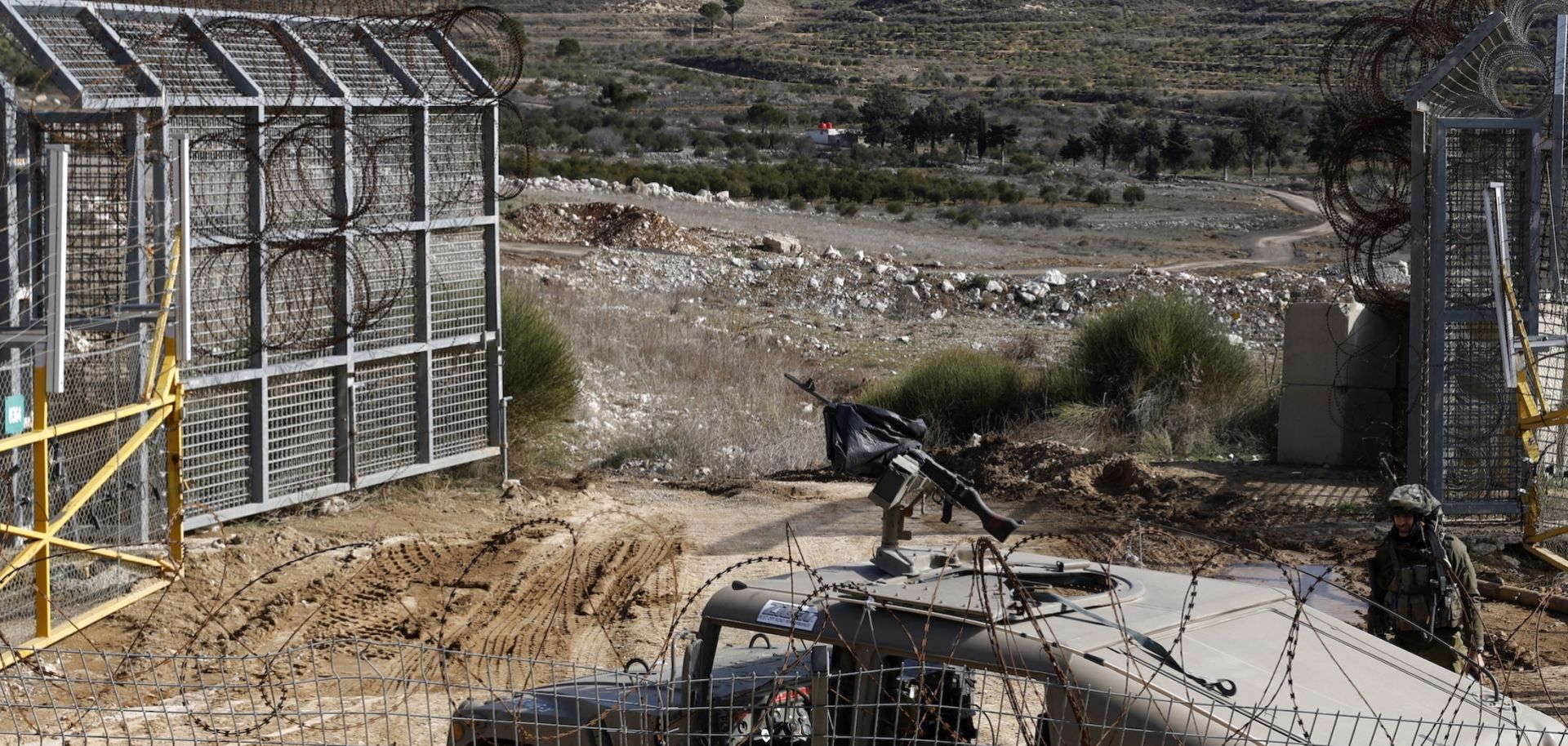
An open-ended Israeli military campaign in southern Syria will harden anti-Israel attitudes in the country as its political transition unfolds, which will embolden some armed groups to attack the Golan Heights and could eventually push Syria back toward anti-Israeli forces like Hezbollah and Iran. On Feb. 25, Israel conducted multiple airstrikes across southern Syria, as Defense Minister Israel Katz said that the country would act to prevent southern Syria from becoming ''southern Lebanon.'' The attack came one day after Syria's transitional government demanded Israel withdraw from the territory it occupied in December 2024 in the wake of the fall of longtime Syrian President Bashar al-Assad. It also came just after Israeli Prime Minister Netanyahu demanded on Feb. 23 the demilitarization of Syria's southwestern Quneitra, Daraa and Suwayda provinces, where Iran-linked groups used to operate before the Assad regime's collapse.
- Since the fall of Assad, Syria's security environment has been in flux, with shifting and unclear territorial control between armed factions. Southern Syria was previously dominated by Iran-backed groups and Russian military police under Assad, but the sudden uprising in November and December 2024 saw these forces cede the region to an umbrella of fighters under the Deraa Military Council, which has since nominally folded itself into the Syrian transitional defense forces.
- As rebels took territory from the Assad regime, Israel sent forces into the U.N.-brokered demilitarized zone in Quneitra province to secure the area. But those Israeli forces then pushed deeper along the Syrian-Lebanese border onto Mt. Hermon, where Israel now controls a strategic vantage point overlooking the lower regions that reach to Syria's capital of Damascus.
Israel is taking steps to aggressively expand its buffer zone across southern Syria as Hayat Tahir as-Shams (HTS), the country's new provisional rulers, focus on consolidating internal control. HTS is nominally anti-Israel but has shifted to a more pragmatic approach to the country since taking over Syria in December 2024. For example, the group demurred from militarily responding directly against Israel after it conducted mass airstrikes on the remnants of the Assad regime's air force and heavy weapons. HTS has tens of thousands of only lightly armed fighters and no air defenses after Israel's strategic destruction campaign in December. But the total Syrian territory that Israel wants demilitarized encompasses around 4,000 square miles and over 1.5 million people, which constrains Israel's ability to use ground forces to occupy the area — especially as Israel is also facing fragile ceasefires with Hezbollah in Lebanon and Hamas in Gaza, an active front in the West Bank, and an increasingly war-weary population at home. As a result, Israel is utilizing airstrikes to enforce the new, expanded demilitarized zone in a more geographically constrained version of its long anti-Iran campaign during the Assad era.
- Between 2013 and 2024, Israel conducted hundreds of airstrikes in Syria to destroy Iranian military sites and associated militias. Over the years, this campaign gradually weakened Iran's position in the country to the point where Tehran was unable to intervene to halt the overthrow of Assad in December.
- Israel has reportedly prepared for a long stay in the demilitarization zone in Syria, as its government hopes that Syria's political transition will result in a more neutral provisional government that can sustain a possible detente with Israel.
With HTS strapped for resources and eager to avoid new conflicts, the militants are unlikely to launch attacks on Israel in the coming months, but threats from other armed groups in Syria will incentivize Israel to continue periodic attacks there. HTS fighters are currently spread across the country, dealing with former regime elements, maintaining everyday security, and confronting rival factions like the Kurdish-led Syrian Democratic Forces in the northeast. Additionally, HTS is keen for Western countries, particularly the United States, to remove Assad-era sanctions hampering Syria's economy — something that would become less likely if HTS engages in a sustained conflict with Washington's key regional ally, Israel. As a result, HTS is unlikely to react to Israeli military provocations and will focus more on core security concerns farther north (namely, remaining Assadists and armed Kurdish forces). However, HTS does not control the entire security situation in Syria. Indeed, individual militant groups that are nominally part of the provisional government's security forces are expected to keep trying to exert control in the south, and some of these groups will likely remain anti-Israel. At the same time, other radical factions like the Islamic State may exploit the security vacuum in southern Syria to occasionally attack Israeli troops. These ongoing security threats will, in turn, likely compel Israel to continue its intermittent strikes on targets it believes indicate a militant buildup within southern Syria.
- The European Union recently lifted sanctions on Syria's energy and banking sectors, marking a key step toward gaining substantial reconstruction aid and emerging from over a decade of economic isolation. However, the Trump administration has reportedly delayed the further lifting of U.S. sanctions on Syria as the State Department assesses the country's strategic orientation and its relations with Israel. Without U.S. sanction relief, most reconstruction aid will remain frozen.
- During the Syrian Civil War, the Islamic State managed to establish a small enclave in the Israeli-controlled Golan Heights, showcasing the group's ability to create isolated havens in geographically disparate areas.
- Across southern Syria, the Druze community has also emerged as an independent faction, with a recent anti-HTS armed wing emerging in Sweiyda province.
Hard-liners within the HTS-led provisional government will criticize the lack of response to Israeli attacks, leading to further policy splits and internal divisions as the transition unfolds that could spur new episodes of violence. Syria's current transitional process is still marked by divisions, with a national dialogue conference on Feb. 24 reportedly ending with broad outlines of the country's future but without significant political breakthroughs among the various factions within Syria. Furthermore, Syria suffers from a lack of civil society due to decades of political repression and civil war, which complicates the process of developing a transitional government capable of holding new elections and rewriting the constitution. In this environment, HTS has become the default ruler of the country and is moving toward an extended transition process that increasingly appears authoritarian in nature. However, without significant buy-in from the various factions, splits over issues like responding to Israeli attacks will likely exacerbate divisions that hinder the transition process, potentially leading to new bouts of internal violence.
- There are no formal political parties involved in Syria's transitional process, but rather an assortment of militants and individual grassroots activists — a legacy of decades of one-party rule by the Ba'athists.
- The one-day national dialogue conference excluded Syria's Kurds and made little progress in developing a predictable format for the political transition, implying that the transition will continue to be driven by the personalities of the militants who overthrew Assad rather than a procedural and consensus-based approach.
An extended Israeli military campaign in southern Syria, especially if paired with sustained U.S. sanctions, would gradually push the provisional government closer to anti-Israel factions, including even former enemies like Hezbollah and Iran — a process that could further create divisions and violence inside Syria itself. To mitigate domestic criticism regarding repeated Israeli military actions in Syria, the provisional government will likely appease hard-liners by demanding an Israeli withdrawal from southern Syria and avoiding any normalization process with Israel as long as Israeli forces remain in the country. Ongoing Israeli strikes across Syria will likely reinforce anti-Israel sentiment and shape Syria's evolving foreign policy toward a more overtly anti-Israel stance. Should this trend align with continued lack of substantial sanctions relief from the United States, Syria's provisional government and its factions are increasingly likely to seek alternative partners for economic and security cooperation, including former rivals like Hezbollah and Iran, to which it might turn for arms and support in the face of extended Israeli campaigns. But with the memory of the civil war recent, turning to such former enemies will exacerbate divisions inside Syria itself, particularly from Sunni groups that remain strongly opposed to Iran and Hezbollah, resulting in growing risks of renewed civil conflict.
- Israel's campaign in Syria may also be extended partly for domestic political reasons, as embattled Prime Minister Benjamin Netanyahu tries to replicate in Syria his often politically successful strategies of escalation and de-escalation that he employed in Gaza before the Oct. 7 Hamas attack. With HTS weakened militarily and still striving to gain favor with the United States, the Netanyahu government will likely conclude that it faces few security or political risks in conducting intermittent strikes in Syria.
- The Trump administration may assert that serious sanctions should remain in place unless Syria normalizes relations with Israel, as the White House embarks on a firmly pro-Israel regional strategy reminiscent of its approach to Sudan during its first term. If this becomes the U.S. strategy for Syria, sanctions relief is unlikely, as normalization between Syria and Israel would be a nonstarter for Syria's fragile transitional government.
