
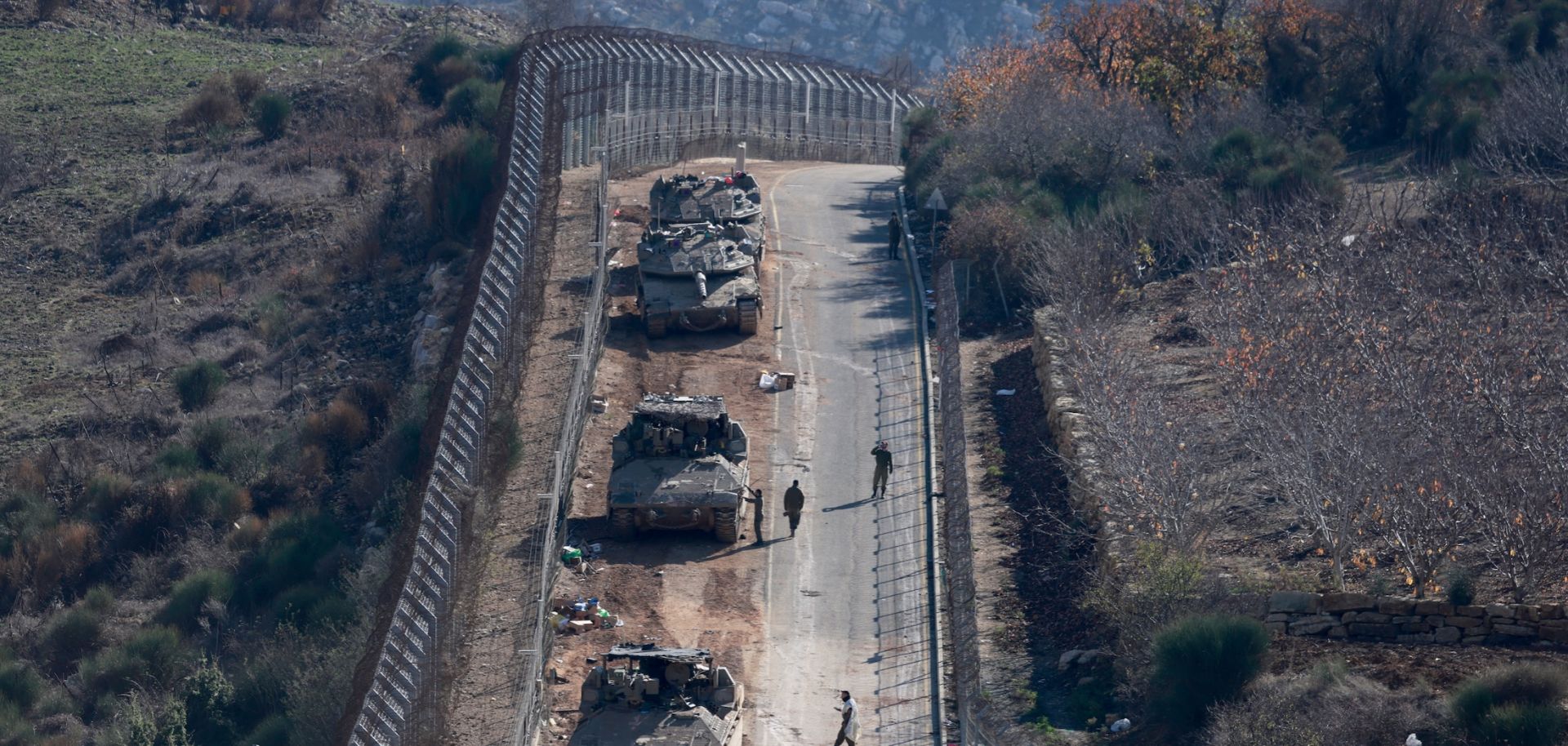
Israel's expanding military and settler presence in the disputed Golan Heights will in the near term reduce threats from Syria, but over time it will stoke political tensions inside Israel, result in further diplomatic blowback and open the door to a potential proxy conflict with Turkey in Syria. Since the collapse of Bashar al Assad's regime in Syria on Dec. 8, the Israel Defense Forces, or IDF, have entered the demilitarized zone along the Syrian-Israel border to seize strategic military positions, including the Syrian side of Mount Hermon, amid concern that the conflict in Syria could spill over into Israel. During a visit to the border on Dec. 17, Israeli Prime Minister Benjamin Netanyahu confirmed that Israeli forces would remain on the Syrian side ''until another arrangement can be found that guarantees Israel's security.'' In addition, the Israeli Air Force has conducted more than 350 strikes against targets in Syria to prevent Hayat Tahrir al-Sham, or HTS, and other armed groups from obtaining weapons left by the Assad regime that could potentially be used against Israel. Separate from Israel's military activity, on Dec. 15, the Israeli Cabinet, which is composed of right-wing and far-right members, approved an $11 million plan to encourage the expansion of Israeli settlements in the Golan Heights through education, renewable energy development and integration programs, with eventual ambitions to double the setter population.
- In a Dec. 10 statement, the IDF estimated that its attacks have destroyed between 70-80% of the Assad regime's military assets, including chemical weapons, air defense systems, long-range weapons, fighter jets and naval vessels.
- The United Nations, in addition to countries including Turkey, Qatar, Oman, Algeria and Egypt, have condemned Israel's advance in the demilitarized zone as violating the 1974 ceasefire agreement between Israel and Syria, which established the zone following the 1973 Yom Kippur War.
- Israel de facto annexed the Golan Heights in 1981. Currently, the disputed territory has 30 Israeli settlements and around 20-25,000 Israeli settlers, in addition to around 20,000 members of the religious Druze minority.
The fall of the Assad regime in neighboring Syria has further reduced the Iranian threat to Israel, but the resulting power vacuum could still lead to spillover violence and cross-border attacks as various groups vie for influence in the war-torn country. The Assad regime had been a close ally of Iran, having relied on Hezbollah and other Iranian-backed militias to back government forces during Syria's civil war that broke out in 2011. However, the more than decade-long civil war weakened both the morale and the capabilities of the Syrian government's forces. As a result, during the Hamas-Israel war that began in 2023, and the broader regional conflict since then, the Syrian military was unable to defend against regular Israeli airstrikes to destroy Syrian weapons stockpiles and disrupt Iranian weapons supply lines that ran through Syria, and was even less equipped to potentially mount a military campaign against Israel in retaliation. This weak military position also left the Assad regime vulnerable to HTS rebels' rapid advances last month, leading to its rapid defeat on Dec. 8. The regime's collapse has since disrupted the pro-Iranian networks and supply lines, thereby reducing the ability of Iran's regional allies and proxies — including Syrian militias and, most crucially, Lebanese Hezbollah fighters — to re-arm and conduct substantial attacks against Israel. Nevertheless, the toppling of Assad's government and the uncertainty around forming a new provisional government in Syria portend a heightened risk of factionalization within the country, as HTS, Turkish-backed Syrian opposition militias and Kurdish groups also compete for influence. Over time, this power competition could lead to clashes in Syria that spill over into Israel, or result in deliberate attacks on Israel from Syrian territory. Furthermore, fighting among the various armed factions risks creating security vacuums that provide ideal conditions for the Islamic State and other jihadist groups to resurge in Syria, presenting additional security threats to Israel and the broader region.
- Although Iran is reportedly in contact with HTS officials, Syria's new HTS-led government is unlikely to align itself closely with Iran, largely due to Tehran's long-term backing of the Assad regime. If members of HTS or the provisional government become too close with Iran, they would also likely risk being targeted by Israeli assassinations, as Israel has repeatedly demonstrated its ability to kill Syrian and Iranian officials in Syria.
- The United States has conducted multiple rounds of airstrikes against Islamic State targets in Syria since the Assad regime's collapse. On Dec. 10, U.S. President Joe Biden spoke of the persistent threat posed by the jihadist group, saying, ''We're clear-eyed about the fact that [the Islamic State] will try to take advantage of any vacuum to reestablish its capability and to create a safe haven.''
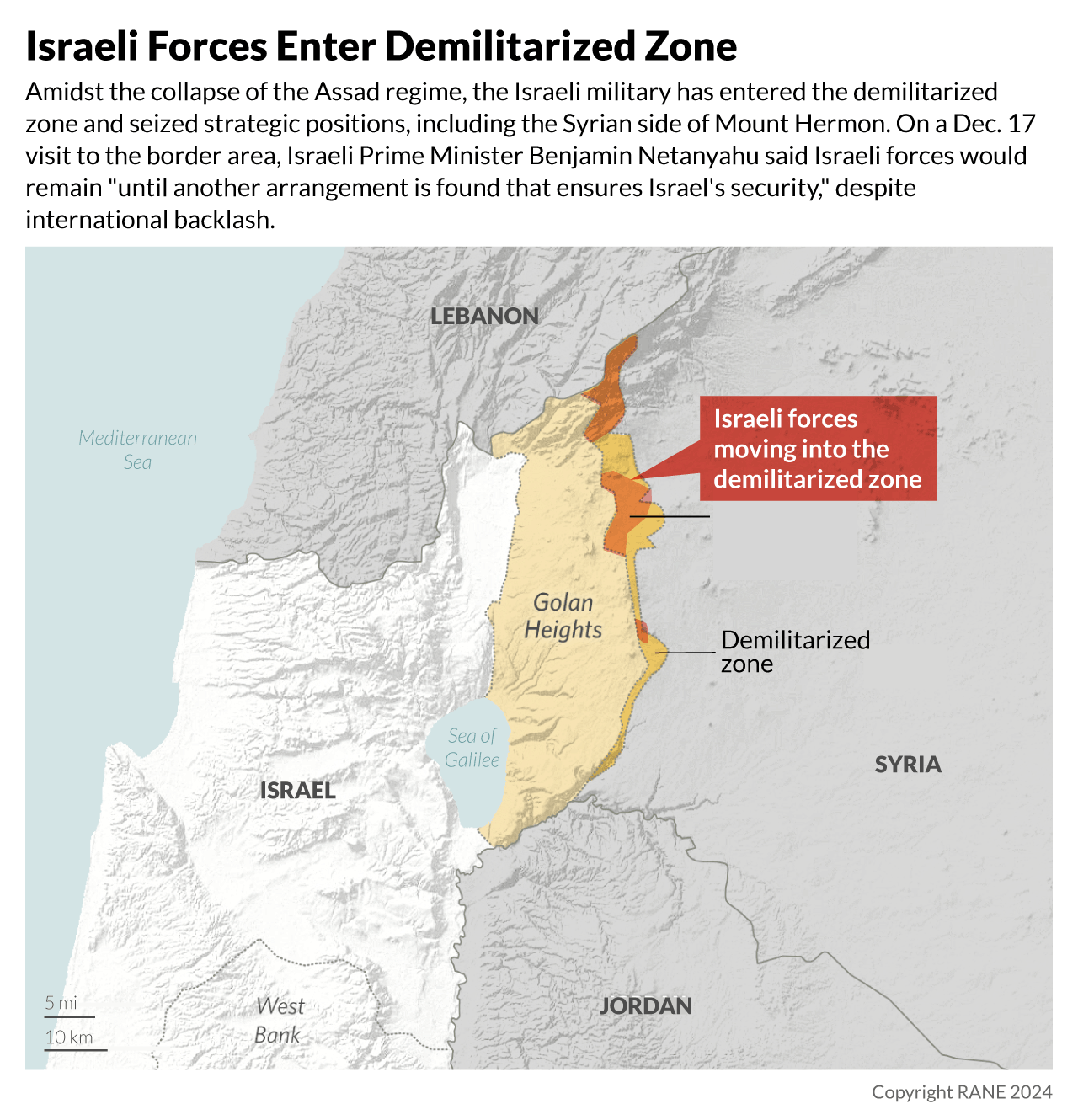
In the short term, Israel's priorities in Syria will be mitigating the risk of potential cross-border attacks from HTS or other armed groups through continued airstrikes, limited ground operations and an entrenched border presence. As HTS works to establish a provisional government and later a permanent government with formalized institutions — a process that will likely take years — the group is unlikely to pose a significant threat to Israel. Ahmed al-Sharaa (also known as Abu Mohammed al-Golani), the leader of HTS and the de facto leader of the new Syrian government, has rhetorically condemned Israel's airstrikes on Syrian territory, but has also acknowledged that ''the general exhaustion in Syria after years of war and conflict does not allow us to enter new conflicts.'' In addition to war weariness and HTS's current focus on stabilizing Syria, ongoing Israeli airstrikes against the remnants of the Assad government's weapons stockpiles will significantly constrain HTS's ability to use those weapons against Israel. However, even with HTS's degraded capabilities and its leader's expressed desire for peace, the group's jihadist origins mean Israeli leaders will likely continue to see the group as a potential national security threat. Furthermore, Syria's broader instability and security vacuums, now worsened by a lack of a central security force, will likely provide opportunities for the Islamic State and other jihadist groups to reconstitute themselves. To mitigate this risk, Israel will likely also conduct airstrikes and/or limited ground operations against these groups. Such efforts will, for now, be aided by the remaining U.S. troops in Syria, who are focused on combatting the Islamic State; but if U.S. President-elect Donald Trump again moves to withdraw those troops, Israel may have to expand its counterterrorism operations to offset the loss in U.S. military support. With such uncertainty, Israel will, at a minimum, likely hold its defensive positions in the demilitarized zone that lies between it and Syria in the coming years.
- In July 2016, HTS's precursor, the al-Nusra Front, split from al Qaeda. In 2017, it merged with other Syrian groups opposed to the Assad regime to form HTS. The group was primarily concentrated around Syria's Idlib province before its Nov. 27 advance on Aleppo, which it seized on Dec. 8. Due to its jihadist origins, many countries and international organizations — including the United States, Turkey, the European Union and the United Nations — designate HTS as a terrorist organization. However, HTS has attempted to distance itself from its jihadist past with how it has governed Idlib and promised to respect the rights of ethnic and religious minorities after overthrowing the Assad regime.
- HTS's weapons arsenal is largely composed of Turkish- and Arab-supplied weapons that HTS confiscated during clashes with other rebel groups, as well as the former Assad government, over the course of Syria's civil war. However, HTS has developed some rudimentary indigenous drone capabilities in makeshift workshops, relying on 3-D printed parts when components were unavailable. Nevertheless, it will be years before the group could potentially develop an air force or naval fleet that would pose a greater threat to Israel.
- On Dec. 10, a White House spokesperson reaffirmed that the 2,000 U.S. troops stationed in Syria would remain there to counter the Islamic State. But that could change once Trump retakes office in January, as he withdrew many U.S. troops from Syria during his first term, and has floated the idea of doing so again, which would decrease military resources available to combat the Islamic State and other jihadists.
The far-right members of Israel's government are also capitalizing on a weak Syrian government and declining regional tensions to expand Jewish settlements in the disputed Golan Heights, which will likely spur domestic and international pushback. With HTS unwilling and unable to significantly retaliate against Israeli actions over the next several years, and with Iran's regional proxies and allies significantly weakened, Israel's government is seizing the moment to tighten its grasp on the Golan Heights. On Dec. 15, the Israeli Cabinet approved a $11 million plan to double the population of the disputed area through increased settlement, with Prime Minister Benjamin Netanyahu saying it was ''especially important at this time'' to ''strength[en] the Golan,'' which he equated to ''strengthening the State of Israel.'' The easing of Israel's other conflicts is likely further driving this new focus on the Golan Heights, with Israel's 60-day ceasefire with Hezbollah mostly holding since it entered force on Nov. 27, and the intensity of fighting with Hamas in the Gaza Strip also decreasing in recent weeks. Additionally, Israel's far-right leaders likely believe the incoming Trump administration will back their Golan Heights plans — especially given that Trump's nominated ambassador to Israel, Mike Huckabee, has already hinted at supporting an Israeli annexation of settlements in the West Bank. However, much of the international community will probably view expanding Israeli settlements in the disputed area as acts of aggression, rather than defense; such settlements will thus risk further straining Israel's relations with Arab nations and key allies like Germany, which is Israel's second-largest weapons provider behind the United States. Additionally, left-wing and moderate Israelis will likely protest efforts to expand Golan settlements, for fear this could eventually drag Israel into yet another war by antagonizing the new Syrian government. Indeed, while HTS will be incapable of challenging Israel in the short to medium term, Israeli moves seen as infringing on Syrian sovereignty will likely still heighten tensions between the two countries in the long term, raising the risk of conflict in future years.
- On Dec. 15, Netanyahu said that strengthening the Golan Heights would more broadly strengthen Israel's security posture since a ''new front'' had opened in the broader regional conflict after the Dec. 8 collapse of the Assad government in Syria.
- In discussing the Golan Heights, a spokesperson for Germany's foreign ministry said on Dec. 16 it was ''perfectly clear under international law that this area controlled by Israel belongs to Syria and that Israel is therefore an occupying power.'' German officials also called on Israel to forgo its plan to expand Golan Heights settlements, though German elections in Feb. 2025 are likely to result in a new government that is unlikely to halt or significantly reduce aid to Israel despite political and legal pressures.
- In early December, a small group of far-right Israeli settlers entered southern Lebanon and constructed a rudimentary tent settlement without the permission of the Israeli government; the group was later removed by the IDF. However, small contingents of far-right settlers will likely be emboldened to push for expanded settlements in military-occupied areas.
In the long term, the new Syrian government's increasing military capabilities, as well as a persistent jihadist threat, could incentivize Israel to support an anti-Turkish proxy within Syria, such as the Kurdish Syrian Defense Forces (SDF), which may eventually position Israel against Turkey in a proxy conflict, especially in northeast Syria. In post-Assad Syria, Turkey is well-positioned to expand its influence through its key allies including the Free Syrian Army (FSA) and the Syrian National Army (SNA). To entrench that influence, Ankara will also likely provide the new Syrian government with military support, including through training and sales of advanced weapons, like Turkish-made drones. This, however, will likely strain Turko-Israeli relations, as a more militarily capable rebel government in Syria would pose a greater threat to Israel. As such, Israel may look to counter Turkish influence by propping up an anti-Turkish group within Syria, such as the SDF, as a counterweight. Israel has long-established contact with the Kurdish group and shares regional intelligence, and on Dec. 9 Israeli Foreign Minister Gideon Sa'ar called the Kurds a ''stabilizing force in [Syria].'' Increasing support to the SDF would give Israel a means to project power into Syria and, compared with Israeli positions in the Golan Heights, SDF forces in the northeast part of Syria would be much better positioned to fight jihadism in the country. In the long term, however, increased Israeli support may embolden the SDF to take a more aggressive stance against Turkish-backed groups, opening the door to a proxy conflict between Israel and Turkey, which would most likely be fought in the northeastern Kurdish strongholds of Syria.
- On Dec. 15, Turkish Defense Minister Yasar Guler said that Turkey would be willing to provide military training to the new Syrian government upon request. Turkey was also one of the first countries to re-open its embassy in Damascus following the collapse of the Assad regime.
