
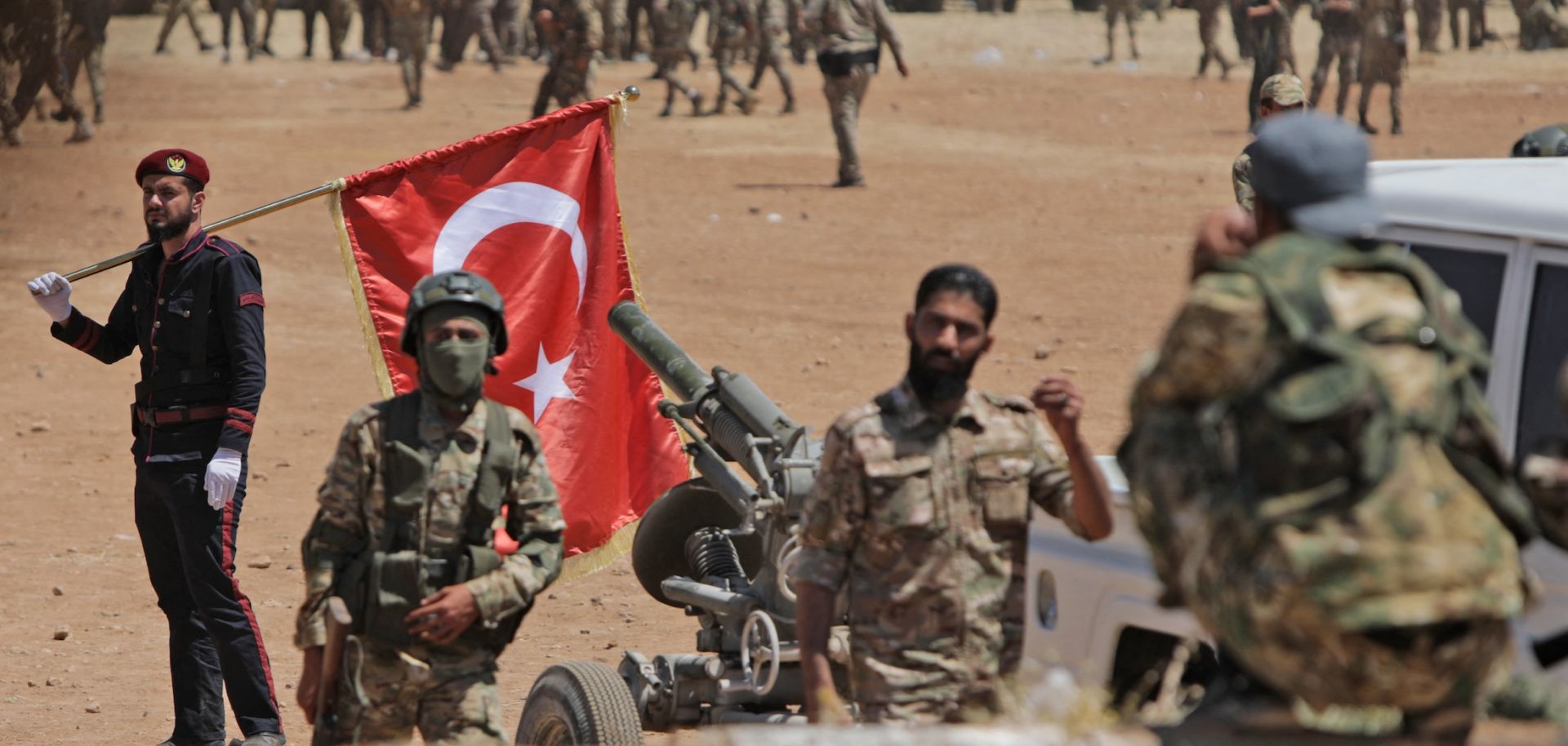
Turkey will likely promote the formation of a stable, pro-Turkey provisional government in Syria following the collapse of Bashar al Assad's regime; Ankara will also assert its influence over Syria's new leaders to prevent Kurdish autonomy, promote Turkish business interests and facilitate the return of Syrian refugees, which will risk heightening tensions with Israel in the long term. In the wake of the Assad government's collapse, Turkey has advocated for Syrian sovereignty while simultaneously promoting its own security and political interests in the country. On the same day rebels led by Hayat Tahrir al-Sham, or HTS, took control of Damascus, Turkish Foreign Minister Hakan Fidan on Dec. 8 spoke about Syria's political future on the sidelines of the Doha Forum in Qatar, noting ''opposition groups should be united now.'' Fidan's remarks came as the Turkish-backed Syrian National Army, or SNA, was launching attacks against Kurdish fighters whom Turkey considers terrorists. Later, on Dec. 9, Turkey and the United States brokered a deal for Kurdish forces to withdraw from the northern city of Manbij following an advance by the SNA. The same day, Turkish President Recep Tayyip Erdogan announced plans to open a third border crossing with Syria to facilitate the return of Syrian refugees, thousands of whom had already begun to return to Syria following the news of Assad's demise.
- Despite Turkey's support of the Syrian opposition, Ankara has rejected allegations that it played a role in the HTS offensive that began on Nov. 27. After seizing the city of Aleppo on Nov. 30, HTS rebels rapidly took control of additional territory throughout Syria, including the key cities of Hama and Homs, before eventually capturing the Syrian capital of Damascus on Dec. 8.
- In discussing Turkey's ambitions in Syria on Dec. 9, Erdogan said ''Turkey has no eye on the territory of any other country,'' adding that ''the only aim for our cross-border operations is to save our homeland from the terrorist attacks.''
Turkey's longstanding backing of the Syrian opposition and its military operations against the Kurdish fighters in northern Syria, combined with the surge of Syrian refugees that have fled to Turkey throughout the nearly 14-year civil war, significantly strained Turkish-Syrian relations under the Assad regime. Since the start of Syria's civil war in 2011, Turkey has provided political, military, and intelligence support to opposition groups aiming to topple the Assad government, which led Ankara and Damascus to cut ties in 2012. Turkey initially welcomed Syrian refugees with an ''open door'' policy at the start of the civil war, when Ankara believed the conflict would be short-lived and refugees would be able to quickly return home. However, as the war dragged on, Turkish views on its growing population of Syrian refugees began to sour. In recent years, Turkish citizens have increasingly taken to blaming refugees for crime within Turkey and the country's economic crisis, marked by high inflation and sluggish economic growth. In addition, Turkey has conducted military operations against the Kurdistan Workers' Party/People's Defense Units, or PKK/YPG, in northern Syria to crack down on cross-border attacks. In 2019, the United States and Turkey agreed to establish a buffer zone along the Syrian-Turkish border, but this collapsed when Turkey conducted a military offensive in northeastern Syria after then-U.S. President Donald Trump announced plans to withdraw U.S. forces along the Turkish-Syrian border. Later, an agreement between Russia, Syria and Turkey established a demilitarized buffer zone in Syria's Idlib province, which Turkey has expressed intent to expand to crack down on PKK/YPG forces. In recent years, as Syrian normalization efforts began to gain momentum throughout the region, there were initial discussions about a Turkish-Syrian rapprochement. However, the Assad government had conditioned normalization with Ankara on the withdrawal of Turkish forces from Syrian territory — a non-starter for Turkey, which views its military presence along the Syrian border as essential to its national security.
- Turkey hosts the largest number of Syrian refugees, around three million people. In 2016, the European Union and Turkey finalized a deal that would stem the flow of Syrian refugees entering Europe through Turkey. The European Union initially agreed to pay Turkey three billion euros in exchange for Turkish cooperation to crack down on irregular migration smuggling routes and enable the return of new irregular migrants from Greek islands to Turkey. The European Union later agreed to additional payments to Turkey for its continued cooperation to curb irregular migration.
- Turkey has been combating a PKK insurgency since 1978 after the Kurdish militant group pushed for an independent Kurdish state. Despite periodic ceasefires, the PKK has launched cross-border attacks from Syria and Iraq into southeastern Turkey. The group has also periodically conducted high-profile attacks, such as the Oct. 24 attack on Turkish Aerospace Industries near Ankara. In response to this threat, Turkey has cracked down on the PKK both domestically and in northern Syria and Iraq, primarily through limited military operations and airstrikes.
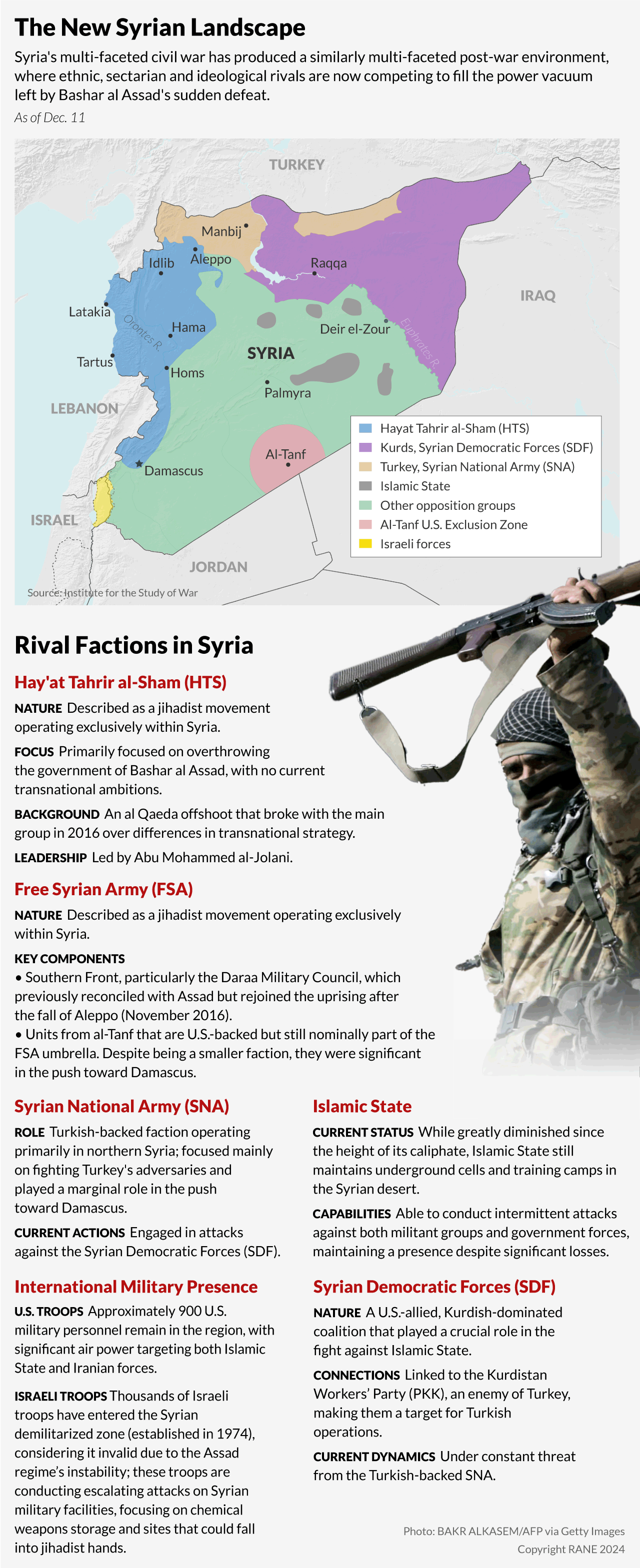
In the coming months, Turkey will likely back HTS's plan to create a provisional government in Syria to promote stability, and will leverage its Syrian proxies and strategic positions in the country to exert influence. Fidan's recent remarks noting that ''[Syrian] opposition groups should be united now'' underscore Turkey's desire for the creation of an inclusive unity government in Syria. This would increase Turkish influence within the provisional government through the incorporation of Turkish-backed opposition groups, including the Free Syrian Army, or FSA, and the SNA. Furthermore, HTS's key weapons supply lines run through Turkey, which Ankara could cut off if the group starts attacking Turkish-backed groups such as the FSA and SNA. With limited alternatives to the Turkish supply lines, HTS will be less likely to fight Turkish-backed opposition groups, thereby enabling Turkey to wield significant influence over the new Syrian government.
Progress toward securing international aid and recognition for this provisional government would provide Turkey with business opportunities for its growing military defense and construction sectors, which would further increase Turkish influence over the new Syrian government. Many countries and organizations — including the United States, the European Union and the United Nations — currently designate HTS as a terrorist organization. But a transition away from the group's jihadist origins toward a legitimate, politically inclusive government would likely galvanize a push for sanctions relief and/or revoking the terrorist designation. If Syria settles into relative stability and obtains increased international aid and cash inflows, Turkey would likely be able to obtain defense and construction contracts with the new government, which would increase its influence in Syria while benefitting some of Turkey's key growing sectors. Following Israel's attacks against Assad-era chemical weapons caches and heavy machinery, including air defense systems, the new rebel government will likely seek a reliable partner to provide it with weapons — a role Turkey is naturally suited for, given its established weapons supply lines to Syria and longstanding connections to the Syrian opposition. In addition, Turkey has been developing its indigenous military production through drones, such as the Bayraktar, which has proven very popular in Ukraine and African countries due to their low cost. Inking long-term contracts with the new Syrian government would further boost Turkey's defense sector. Turkey also will likely try to obtain construction contracts to rebuild parts of Syria, which would further boost Turkey's construction sector, which already has a substantial footprint abroad.
- Since the collapse of the Assad regime, the Israeli air force has conducted over 400 strikes on weapons targets, including remnants of the Syrian Air Force as well as the Assad government's naval fleet. The Israeli military estimates that it has destroyed up to 80% of Syrian weapons. As such, the new rebel government — as well as other militant groups in Syria — will have few weapons from the previous regime that it can use to form a military.
- HTS has had easy access to basic weaponry from the numerous arms that entered Syria from Turkey and Arab nations during the civil war, most of which were reportedly captured from other rebel groups or regime forces. HTS has supplemented these weapons with drones produced in small makeshift workshops and has relied on 3D-printed technology to create parts when they were not accessible.
- The United Nations has said that it would be willing to reconsider HTS's terrorism designation if the group established an inclusive provisional government in Syria. The United States and the United Kingdom have also expressed a willingness to reconsider the HTS's terrorism designation, or at the very least, provide some sanctions relief.
Turkish influence over the new government will very likely prevent the establishment of a semi-autonomous Kurdish entity in Syria, and Turkey will likely increase military operations against Kurdish forces, especially if the United States withdraws from Syria. Although Turkey has promoted the formation of an inclusive opposition government in Syria, Ankara will very likely use its influence over the country's new leaders to constrain the formation of a semi-autonomous region for Syrian Kurds. This issue will likely remain a point of contention between the new Syrian government and the U.S.-backed Kurdish Syrian Democratic Forces, or SDF, which has incorporated the YPG since 2015. Even so, the SDF will likely make some concessions to the new rebel government in return for representation and provisions to help protect the group from Turkish-backed forces. However, regardless of any SDF-Syrian government deals, Turkey will likely expand military operations against the PKK/YPG along the Syria-Turkey border, especially if the incoming U.S. Trump administration follows through on its stated goal of withdrawing troops from Syria. While Syria's new government would likely rhetorically protest these actions, its reliance on Turkey for military and economic development would likely constrain any substantive action against Turkey in the short to medium term.
- The United States has approximately 900 troops in Syria as part of its mission to combat the Islamic State. During his first term, Trump withdrew many, but not all, U.S. forces from Syria to remove troops from an ''endless war.'' On Dec. 10, a White House spokesperson said U.S. troops would remain in Syria to combat the Islamic State following the collapse of the Assad regime. However, the incoming Trump administration showed interest in a further troop withdrawal from Syria even prior to the collapse of the Assad regime. Furthermore, in a Dec. 7 post on Truth Social, Trump wrote, ''In any event, Syria is a mess, but is not our friend, & THE UNITED STATES SHOULD HAVE NOTHING TO DO WITH IT. THIS IS NOT OUR FIGHT,'' signaling his intent to disengage from Syria in his second term.
If Syria stabilizes, the relative calm will reduce the waves of refugees fleeing the country and fuel Turkey's push to repatriate existing Syrian refugees. Despite some potential clashes with the SDF in the north, a stable Syria without infighting between various militant factions would forestall another wave of displaced Syrian refugees from crossing the border into neighboring countries, including Turkey. Meanwhile, some Syrian refugees in Turkey have already begun to return to Syria, and hostile conditions and harassment in Turkey will likely drive more Syrian refugees to follow suit. However, many will remain hesitant to return to Syria amid uncertainty about the country's future. As a result, Turkey's ruling Justice and Development Party, or AKP, will likely pursue policies to promote Syrian refugees' repatriation to appeal to anti-refugee sentiment within Turkey. To that end, Turkey will likely open additional border crossings with Syria to facilitate the flow of additional refugees from Turkey and support reconstruction aid that would make a return more appealing. Furthermore, there have been reports of cities and districts controlled by the main opposition party, the Republican People's Party, or CHP, promoting the return of Syrian refugees by paying their transportation costs.
- Turkey's main opposition party has long criticized the ruling AKP's stance on Syrian refugees. Following the collapse of the Assad regime, the leader of the CHP, Ozgur Ozel, posted on X, ''Our primary concern regarding Syria is the security and peace of our citizens. A comprehensive plan must be immediately implemented to facilitate the return of Syrians who have been living in Turkiye under various statuses for years.''
In the long term, Turko-Israeli relations will likely further deteriorate as Turkish influence in Syria grows, potentially resulting in a proxy conflict of the SDF against Turkish-backed groups. Growing Turkish influence in Syria will likely worsen Turkey-Israel relations, which are already shaky following Turkish support for Palestinians in Gaza. To combat Turkey's influence in Syria, as well as the potential resurgence of the Islamic State and other jihadists amid the instability there, Israel could increase support for the SDF, particularly if the United States withdraws from Syria. Israel would be even more likely to do so if Turkey provided advanced weaponry to the new Syrian regime. Such Israeli support could lead the SDF to grow more assertive against Turkish-backed forces, and over time, this scenario could open the door to a proxy conflict between rival Syrian militant groups.
- Since the collapse of the Assad regime, Israeli military forces have entered the demilitarized buffer zone along the Syria-Israel border that was established in the 1974 October war ceasefire agreement. Israeli forces have secured Mount Hermon and other strategic locations. Turkey, Qatar and Egypt condemned Israel's seizure of positions as violating Syria's sovereignty.
- On Dec. 9, Israeli Foreign Minister Gideon Saar praised the SDF for its fight against the Islamic State and called for Turkish-backed attacks against Kurds to stop, saying, ''It's also a commitment for the future of Syria, because the Kurds are a stabilizing force in this country.'' However, Saar's additional remarks prioritized Israeli safety and did not provide any support guarantees for the SDF.
- Turko-Israeli relations have deteriorated throughout the Israel-Hamas war, as Erdogan has increased anti-Israel rhetoric and positioned Turkey as a champion of the Palestinian cause. Furthermore, in May, Turkey imposed a trade embargo on imports from and exports to Israel in retaliation for Israel's prohibition of a Turkish humanitarian aid drop into Gaza.
