
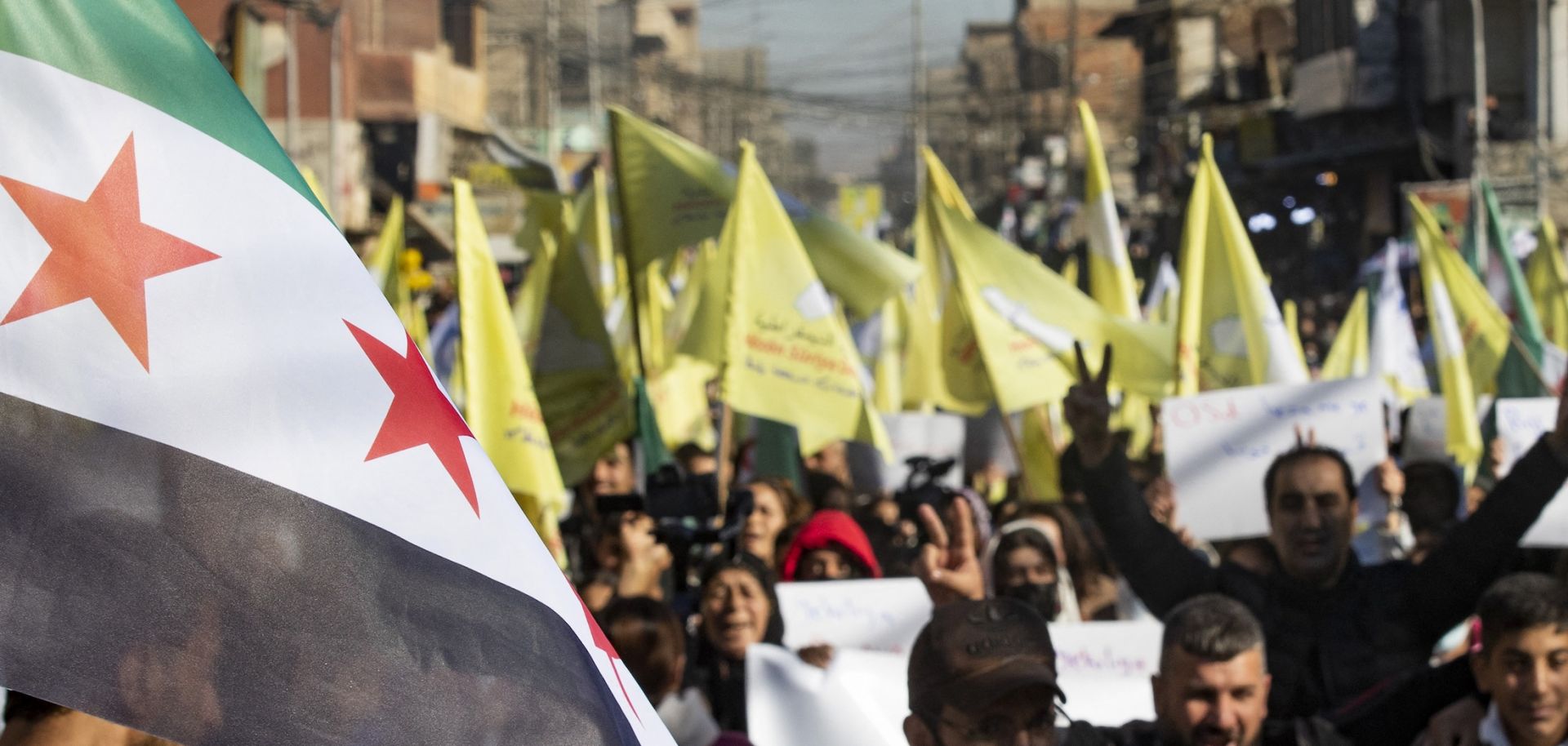
Recent developments in Turkey and Syria suggest that Kurdish militants for the first time in a decade are moving toward a peace process with Turkey. If successful, this would increase the probability of Turkish constitutional reform needed to give President Recep Tayyip Erdogan another term, while its failure could presage a resumption of regionwide violence. On Feb. 18, The New Arab news outlet reported that the Kurdish-dominated Syrian Democratic Forces had agreed to fold their forces into the Syrian provisional government's military forces. This report is one of several recent developments indicating a growing trend toward a renewed Turkish-Kurdish peace process. Pro-Kurdish lawmakers in Turkey have suggested that Kurdistan Workers' Party founder Abdullah Ocalan might soon call for the resumption of talks and for the party to lay down arms sometime in March. This development comes months after Turkey's ultranationalist Nationalist Movement Party, or MHP, softened its approach to the Kurdish issue, indicating a willingness to resume possible talks with elements of Turkey's Kurdish opposition. Against this backdrop, Turkey's government has also suggested its interest in renewed peace talks and has refrained from launching a major assault against the SDF, which it has long accused of harboring the Kurdistan Workers' Party, or PKK, a group Ankara has labeled a terrorist organization.
- The last Turkish-Kurdish peace process began in 2013 against the backdrop of significant domestic political pressure on the ruling Justice and Development Party, or AKP, to secure the country following major anti-government protests. But the process collapsed in 2015 after the AKP performed poorly in the elections that year. To win over the ultranationalist MHP and nationalist voters to secure parliamentary control, the AKP pivoted to hard-line anti-Kurdish policies and abandoned the peace process, leading to a resurgence of hostilities.
- The PKK has fought for increased Kurdish political and cultural rights in Turkey since the 1980s, moving over the years from a demand for outright independence to a less aggressive demand for greater autonomy for Kurds. The group has bases in Southeastern Turkey and in Iraq, while some fighters have also operated from northeastern Syria, where the SDF established an autonomous zone during the Syrian Civil War.
- The MHP has long opposed negotiations with the Kurds, fearing that concessions to the movement might undermine Turkey's unity and territorial integrity. But in October 2024, Devlet Bahceli, the leader of the MHP, suggested that Ocalan could be released in exchange for the PKK laying down their arms. This marked a significant shift in the MHP's hard-line stance demanding Ocalan's continued imprisonment. The AKP, allies of the MHP, quickly welcomed these comments.
Turkey's government is attempting to create political conditions that might enable President Recep Tayyip Erdogan to secure another term after elections in 2028, which is incentivizing outreach to the Kurds. Erdogan's term will constitutionally end in 2028; extraordinary measures such as snap elections that could reset his term limit or changing the Turkish Constitution would be required to extend his time in office. The Turkish government coalition currently lacks the necessary votes in parliament to take either action, which forces them to seek out the opposition in hopes of finding allies amenable to early elections or constitutional amendments. In the face of an impasse with the secular nationalist Republican People's Party, the AKP has shifted its focus toward Kurdish parties like the People's Equality and Democracy Party, a coalition of Kurdish groups long associated with the PKK. Meanwhile, the collapse of Bashar al Assad's government in Syria has placed Hayat Tahrir al-Sham in charge of the provisional government, with which Turkey has since sought to increase diplomatic, economic and security relations. This development has provided Turkey a new advantage against the SDF to undermine its autonomy as HTS integrates the SDF into the provisional forces. Consequently, it seems the PKK has become more receptive to the idea of renewed peace talks with Turkey to maintain the limited autonomy Kurds have achieved in northeastern Syria and potentially secure concessions for Turkish Kurds through negotiations with the Turkish government. But these conditions take place against the backdrop of continued Turkish crackdowns against Kurdish activists and politicians, crackdowns still popular with Turkish ultranationalists.
- The SDF faces additional pressure because the United States under President Donald Trump is signaling again that it will remove its approximately 900 troops from Syria sometime this year, a policy that, if implemented, would deprive the SDF of its primary security guarantor that has been instrumental in preventing escalated Turkish military operations.
- Turkey's ruling People's Alliance, which includes the AKP and MHP, currently has 321 votes in Turkey's Grand National Assembly; calling a constitutional referendum requires 360 votes. Support from the People's Equality and Democracy Party, which has 57 seats in the Grand National Assembly, would generate enough support for a referendum.
The PKK is likely to increasingly pursue a conciliatory path with Turkey as it adapts to the strategic changes resulting from government turnovers in Syria and the United States, raising the possibility of formally resuming what would be complex and uncertain Turkish-Kurdish talks. To preserve the language and cultural rights attained in Syria during the civil war, Syrian Kurds are expected to integrate into the post-Assad Syria led by the HTS provisional government. This process will involve relinquishing their autonomy as a security force but maintaining some degree of autonomy in the northeast – a process likely to be hastened by the new Trump administration's overarching goal to pull U.S. troops from Syria eventually. But to fully remove the threat of a Turkish invasion, this process will also mean the PKK will have to integrate with the provisional government's security forces or exit Syria. In Turkey meanwhile, it remains uncertain whether Ocalan will indeed call for the full disarmament of the PKK, especially since such a significant initial move without securing Turkish concessions in exchange could undermine the PKK's leverage during peace negotiations with the Turkish government. A pledge for eventual disarmament and the disbandment of the PKK might emerge, however, if the Turkish government indicates a willingness to offer linguistic and cultural concessions as part of a comprehensive peace process. On both fronts, this process is likely to be prolonged, and to involve considerable distrust between Turkey and various Kurdish groups. Turkish ultranationalists will also criticize certain demands from Kurdish groups if they perceive that granting linguistic or political concessions could foster the prospect of an eventual Kurdish independent state in Turkey, Syria or Iraq.
- Turkey maintains a total bar on the Kurdish language in schools and government institutions, and allows only limited use in media, while political parties based on ethnic groups, including the Kurds, are banned under Turkish law. Expanded linguistic rights are key demands of the PKK, but something historically resisted by Turkish ultranationalists, who worry they pose demands for a separate Kurdish state.
- The SDF renamed northeastern Syria "Rojava" (Kurdish for "the west," as in "west Kurdistan") in an attempt to try to create a permanent Kurdish-Arab autonomous region in the course of the civil war. The region was nearly overrun by the Islamic State in the 2010s, but U.S. military intervention rolled back the Islamic State and helped Rojava gain de facto autonomy.
In the long run, Kurdish parties will continue to remain skeptical of backing Turkish constitutional reform that could extend Erdogan's power into the 2030s, while splinter groups will oppose compromise with the Turkish government, potentially undermining the chances for a sustained peace agreement and presaging a return to wide-scale violence. Erdogan's role in the collapse of the 2015 peace process created lasting distrust between the Kurds and the Turkish government, suggesting that even with a peace process underway or signed, Kurdish parties may be reluctant to engage in a political process that would extend Erdogan's rule into the 2030s, especially since in the future Erdogan might once again decide to solicit support from ultranationalists intent on minimizing Kurdish identity and political parties in Turkey. As a result, even if a peace process leads to a cessation of hostilities, Kurdish parties may oppose or delay their involvement in such reforms as the 2028 constitutional deadline approaches for the end of Erdogan's term. This, in turn, would further strain relations between Turkish nationalists eager to extend Erdogan's rule and these Kurdish parties. Meanwhile, if the peace process makes progress and involves compromises on Kurdish identity and a path towards autonomy, hard-line Kurdish militants might split off from the PKK, conducting isolated attacks against Turkish targets and worsening Turkish-Kurdish relations. If the process unravels entirely, violence would likely surge, with fighting resuming at scale in Iraq, Syria and Turkey.
- After the collapse of the 2013-15 peace process, violence resurged in the months after the November 2015 election returned the AKP to government in a coalition with ultranationalist allies, as the government fulfilled its promise to the ultranationalists to crack down on Kurds and the PKK resumed attacks against the Turkish government.
- Should the talks fail, the AKP is likely to expand its anti-Kurdish crackdown to prevent anti-government Kurds from holding office or voting, strengthening the AKP's hold on the country's political system and increasing its chances of retaining power after 2028.
