
Editor's Note: This is the second installment of a two-part series on Saudi Arabia's regional strategy. Part one can be found here.
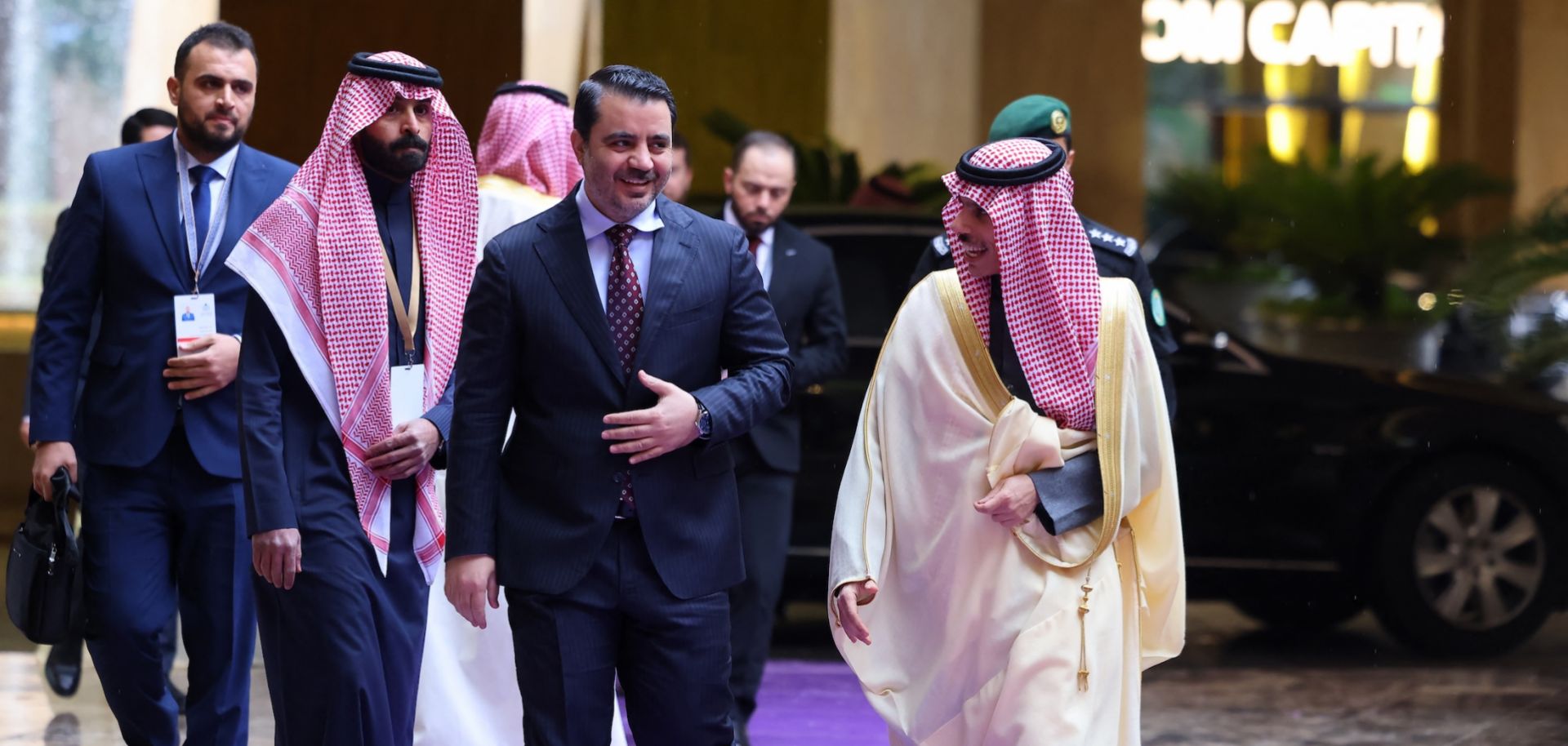
Saudi Arabia's re-engagement with Lebanon, Syria and Iraq will partially counterbalance the shifting regional influence of Turkey, Qatar and Iran. However, sectarian politics and the meddling of foreign powers will limit Saudi gains, making Riyadh more aggressive in the long term, particularly in Syria and Lebanon. On Feb. 2, Syria's transitional President Ahmad al-Sharaa traveled to Riyadh for his first diplomatic trip abroad, meeting Saudi Crown Prince Mohammed bin Salman and discussing economic, humanitarian and diplomatic cooperation. The visit came after Saudi Foreign Minister Prince Faisal bin Farhan arrived in Damascus on Jan. 24. Prince Faisal also visited Lebanon on Jan. 23, making him the first top Saudi diplomat to travel to Lebanon in 15 years. The minister reportedly conveyed Saudi Arabia's support for the Lebanese people and state while urging political reforms to unlock foreign aid and investments. Finally, Saudi Arabia and Iraq on Nov. 4 signed a memorandum of understanding on military and defense cooperation that Saudi Arabia's official press agency deemed a ''significant step forward.'' This follows a July 2022 memorandum of understanding to connect their electricity grids, aiming to supply Iraq with 1,000 megawatts of power.
Saudi Arabia is re-engaging with Lebanon, Syria and Iraq to fill the void left by Iran's waning regional influence and counterbalance Turkey and Qatar's growing or expanding influence. While Iran's influence is entrenched in the Levant, Saudi Arabia plans to use economic and political maneuvers to partially offset this sway, particularly amid Iran's recent regional setbacks. For instance, the weakening of Lebanon's Iranian-backed militant group Hezbollah in 2024 and Lebanon's subsequent election of a Saudi-favored presidential candidate and prime minister in 2025 have convinced Riyadh that it is time to renew ties with the Lebanese government after at least a decade of disengagement. Meanwhile, in Syria, the December 2024 overthrow of Bashar al Assad's Iranian-backed regime by Turkish-backed rebels has created new openings for Turkey and Qatar to shape the war-torn country's future, motivating Saudi Arabia to intervene to counter their Islamist influences. Finally, Iran's decreased regional influence offers additional incentives for Riyadh to increase engagement with Baghdad, primarily to counter the threat of Iranian-backed militias and support Sunni political inclusion to prevent extremism and enhance regional stability. In all three countries, Saudi Arabia's overarching goals include reducing Iranian influence, maintaining regional stability, increasing regional economic and political integration, securing economic opportunities, countering extremist threats and reestablishing Riyadh's role as the Arab world's leader.
- Saudi Arabia disengaged from Lebanon in the mid-2010s following Hezbollah's 2012 entry into the Syrian civil war and the election of Hezbollah ally Michel Aoun as president in 2016. Until then, Saudi Arabia had continuously funded Lebanese governments in a failed effort to counter the growing influence of Hezbollah and Iran, and many wealthy Saudis had financial ties to Lebanon's banking sector and real estate.
- Riyadh's attempt to normalize relations with former Syrian President Bashar al Assad's regime in the past few years made little progress due to al Assad's unwillingness and inability to address key Saudi security concerns, including Iran's influence and the Captagon trade.
- The memorandum of understanding between Iraq and Saudi Arabia highlights Riyadh's efforts to advance its relations with Iraq, as well as Baghdad's desire to diversify its foreign partners.
In the coming months, Saudi Arabia will continue to reengage with Lebanon's new government via economic, political and military channels to further reduce Hezbollah's influence. In return for Saudi aid, Riyadh will likely demand at least minimal reforms in the Lebanese banking sector for transparency, with Saudi officials emphasizing anti-corruption measures and oversight of exports and imports. These reforms will help ensure that Saudi funds help the Lebanese state strengthen its institutions and capitalize on Hezbollah's weakness, rather than inadvertently fund corrupt networks or strengthen Hezbollah's coffers. Politically, the kingdom will seek to rebuild its traditional Sunni allies in Lebanon, including remnants of former Prime Minister Saad Hariri's Future Movement, and shore up Christian groups willing to distance themselves from Hezbollah, further decreasing the latter's influence over Lebanon's National Assembly and Cabinet. This approach will also serve as a counterweight to Turkey and Qatar, both of which could expand their reach in the Levant and Lebanon through financial assistance and support for various political factions, including Islamists. Finally, Saudi Arabia will continue to back the Lebanese Armed Forces through financial donations and security coordination that will be instrumental in securing Saudi influence and forestalling a resurgence of Hezbollah.
- Saudi Arabia has for years urged consecutive Lebanese governments to enact structural reforms to unlock foreign aid and investments, but each of these governments was either unwilling and/or incapable of doing so due to domestic political divisions and regional upheaval.
In Syria, Saudi Arabia will leverage diplomatic and economic engagement to rebuild the country's shattered infrastructure, aiming to stabilize Syria while also countering regional rivals' growing influence. Saudi Foreign Minister Prince Faisal's January visit to Syria signals that Saudi Arabia is increasing engagement with Syria's interim government as it consolidates power. In return, new Syrian President al-Sharaa's choice of Saudi Arabia as the destination for his first diplomatic visit signals his interest in expanding Saudi Arabia's role in Syria's reconstruction process. Al-Sharaa's visit also suggests that his government is open to meeting Saudi calls for an inclusive political framework in Syria that involves all sectarian groups and reins in extremist ideologies. Progress on dismantling Syria's Captagon production networks would also serve as a useful confidence-building measure, enabling deeper trade cooperation with Saudi Arabia and other Arab states — particularly Jordan, whose ties with Syria are rapidly improving. To pave the way for substantial Saudi investment, the kingdom will lobby to facilitate partial U.S. sanctions relief, which would allow Saudi companies and allies to inject capital into Syria's private sector and selectively support its public sector in reconstruction efforts. With these investments, Riyadh will aim to prevent the spillover of Islamist militancy into neighboring Jordan, Lebanon and Iraq, which is imperative for safeguarding regional security.
- Unlike in Iraq, where Saudi Arabia relies on investments and diplomatic ties to counter Iran, Riyadh took a more active role in Syria's civil war, where it supported opposition groups and sought to isolate al Assad's regime economically.
- Before the war, Syrian-Saudi trade was strong, featuring key exchanges in oil and energy, agricultural exports, textiles, construction investments, financial ties, religious tourism and pharmaceuticals.
Meanwhile, Saudi Arabia will also likely expand economic and security engagements in Iraq and may support Sunni political factions to curb Iran's and Turkey's influence. Riyadh will likely invest in Iraq's power sector — long plagued by chronic shortages — and in its broader private sector to win local popular and political support, as well as reduce Baghdad's dependence on external actors. Saudi Arabia will also likely fortify Iraqi security forces, aiming to help them clamp down on transnational drug smuggling networks, thwart terrorist threats, strengthen state sovereignty and reduce the influence of non-state militias, especially hardline Iranian-backed factions like Asaib Ahl al-Haq. Meanwhile, with Iraq's parliamentary elections scheduled for late 2025, Saudi policymakers will likely intensify outreach to Sunni factions and possibly even form quiet alliances with certain Shiite groups that are less aligned with Tehran — though Riyadh will tread carefully to avoid derailing its detente with Iran.
- Baghdad will seek to bandwagon and maintain multiple alliances, balancing regional and international relationships to maximize its strategic and economic benefits and limit destabilizing factors, including Iran's role.
- Saudi Arabia's engagement in Iraqi security will likely include support for the armed forces and intelligence sharing, especially if the United States withdraws from Iraq, to prevent other actors — mainly Iran and Turkey — from filling the vacuum.
While Saudi Arabia's investments and diplomatic outreach will benefit Lebanon, Syria and Iraq economically, the Levant's sectarian politics and vulnerability to foreign meddling will limit Riyadh's gains. In Lebanon, Hezbollah and Iran's entrenched power base will continue to constrain Saudi influence despite potential improvements in economic and political governance. Additionally, Saudi interests in Lebanon may diverge from those of the United States and France, which could further limit Riyadh's influence there. In Syria — where Turkey and Qatar maintain strong ties to the leading factions, and where Israel's security concerns pose ongoing risks — competing regional interests and the potential for sectarian unrest and fragmentation will temper Saudi engagement. Meanwhile, Iraq will face a similarly complex landscape, as Saudi efforts to strengthen Baghdad's sovereignty will clash with Iran's determination to safeguard its influence through political manipulation and proxy forces, particularly in anticipation of the 2025 elections.
In the long term, Saudi Arabia may become more assertive in Lebanon and Syria (which it considers more strategically relevant) while likely maintaining cautious engagement with Iraq to preserve its detente with Iran. Out of the three Levantine countries, Syria and Lebanon are the most important for the Saudis due to their locations along the Mediterranean coast, an important trade hub and gateway into the Arab world. Saudi Arabi is also concerned about Syria's and Lebanon's fragile security environments, which involve the Islamic State, Hezbollah and the Captagon trade, as well as about growing Turkish and Qatari influence. Against this backdrop, limitations on Saudi Arabia's ability to gain influence through measured political and economic engagement may push the kingdom to adopt a more assertive stance in Syria and Lebanon. For instance, Saudi Arabia may intensify its economic support for various factions in Syria and Lebanon, using them as leverage to maintain regional influence even at the expense of destabilizing these countries. However, in Iraq, Saudi Arabia will likely maintain diplomatic and economic engagement without provoking Iran to protect its detente with Tehran and prevent any potential attack by Iranian proxies on Saudi oil and gas infrastructure. This approach would become even more crucial for Riyadh if the United States and Israel launched attacks on Iran or Iraq, as Riyadh would seek to avoid direct entanglement while still safeguarding its influence.
- On Sept. 14, 2019, drones and cruise missiles struck Abqaiq and Khurais, two of Saudi Aramco's most critical oil processing sites, temporarily cutting Saudi oil production by nearly 50% and disrupting global energy markets. While the Iran-backed Houthi rebels in Yemen claimed responsibility, U.S. and Saudi officials suggested that the attack was launched from either Iran or Iraq, with intelligence reports pointing to Iran-backed militias in Iraq as a potential source of strikes. However, Iraq denied that its territory was used for the attack, and Iran rejected any involvement.
- Saudi Arabia fears that taking aggressive action against Iran in Iraq or Yemen — especially amid direct U.S. and Israeli attacks on Iran — could make its oil and gas infrastructure a target for Iran-backed groups from both countries.
