
Editor's Note: This is the first installment of a two-part series on Saudi Arabia's regional strategy. The second installment will discuss how former U.S. President Donald Trump's return to the White House in January 2025 will affect the kingdom's calculations.
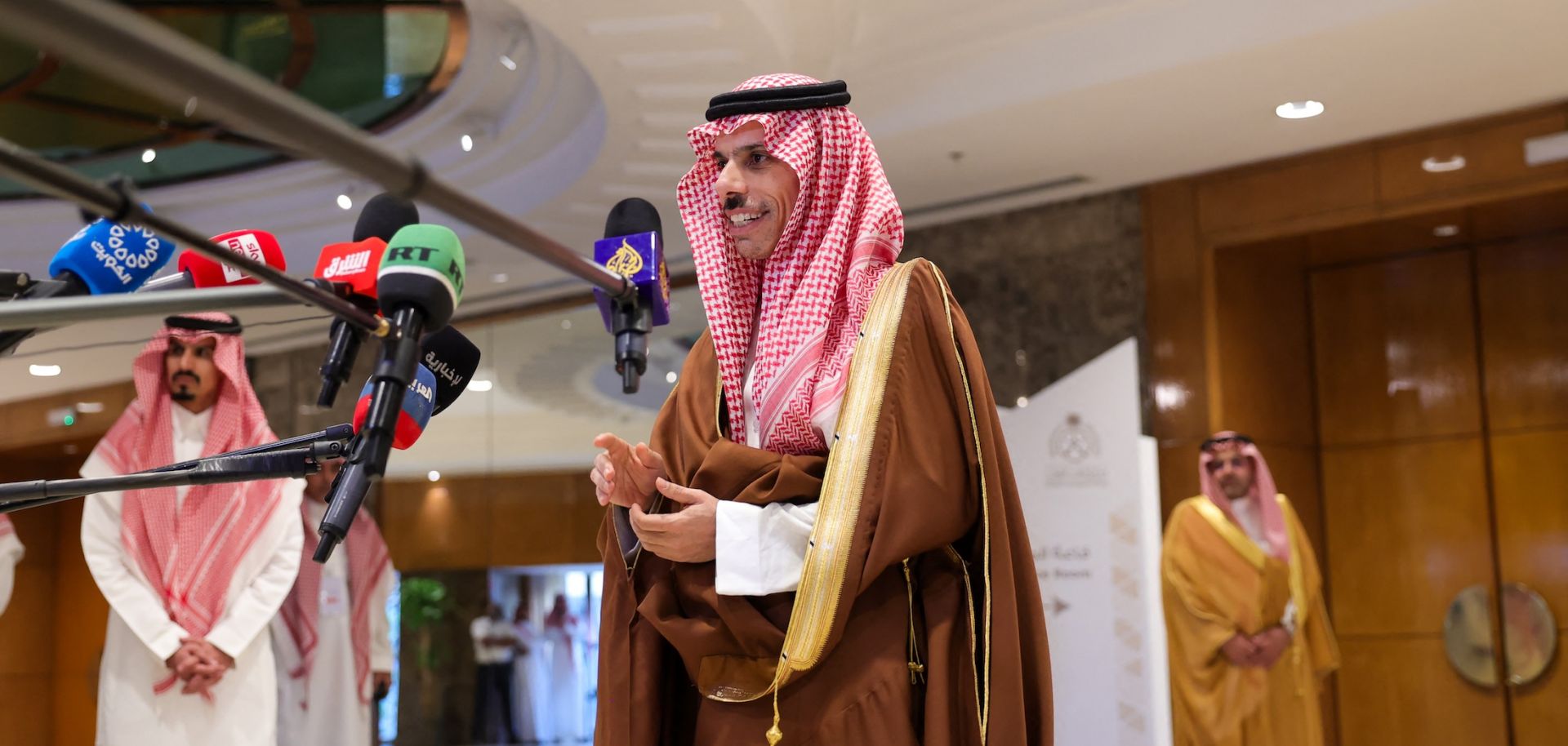
Saudi Arabia will continue to pursue a regional strategy of balancing between Iran and its opponents, though protracted regional conflicts risk undermining the kingdom's goals, economic diversification strategy and efforts to normalize ties with Israel. On Nov. 11, during the Arab League and Organization of Islamic Cooperation summit held in Riyadh, Saudi Crown Prince Mohammed bin Salman condemned Israel's actions in Lebanon and Gaza, demanding a stop of Israeli military operations in both places, while calling on countries of the world to recognize Palestinian statehood. Prince Mohammed's statements came less than two weeks after Saudi Arabia hosted the first meeting of its global alliance to push for Palestinian statehood on Oct. 30, with reportedly 90 countries represented. While this was largely a preliminary meeting with no substantive results, the initiative is designed to advocate for a two-state solution to the Israeli-Palestinian conflict, which would establish an independent Palestinian state. Meanwhile, on the same day, Saudi Foreign Minister Prince Faisal bin Farhan reiterated the kingdom's position that it will not normalize diplomatic relations with Israel before the establishment of a Palestinian state. He went on to pledge to mobilize Saudi and regional public opinion against Israel's actions toward Palestinians. For months, Saudi Arabia has condemned Israel's actions in Gaza, even calling them ''genocidal'' at times, while conditioning normalized ties with the country on the creation of a Palestinian state, despite U.S. efforts to broker a historic normalization deal between the Saudis and the Israelis.
- In his comments, Prince Faisal also denied reports of Saudi military exercises with Iran, which a Saudi defense military spokesperson said on Oct. 23 had taken place in the Gulf of Oman. The foreign minister's denial seemingly aimed to distance Riyadh from Tehran and came as Saudi Arabia seeks to secure a defense pact with the United States.
Saudi Arabia's Shifting Stance on Iran
Saudi Arabia's foreign policy under Crown Prince Mohammed has shifted notably from a posture of regional confrontation to a more conciliatory stance, particularly following the normalization of relations with Iran in 2023. Early in his leadership, Prince Mohammed emphasized a hard-line approach to regional foreign policy, including a military intervention in Yemen, a blockade of Qatar and a strong stance against Iran. However, as of 2023, his approach has shifted to reduce regional tensions as Saudi Arabia strives to meet the goals of its Vision 2030, a strategic framework aimed at reducing the kingdom's reliance on oil, diversifying its economy and developing public service sectors such as health, education, infrastructure and tourism. Launched in 2016, this framework emphasizes transforming Saudi Arabia into a global investment powerhouse and a logistics hub connecting three continents.
The wars in Gaza and Lebanon are testing Saudi Arabia's delicate balancing act as it tries to insulate itself from the repercussions of a regional war, seeking to maintain diplomatic ties with Iran while also calling for a two-state solution for Palestinians that would enable it to normalize diplomatic ties with Israel. Since the outbreak of the Israel-Hamas war in October 2023, Saudi Arabia's regional strategy under Prince Mohammed has focused on diplomatic openness and de-escalation of regional tensions — aspects that are key to achieving the goals of Vision 2030 by reducing security threats to the kingdom. For this reason, Saudi Arabia and Iran have continued to mend their diplomatic relationship since normalizing ties in March 2023, with officials from both countries frequently visiting one another and developing economic ties, albeit still limited, such as via more interconnected tourism sectors. Against this backdrop, Israel's ongoing conflicts with Iranian proxies in Gaza and Lebanon are stalling Riyadh's push for normalization with Israel, which is considered a pathway to regional stability and economic integration. Saudi leadership has maintained that normalization with Israel is contingent upon a viable Palestinian state, aligning itself with broader Arab and Muslim sentiment to prevent domestic instability and highlight its leadership of the Sunni Muslim world. This stance complicates Riyadh's balancing act in the region, particularly regarding Iran. Meanwhile, Israel's invasion of Lebanon and tit-for-tat attacks with Iran further complicate Riyadh's regional strategy, as Saudi Arabia and Iran have competing interests in Lebanon and have historically battled for influence there.
- Normalization with Israel could bring Saudi Arabia significant security, economic and diplomatic advantages, bolstering the kingdom's regional influence and aligning with its broader strategic goals, including regional integration and economic diversification.
As things stand, Saudi Arabia's aspiration to normalize ties with Israel is unachievable due to the current Israeli government's unwillingness to pursue a two-state solution to the Palestinian conflict. Even if Palestinian statehood remains a secondary objective in Saudi Arabia's regional strategy, the war in Gaza and Israel's actions against the Palestinians have mobilized Saudi public opinion against the Israelis, especially since the Israel-Hamas war has introduced the Israeli-Palestinian conflict to much of Saudi Arabia's large youth population for the first time. To avoid backlash at home, Riyadh will continue to condemn Israeli action and employ aggressive rhetoric against the Israelis, effectively conditioning normalization with Israel on a two-state solution to the conflict. In post-war Gaza, Saudi Arabia is also unlikely to participate in a plan that makes Riyadh an influential player in Palestinian domestic affairs, such as participating in the governance of the strip, as Riyadh aims to avoid being seen as engaging in a strategy that does not directly result in a Palestinian state. This also means Riyadh is unlikely to sponsor an initiative similar to the Arab Peace Initiative of 2000 or take any other lead role in resolving the conflict, especially considering the Saudis' strained relations with both Hamas, which governs Gaza, and the Palestinian Authority, which governs the West Bank. As a result, normalization with Israel will remain far-fetched in the near future unless a cease-fire is reached, which seems unlikely for now with the war in Lebanon now expanding.
- The Atlantic reported on Jan. 8 that during a meeting with U.S. Secretary of State Antony Blinken, Saudi Crown Prince Mohammed said he did not care much about the ''Palestinian issue'' but noted Israel's actions were introducing younger Saudis to it, hinting that public sentiment was compelling him to make the issue meaningful and its resolution a condition for Saudi-Israeli normalization.
- Despite Saudi Arabia's condemnation of Israel and its support for Palestinian statehood, the kingdom has poor relations with both Hamas and the Palestinian Authority. While the Saudis have expressed a willingness to improve ties with the Palestinian Authority, progress has not materialized, meaning it is unlikely that Saudi Arabia will play a large role in post-war Gaza unless an unlikely breakthrough occurs in Israel's willingness to accept and implement a two-state solution.
Israel's weakening of Hezbollah opens the door for Saudi Arabia to reassert its influence in Lebanon to counter Iran's, which would strain but not break Riyadh's relations with Tehran. Saudi Arabia will likely take a cautious approach to the conflict in Lebanon, opting to watch events unfold while carefully balancing its interests. The kingdom will likely continue to condemn Israeli actions and express support for Lebanon's sovereignty, people and state institutions, maintaining Riyadh's long-standing position of backing the Lebanese government. However, Saudi Arabia covertly sees potential opportunities in the conflict, particularly if Hezbollah, the Iranian-backed Lebanese political and militant group, is significantly politically and militarily weakened in the aftermath. In such a scenario, Riyadh may aim to reassert its influence in Lebanon, hoping to counter Iran's dominance by stepping into any power vacuum left by a diminished Hezbollah. This would likely play out by Saudi Arabia conditioning aid to Lebanon on reforms, the election of a president and the formation of a Cabinet that is not under the influence of Hezbollah and its allies. Riyadh's broader regional goals of limiting Iranian influence will be key in shaping its approach to Lebanon's internal dynamics during and after the conflict. Despite Hezbollah's importance to Iran, increased Saudi influence in Lebanon would unlikely lead to a full rupture of Saudi-Iran relations, though it may strain the two countries' diplomatic ties, which could manifest as increased support for proxies in Lebanon, as well as more aggressive diplomatic rhetoric or media campaigns between the two sides.
- Saudi Arabia and Iran have long vied for influence in Lebanon, primarily through their support for opposing factions. Iran has cultivated significant influence through Hezbollah, while Saudi Arabia has backed Lebanon's main Sunni politicians and parties, as well as the Maronite Lebanese Forces, aiming to counterbalance Hezbollah's dominance and reduce Iranian sway in the region. This competition has intensified Lebanon's political and sectarian divides, contributing to recurrent governmental paralysis and social unrest over the years, as well as the country's ongoing economic crisis.
Saudi Arabia will pursue diplomatic initiatives with Iran and continue to distance itself from the conflict with Israel, in the hopes of insulating the kingdom from reprisal attacks by Iran and/or its regional allies and proxies. To avoid being the target of Iranian-backed attacks like those seen in 2019 against its state-run oil giant Saudi Aramco, Saudi Arabia will lean on newly normalized relations with Iran to continue diplomatically engaging with the country. Riyadh will also aim to distance itself from Israel and the wider regional conflict to avoid alienating Iran, which might otherwise prompt its proxies to attack the kingdom, including its crucial oil and gas infrastructure. Regional tensions, sanctions on Iran and diplomatic sticking points limit how much relations between Iran and Saudi Arabia can progress. But Tehran and Riyadh will nonetheless pursue projects related to tourism, trade unsanctioned goods like agricultural products, and execute periodic and limited military cooperation, such as joint military drills or intelligence sharing over extremist threats like the Islamic State. Finally, Saudi Arabia will likely refrain from actions that could be seen as aggressive against Iran or helpful to Israel, such as sharing intelligence with Israel on Iran's plans in case of a future cycle of attacks; similarly, the kingdom is unlikely to allow Israel and/or the United States to use Saudi airspace to attack Iran or its proxies in Iraq or Yemen.
- In September 2019, drone and missile attacks on Saudi Aramco's facilities, widely attributed to Iran or Iranian-backed Houthi rebels, temporarily cut Saudi oil production by 50%, disrupting 5% of global supply and briefly spiking oil prices. The attack exposed vulnerabilities in regional energy infrastructure, intensified Saudi-Iranian tensions and raised global energy security concerns, prompting Saudi Arabia to strengthen its defenses and rapidly repair the damaged facilities.
- In April 2024, Saudi Arabia and the United Arab Emirates reportedly collaborated with the United States and Israel by sharing crucial intelligence on an impending large-scale Iranian missile and drone assault targeting Israel. This cooperation involved radar tracking data and early warning signals. However, the dynamics shifted in October when Iran urged Saudi Arabia not to allow Israeli aircraft access to its airspace, and the Saudis heeded the warning. Saudi Arabia was also the first state to condemn Israel for its direct attack on Iran on Oct. 26.
Finally, in Yemen, the Saudis will likely refrain in the short term from provoking Iran-backed Houthi militants to prevent any reprisal attacks, though the risk of Houthi strikes will persist amid regional tensions. Houthi attacks against Saudi Arabia in recent years have posed the biggest threat to the kingdom's regional plans and economic development, given that they caused numerous disruptions to travel and oil production. With that in mind, the kingdom will aim to keep the Houthis at the negotiating table regarding a potential permanent cease-fire in Yemen and will press the war-torn country's internationally recognized and Saudi-backed government in Aden to refrain from provoking the Houthis, given that the militants would likely take revenge for any such attacks by targeting Saudi Arabia. Nonetheless, with tensions persisting between Iran and Israel, the Iranian-backed Houthis still pose a threat to Saudi Arabia. Though the Houthis have not attacked Saudi Arabia since the start of the Israel-Hamas war, that could change if hostilities deepen between Iran and Israel, particularly if Israel continues directly attacking Iran or if the United States and its allies attack Iran or use Gulf countries' airspace. Such Houthi strikes could target Saudi Arabia's oil and gas sector to destabilize a key U.S. ally, deter investors, and create an energy shock and a security dilemma for Saudi Arabia, which still relies on oil exports as it tries to diversify its economy with Vision 2030.
- In April 2022, the United Nations, with support from regional countries like Saudi Arabia and Oman, brokered a truce in Yemen's civil war between the Iranian-backed Houthis and other Yemeni factions to pave the way for negotiations on a permanent cease-fire. While the talks on a permanent cease-fire have not progressed, the truce has held, despite the Houthis' attacks on ships transiting the Red Sea.
- In March 2022, the Houthis attacked a Riyadh oil refinery, briefly disrupting operations and causing volatility in supply and pricing for refined oil products.
- The Yemeni government recently tried to enforce banking restrictions aimed at tightening control over the flow of funds to Houthi territories, including blocking access to certain financial institutions in Houthi-controlled areas. In response, the Houthis issued strong statements condemning the banking sanctions, framing them as an act of ''economic warfare'' designed to starve the population in Houthi-controlled areas. The Houthis warned that if the government continued these financial restrictions, the group would retaliate by attacking Saudi Arabia's critical infrastructure, including oil and gas facilities, which are vital to the kingdom's economy and global energy supplies. In response, Saudi Arabia reportedly urged the Yemeni government to ease the banking restrictions on Houthi areas to prevent further escalation, which the government eventually did.
