
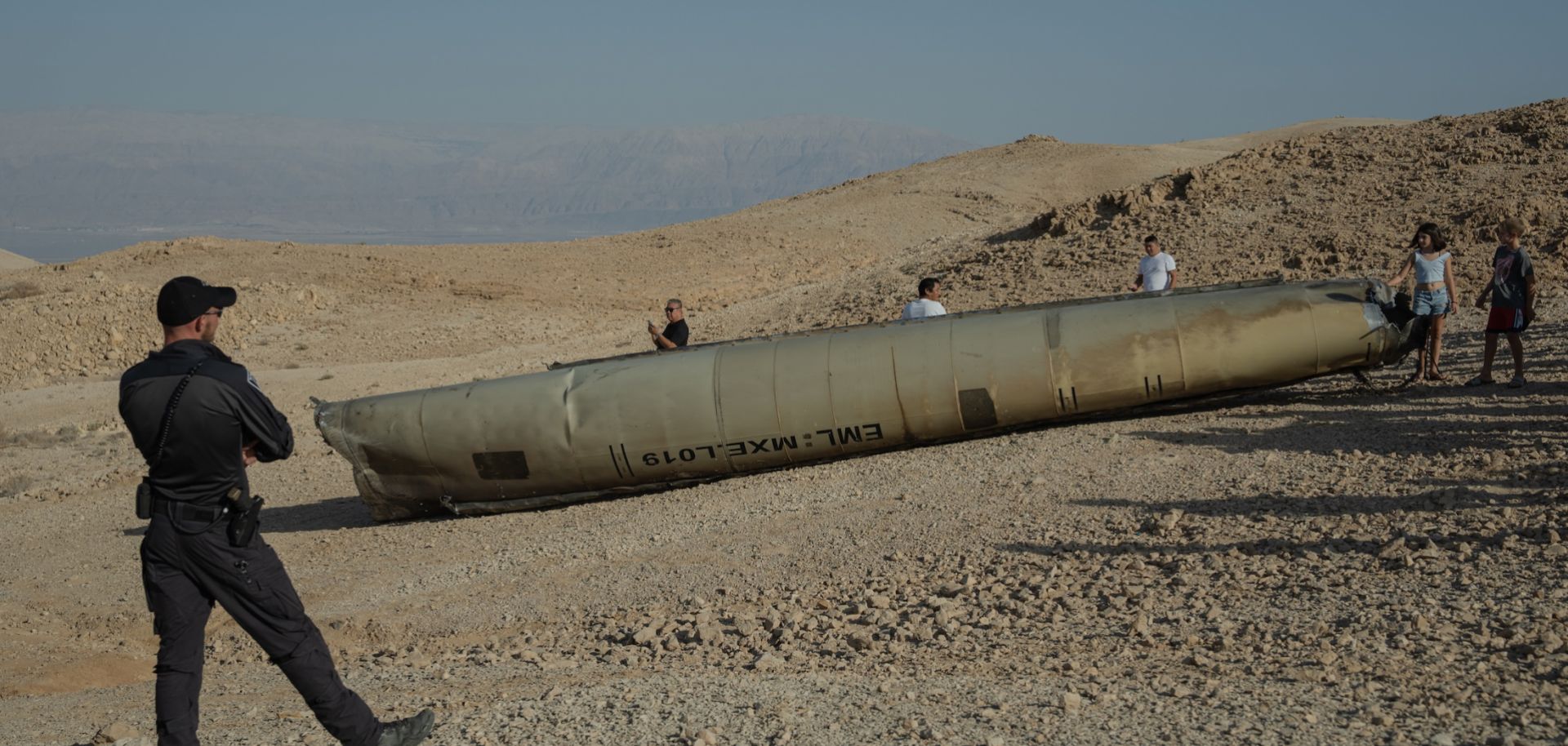
With a second round of Israeli-Iranian direct strikes concluded, the two rivals have now normalized direct attacks on one another. With this taboo broken, how will their conflict evolve?
Certain fundamentals have not changed. Iran remains conventionally weaker than Israel, whose Oct. 26 airstrikes showcased Israel's ability to conduct missions both near Iranian airspace and against multiple sensitive targets. At the same time, Israel still lacks the conventional capability to fully dismantle Iran's large military-industrial complex or break Iran's political will to continue its conflict with Israel and Iran's support for its regional proxies and allies. Israel appears to have the freedom to conduct military operations on its own terms, but it is unclear whether it can act on such freedom without producing major geopolitical shocks, let alone succeed in achieving Israel's ultimate goal of ending the Iranian threat to itself. And it is also unclear if the incoming administration of U.S. President-elect Donald Trump will back Israel in doing so — backing that will be critical to understanding Israel's future in the conflict.
What Israel Has Accomplished With Direct Strikes on Iran
In the early hours of Oct. 26, the Israeli Air Force (IAF) managed to build on its largely symbolic April 19 attacks to hit Iranian air defenses and sites associated with Iran's missile program. But even these more recent strikes were relatively restrained and did not target Iran's nuclear or energy facilities directly. Still, this was an achievement in and of itself, by proving that Israel can conduct long-range air strikes on Iran without needing direct U.S. support (like in-air refueling), and that Iran's air defenses are insufficient to stop such attacks. Whether the strikes truly destroyed Iran's S-300 missile air defense network, as the Israelis claimed and the Iranians denied, is perhaps beside the point, given that the Russian-built S-300 system was still unable to block the attacks or down IAF fighters-. And while it's likely disrupted at least aspects of Iran's missile program, like facilities used for fuel mixing, Iran's current arsenal appears untouched; Iran seems to have as many missiles today as it did before the attacks, given that Israel did not go after storage facilities or launch sites. In striking Iran, Israel did not go as far as it could have. Instead, the attack aimed to show that Israel can strike within Iran as it chooses and may escalate to more strategic targets in the future.
This is perhaps the fundamental question going forward: How much further will Israel and Iran go? Certainly, with a second round of strikes between them, it is accurate to say that a type of regional conflict is underway. But it is not perhaps the regional conflict that many had in mind. It has not produced a massive spike in oil prices, nor has it pulled the United States into direct military action against Iran. Countries like Saudi Arabia, the United Arab Emirates, Bahrain and even Egypt, which borders Gaza, have stayed out of this struggle. But the geography of the conflict nonetheless remains expansive and could further escalate.
Iran Focuses on Remaining Intact
For Iran, the contest is about maintaining its current political system and foreign policies against stronger rivals. Certainly, the Iranians are learning about their own conventional capabilities as they conduct ballistic missile strikes on Israel. They have learned that they must conduct much larger swarms with their more advanced equipment to inflict material damage in Israel. And they have learned that, despite this threat, they are not fully able to deter Israeli behavior. The Oct. 26 strikes showed them that their air defenses remain incapable of blocking Israeli action as well. But it may also have shown them that their infrastructure is still expansive enough that if Israel is serious about a strategic destruction operation, it will have to do so over an extended period that will put Israeli jets at risk of being shot down — and its pilots at risk of capture.
Moreover, Iran is witnessing a region full of countries working hard to maintain neutrality to avoid the maximum-scale regional war scenario. Saudi-Iranian relations are continuing to improve, and in fact, military ties between the two are deepening. Iran claimed that Saudi Arabia recently took part in a naval exercise and that there have been high-level military official visits between the two, suggesting that Iran has little current interest in harassing tankers leaving Saudi Arabia or turning the Strait of Hormuz into an impassable waterway. Instead of seeing a regional coalition of like-minded states that want to see its Islamic Republic overthrown, Tehran is witnessing a region split by states eager for neutrality as they seek their own domestic economic development and try to fend off domestic populations angry over Israel's campaign in Gaza. These are no small diplomatic feats, and by doing so Iran also gains tangible security outcomes, like denying Saudi, Emirati and other Gulf Arab airspace to Israeli and American jets that might eventually move against Iran. This detente also carries with it the potential for Iran to deepen trade relations with regional states in sectors like agriculture, which is unsanctioned by the United States.
Meanwhile, at home, Iran is not seeing a surge in anti-war protests or anti-regime behavior beyond what already existed before the Israel-Hamas war broke out in October 2023. Israeli airstrikes inside Iran have not produced a legitimacy crisis for the regime, but they have fueled its propaganda that the very system of the Islamic Republic is necessary to protect Iran from its enemies. The internal media spin that Israel's strikes have produced minimal damage is also meant to serve the same domestic narrative that the Islamic Republic is capable of doing so. After all, few things can rally divided populations like an external aggressor; for Iran, extended conflict with Israel has the chance to unite, or at least distract, a population that is otherwise divided on many other social, economic and political issues.
These factors suggest that Iran is relatively comfortable, at least at the moment, in conducting future rounds of strikes directly against Israel in response to Israeli provocations. These provocations could be yet more Israeli assassinations of prominent pro-Iranian figures like the now-deceased leaders of Hezbollah and Hamas, or they could be in reaction to Israeli actions against Iranian officials and forces positioned abroad. Tehran can still calculate that direct strikes on Israel will prompt an assertive U.S. defense but not direct American participation in a counter-attack. Meanwhile, Israeli counter-attacks, while significant, will most likely not be gauged as a strategic destruction campaign that would destroy Iran's nuclear program, cripple its energy sector or severely damage its missile program.
Trump's Opinion on the Matter
In Israel, there are plenty of hawks arguing Iran is too conventionally weak to deter attacks on its nuclear program and energy facilities. Iran's nuclear program, of course, has long been the target of Israeli hawks who believe it will eventually be used to develop a nuclear weapon. The program's destruction would achieve a significant goal, particularly for the government of Prime Minister Benjamin Netanyahu, who has warned about Iran's nuclear development for over a decade. In addition, targeting Iranian energy facilities could also squeeze Iran in a way sanctions cannot by physically depriving Iran of its most valuable export. Israel could calculate that such strikes would end Iran's black-market oil trade and deprive the government of critical revenue. Without such revenue, Iran's entire anti-Israel foreign policy becomes significantly more difficult.
But these hawks must still take into account American opinion. Incoming President Donald Trump is an Iran hawk himself in some ways and a dove in others. In his first term, he was very comfortable with using ''maximum'' economic pressure and comfortable using military pressure. When Iran destroyed Saudi oil facilities in 2019, Trump, wary of further escalation and aware that Iran's attack had a limited impact on global oil supplies, responded with a cyberattack on Iran that similarly appeared to have a limited impact. He also restrained the U.S. Navy from aggressively blocking an Iranian naval harassment campaign against oil tankers that began that same year. During his first term, he never greenlit an Israeli air campaign against Iran proper, again worried about energy shocks.
But Trump could be erratic. When a U.S. contractor was killed by Iranian-backed militias in Iraq in December 2019, Trump responded by rapidly moving up the escalation ladder to killing Iranian Quds Force General Qassem Soleimani in January 2020. Iran responded with a mass ballistic missile strike on U.S. troops, but when that attack only wounded soldiers, Trump's dovish instincts returned and he demurred from retaliation.
In his second term, Trump is certain to return to enhanced sanctions enforcement, but whether he will back Israel's military campaign against Iran is less clear. Trump may be content to allow Israel to steadily increase its campaign in Iran, particularly if it is slow-moving and does not carry a risk to U.S. troops or energy markets. He may also suddenly throw U.S. forces into the fray, in response to either a high-casualty Iranian attack on Israel or regional harassment against U.S. forces and/or energy targets in the Gulf. And Trump may even step into the role of mediator, forcing de-escalation from Israel through the political strongarming of Netanyahu, should he feel his domestic agenda is threatened by continued cycles of violence in the Middle East that might well produce that long-feared energy shock.
If Israel escalates, however, then so too must Iran — an escalation that will now also be tied to fending off the United States' renewed maximum-pressure campaign under Trump. This escalation could still remain within the confines of an Israeli-Iranian conflict, one that limits the risks of geopolitical shock. But Iran increasingly has less incentive to do so. Its drive to develop a nuclear weapon is stronger now, as Iran grapples with a regional proxy network weakened by Israel and braces for four years of hostile U.S. ties under a Trump administration full of hawks who want to overthrow its government. Iran's incentives to produce the long-feared energy shock also rise the less oil it can export and the more at risk it is of a sustained Israeli aerial campaign.
Detente or not, there will come a point when Iran will debate if good relations with Saudi Arabia outweigh the pressure it can put on the United States by targeting Saudi oil production again. And should the United States signal it supports an open-ended Israeli campaign against Iran, or even join it, then Iran must decide if it is ready to directly strike U.S. troops throughout the region, suddenly pulling it into a U.S.-Israeli military confrontation that Iran has strived to avoid for years. Few of these are palatable options for Iran, but faced with a hawkish Israel and a potentially more hawkish United States, it will have to consider them.
