
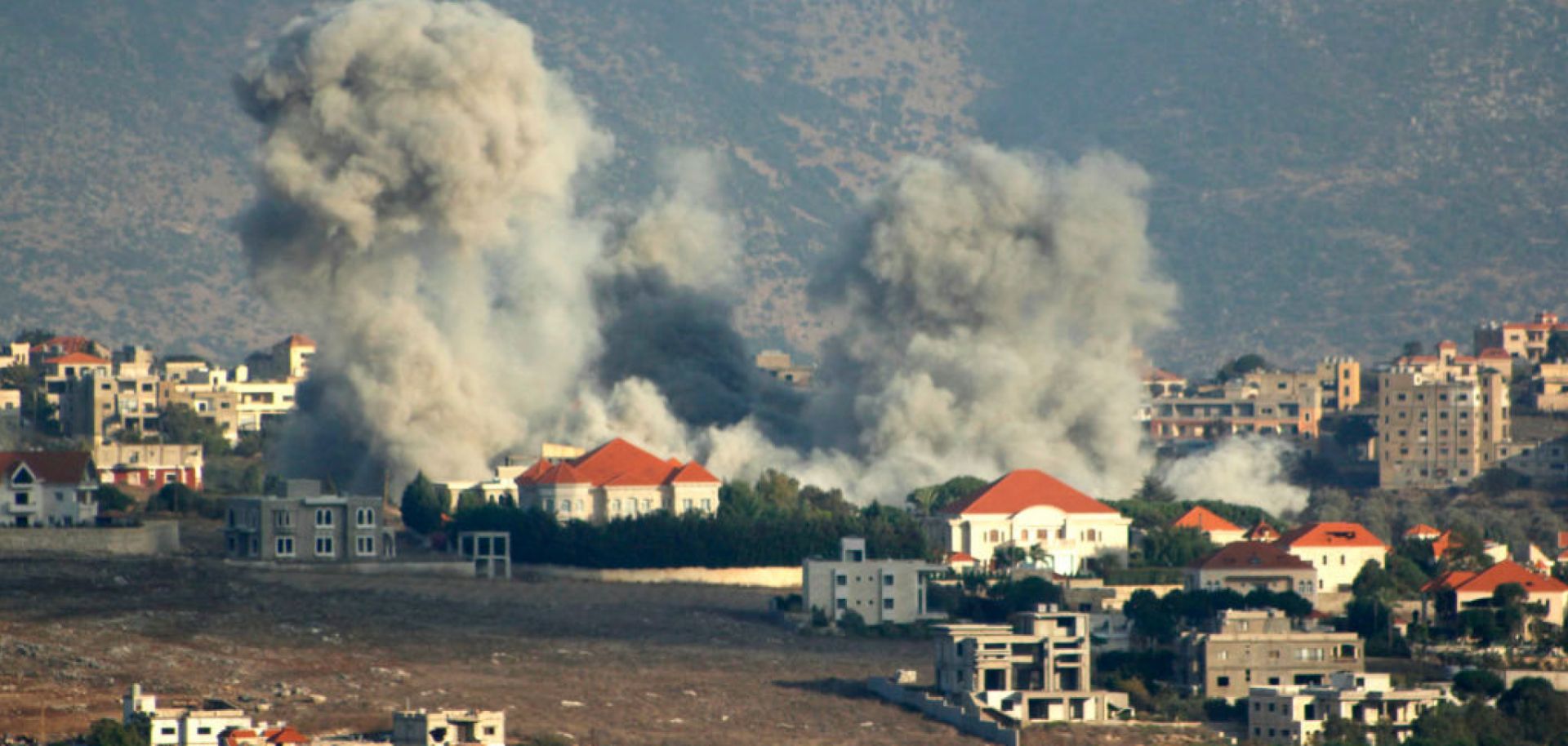
While Israel's invasion of Lebanon may initially boost domestic support for Hezbollah's fight against Israel, various Lebanese factions will probably become increasingly critical of the group as the war wears on, especially if Israeli troops advance and Hezbollah faces further setbacks, increasing the likelihood of localized violence between Hezbollah and its Lebanese rivals. Israel's Oct. 1 ground incursion in southern Lebanon threatens to weaken Hezbollah's domestic image further after the group failed to prevent Israel from infiltrating its ranks following the Sept. 27 assassinations of Hezbollah leader Hassan Nasrallah and several other senior officials. However, even before Israeli ground troops began crossing into Lebanese territory, signs were mounting that Lebanese citizens would at least initially rally against an Israeli invasion. On Sept. 28, caretaker Prime Minister Najib Mikati — who heads Lebanon's severely paralyzed government — called on Lebanese citizens to ''come together,'' saying ''our national responsibility at this historic and exceptional moment requires setting aside political differences.'' The Lebanese army then echoed this sentiment on Sept. 29 by urging Lebanese citizens to preserve national unity while depicting Israel as a common enemy that was ''working to implement its destructive plans and sow division among Lebanese.''
- Nasrallah, who had served as Hezbollah's leader since 1992, was a highly charismatic and influential figure in Lebanon. He gained domestic support among Lebanese Shiites (who comprise a reported one-third of Lebanon's population) — especially after Hezbollah thwarted Israel's invasion of Lebanon in 2006.
- Hezbollah said its decision-making body, the Shura Council, will convene to select a new leader for a three-year term ''at the earliest opportunity,'' but has not provided further detail on a timeline. Hashem Safieddine, Nashrallah's cousin and the head of Hezbollah's Executive Council since 2001, was widely anticipated to be Nasrallah's successor, though both Safieddine and his replacement were allegedly killed in an Israeli airstrike on Oct. 3, according to Israeli Prime Minister Benjamin Netanyahu.
- According to senior U.S. and Israeli officials, Israel's escalated airstrikes have destroyed half of Hezbollah's missile and rocket arsenal. The Israeli pager and walkie-talkie attacks on Sept. 17-18 also reportedly severely injured 1,500 Hezbollah fighters. Nevertheless, Hezbollah still has tens of thousands of missiles and rockets in its arsenal and maintains its weapons supply chain with Iran to replenish some capabilities. Additionally, the group still has an estimated 40,000-50,000 fighters, which will enable it to continue fighting against Israel for at least several more months.
The fallout from Hezbollah's conflict with Israel has further damaged Lebanon's struggling economy after years of crisis and political paralysis. When the Gaza war broke out in October 2023, Lebanon's economy had already been in crisis for years with no near end in sight due to the country's deep political dysfunction. Since former President Michel Aoun's term ended in 2022, the deadlocked parliament has failed to select a new president or pass legislation to address Lebanon's worsening economic situation. Hezbollah has contributed to this by not only preventing a vote in parliament on a consensus presidential candidate, but also opposing economic reforms that would increase transparency and reform the banking sector (since the current weak system enables the group to conceal and finance illicit activities). The lack of these economic reforms has left Lebanon unable to secure a much-needed IMF bailout after seven consecutive years of economic contraction. Hezbollah's involvement in the Hamas-Israel war over the past year has only since exacerbated Lebanon's economic woes by reducing tourism revenue, damaging infrastructure and disrupting the country's agricultural exports. The collateral damage from Israeli airstrikes (especially those in dense civilian areas) and the Sept. 17-18 pager attacks (which killed at least 32 people) have further strained Lebanon's fragile healthcare system as well, by quickly overwhelming hospitals with injured patients. Lebanon's limited resources have also been further strained by the growing number of internally displaced Lebanese citizens, estimated at around 1 million, in addition to the large Syrian refugee population that Lebanon has housed since the outbreak of the Syrian civil war in 2011.
- The Lebanese parliament has been unable to agree on a new president since Hezbollah blocked the election of any candidate other than key Hezbollah ally Suleiman Frangieh, who is a nonstarter with other political parties.
- In late September 2024, the Economist Intelligence Unit forecasted the Lebanese economy could shrink by 10-25% by the end of 2024 amid Israel's escalating cross-border attacks, which will likely continue to deter tourism while destroying crops and damaging critical infrastructure.
- According to the World Bank, 44% of people living in Lebanon (including refugees) were living in poverty in 2022 — nearly quadruple the amount who were living in poverty ten years earlier. This rate has likely only increased since then.
- In 2023, tourism accounted for approximately 25% of Lebanon's GDP, bringing in $5.4 billion in revenue. In August 2024, a Lebanese bank estimated the expanded conflict with Israel could decrease tourism revenues by 50-55% in 2024.
- In the aftermath of Israel's deadly attacks on pagers used by Hezbollah members, private medical facilities in Lebanon — which represent 85% of hospital beds in the country — were at full capacity. Between 2019 and 2021, following the Lebanese economic crisis in 2019, the World Health Organization noted that 40% of Lebanese doctors and 30% of nurses left the country either temporarily or permanently to seek better employment opportunities, limiting the number of healthcare providers in the country and reducing hospital bed capacity by 50%.
- Lebanon hosts approximately 1.5 million Syrian refugees in a country of 6.6 million citizens. Recent Israeli airstrikes have internally displaced around 1 million people, and more than 30,000 individuals, mostly Syrians, have crossed the Lebanese border into Syria.
Lebanese citizens and lawmakers will likely initially come together in the face of Israel's incursion in the south, which will temporarily reduce domestic criticism of Hezbollah and ease sectarian divisions within the government. Aside from consolidating support among Hezbollah's ideological base, at least in the short term, the Israeli invasion will likely help bring together traditionally Hezbollah-opposing sects — like Sunni Muslims, the Lebanese Forces (a Maronite political party and former militant group) and the Kataeb Party (a right-wing Christian party) against Israel. Although the Israel Defense Forces (IDF) have claimed their strikes have been directed at Hezbollah targets, the IDF has attacked densely populated residential areas in Lebanon, incurring civilian casualties and damage. Furthermore, Israel's slowly expanding ground invasion will revive memories of Israel's 1982 invasion, which resulted in an 18-year Israeli occupation of southern Lebanon, further fueling anti-Israeli sentiment among the Lebanese people. In this environment, politicians across the sectarian spectrum will likely call for Lebanese unity, though they may not necessarily back Hezbollah's militancy, to prevent sectarian violence from exacerbating the conflict. Should Hezbollah recover from its recent losses and successfully force Israel to retreat and/or bog it down in a war of attrition that leads to major Israeli casualties, popular support for Hezbollah would only further increase.
- Although Israel is more prepared for a war in Lebanon than it was at the start of the 2006 war, Hezbollah's preparedness to resist an Israeli invasion has also increased, as the group now has up to 50,000 fighters compared with the roughly 5,000 it had in 2006. Furthermore, Hezbollah's arsenal has expanded and it has developed a robust tunnel network that provides a geographic tactical advantage where the ground fighting has commenced.
- Figures across the Lebanese sects have called for national unity preceding and in the wake of Israel's invasion. Caretaker Prime Minister Najib Mikati, a Sunni Muslim, said ''Our national responsibility at this historic and exceptional moment requires setting aside political differences.'' In addition, the Lebanese Forces, a Christian group and Hezbollah opponent, called on its supporters to go ''radio silent'' on social media. Furthermore, former Prime Minister Saad Hariri, whose father was killed by Hezbollah operatives, called for Lebanese to ''rise above differences.'' While many Lebanese Christians and Sunni Muslims traditionally oppose Hezbollah, some groups within the sects also back Hezbollah.
However, if the Israeli invasion leads to a months-long protracted conflict, sectarian divides will remerge to pressure Hezbollah to reach a cease-fire with Israel and shift Lebanon's balance of power away from the group, though Hezbollah will not easily cede power. Even if most Lebanese Shiites continue to back Hezbollah, a prolonged war lasting several months would likely weaken domestic support for the group, especially among non-Shiites like Christians and Sunni Muslims, who largely oppose Hezbollah. As Israel's ongoing attacks destroy more infrastructure, kill more civilians and leave more people internally displaced within Lebanon, popular resentment toward Hezbollah for embroiling Lebanon in conflict would very likely grow, which opposition parties and sectarian groups would probably try to capitalize on to further weaken Hezbollah. Christians, Sunni Muslims and the few opposition Shiites would likely come together to call for an end to the war, even if they are unlikely to outright blame Hezbollah for fear of alienating Shiite Muslims who support the group. This would likely see sectarian factions pressure Hezbollah to reach a cease-fire that would see Israeli troops halt their attacks and withdraw from southern Lebanon. Already, on Oct. 7, a group of 12 opposition lawmakers in Lebanon's parliament issued a statement calling for an immediate cease-fire and for the Lebanese government to distance itself from regional conflicts and foreign interference. Such pressure would presumably only increase if Israeli troops appear to be advancing deeper into Lebanon and if Hezbollah loses significant manpower and equipment on the battlefield. From such a weakened position, Hezbollah may be more willing to agree to a cease-fire and frame it as a sign of Lebanese unity, which would provide it more time to withdraw and regroup. But for Israel to sign such a deal, Hezbollah would very likely need to agree to withdraw from its strategic positions in southern Lebanon and let the Lebanese army serve as the primary security force there — concessions Hezbollah would likely only be willing to make if a combination of domestic political pressure and painful battlefield losses leaves the group feeling it has little other option.
- Prime Minister Mikati has already backed a diplomatic resolution to the conflict, having said, ''We have no option but the diplomatic option.'' Furthermore, Mikati said that Lebanon was ready to fully implement U.N. Security Council Resolution 1701 and deploy the Lebanese army south of the Litani River, which is about 30 kilometers (or 20 miles) north of the Israel-Lebanon border.
- Although Lebanon's weapons supply chains will likely remain intact — though at times momentarily disrupted by Israeli strikes — a prolonged conflict marked by significant Hezbollah casualties and intelligence failures would likely result in weakened and demoralized fighters. Furthermore, Nasrallah's successor may not be as charismatic and may, in turn, isolate less ideologically motivated Hezbollah members.
- Hezbollah's deputy leader, Naim Qassem, said that Hezbollah supports ''political efforts [that] work towards a cease-fire'' without conditioning them to a cease-fire deal in Gaza. However, Qassem also said that a Hezbollah-Israel cease-fire was a precondition to any other decisions, alluding to Hezbollah's unwillingness to elect a Lebanese president prior to an end to the fighting in Lebanon.
If other Lebanese factions try to weaken Hezbollah's political power amid pressure from countries like the United States and Saudi Arabia, Hezbollah would likely respond with aggression, raising the risk of at least isolated sectarian violence. The United States, Europe and regional partners like Saudi Arabia will likely continue to pressure Hezbollah's political rivals in Lebanon, as well as state entities like the Lebanese Armed Forces, to take advantage of Hezbollah's weakened position and elect a new president, thereby breaking the government's yearslong political deadlock while reducing Hezbollah's (and, by extension, Iran's) dominance in Lebanese politics. U.S. pressure to do so, in particular, would likely increase if Iran becomes more embroiled in the conflict with Israel by sending troops to Lebanon and/or more weapons to Hezbollah, Tehran's most important regional ally. If pro-West sects and opposition parties in Lebanon, including the Lebanese Forces and Kataeb Party, heed this pressure by taking more overt action to further weaken Hezbollah politically and militarily, Hezbollah would likely respond with aggression, opposing any collusion with the United States. This would increase the risk of localized violence, like the deadly 2021 clashes that broke out between Hezbollah and the Lebanese Armed Forces following protests over the handling of investigations into the 2020 Beirut port explosion. Such conflicts, however, are more likely to occur between Hezbollah and other sects or opposition parties, especially those with militant roots that have previously engaged in armed conflict with Hezbollah, like the Lebanese Forces. If the war with Israel significantly degrades Hezbollah's capabilities and the Lebanese opposition tries to take advantage of this weakness, Hezbollah may be compelled to respond more forcefully to the domestic threats to its power by conducting larger, but still geographically limited, attacks and violent incidents (like the 2008 Beirut takeover that killed roughly 100 people), as the group tries to show that, despite being weakened, it remains a major player in Lebanese politics. Nevertheless, neither Hezbollah nor the opposition has a political imperative to stoke sectarian violence at a scale that could threaten civil war, which for Hezbollah, would risk further tarnishing its domestic image and fueling the narrative of the group being the main source of Lebanon's instability; opposition sects and parties, meanwhile, would unlikely have the capacity to defeat even a weakened Hezbollah in combat. A large-scale domestic conflict is thus highly unlikely.
- On Oct. 8, a U.S. State Department spokesperson said the United States ultimately wanted to see Lebanon ''break the stranglehold that Hezbollah has had on the country and remove Hezbollah veto over a president.''
- In 2008, Hezbollah seized control of much of western Beirut in a series of clashes between the group and the U.S.-backed Lebanese government, which began during a general strike. Hezbollah's aggression during the conflict was driven by a desire to not only assert its domestic power but push back against U.S. influence in Lebanese politics.
