
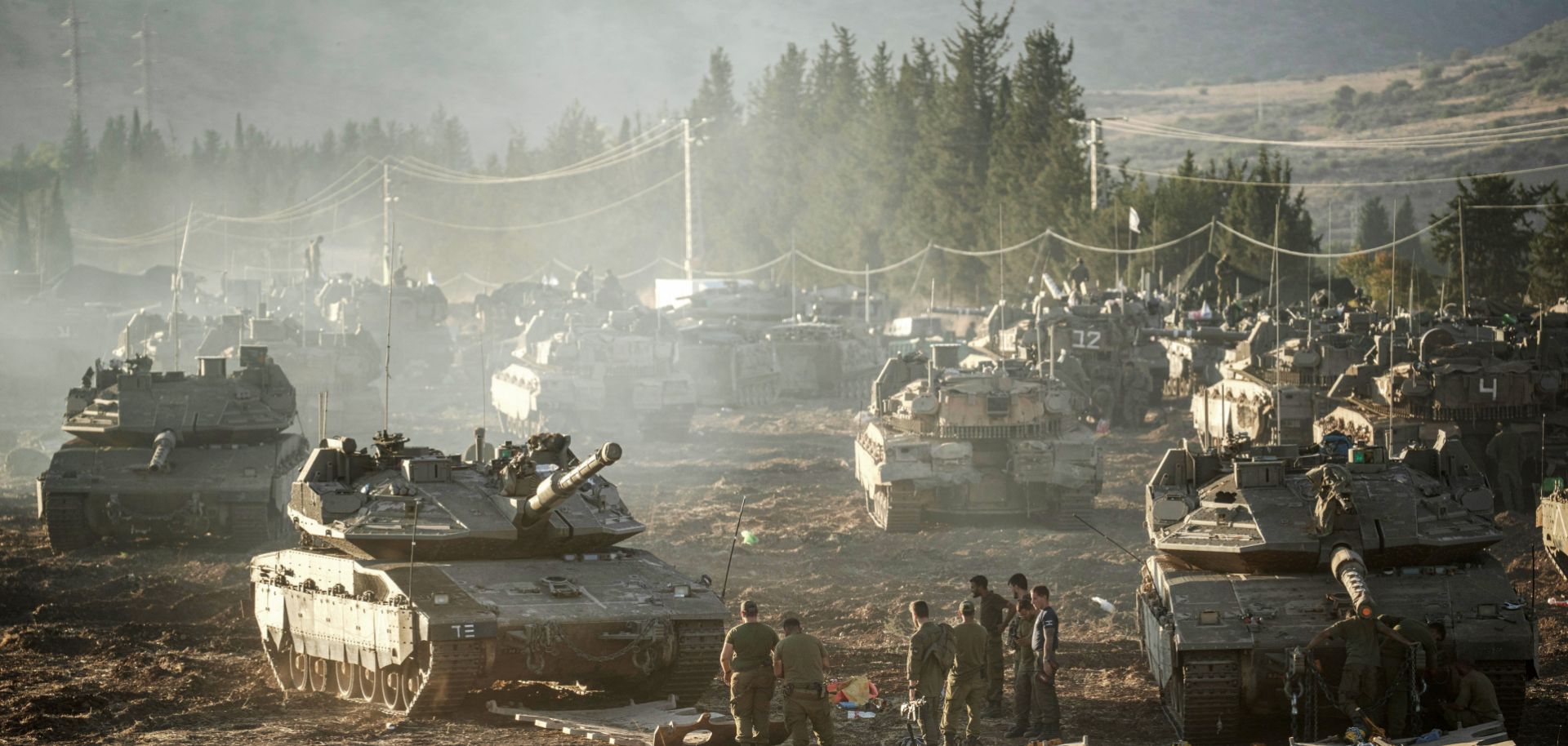
Israel has multiple options for ground operations as Hezbollah tries to re-organize and recuperate from its losses, but no operation will firmly and quickly secure southern Lebanon, and could pull Israel into a longer and more extended campaign that does not fully secure its goals and causes more damage to Lebanon. On Sept. 30, signs mounted that Israel was preparing for an invasion of Lebanon, with tanks sighted on the northern Israeli border and U.S. officials warning that an operation could be imminent. Prior to that, over the weekend of Sep. 28-29, the Israel Defense Forces (IDF) continued their large-scale aerial strikes across Bekaa, Beirut, southern Lebanon and the Syria-Lebanon border following the IDF's Sept. 27 assassination of Hezbollah Secretary-General Hassan Nasrallah and senior Hezbollah and Iranian Islamic Revolutionary Guard (IRGC) commanders. These operations aimed to degrade Hezbollah's capabilities, dismantle its command structure and block arms shipments from Syria by effectively establishing a military blockade against the group, isolating it from its allies and supply lines from Iran. Meanwhile, in his first address since Nasrallah's assassination, acting Hezbollah leader Naim Qassem vowed to continue the fight, claiming the group retains its medium-to-long-range strike capacity. He also stated that Hezbollah's leadership structure had been swiftly reorganized in the wake of the Israeli assassinations and that the group was prepared to defend against a ground incursion.
- Anonymous Israeli officials claimed that the IDF in recent days and months had already started special operations against Hezbollah in southern Lebanon, accessing tunnels to gather intelligence on them and the group's readiness to fight a ground war.
- Over the weekend of Sept. 28-29, Israeli strikes in Lebanon killed more high-ranking militants, including Hamas-in-Lebanon leader Fatah Sharif and several other Palestinian militant officials.
Israel is taking advantage of temporary chaos in Hezbollah after a series of successful strikes on the group, including the killing of Nasrallah, and Hezbollah's so far limited blowback. The government of Israeli Prime Minister Benjamin Netanyahu is likely seizing what it sees as a once-in-a-lifetime opportunity to dismantle Hezbollah's military wing. Israel's successive tactical wins — including the Sept. 17-18 attacks against Hezbollah's electronics — and the consequent damage to Hezbollah's command and control structure and its military capabilities are also encouraging the Israeli military to seize the chance to physically enforce a buffer zone in southern Lebanon, in the hopes of allowing northern Israelis to return home after being forced to flee due to Hezbollah's cross-border rocket attacks. Additionally, seeing that until now Hezbollah has been largely ineffective in retaliating to Israel's bombing campaign despite launching dozens of rockets a day, including some ballistic missiles toward major cities, the Israelis are growing emboldened that Hezbollah is significantly depleted and is unable to efficiently defend against the Israelis on the ground or consistently threaten Israel's cities. Finally, the Israelis are also exploiting Iran's apparent unwillingness to rush to Hezbollah's defense or significantly retaliate against Israel for the killing of Nasrallah, despite Hezbollah being Tehran's most armed, organized and important proxy in the region.
- On Sept. 30, Israeli Defense Minister Yoav Gallant hinted that a ground operation inside Lebanon could be imminent. The same day, Iran's foreign ministry said it would not send troops to fight alongside Hezbollah.
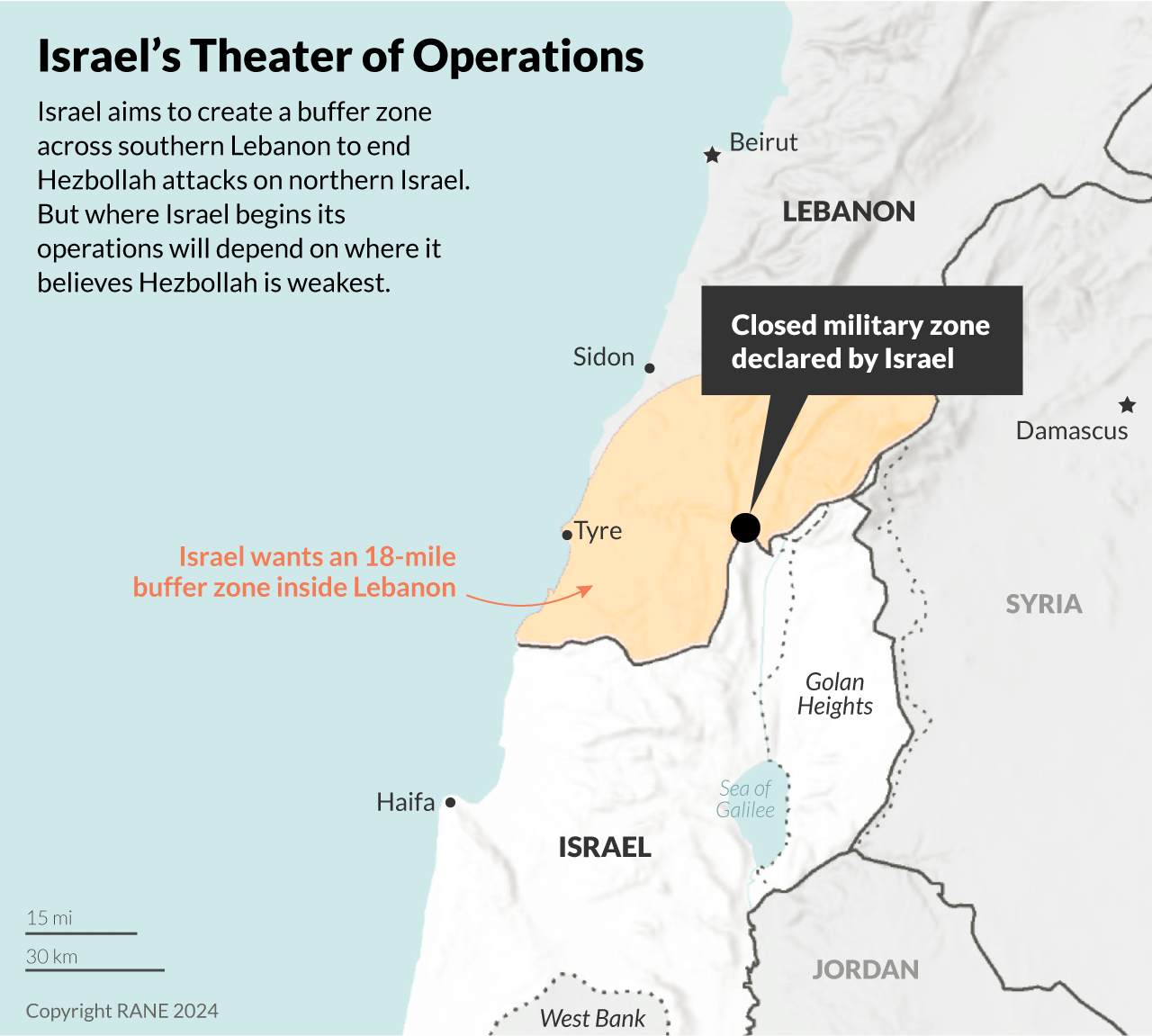
Israel will likely launch at least a limited ground incursion into Lebanon as its first choice, though Israel may adopt more aggressive strategies to create its desired buffer zone in the south. Israel has stated that it is not seeking to destroy Hezbollah, which was the goal of Israel's 2006 war with the Lebanese group, but rather weaken Hezbollah to the point where the group is forced to withdraw from the border and end attacks on Israel. As a result of this less expansive goal, Israel will gauge ground operations that are designed to break Hezbollah's political will to resist and create a buffer zone in the south without diverting focus from the Gaza and West Bank theaters. These options, in order of most likely to least likely, include:
- Incursions in southern Lebanon followed by withdrawals back to the border, akin to Israel's strategy in Gaza. In an option similar to the current tactics it is using against Hamas in the Gaza Strip, Israel would send over limited numbers of troops into southern Lebanon, dismantle Hezbollah infrastructure, kill and capture Hezbollah fighters, and then pull back to the border. Such efforts would be aimed at establishing a limited ''sanitary zone'' that Hezbollah and other militants cannot entrench or move into, which Israel would enforce by cross-border fire rather than ground troops. This would reduce the risks of Israeli forces being trapped in a guerrilla war, and would be seen as less diplomatically problematic by the United States and other key Israeli backers given it would clearly avoid occupying Lebanese territory. But it would be a slow process against an entrenched enemy that, unlike Hamas, has clear supply lines to a major military-industrial center in Iran. Moreover, this strategy would have to be sustained for weeks or even months to break Hezbollah's political will to continue fighting — a prolonged fight that Israel's government may not be able to sustain from a political standpoint, given Isrealis' increasing war weariness.
- Limited border zone operations to occupy a buffer zone. In this scenario, the Israelis would send over forces to occupy a strip around 10 kilometers (roughly 6 miles) deep inside Lebanon. This would be more diplomatically and militarily risky than raids and withdrawals but would not involve major numbers of troops in an open-ended campaign against Hezbollah deeper into Lebanon. However, it would leave Israeli forces exposed to recurrent guerrilla attacks from not only Hezbollah but also Palestinian militants like Hamas, all of whom would gain a major recruitment boost amid Israel's occupation of Lebanese territory. Hezbollah might eventually be convinced to come to a diplomatic settlement to return this territory, but only after an extended conflict that would be costly for both sides, and would likely also see yet more Israeli assassinations against Hezbollah and more Hezbollah attacks on Israeli cities.
- A push to the Litani River, followed by a withdrawal. Seeing Hezbollah in disarray, the IDF would push deep into the south of Lebanon to the Litani River, flooding the area with troops to dismantle Hezbollah's infrastructure and maximize the number of fighters it can kill and capture. After this shock push, the IDF then declares Hezbollah's capabilities sufficiently diminished and returns to Israel and/or a 10 kilometer buffer zone to restart negotiations with Hezbollah to end the fighting. In addition to involving a large number of Israeli ground forces, this operation could draw in the Lebanese Armed Forces (LAF), result in large numbers of Israeli casualties, and would be diplomatically opposed by most countries, including the United States. But while by no means guaranteed, such a sustained operation could also weaken Hezbollah's will to fight and make a diplomatic settlement that creates a buffer zone more likely, particularly if Israel threatens to repeat it more than once.
- A push to the Litani River that recreates a temporary version of the 1982 buffer zone. In this scenario, the IDF concludes that holding Lebanese territory is the only way to achieve Israel's security goals and make Hezbollah willing to negotiate a sustainable end to fighting. This invasion option would use the most troops for the longest period of time, as Israel would have to hold territory south of the Litani River until Hezbollah agreed to a diplomatic settlement. This option becomes more attractive if the IDF assesses that recent targeted strikes on Hezbollah have fatally weakened its command and control and that the IDF has a window of opportunity to firmly reshape the dynamics of Lebanon's south with less cost as a result. The United States, Arab states and much of Europe would oppose this open-ended occupation, and it might result in the United States holding up shipments of arms to Israel (like 2,000-pound bombs) as a result. If Hezbollah was able to kill sufficient numbers of Israeli troops, it would weaken Israel's resolve to maintain the buffer zone, and might force Israel to end fighting without gaining a guarantee of Hezbollah's permanent exit from Lebanon's south.
Regardless of what it decides to do next, the IDF will face the prospect of having to deepen its ground operations in Lebanon, up to and including ground operations that push past the Litani River toward Beirut or the Bekaa Valley, sparking a humanitarian crisis and worsening Lebanon's instability. Should these options fail to produce a diplomatic settlement with Hezbollah, Israel will be trapped in an open-ended ground campaign in Lebanon and forced to consider ground operations further north into Lebanon to attempt to break Hezbollah's will to fight, cut off its supply lines, and destroy its weapon caches. These operations could see IDF forces north of the Litani River push toward Lebanon's capital of Beirut, similar to the drive in 1982, and also toward the Bekaa Valley in the country's east, from which Hezbollah is centered and where many of its main supply lines from Iran lie. Israeli ground operations as far north as Bekaa might not involve traditional brigades but rather commandos, who would also likely start to operate more often inside Syria to interdict supplies from Iran, capture and kill top Hezbollah leaders, and weaken Hezbollah's overall posture. Meanwhile, Israel's air campaign would intensify over the rest of Lebanon, striking Hezbollah forces as well as the transportation infrastructure needed to resupply them to attempt to cripple the organization. This would likely spark a new humanitarian crisis and refugee flows toward Syria, Turkey, Jordan and Europe. It would also prompt a backlash against Hezbollah from anti-Hezbollah elements in Lebanon — a prospect that would worsen the country's already tenuous stability and increase the likelihood of further sectarian conflict.
- In September, Israel began its current anti-Hezbollah campaign with a commando raid at a reported weapons manufacturing site in the Syrian city of Masyaf, which is located just over 50 km north of Lebanon, in the first reported incidence of Israeli ground troops in Syria.
