
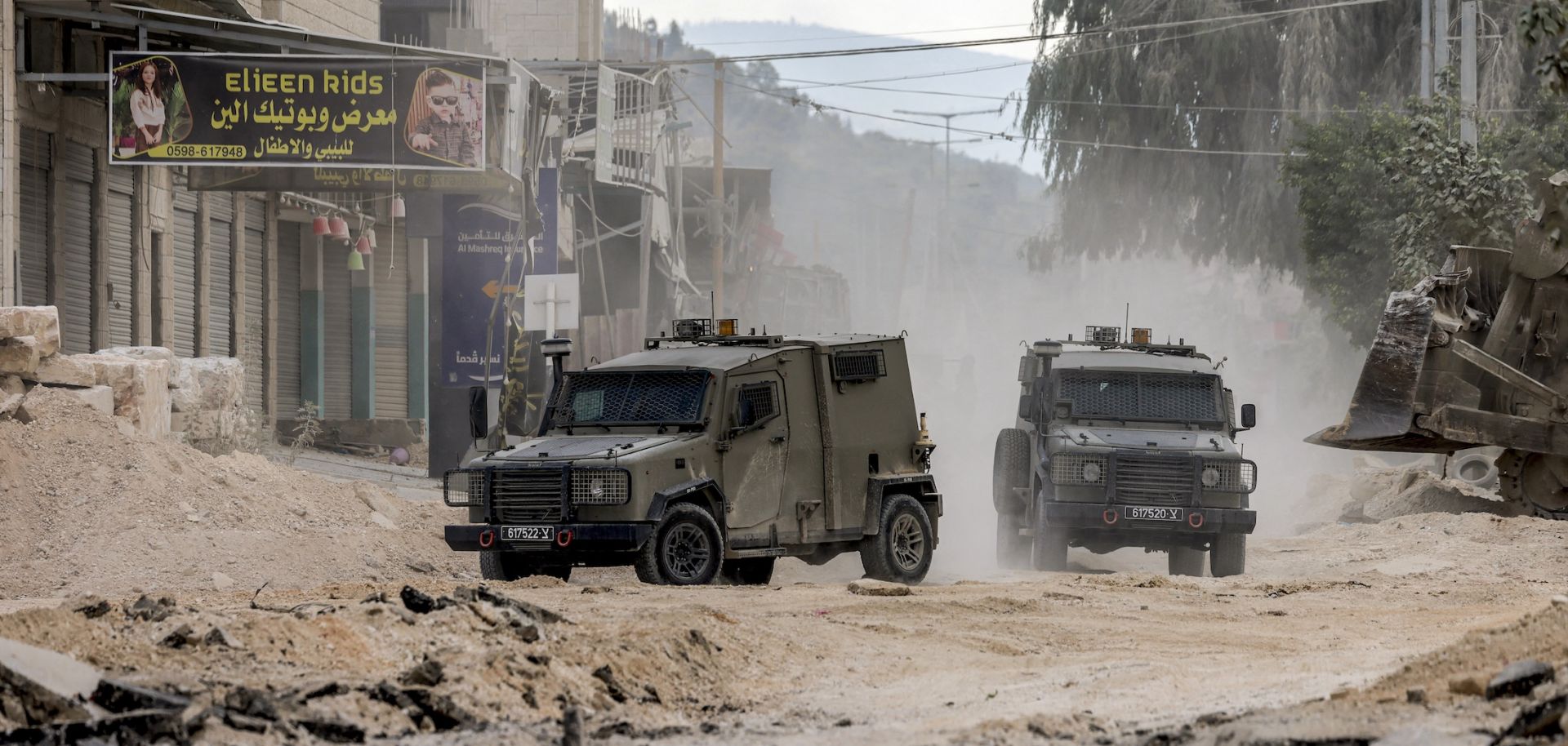
In the coming months, wide-scale Israeli military operations and expanding settlements in the West Bank will further weaken the Palestinian Authority and put the territory at greater risk of uprising, leading to widespread violence that spills over into Israel and to the diplomatic isolation of Israel. On Aug. 30, the Israel Defense Forces killed the chief commander of Hamas in the West Bank and two other militants in the city of Jenin. The killing came shortly after the IDF on Aug. 28 began wide-scale ground operations and drone strikes around the northern West Bank in the Jenin and Tulkarem areas. The IDF operations appear among the largest since the end of the Second Intifada in 2005, and involved bulldozers, armored vehicles and drones. Foreign Minister Israel Katz called the operation "war for all terms and purposes," saying the IDF was working to prevent an Iran-backed eastern front from forming in the West Bank. In response, the two main Gaza-based militant groups fighting the IDF — Hamas and Palestinian Islamic Jihad — called for a general mobilization against Israel in the West Bank, with PIJ saying the operation signaled "open and undeclared war." By contrast, the Palestinian Authority — the Fatah-run governing entity in the West Bank — condemned the operation as a "violation and crime," but did not explicitly call for a violent response or mobilization.
- Katz also called on the Israeli government to evacuate civilians from Jenin, as it has in Gaza, to facilitate combat operations in another sign that the Israeli government considers the operation open-ended and part of a wider campaign.
The Israeli government is conducting a wide-scale operation to suppress militants in the West Bank while simultaneously fighting Hamas in Gaza. The West Bank's security situation has steadily deteriorated over the past few years, particularly in restive cities like Jenin, Hebron and Nablus. Since the start of the Gaza War in October 2023, violence there has intensified, and Israel has accused Iran of supplying weapons to militant groups like Hamas, PIJ and a West Bank group called the Lions' Den in an attempt to destabilize the territory. Meanwhile, since the start of the Gaza War, Israel has accelerated the creation of settlements in the West Bank and Israeli settlers have increasingly conducted vigilante attacks on Palestinian property and civilians, facing few repercussions from an Israeli coalition government in which the far right holds significant influence. These incidents have contributed to more Palestinian militant reprisals against Israeli settlements and settlers in the West Bank as well as sporadic attempts to spread violence into Israel itself, including Jerusalem.
- On Aug. 18, Hamas claimed responsibility for its first attempted suicide bombing in Tel Aviv in almost 20 years, declaring that it coordinated with the PIJ to do so. The attack failed when the bomb prematurely exploded, killing its carrier; Hamas declared it would begin a suicide bombing campaign against Israel until the war in Gaza ends.
- On Aug. 21, the IDF assassinated Fatah official Khalil Makdah in Sidon, Lebanon; the IDF and Israeli internal security service Shin Bet accused him of working with Iran and Hezbollah to smuggle arms into the West Bank to attack Israel alongside his brother Mounir Makdah, another senior Fatah official.
In the coming weeks, the Israeli military will likely launch more large-scale raids to degrade Palestinian militias' capabilities in the West Bank, but operations will weaken the legitimacy and law enforcement capacities of the authority and embolden Israeli settlers to create more settlements. Facing few domestic repercussions or serious pushback from key allies like the United States — which thus far does not appear to be explicitly publicly opposing the IDF campaign in the West Bank despite recently adding new sanctions against some Israeli settler groups — the Israelis will use their military campaign in the West Bank to try to diminish militancy there. This is especially likely because the Palestinian Authority at least for now appears unlikely to push back strongly against any Israeli actions given its financial dependence on Israel. Violence in the West Bank — already at very high levels — will likely further spike and expand toward other major West Bank cities such as Ramallah and Bethlehem. But so long as the Palestinian Authority wields effective control over its security forces, which still put an upper limit on the extent of Palestinian militancy and social unrest, it will not devolve into a formal intifada. That said, the authority will face immense domestic pressure from those in the West Bank who, seeing a new Israeli military campaign after months of violent raids and the ongoing war in Gaza, will flock to the Palestinian militant cause. This will strain the Palestinian Authority's grip on the already volatile security situation in the West Bank, while authority-affiliated security forces may also shift toward support for actions against Israel as confidence in the Palestinian Authority establishment diminishes. Meanwhile, Israeli settlers and far-right factions and individuals — emboldened by the IDF's military operations to carry out more violence and advance more illegal settlements in the West Bank — will further strain the situation and add another layer of pressure on the Palestinian Authority to participate in the struggle in some form.
- Economic constraints on the Palestinian Authority force it to maintain a pragmatic relationship with Israel to obtain tax revenue and so be able to pay public salaries in the Palestinian territories.
- In addition to more Israeli ground raids in the West Bank, the past few weeks have seen Israeli troops start to rely more on airpower, including drones and combat helicopters. The Israelis will likely use more of these tactics to eliminate Palestinian militant commanders entrenched in some of these cities.
In the coming months, a weakened Palestinian Authority and the stepped-up IDF campaign will increase the likelihood of a third intifada, leading to a protracted period of intense violence in the West Bank and Israel. Sustained military action by the IDF and attacks by Israeli settlers amid Palestinian anger over Israeli actions in Gaza means the West Bank will become increasingly volatile. Provocative actions by figures like Israel's ultranationalist Israeli Security Itamar Ben-Gvir — especially around sensitive sites like Al-Aqsa Mosque, the third holiest site in Islam and a place where perceived Israeli provocations frequently trigger Palestinian unrest — could serve as flashpoints for widespread unrest, increasing the potential for large-scale Palestinian resistance. Coming under immense pressure from a populace frustrated by continued occupation, expanding settlements and perceived Israeli provocations, the Palestinian Authority may find itself compelled to participate in or support any third intifada. This would mark a significant shift, as authority involvement would likely lend greater heft and legitimacy to the uprising, intensifying the conflict. A third intifada would likely give rise to widespread protests, riots and clashes between Israeli settlers and Palestinians in the West Bank. Palestinians would also likely announce general strikes. And given Hamas' latest announcement of a suicide bombing campaign, in the event of a widespread uprising, Palestinian militant groups would likely attempt to carry out more guerrilla-style attacks such as shootings and bombings against Israelis in the West Bank and in Israel itself, with some attacks perhaps slipping by Israeli defenses amid security services' strained resources and attention. A potential uprising could also spill over into Israel, leading to potential protests, riots or intercommunal clashes in Arab-Israeli communities, challenging the government's ability to maintain order and deepening divisions regarding Israel's military actions in the West Bank, Gaza and along the northern border with Lebanon.
- The Second Intifada from late 2000 through early 2005 expanded with the tacit support of then-Palestinian President Yasser Arafat for a larger Palestinian uprising following then-Israeli Prime Minister Ariel Sharon's controversial visit to Al-Aqsa Mosque. This support allowed Palestinian factions to mobilize and intensify protests and violent actions against Israeli forces, marking the beginning of the uprising.
- Among many of his provocative actions, Ben-Gvir said Aug. 26 that he would build a synagogue at Al-Aqsa Mosque if he could. Ben-Gvir has on several recent occasions disregarded the Israeli government's ban on Jewish individuals praying at the site.
A third intifada would also significantly worsen Israel's diplomatic standing abroad, leading to more rifts with its Western allies and a freeze in the normalization process with Saudi Arabia, and delaying a potentially large war with Hezbollah. Already under major international criticism for its actions in Gaza, if Israel is seen as causing a third intifada through its actions, its Western allies — themselves facing significant domestic opposition to their support for Israel in its war in Gaza — would face even more domestic pressure that would further strain their relations with Israel, further isolating it. The United States and Europe are likely to impose more sanctions on Israeli ultranationalist figures, organizations and settlers encouraging violence, and might even limit arms transfers to Israel. Progress on Israel's normalization with Saudi Arabia would meanwhile completely halt given the latter's leading role in the Arab and Muslim world, and given that Riyadh has conditioned normalization on the existence of a pathway to Palestinian statehood. More broadly, pro-Palestinian sentiment within the Middle East would likely significantly escalate in the case of an intifada. Countries that have normalized relations with Israel, like the United Arab Emirates and Morocco, would likely crack down on criticism of their respective governments and take symbolic actions against Israel but stop short of severing relations due to the economic, military and technological benefits from normalized ties. Other countries such as Jordan could face more intense social unrest in response to their stances on Israel, threatening their stability, especially given that Iran would try to exploit this sentiment to open another front against Israel. And a full-fledged Palestinian uprising would force Israel to divert military resources and some troops and equipment toward the West Bank and to secure Israel proper, constraining its capacity for ground incursions into Lebanon to the point it would have to rule out an invasion at least temporarily. Securing the West Bank would also be a higher political priority for the Israeli government than ground incursions in Lebanon, as the Israeli government would struggle to maintain public support should it appear to fight a two- or three-front ground war.
- Jordan hosts the largest Palestinian refugee population of any country, and since Oct. 7, 2023, has faced social unrest in which protesters aim to force the government — which signed a peace treaty with Israel in 1994 — to take a more aggressive stance toward its neighbor. Amman reportedly fears the growing violence in the West Bank will cause yet another exodus of Palestinians to Jordan. Iran meanwhile on several occasions has sought to smuggle arms to Palestinian militants in Jordan to open up a new front against Israel as it has in Syria and Lebanon.
- In the event of another intifada, Iran-backed militias in the region including the Houthis in Yemen, Lebanese Hezbollah, and Kataib Hezbollah in Iraq would likely carry out symbolic attacks against Israel in support of the Palestinians, though they are unlikely to escalate against Israel mainly for fear of wider reprisals from Israel and the United States.
- Top EU diplomat Josep Borell has reportedly asked EU member states to impose sanctions on Israeli ministers, likely hinting at Ben-Gvir and Minister of Finance Bezalel Smotrich, for hate messages against Palestinians and for suggesting policies that would violate international law. This highlights the potential ramifications of the increased violence in the West Bank advocated by these two ministers, which could strain relations between Israel and its Western allies in the longer term.
- Middle Eastern Arab states are fragile, and based on past precedent are prone to sudden outbursts of unrest and regime changes. Given the wave of pro-Palestinian protests seen during the past few months in these countries, especially those with normalized relations with Israel such as Egypt, Jordan and Morocco, these states would want to avoid mass social unrest in the event of a third intifada and thus would likely need to be more assertive diplomatically with regard to Israel. It remains unlikely, however, that these countries would completely cut ties with Israel due to the many economic, military and diplomatic benefits of links with the country.
