
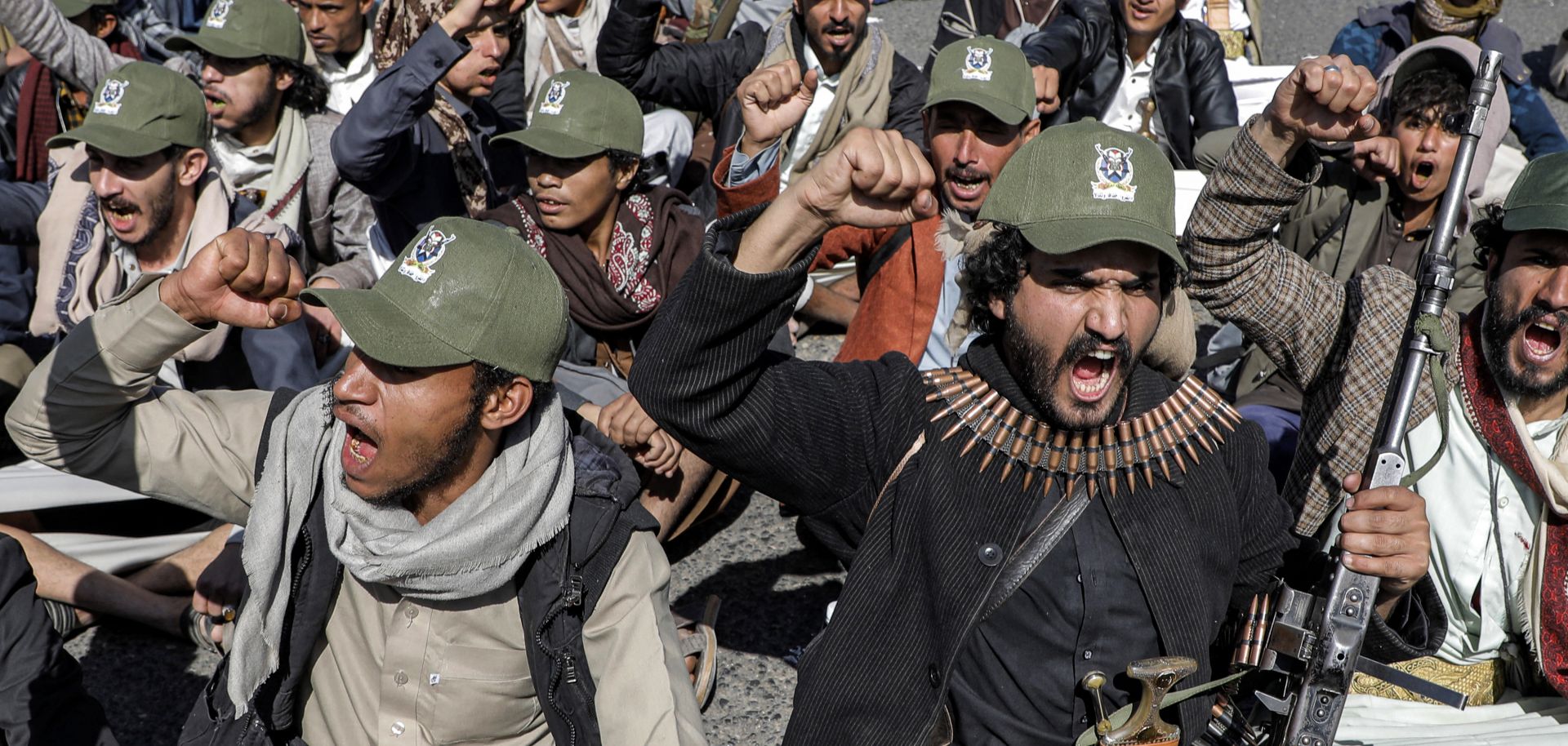
Despite threats to the de facto cease-fire in Yemen's civil war, economic vulnerabilities will likely constrain the Houthis while Saudi Arabia and the United Arab Emirates continue to disengage from the conflict; a major escalation in fighting is thus unlikely, and even if the Houthis attack Gulf energy infrastructure, there would likely be space for de-escalation. Since the Israel-Hamas war broke out in Gaza in October 2023, Yemen's Iranian-backed Houthi militants have attacked Israel and Israeli-linked shipping in the Red Sea in solidarity with Palestinians. Over the past year, these attacks have garnered far more attention than the domestic and regional security threats generated by the Houthis' ongoing war in Yemen against the Saudi-backed coalition supporting the internationally recognized Yemeni government. However, multiple events have threatened to escalate the conflict in Yemen, which has been in a de facto cease-fire since April 2022. In July 2024, the Houthis threatened to attack Saudi Arabia's airports, banks and oil facilities after Yemen's Saudi-backed government decided that banks in Houthi-controlled territories must be relocated to Aden to isolate the Houthis from the international financial system. The situation was diffused when Saudi Arabia subsequently threatened to withdraw support for the internationally recognized government and pressured it to back down and de-escalate the banking crisis. Tensions escalated once more ahead of Israel's Oct. 26 attack on Iran, when Gulf states, including Saudi Arabia, expressed concern that their oil and energy facilities would be targeted by Iranian regional allies and proxies, such as the Houthis, if Israel attacked Iran's oil facilities. Although Israel's attack avoided Iranian energy infrastructure, future Israeli attacks against Iran have a heightened likelihood of targeting sensitive nuclear or energy targets, meaning the threat of Houthi attacks against Gulf energy targets cannot be ruled out.
Yemen's Decade-Long War
The civil war in Yemen began in September 2014 when Houthi rebels took control of the capital Sanaa and demanded lower fuel prices and a new government. The conflict further expanded in early 2015 after the Houthis overtook the Yemeni presidential palace and forced the president to resign. Later that year, coalition forces backed by Saudi Arabia and, subsequently, the United Arab Emirates began to conduct airstrikes against the Houthis and engage in an economic pressure campaign. However, Saudi Arabia began to withdraw from the conflict in 2021 after sustaining Houthi attacks on its territory and spending billions of dollars on the war. In April 2022, warring parties agreed to a U.N.-brokered cease-fire after the Houthis faced pressure from insufficient humanitarian aid, as well as high food and fuel prices brought on by global supply shocks related to Russia's invasion of Ukraine in February 2022; the cease-fire agreement allowed the Houthis some flexibility to move additional humanitarian aid into their controlled territory. Even after the cease-fire officially expired, it has largely remained intact. In mid-July, the U.N. envoy for Yemen warned of reported clashes between Houthi militants and Yemeni government forces along the civil war's frontlines, as well as "an increase in military preparations and reinforcements" amid concern that the de facto cease-fire would collapse.
Houthi maritime attacks and surging anti-Western and anti-Israeli sentiment have complicated progress toward a permanent cease-fire, increasing the number of Houthi fighters and giving them greater flexibility for potential ground operations. Prior to the start of the Israel-Hamas war, efforts toward a formalized end to Yemen's civil war had made progress. However, the Houthis' maritime strikes beginning in late 2023 and the wider regional instability brought on by the Gaza war have since complicated the peace process. Furthermore, the Houthis' attacks on Israel — one of which was fatal — and their maritime attacks have boosted domestic support for the militant group in Yemen and increased recruitment, with U.N. experts estimating that the Houthi movement currently has around 350,000 fighters, an increase from 220,000 in 2022. In addition, while U.S. and U.K. strikes on Houthi weapons stockpiles and launch sites have likely degraded some of the group's capabilities to launch projectiles against Israeli territory and maritime vessels around the Red Sea, these targeted attacks are unlikely to have significantly impacted the Houthis' ground capabilities for the civil war. Thus, with its elevated fighting numbers, maintained ground capabilities and relatively unobstructed overland supply lines through Oman, the Houthis may be in a stronger position in Yemen's civil war than before they agreed to the cease-fire in April 2022.
- In December 2023, the U.N. envoy to Yemen said the Houthis and the Saudi-backed coalition had agreed to take steps toward a cease-fire, though little progress has been made since then.
- In January 2024, the United States and the United Kingdom began to conduct airstrikes against the Houthis, which have largely targeted the group's launch sites and weapons stockpiles in Yemen.
- In mid-2023, Saudi Arabia hosted Houthi leaders during the annual hajj pilgrimage to Mecca, exchanged bodies of deceased fighters with the Yemeni militant group, and suspended restrictions on ships entering the Houthi-controlled Port of Hodeidah — all signs of positive collaboration. Nevertheless, disputes between the Saudi-backed coalition and the Houthis, such as the involvement of the internationally recognized Yemeni government in peace negotiations and the source of payments for public sector workers in Houthi-controlled territory, remain obstacles to a permanent cease-fire.
Saudi Arabia and the United Arab Emirates will likely continue to try to de-escalate tensions with the Houthis to prevent a resurgence of major fighting in Yemen and a regional expansion of the Israel-Iran conflict. With the Houthis' increased manpower capabilities, Saudi Arabia and the United Arab Emirates would likely have to devote significant personnel and material resources to Yemen if major fighting were to recommence, which the two Gulf states are not incentivized to do after having withdrawn from the conflict in recent years. Furthermore, Saudi Arabia and the United Arab Emirates have normalized (albeit fragile) relations with Iran, and have sought to remain neutral in the Israel-Iran conflict. The Gulf countries have also declined to participate in recent U.S.-led initiatives against the Houthis for fear of making themselves the target of reprisal attacks. In mid-October, before the Oct. 26 Israeli attack against Iran, officials from Gulf countries met with Iran's foreign minister to affirm their neutrality and mitigate the risk of being attacked amid speculation that the Houthis or other Iranian-backed groups could attack Gulf oil targets in response to the expected Israeli attack. In addition, the economic development plans of Saudi Arabia and the United Arab Emirates aim to generate much more foreign investment in key non-oil sectors like tourism, which requires investor confidence in regional security. As a result, Saudi Arabia and the United Arab Emirates will likely avoid provocations toward the Houthis and/or Iran to prevent a regional expansion of the war and avoid being dragged into a conflict with the Houthis. This means the two Gulf countries will continue to restrict U.S. military operations from their territories in any attacks targeting Iran, its allies and/or its proxies. Furthermore, Saudi Arabia and the United Arab Emirates will likely encourage the United States to pressure Israel to restrain its attacks against Iran, though this will become harder once President-elect Donald Trump returns to the White House in January 2025, as his administration will be filled with ardent pro-Israel personnel.
- In February, the United Arab Emirates prohibited U.S. forces stationed there from executing any attack against Iran or its allies and proxies from its territory. The United States subsequently moved some of its military assets to Qatar.
The Houthis may leverage their increased manpower to threaten or conduct some limited attacks, but economic vulnerabilities will likely prevent the group from restarting major fighting, especially if the United States takes a hardline approach under Trump. With their increased recruitment and ground capabilities, the Houthis have the upper hand in the civil war and may threaten or conduct limited attacks to resist economic pressure and extract concessions in future cease-fire negotiations, especially considering Saudi Arabia's and the United Arab Emirates' reduced commitment to the civil war. However, even if the Houthis conduct some attacks, they will likely be limited in size and scope, and if they occur, attacks would be more likely to focus on existing hotspots on the front lines, which have not provoked a significant international response thus far. Even so, increased attacks would risk incurring economic pressure from the internationally recognized government and the United States, particularly under the incoming Trump administration, which will likely prioritize ending Houthi maritime attacks to resume Red Sea shipping routes. If the Trump administration takes a hardline stance against the Houthis, the United States would likely apply more pressure through new sanctions and designating the group as a foreign terrorist organization to further constrain its financial connections. However, this designation would also risk curbing humanitarian aid inflows to Houthi-controlled territory, which could upset the precarious balance between the Houthis, local tribes and public servants. Amid a severe humanitarian crisis marked by food insecurity and a heavy reliance on aid, as well as the Houthis' longstanding inability to pay public sector workers, the Houthis are highly vulnerable to economic pressure. As a result, the Houthis will remain incentivized to constrain their aggression to avoid economic retaliation.
- In late July, Russia backed away from a deal with the Houthis to sell anti-ship missiles amid pressure from the United States and Saudi Arabia. While the sale would not have significantly expanded the Houthis' capabilities to conduct attacks against Saudi Arabia, Riyadh's concerns over the sale persisted.
- Yemen has been embroiled in one of the worst humanitarian crises since the start of its civil war in 2014. According to the World Health Organization, more than two-thirds of Yemen's population needs humanitarian assistance, with women and children disproportionately impacted by the crisis.
- In January, the Biden administration redesignated the Houthis as Specially Designated Global Terrorists to isolate the group from the global financial system while minimizing the risk to humanitarian aid deliveries. If the Trump administration upgrades the group's classification to that of a foreign terrorist organization, the designation would sanction foreign individuals and groups that provide material support to the Houthis, as well as potentially jeopardize some humanitarian aid into Houthi-controlled territory.
Despite these constraints, even if the Houthis attacked Saudi Arabia or the United Arab Emirates, it would not necessarily prompt the two countries to intervene in Yemen, which would risk restarting major fighting in the civil war. If such an attack were to occur, either as part of a coordinated Iranian attack or as an independent Houthi attack, it would heighten the risk of Saudi or Emirati retaliatory attacks against the Houthis. However, depending on the size and scope of the Houthi attack, there may be space for de-escalation. While Saudi Arabia and/or the United Arab Emirates would have the political backing to respond, retaliations would risk escalation in a tit-for-tat attack cycle with the Houthis and jeopardize some of the Gulf countries' other goals, such as investor confidence and regional stability. Furthermore, Saudi Arabia has shown that it does not have the political imperative to respond to attacks that result in only limited casualties, having chosen not to respond to some attacks that killed a handful of Saudis. Riyadh would thus likely prioritize de-escalation to avoid becoming embroiled in a greater conflict with the Houthis. Even if energy assets were targeted, the political imperative to respond would decrease if repairs could be made and production could resume in a relatively short time frame. Instead, Saudi Arabia and the United Arab Emirates may rely more heavily on the United States' presence in the region and the ongoing U.S. and U.K. strikes against the Houthis as retaliation, potentially encouraging an expansion of the attacks or additional attacks using the U.S. B-2 bombers to target the Houthis' underground storage facilities to further degrade their capabilities.
- In September 2019, Iranian-made drones struck Saudi oil processing facilities in Abqaiq and Khurais, forcing the facilities to close temporarily for repairs and briefly reducing Saudi oil production; however, within weeks, oil production resumed to normal capacity, allowing for de-escalation. The Houthis claimed responsibility for the drone attack, but the United States and Saudi Arabia blamed Iran, with France, Germany and the United Kingdom also holding Iran accountable.
