
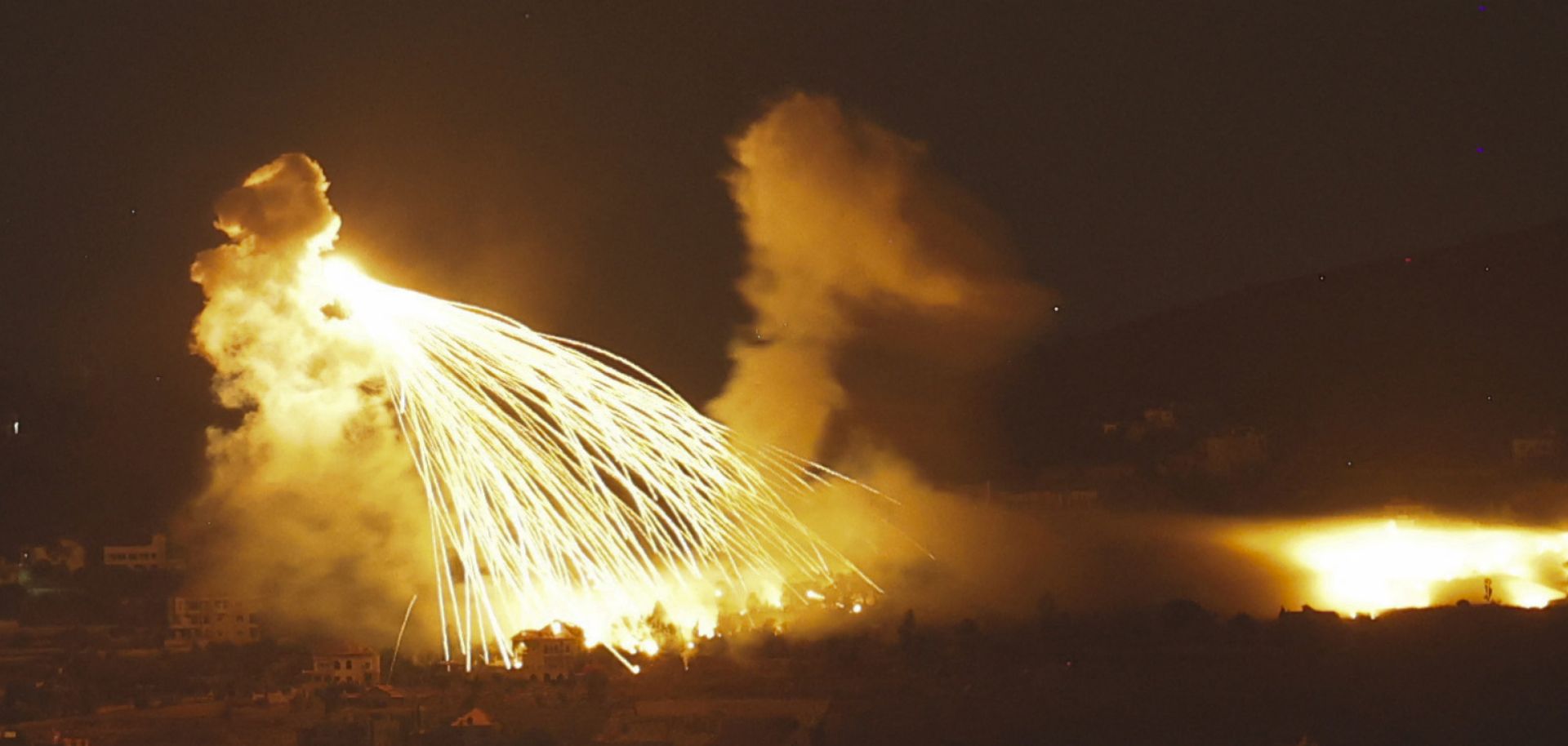
Hezbollah and Israel are entering a new phase of conflict that will likely lead to a protracted war of attrition that, despite Israel's expanding ground and aerial campaign, favors Hezbollah in the long term if the group can tie down Israeli forces in southern Lebanon. On Oct. 20, Israeli fighter jets struck dozens of buildings across Lebanon, including in Beirut's suburbs, targeting branches of the Hezbollah-run bank Al-Qard Al-Hasan, hours after the Israeli military announced a new phase of targeting the Lebanese political and militant group's banks and financial infrastructure. The Israeli attacks came a day after Hezbollah launched three drones, one of which struck Israeli Prime Minister Benjamin Netanyahu's residence in the central seaside town of Caesarea; Netanyahu and his wife were not at their residence at the time of the attack, but the drone strike marked the first time since the beginning of the war that a target directly affiliated with Netanyahu or Israel's political leadership was hit. The same day, Hezbollah launched more than 200 projectiles against numerous major Israeli towns and cities like Haifa, Nahariya, Acre and Safed. In turn, the Israel Defense Forces (IDF) launched at least 10 airstrikes on Beirut's southern suburbs, which are densely populated and known as a Hezbollah bastion, among various other Hezbollah targets across Lebanon.
- On Oct. 13, Hezbollah launched a swarm of drones toward an IDF base in Binyamina, a town south of Haifa, killing at least four Israeli soldiers and injuring over 60, making it one of the deadliest attacks by the group against Israel since the Gaza war broke out in October.
- Since the onset of the Gaza war in October 2023, cross-border clashes between Hezbollah and Israel have significantly expanded both in geography and intensity. But Israel's Sept. 27 assassination of longtime Hezbollah leader Hassan Nasrallah and Oct. 1 launch of a ground invasion in southern Lebanon have since brought the two foes into a wider war.
The Hezbollah attacks are part of the group's recently announced escalation as the IDF widens its degradation campaign not just against Hezbollah's military capabilities but its support infrastructure, as both sides prepare for a long war of attrition. Hezbollah appears to have recuperated from the recent string of successful Israeli attacks, and is now preparing for a prolonged fight with Israel. Following the assassinations of Nasrallah, his likely successor and most of Hezbollah's top leadership, the group has reportedly forged a new chain of command that can directly and secretly communicate with its forces on the ground. On Oct. 18, Hezbollah released a statement declaring that it was entering a new phase of escalation in its war with Israel in which the group will no longer be restrained and will use more of its advanced precision-guided missiles and drone capabilities. The announcement came several days after acting Hezbollah leader Naim Qassem warned in a televised speech that Hezbollah would attack anywhere in Israel given that the Israelis have been targeting all of Lebanon, and announced a cease-fire was the only solution for Israel's northern residents to go back to their homes. The IDF, meanwhile, has continued to expand its ground incursions in southern Lebanon while simultaneously using the air force to strike targets deeper inside the country, including Beirut. The IDF has also been targeting Hezbollah-affiliated relief centers, ambulances and, most recently, banks, as part of a strategy aimed at degrading not only Hezbollah's military position but also its support infrastructure, including the group's social organizations that serve the Lebanese Shiite community. Israel's escalating attacks and Hezbollah's recuperation signal the two sides are headed toward a long war of attrition.
- Until now, the IDF has advanced at a slow and limited pace, focusing on demolishing Hezbollah's military infrastructure in the towns and villages in Lebanon immediately adjacent to the Israeli border.
In this next phase, Hezbollah will work on launching more frequent and damaging attacks against civilian and military targets in Israel's north and center, while the group defends against the Israeli ground incursion. Hezbollah will attempt to maximize the damage caused by its attacks, both in Israel and against IDF ground troops in southern Lebanon. The group will launch more frequent and geographically widespread rocket strikes focused on overwhelming Israel's air defenses and progressively threatening Israeli communities farther south in and around Haifa, in the hopes of forcing more evacuations that further pressure on the Israeli government. Additionally, the group will start to rely more on its arsenal of drones that the Israelis have struggled to counter, as evidenced by the deadly Oct. 13 attack on an IDF base and the Oct. 19 attack on Netanyahu's home. Through these attacks and Israel's subsequent struggles to resist them, Hezbollah will aim to deal psychological blows to the Israelis by highlighting the ongoing threat posed by the group's drone tactics. Over time, Hezbollah will also begin deploying its more advanced ballistic missiles, which until now it had largely avoided using. These more sophisticated weapons could be used to attack Israel's financial hubs of Haifa and Tel Aviv, further disrupting the Israeli economy. Finally, on the ground in Lebanon, Hezbollah will try to inflict as much damage on the advancing Israeli forces as possible, using its fighters' concealed positions, as well as its advanced arsenal of anti-tank guided missiles and the hard geographic landscape of Lebanon, to kill more and higher-ranking members of the IDF, while bogging Israel down in an increasingly costly war.
- On Oct. 14, Hezbollah released a video claiming it had developed two new missiles that were ready to be used, the Qader 2 and Nasr 1, adding that the latter was a ''precision ground-to-ground missile developed by Islamic Resistance engineers.''
- According to press reports, Israeli security officials have informed the government that Hezbollah still retains one-third of its stockpile of medium- and short-range missiles, but this is unverified and Israeli officials have previously underestimated Hezbollah's reserves. Meanwhile, Hezbollah sources and its acting leader Naim Qassem have declared that the group's capabilities are fine and that Hezbollah still retains its precision-guided and long-range ballistic missiles arsenal alongside considerable stockpiles of other weapons. Despite losing thousands of fighters to cross-border clashes and Israel's devastating pager attack on Sept. 17, Hezbollah still has thousands of trained and experienced fighters positioned in southern Lebanon, and several thousand elsewhere in Syria and Iraq. The group also has thousands of foreign fighters it can call on should it face shortages in manpower. Additionally, Iran still maintains a supply line through Iraq and Syria to keep arms flowing to Hezbollah.
- The wars in Lebanon and Gaza are taking a toll on the Israeli economy due to high military spending, stalled growth and labor disruptions caused by the large numbers of reservists being called up for active duty. Economists have warned the ongoing tumult could eventually deter investment from Israel and undermine business and financial confidence in the country — a scenario that would weaken Israeli political support for an extended conflict.
- Since Israel launched its invasion on Oct. 1, dozens of IDF troops have been killed and hundreds injured in combat in southern Lebanon, while the IDF claims that Hezbollah has lost more than 1,500 fighters.
Israel, meanwhile, will continue to capitalize on its recent tactical gains by expanding its aerial bombardment campaign and ground invasion. The IDF will seek to build on the damage caused by its recent attacks on Hezbollah's leadership and military infrastructure by maintaining and, at times, expanding the geographic scope of its aerial strikes against the group. The Beirut suburbs will continue to be targeted, displacing more Lebanese civilians. Israel will also conduct more frequent strikes in Lebanon's Bekaa Valley and areas near the Lebanese-Syrian border as the IDF tries to cut off Hezbollah's supply lines from Syria and Iran. Additionally, to fulfill its main objective of dismantling Hezbollah, the IDF will increasingly attack non-military targets, like the group's financial institutions, social organizations and political wing. Meanwhile, Israel will slowly expand its ground invasion, first horizontally by trying to simultaneously infiltrate from Lebanon's western, central and eastern sectors, and then vertically by deepening operations inside southern Lebanon. While IDF troops may face greater resistance as they advance northward, Israel's highly capable army will almost certainly be able to move deeper into southern Lebanon, especially as its ground troops will first be covered from the air before advancing. At the very least, the IDF will aim to push Hezbollah farther north of the Litani River — and farther away from the Israeli border — to prevent the group from launching rockets into northern Israel or conducting a future assault akin to Hamas' surprise Oct. 7 attack. Through this expanding invasion, Israel hopes to eventually exert enough pressure on Hezbollah that the group is forced to agree to a diplomatic settlement that is highly favorable to Israel.
- Israel attempted on Oct. 9 to assassinate senior Hezbollah political figure Wafiq Safa.
- Israel has reportedly been demolishing Hezbollah's tunnel infrastructure at border areas, including an underground command center and weapons depot belonging to Hezbollah's elite Radwan Forces. Israel has also allegedly been clearing landmines in the areas of Golan Heights that border Lebanon, signaling a potential widening of the front. The IDF could use the Israeli-occupied region to drive west and encircle Hezbollah forces, or to push toward the Bekaa Valley — though the latter is less likely because it would stretch the IDF's forces and supply lines too thin and leave them exposed to Hezbollah's counter-fire.
In the coming months, Israel and Hezbollah's escalations will likely lead to a protracted battle of wills where both sides become war-weary but are unwilling to fully disengage. Israel and Hezbollah's maximalist war aims portend an extended conflict with no near end in sight. For Hezbollah, returning to the pre-Oct. 7, 2023, status quo is far-fetched, as the Israelis are unlikely to accept any form of unwritten rules of engagement following the current conflict. Israel, meanwhile, is unlikely to succeed in eliminating the Hezbollah threat and eventually establishing a physical buffer zone that could protect Israel from future attacks. For one, Hezbollah will likely be able to keep launching drones, missiles and especially rockets across the border for the foreseeable future, thereby leaving Israel unable to fulfill its pledge to secure the northern Israeli communities that have been bombarded with Hezbollah strikes over the past year. And in southern Lebanon, Hezbollah will likely also be able to stand its ground in some areas and extract heavy tolls on the invading IDF troops, complicating Israel's efforts to occupy areas south of the Litani River. But despite this, Israel remains unlikely to quickly concede in southern Lebanon, as more than a year of war that the government has framed in almost existential terms has made Israelis more accepting of IDF casualties.
A diplomatic settlement remains unlikely unless Israel or Hezbollah inflicts significant casualties on the other, the United States increases diplomatic pressure on both sides, or a cease-fire in Gaza is reached. A diplomatic settlement appears unlikely anytime soon given both Israel and Hezbollah's will to fight, though several developments could gradually increase the prospects. First, should one side inflict heavy casualties on the other, the weakened side would be pressured to reach a deal that is favorable to the other. Second, as Israel and Hezbollah become embroiled in a stalemate, the United States may increase diplomatic pressure on Israel and Lebanon to end the conflict and agree to mutually acceptable terms; in this scenario, Israel and Hezbollah could agree to some form of settlement where each could claim victory, similar to the resolution that ended their 2006 war. And third, if Israel's recent assassination of Hamas chief Yahya Sinwar spurs progress toward a cease-fire in Gaza, it could facilitate similar progress to end the Israel-Lebanon war, which is largely tied to what is occurring in Gaza.
- On Oct. 21, the administration of U.S. President Joe Biden dispatched special envoy Amos Hochstein to Lebanon to present a cease-fire proposal that the Israeli government sent to the United States. The proposal contains conditions for the Israelis to de-escalate in Lebanon, contingent on the application of U.N. Security Council Resolution 1701 (which resolved the 2006 Lebanon War), with an expanded role for U.N. peacekeepers to help implement the resolution and protect Lebanon's borders. But it also allows Israel to operate over Lebanese airspace, and to physically enter Lebanon to remove any potential threat, which is a breach of Lebanese sovereignty and contradicts U.N. Security Council Resolution 1701. Lebanon is thus unlikely to accept the proposal, but it will likely be the opening gambit of a long negotiating process that will be influenced by developments on the battlefield.
A long war of attrition will likely favor Hezbollah, which can declare victory merely by surviving Israel's onslaught, while Israel's political drivers for war will likely erode under heavy economic and military losses. Israel's past invasions of Lebanon in 1982 and 2006 demonstrate that a long Israeli war or an occupation is unsustainable. With constant access to Iranian supplies, Hezbollah will likely be able to withstand Israel's military pressure and force the IDF into a disadvantageous fight on its home turf. Should Israel become bogged down in a costly and prolonged war, sustaining heavy casualties and economic losses, Israeli leaders' political drive to continue the war would wane, compelling them to agree to a diplomatic settlement on Hezbollah's terms. This is partly because Israel's government ultimately must continue to seek the backing of its people to sustain the war, making it more constrained by popular pushback than Hezbollah. Moreover, given that Hezbollah is much more entrenched and capable than other militant groups like Hamas, and is also a major player in Lebanese domestic politics, Israel is unlikely to achieve its maximalist goals of dismantling Hezbollah and permanently preventing rocket fire so displaced northern Israelis can return home. This will, in turn, increase the likelihood of Israel being forced to reach a diplomatic settlement that would be considered a win for Hezbollah, which would have withstood the Israeli onslaught and survived to fight another day.
Conversely, a diplomatic settlement favorable to Israel would become more likely if its ground invasion in southern Lebanon progresses or the United States gets directly involved in the conflict. Conventionally a superior military force, Israel could still achieve a military victory should its political support at home and abroad hold out. If given enough time, the Israelis could push toward the Litani River over the next few months and continue to decimate Hezbollah's leadership and arsenals. Israeli military pressure on Hezbollah for a sustained period could also eventually weaken Hezbollah's popular support and embolden its rivals in Lebanon, altering Hezbollah and Iran's calculus as to the political gains of continued fighting. This outcome would likely prompt Hezbollah and/or Iran to accept realities on the ground and agree to a diplomatic settlement that is unfavorable to their interests, including withdrawing or drawing down south of the Litani River. In addition, should Israel-Iranian cycles of escalation increase U.S. support for Israel's campaign in Lebanon, the United States may get directly involved by participating in attacks against Hezbollah or Iran — a development also likely to weaken Hezbollah's resolve for extended conflict with Israel.
