
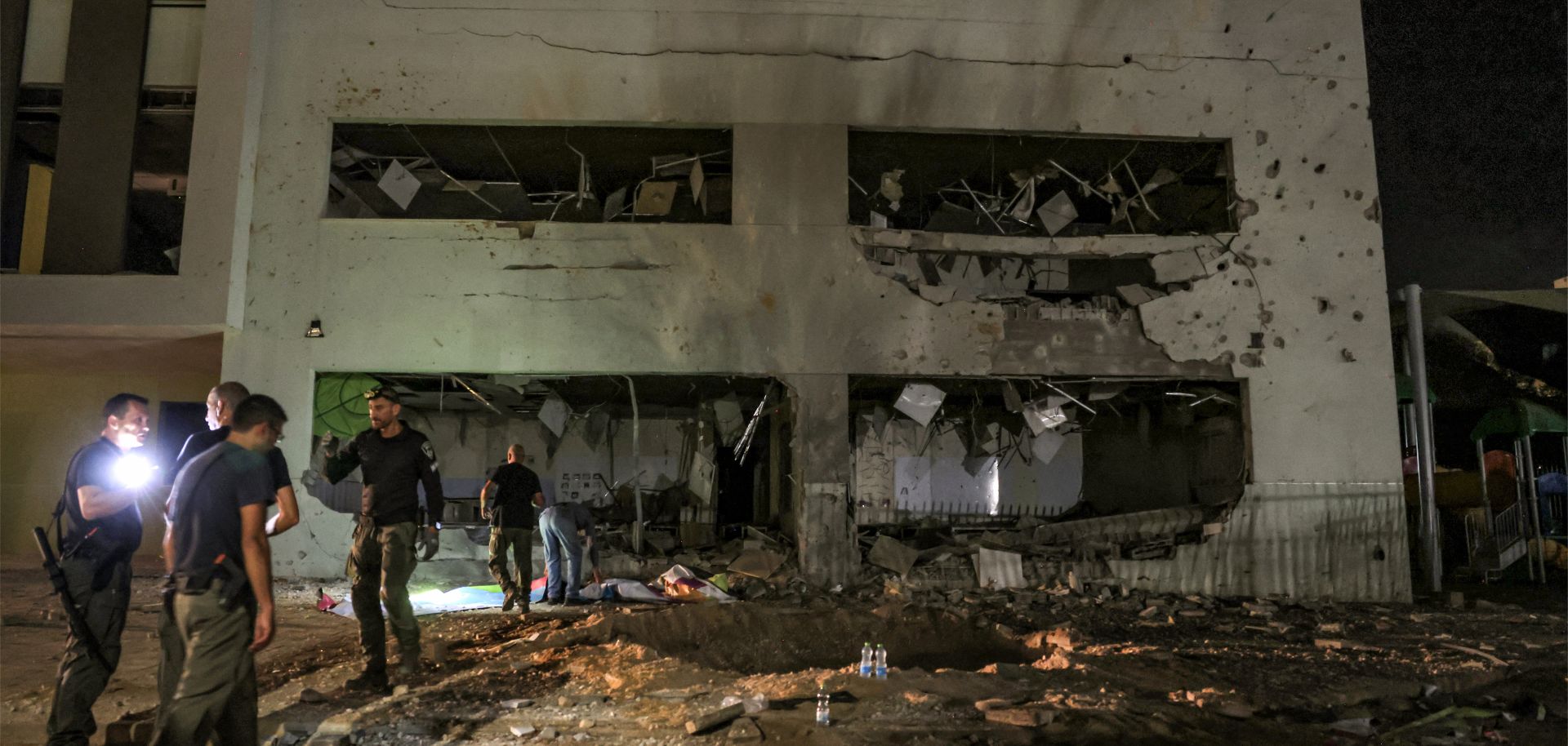
In response to Iran's missile barrage, Israel will most likely attack a small number of Iranian targets, but there is a chance Israel will pursue more escalatory options — including numerically higher and geographically wider attacks, or even an ongoing aerial campaign — which would likely invite further Iranian attacks that lower the threshold to more frequent direct conflict. On Oct. 1, Iran's Islamic Revolutionary Guard Corps (IRGC) launched around 180 ballistic missiles toward Israel, including the Mossad headquarters in Tel Aviv, in what the IRGC said was retaliation for the killings of Hamas leader Ismail Haniyeh in Tehran on July 31, Hezbollah leader Hassan Nasrallah in Beirut on Sept. 27, and an Iranian general who was killed alongside Nasrallah. The strikes appear to have had a relatively limited impact on Israel itself, with medics so far reporting only two wounded. It also appears the missiles did not strike major military or civilian infrastructure and may have been deemed not a threat by Israel's air defense systems. The Israel Defense Forces (IDF) threatened retaliation but said they would conduct such operations at a time and place of their choosing, while the United States stated it was taking steps to help defensively secure Israel from further attacks.
- Pro-Iran Iraqi militias put out a statement threatening U.S. forces in the region with attacks should the U.S. participate in Israel's retaliation against Iran.
Iran's attacks aim to respond to Israeli provocations, as well as reassure its domestic supporters and regional proxies after a series of major operational setbacks and assassinations against the Iran-backed groups Hamas and Hezbollah. While the IRGC initially refrained from retaliating to Israel's killing of Hamas political chief Haniyeh, the assassination of Hezbollah leader Nasrallah and an IRGC Quds Force Commander likely catalyzed Iran to respond in order to maintain some degree of deterrence vis-a-vis the Israelis, which has been eroding over time as Israel has increasingly crossed the red lines of Iran and its allies over the past few weeks and months. Iranian leaders also needed to appease the hard-liners that comprise their own domestic support base, as well as show Hezbollah, its most important regional proxy, that Tehran will not abandon it to maintain some degree of political credibility among the Lebanese group and other proxies in Iran's so-called Axis of Resistance. Additionally, the response came after Hezbollah faced several substantial Israeli attacks that left the group in disarray, with the group now facing an Israeli ground invasion of southern Lebanon.
- In its statement released after the missile attack, the IRGC said it had initially refrained from attacking Israel after Haniyeh's death but chose to do so after Nasrallah and Nilforoushan were killed.
- In the wake of Nasrallah's assassination, Hezbollah supporters have reportedly blamed Iran for abandoning the group in its fight against Israel. In a Sept. 30 Axios report, Israeli and U.S. intelligence said they believed Hezbollah had directly asked Iran to retaliate for Nasrallah's death, but Iran had demurred (though Iranian officials have refuted this).
With Israeli casualties looking limited, Israel will most likely respond to Iran's attack by striking a small number of Iranian targets. Despite the wide scale of the Iranian barrage, it appears the attack did not cause significant Israeli casualties. This will weaken Israel's political rationale for an expansive counterstrike against Iran in the near term, especially as Israel is currently focused on the northern front with Hezbollah. However, the IDF will still be looking to find ways to respond against Iran and reduce the likelihood of future Iranian strikes or, at least, mitigate their size and impact. In its least risky approach, the IDF could choose to strike a select number of strategic targets inside Iran, similar to Israel's symbolic response to Iran's April 2024 barrage. Such an attack would be tactically driven and aimed at avoiding significant casualties inside Iran, or significant damage to a key Iranian sector. In likely only a single round, the IDF could strike select targets around Iran's nuclear, energy, missile/drone, and/other military-industrial sectors in limited quantities. This would limit, but not eliminate, the immediate threat of full-scale regional war, as even targeted attacks could still trigger another round of direct Iranian retaliation.
- On April 13, the Iranians launched 170 drones, 30 cruise and 120 ballistic missiles toward Israel, in response to an earlier Israeli attack that struck the Iranian consulate in Damascus, killing senior IRGC commanders. In response to the barrage, which only killed one Israeli civilian, Israel attacked a single S-300 air defense system near a nuclear site in Isfahan, Iran.
But if Israel wants a stronger retaliation, it may conduct strikes designed to severely damage Iran's nuclear program, energy sector, missile and drone program, which would increase the likelihood of Iran responding in kind. Given Israel's recent willingness to push past previously telegraphed red lines, such as the assassinations of Hamas leader Haniyeh and Hezbollah leader Nasrallah, Israel may decide to escalate well beyond what it did in April 2024 and conduct a broader retaliation against many more targets in Iran, particularly Iran's nuclear program, energy infrastructure, and the military-industrial base supporting its ballistic missile and drone program. While these strikes could occur in a single salvo hitting dozens or hundreds of targets across the country, they could also take an even more aggressive form if they are part of an extended campaign with multiple rounds designed to significantly degrade Iran's defensive capabilities and erode its military-industrial complex; the latter would involve repeated strikes on Iran, possibly eventually pulling in the United States. However, in doing so, Israel would risk inviting an Iranian response even larger than Iran's Oct. 1 barrage — especially if the Israeli attacks kill Iranian civilians, which would make Tehran more likely to concentrate its strikes on Israeli population centers, like Tel Aviv, in ways that could overwhelm Israel's air defenses. Moreover, should Israel's response involve multiple rounds of attacks, Iran would likely embark on its own sustained aerial campaign, intermittently launching strikes against the country for the medium term. The United States may also refuse to back such an expansive Israeli campaign against Iran, which would run counter to Washington's overarching interest in regional stability.
Regardless, Israel will remain focused on degrading and defeating Hezbollah in Lebanon — a dynamic that will encourage further Iranian retaliation as Israeli military pressure intensifies against Iran's most important regional proxy. Even if Israel opts for a more restrained retaliation against Iran and Iran refrains from directly striking back, as seen in the events of April 2024, internal pressure from hard-liners in Iran's government may push Iran to intervene more directly as Israel continues to assault Hezbollah, Iran's most important proxy in the region. Israel will likely continue conducting assassinations and covert strikes on Hezbollah, as well as the Iranian leaders and infrastructure supporting the Lebanese group's war effort. This ongoing campaign will, in turn, leave open the potential for future incidents that trigger more Iranian attacks on Israel, which could be even larger than the Oct. 1 barrage as Iran escalates further. Additionally, should Israel's expanding ground operations in Lebanon and ongoing aerial campaign start to pose an existential threat to Hezbollah, the Iranians may be compelled to increase their support to the group, in order to keep Iran's first line of defense relatively functioning. Triggers for this would include deeper Israeli pushes into Lebanon beyond the Litani River, new assassinations of top Hezbollah leaders, and/or significant battlefield setbacks for Hezbollah against Israel. There would still be strong constraints on all-out war between Israel and Iran (including a likely lack of U.S. support for an unrestrained Israeli campaign against Iran that could spur a regional war that harms U.S. interests, and Iran's own deficient conventional capabilities compared with Israel). However, now that the taboo has been broken and drivers for more aggressive action appear set to continue for the foreseeable future, more sporadic exchanges between the two countries are on the table.
