
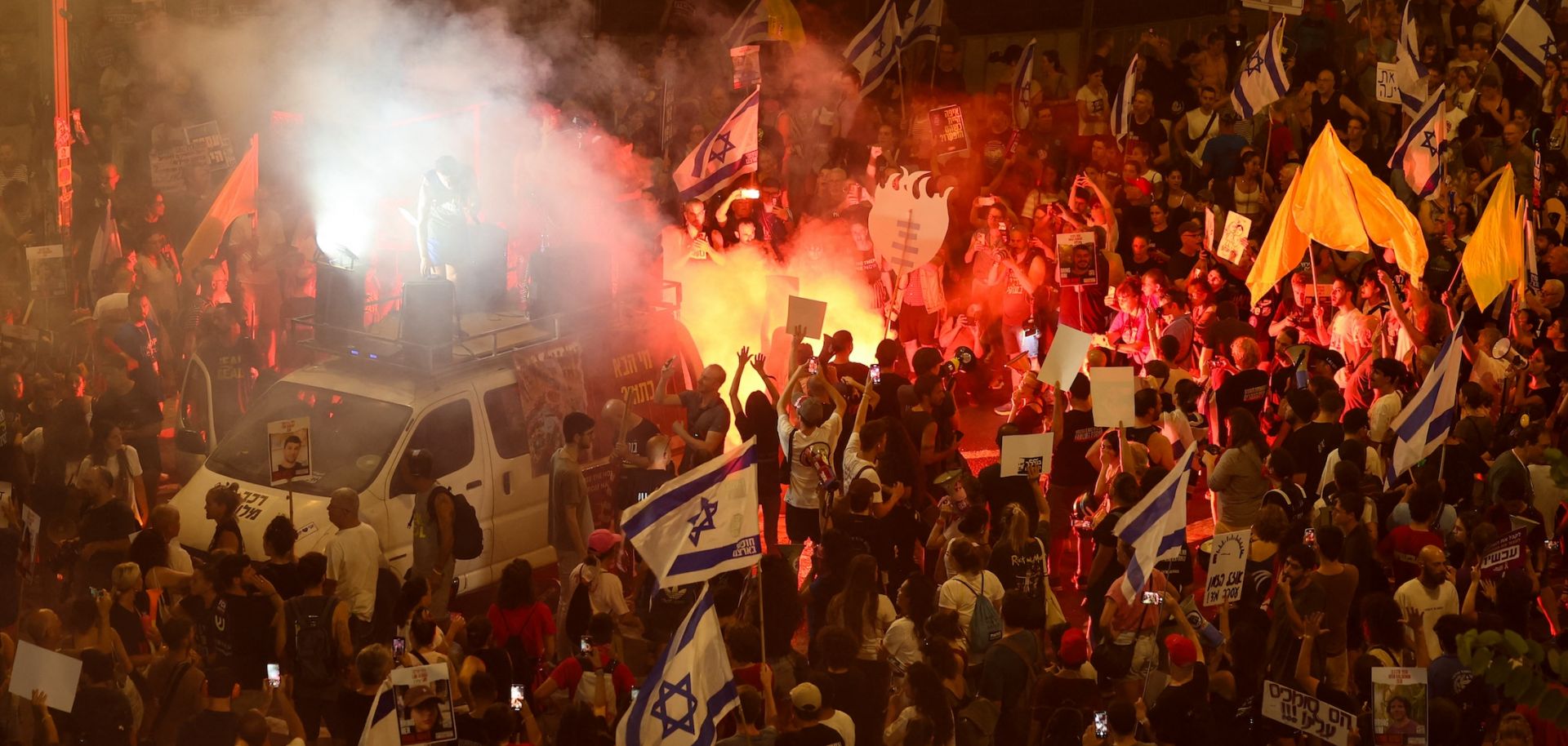
A strengthened anti-government movement in Israel is likely to reduce coalition government unity and could lead to months of disruptions to daily life, incentivizing the Israeli government to intensify military operations in Gaza, pulling forces from the northern front and West Bank, and seeing tensions between pro- and anti-government partisans possibly escalate into violence. On Sept. 2, Israel's largest public union, Histadrut, led a general strike in reaction to the killing of six Israeli hostages in Gaza over the weekend. Although Israel accuses Hamas of executing the hostages, the union and the Israeli opposition blamed the government's war strategy for failing to secure a cease-fire that might have led to their release. The Israeli courts soon ordered the strike to end, claiming it was too overtly political; Hisadrut compiled thereafter. The incident highlighted the political opposition's increasing strength and its ability to cause widespread economic disruption. The Israeli government has shown little indication of being prepared to offer concessions to Hamas, with Prime Minister Benjamin Netanyahu steadfastly demanding that Israel retain control of the Philadelphia Corridor along the Egyptian-Gaza border and a central strip of territory in Gaza.
- About 60 Israeli hostages, 35 of whom reportedly are dead, remain unaccounted for in Gaza. According to some media outlets, the six who were killed last week might have been part of a potential first phase of a hostage deal with Hamas that has so far failed to emerge.
- Histadrut had not previously called for a strike during the Gaza War, and such labor unrest is atypical for wartime, when Israeli union members have tended to rally around the flag.
- Histadrut represents a variety of workers, including bus drivers, teachers, airport workers, grocery workers, municipal workers and others who make up the bulk of those providing everyday services in the country.
Although Histadrut may not call for further general strikes, its open support for the opposition and demands for a cease-fire have bolstered an already popular public movement pressing the Israeli government to negotiate a cease-fire rather than pursue its maximalist war goals of eliminating Hamas and retaining forces in Gaza. Histadrut represents about 800,000 workers in a country of 9.5 million people, or about 8% of the total population. Its public encouragement of striking against government policies will likely fuel further walkouts and other labor actions designed to pressure the government into making concessions, even if the union itself does not lead further strikes under the assumption that courts will break them up. Israeli polls show that most Israelis support a cease-fire over the elimination of Hamas, particularly if it leads to the release of hostages. Far-right parties in the government coalition, however, oppose any cease-fire short of Hamas's complete elimination and have threatened to leave the government if one is signed. Given that polling suggests Netanyahu would struggle to survive an election without far-right support, he will likely continue to resist public pressure for a cease-fire.
- In a July poll, Israel's Channel 12 found that two-thirds of respondents favored a hostage deal over continued fighting with Hamas should such a deal lead to the return of Israelis captured Oct. 7.
- Anti-government protests have occurred for most of the war, partially as anti-Netanyahu protests and strikes from 2023 morphed into ones critical of his government's war strategy and of its repeated failures to reach a deal over the hostages.
Netanyahu's coalition is not entirely cohesive, and centrist members of the government, including Defense Minister Yoav Gallant, may consider negotiating with opposition leaders regarding leaving the government. With 64 out of 120 seats, the government can only afford to lose five seats in the Knesset in a vote of no confidence. Gallant has become increasingly critical of Netanyahu's war strategy, arguing that Israel can return to Gaza after a cease-fire has secured the hostages' lives and accusing Netanyahu of extending the war for his own political gain; the two reportedly have argued during security Cabinet meetings. Recent hostage killings and anti-government unrest could finally spur Gallant to leave the government. Gallant, an influential leader within the Likud party, could bring other members of the Knesset with him if he were to decide to join the opposition. According to Israeli media, Gallant said the demand that troops remain in Philadelphi was an unnecessary constraint and that Israeli forces could readily return to the region after a deal. Netanyahu, however, believes that international pressure would prevent Israeli troops from returning should a deal be reached.
- In previous Israeli governments, such as that of former Prime Minister Naftali Bennett, individual members of the Knesset have engaged in backdoor deals with the opposition to secure positions, then left the government coalition and brought down the government.
As public and political pressure deepens, the Israeli government is likely to seek military successes in Gaza, including rescuing hostages and eliminating more Hamas leaders, to shore up support. This may, however, require shifting resources from Lebanon and the West Bank. The Netanyahu government has already managed to assassinate Hamas political chief Ismail Haniyeh in Tehran and Hamas military second-in-command Mohammed Deif in Gaza. A few Israeli hostages have also been rescued during the campaign, but progress at finding other hostages has been slow. This is partly because Israel has redeployed forces from Gaza to the north and the West Bank and sent reservists home to alleviate the economic strains of the war. To increase its military footprint in Gaza, Israel may decide to pull troops from the northern border and the West Bank, potentially worsening security conditions in the West Bank and delaying a long-threatened incursion into southern Lebanon.
- Israel has kept open the authority to call up nearly 300,000 reservists, though many of these forces are logistical, air defense or otherwise noncombat in nature. Instead, it has relied upon several frontline combat brigades to continue operations in Gaza and maneuver near Hezbollah along the northern border in Lebanon. More forces have also been deployed to the West Bank as security conditions worsen there.
Even with a renewed focus on Gaza, Israel's recent operational history suggests it will struggle to rescue enough hostages to placate the public, leading to inevitable protests and strikes that could become increasingly violent within Israel. The Gaza Strip's vast tunnel network and widespread destruction of civilian infrastructure have hampered Israel's ability to locate hostages despite nearly a year of intense warfare. Even with more forces deployed, the remaining hostages will remain difficult to find in the coming weeks and months, while the deaths of more hostages would further weaken the government and increase the chances of its collapse while sparking more strikes and protests. As the Netanyahu government continues to rely on military force to address the challenge of Hamas in Gaza, the opposition will likely grow bolder, attempting to paralyze the country's economy and force policy changes similar to the nationwide movement that paused judicial reform in spring 2023. Unlike the judicial reform issue, however, partisans on both sides are growing increasingly confrontational, with far-right activists attacking aid convoys intended for Gaza and displacing Palestinians in the West Bank. Netanyahu meanwhile increasingly stands accused of undermining democratic norms, with opposition leaders and protesters seeing him as a threat to Israeli democracy. With these sentiments fueling protest movements, violent confrontations between opposing factions, including far-right activists and Israeli Arabs, may become more likely, potentially leading to the return of intercommunal unrest reminiscent of the May 2021 Gaza War.
- During the most recent strikes and protests, some opposition activists skirmished with police outside of the prime minister's house in Jerusalem, a potential flashpoint as tensions continue to escalate between government and opposition supporters.
