
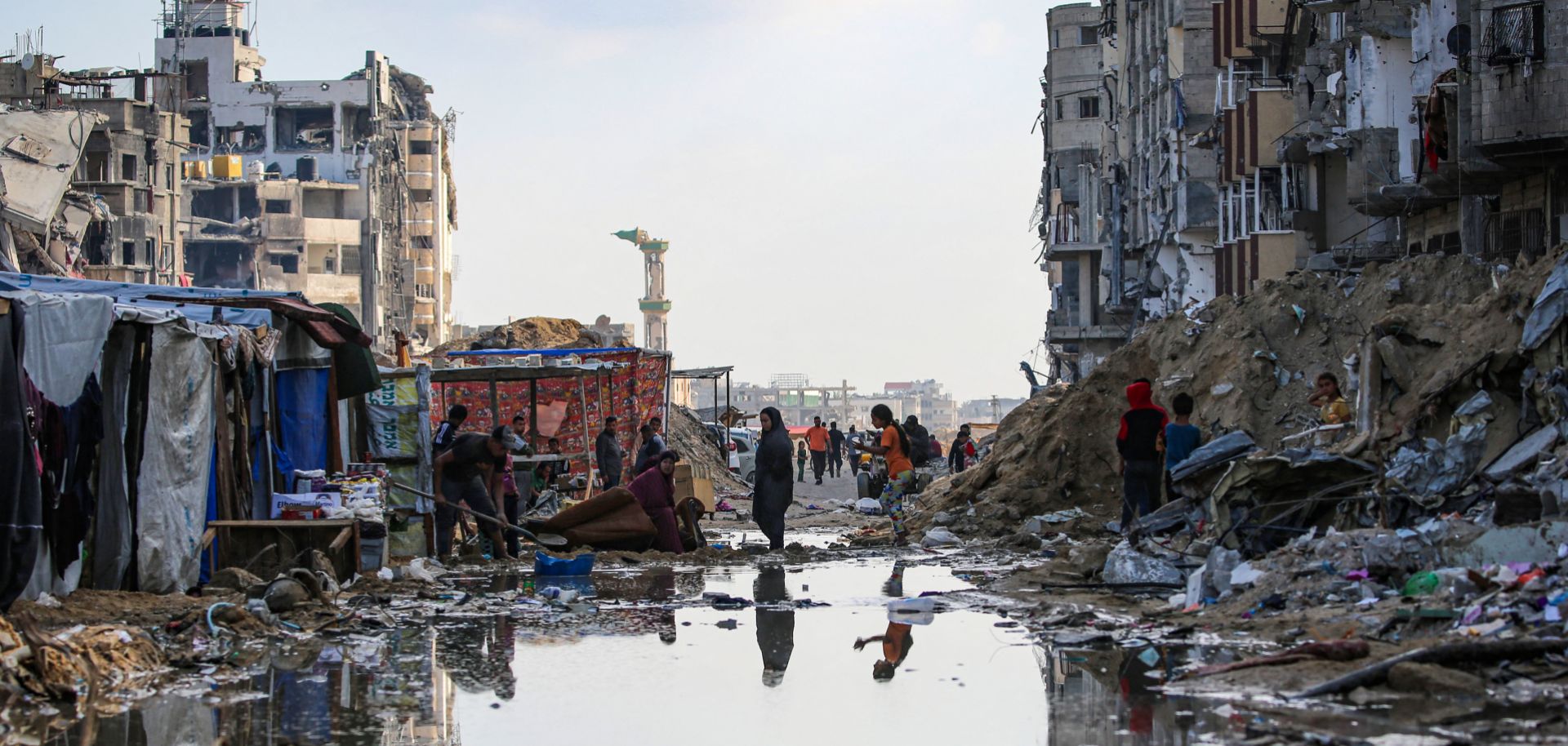
Israel's main post-war Gaza strategies include forming a joint administration with the Palestinian Authority, and/or deploying an international force of Arab peacekeepers. However, these approaches would risk collapsing the Israeli government and are unlikely to prevent the resurgence of Hamas and other militant groups. As military operations in Gaza wind down, Israel's government is under pressure to find a post-war strategy for Gaza. On May 16, the Arab League met in Bahrain and released a statement calling for the deployment of a U.N. peacekeeping force in the Palestinian territories as a precursor to restarting two-state negotiations and ending the Israeli-Palestinian conflict. The Arab League's suggestion was just one of multiple international proposals to find a governing solution for the Gaza Strip, which Hamas has de facto governed since it took control of the enclave in a 2006 uprising against the internationally-backed Palestinian Authority. Meanwhile, the United States is reportedly exploring the option of an Arab-led peacekeeping force for Gaza, with reported interest from Morocco, Egypt and the United Arab Emirates, as a means to end Israel's military involvement in Gaza while also preventing a resurgence of Hamas. In Israel itself, Israeli Defense Minister Yoav Gallant and Israel Defense Forces (IDF) Chief Herzi Halevi have gone public with their criticism of Prime Minister Benjamin Netanyahu, saying that Israel's lack of a formal plan for Gaza's post-war governance is guaranteeing a cycle of violence that leaves Israel diplomatically isolated and its military tied down in Gaza. On May 19, wartime cabinet member Benny Gantz threatened to leave the coalition by June 8 unless the government clearly articulated a post-war strategy for Gaza.
- Israel's government has been reluctant to define the exact plan for post-war Gaza, preferring to offer suggestions that it would simply establish new buffer zones in Gaza and/or find a local governing partner from Palestinian families. However, Israeli, American and Arab critics charge that such plans leave a power vacuum that ensures the return of Hamas and a perpetuation of the humanitarian crisis.
- Netanyahu's government has been reluctant to commit to a formal plan in part because it has diametrically opposite views of what should happen in Gaza. Far-right Israeli cabinet members, such as Finance Minister Bezalel Smotrich and National Security Minister Itamar Ben Gvir, advocate for Jewish settlement and occupation. In contrast, more traditional right-wing and center-right government members like Gallant and wartime cabinet member Benny Gantz suggest the return of the Palestinian Authority to govern in coordination with Arab aid and Israeli military support.
- On May 6, the IDF began limited operations to take Rafah, the last major city under Hamas control, in a sign that the major ground combat operations in Gaza are coming to an end. At the same time, however, the IDF sent another brigade to Gaza City in the north, where Hamas was regrouping, to battle over territory it had already taken in late 2023, as Israel demurs from deploying sustained force inside Gaza and prefers to withdraw troops after major combat missions are complete.
Israel's government will resist announcing a post-war plan that may break up its coalition, while the Palestinian Authority is unlikely to agree to any coordination with Israel that does not indicate a path to statehood. Wartime unity continues to hold together the increasingly fractious Israeli government, and while both the northern front along the Lebanese border and the southern front in Gaza remain active combat zones amid ongoing fighting with Hezbollah and Hamas, respectively, there is still enough public support for the government to maintain cohesion as long as major combat operations are taking place. However, once the IDF completes its Rafah operation in the coming weeks, the government will no longer be able to employ the same narrative to delay announcing a post-war strategy. Concerned about defections from the center-right and far-right, the government is most likely to announce a partial or incomplete plan that will be difficult to implement and will serve as a starting point for negotiations with the Palestinian Authority and international community to bring in support from the Palestinian Authority and international reconstruction aid. However, the Palestinian Authority is unlikely to accept such a plan, as collaborating with Israel in Gaza would weaken its already frail legitimacy in the West Bank, while international actors like the United States and Arab states will demand that Israel offer a more comprehensive plan that explicitly rules out Jewish resettlement and occupation of Gaza.
- Israel reportedly offered the Palestinian Authority an informal role overseeing the Rafah border crossing between Egypt and Gaza after its troops captured the location. This role would have given the Palestinian Authority a say in the distribution of aid and might have served as a prelude to restoring its authority in other parts of Gaza. However, Palestinian Authority President Mahmoud Abbas rejected the offer, saying they would not accept an ''undercover'' role in Gaza.
- An Israeli Channel 12 poll released on May 16 demonstrated divided Israeli public opinion over a post-war plan, with 40% preferring Israeli military rule and 40% saying the Palestinian Authority, backed by the international community, should take charge. These results, combined with the lack of a clear public consensus on what to do after the major combat operations end, feed into government indecision on how to determine a post-war plan for Gaza.
In the near term, Israel is likely to replicate aspects of its military occupation in the West Bank, with troops fighting a Hamas insurgency. For the foreseeable future, this strategy would entail a sustained military deployment in the Gaza Strip, anchoring Israeli forces in key locations, such as the southern outskirts of Gaza City, to regulate north-south movement. Meanwhile, IDF troops would continue to carry out raids and operations against Hamas forces that attempt to re-organize and/or carry out rocket attacks, while IDF commandos continue the hunt for Hamas leaders and hostages in the absence of a diplomatic breakthrough with Hamas that leads to a cease-fire, the release of Israeli hostages, and end of the monthslong war. Yet in doing so, these troops would remain exposed to attack, and casualties would be inevitable, wearing down Israeli public support for this approach. Moreover, the forces required for occupation would likely constrain some of Israel's military options along the northern border with Lebanon, as commandos and combat brigades deployed in Gaza would be needed for a major incursion into southern Lebanon against Hezbollah's well-fortified positions.
- Some Israeli media have speculated that Israel would need to keep up to five combat brigades in and around Gaza for a military occupation strategy, which would deprive the IDF of frontline combat forces for Lebanon. Israel has around 14 active brigades, though that number can readily increase with the deployment of reserve forces.
To free up Israeli troops and reduce political risk to the government, Israel will try to implement a Palestinian-led government utilizing the Palestinian Authority, but the Palestinian Authority's corruption allegations and collaboration with Israel will make this a widely unpopular option among Palestinians in Gaza, fueling support for Hamas. Though the Netanyahu government has previously said that a Palestinian-led governing body in the strip would be neither Hamas-affiliated nor Fatah-affiliated, a long occupation of Gaza would be politically unpopular among every Israeli party but those on the far-right (which want to resettle Gaza). Meanwhile, military considerations to deter Hezbollah will increase pressure on the government to find a way to allow Israel to redeploy its frontline combat brigades out of Gaza and the north. This will lead to a process by which the government seeks a Palestinian partner in Gaza, and given the initial failed results of local governing, Israel will likely turn to the Palestinian Authority as a partner. However, the Palestinian Authority will face challenges in establishing legitimacy: efforts to overhaul its political structure, such as the installation of a new technocratic cabinet, may not address the deep-rooted issues of corruption perpetuated by decades of election absence and stagnant leadership. Furthermore, Palestinians would view coordination between the Palestinian Authority and Israel for security and humanitarian aid distribution as complicity, which could potentially give rise to more militant factions in Gaza, including remaining Hamas and Palestinian Islamic Jihad militant cells. While this Palestinian Authority-led government would likely require an IDF security presence in the strip to fight insurgency and conduct raids on remaining militants, it would require fewer IDF troops than an occupation, enabling some flexibility for demobilization or an operation along the Israel-Lebanon border.
- Rumors that Israel might use local clans to help distribute aid in Gaza first emerged in March 2024, but local clan sources speaking to international media shot down the suggestion, demonstrating Israel's trouble with finding a local partner that is neither Hamas nor Fatah.
In the longer run, if regional tensions decline, some Arab nations might support an international-backed peacekeeping force, but this would require political change in Israel, and even this force would not be capable of completely stopping a return to militancy in Gaza. If tensions in the Middle East decrease — including e.g. via possible diplomatic breakthroughs in Lebanon and/or with Hamas in Gaza — some regional countries (including Egypt, the United Emirates and Morocco, which have normalized relations with Israel) might back a peacekeeping force for Gaza if it includes a process for a Palestinian state. In this longer-term scenario, international forces would provide security, Gulf Arab states would provide reconstruction funds, and the Palestinian Authority would act as the civil authority in Gaza, enabling Israeli forces to fully withdraw from the enclave. This option will become more appealing to the Israeli government over time, particularly as Gaza's reconstruction bill — estimated at least $50 billion — becomes the responsibility of the occupying power. Though Israel would want to limit the scope and scale of an Arab-led peacekeeping force in Gaza, if a peacekeeping operation coincides with significant aid pledges to rebuild Gaza, the current or future Israeli government will become more open to the idea. This proposal, however, could result in policy paralysis if negotiations toward a Palestinian state stall and there are persistent disagreements about the composition of a Palestinian-led government, which could lead to the rapid dissolution of such a force and a security vacuum that Israel would have to quickly fill. Moreover, an Arab-led peacekeeping force would be unwilling to use force on Palestinians and/or carry out missions to hunt remnants of Hamas and/or other militants, giving militants an opportunity to reorganize and reconstitute in Gaza.
- Though the 1979 Camp David Accords are meant to demilitarize the Egypt-Israeli border, both sides have made exemptions for one another's forces in the area in the course of the Israeli-Hamas War as they aim to contain the diplomatic fallout of the conflict. Further exemptions might be granted for more Egyptian forces in Gaza itself, provided they limit the numbers and types of equipment brought into Gaza and/or have monitoring mechanisms through friendly parties like the United States.
All of these options risk destabilizing the Israeli government, threatening to break the coalition ahead of a decision and leaving the Israeli military in charge of Gaza in the meantime. Pragmatic center-right members of the wartime coalition, including War Cabinet Minister Benny Gantz and Israeli Defense Minister Yoav Gallant, do not view a long-term military occupation as a viable option and will pressure Netanyahu for a more concrete plan to facilitate the transition from military operations to a more stable governing system. However, coordination with the Palestinian Authority would likely isolate far-right members of Netanyahu's coalition who have floated ''voluntary emigration'' from Gaza and civilian settlements in Gaza. Both the far-right and elements of the nationalist right are likely to oppose an Arab-led peacekeeping force due to concerns about reintroducing Arab forces into a territory Israel seized from Egypt in 1967. To offset this pressure, Netanyahu will likely delay a formal decision, but by doing so will only increase criticism of the government's management of the war. This criticism may eventually culminate in defections from the government that spark early elections, a process that would effectively freeze the debate on post-war Gaza strategy and leave the Israeli military in charge of implementing short-term, security-based policies rather than a governing or reconstruction strategy.
