
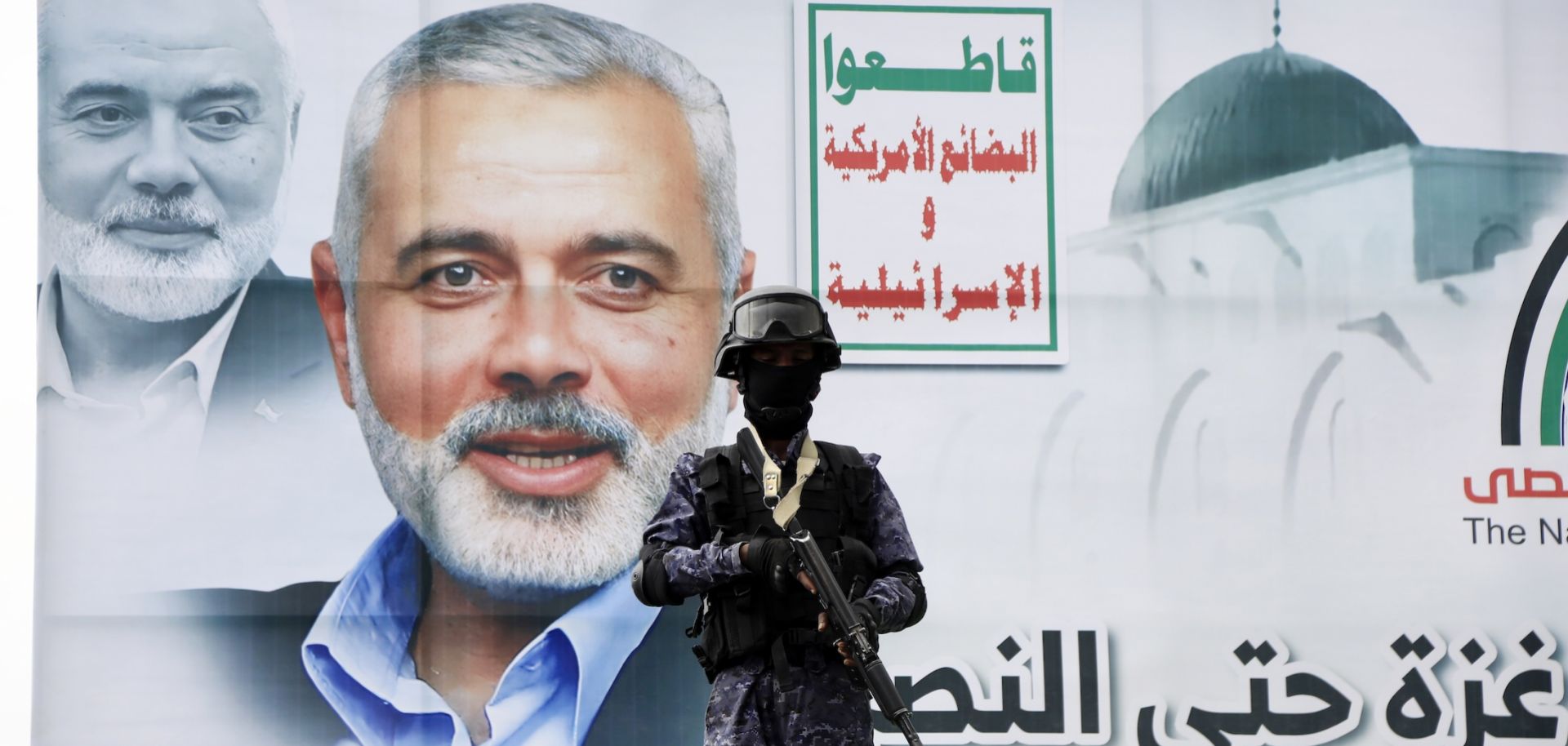
The assassination of Hamas' political chief will undermine Hamas-Fatah reconciliation by deepening drivers that already make unity between the two groups difficult, leaving the Palestinian political movement fractured while fueling instability in Gaza and the West Bank. On July 31, Israel presumably assassinated Hamas' political leader Ismail Haniyeh in Tehran, creating a sudden leadership vacuum in the militant organization, which also governs the Gaza Strip. The killing came a little over a week after Hamas and its West Bank counterpart Fatah announced the beginning of a national reconciliation process outlining goals toward a unified government. This was the first significant political announcement toward unity made by the two Palestinian political forces since at least 2017. Hamas has expressed interest in being involved in post-war Gaza governance. And Fatah — the dominant political party within the Palestinian Authority, which governs the West Bank — has a political incentive to maintain dominance in a unified system and prevent political challenges. But Haniyeh's recent death and the appointment of hard-line Hamas official Yahya Sinwar as his replacement have injected uncertainty into this reconciliation process by deepening the myriad constraints that have prevented the two groups from reuniting after their formal split nearly two decades ago.
- Although the agreement did not provide a roadmap toward reconciliation, it outlined four goals: to establish an interim national unity government representing the entire Palestinian territories, establish a unified Palestinian leadership, conduct a free and fair election of a new Palestinian National Council, and have a unified stance against Israel.
- Hamas won the Palestinian Authority (PA)'s 2006 legislative elections, but also caused the United States, Israel, and Europe to threaten to cut off aid to the PA because Hamas was a designated terror group. Subsequently, Hamas and Fatah fought a brief civil war in 2006 over control of the Gaza Strip, which saw Hamas oust Fatah from Gaza. The resulting political crisis culminated in the formal split between Fatah and Hamas, with the PA de facto dominated by Fatah.
- Haniyeh's previously designated successor, Saleh Arouri, was also killed in an Israeli airstrike in Beirut in January 2024.
Hamas' temporary leadership vacuum will feed into pre-existing constraints toward reconciliation, like contention for political dominance in the Palestinian territories, ideological differences between Hamas and Fatah, and strong resistance by the United States and Israel. Without a concrete blueprint for reconciliation, and with both groups mired in internal political challenges, neither Hamas nor Fatah will likely make substantial progress toward reconciliation. Fatah's security coordination efforts with Israel make it difficult for Hamas to deepen its political relationship with Fatah, especially in the wake of Haniyah's assassination. In addition, Hamas' growing approval after the Oct. 7, 2023, attack on Israel, especially among Palestinians in the West Bank, disincentivizes Fatah from offering political concessions to Hamas in the PA or the Palestine Liberation Organization (PLO), fearing a steep loss of influence in formal Palestinian politics. Furthermore, Hamas and Fatah have significant political and ideological differences, including recognition of the state of Israel, as well as willingness and ability to cooperate with Israel and the broader international community; Fatah accepts a two-state solution while Hamas still aspires to replace Israel with an Arab, Islamist state, though some factions of Hamas hold a more pragmatic stance prioritizing Palestinian statehood within the existing territories. Israel and the United States will likely pressure Fatah against reconciliation with Hamas, which would result in the loss of a reliable Palestinian negotiating partner and hamper Western aspirations for the PA to assume a governing role in post-war Gaza. The inclusion of Hamas in a unified Palestinian government through a formal reconciliation would also alienate international partners that see Hamas as a terrorist organization, including the United States and the European Union. Furthermore, if Fatah allows Hamas a more formal role in the PLO or the PA, it risks triggering expanded sanctions from Israel, the United States, and the European Union, whom the Palestinian Authority is reliant upon for tax revenue, weapons and training. Such sanctions would unlikely be lifted unless Hamas offered serious political concessions, such as accepting Israel's right to exist and halting militancy against Israel, but Hamas is very unlikely to agree to either of those conditions. Finally, should Hamas gain a formal role in the PLO or PA, Israel's current campaign of assassination would expose both organizations to potential Israeli covert action.
- In a poll conducted by the Palestinian Center for Policy and Survey Research to assess Palestinian sentiments toward preferred political parties that was released in June, 40% of respondents said that they preferred Hamas while only 20% said they preferred Fatah. Still, around a third of respondents said they did not support any faction or had no opinion. Prior to the war, Fatah was slightly favored over Hamas, with 26% of respondents preferring Fatah compared with 22% favoring Hamas.
- One of the main ideological differences between Fatah and Hamas is the recognition of Israel. While Hamas has previously said that it could accept a two-state compromise with Israel, Hamas has not said that it would recognize Israel nor stop an armed fight against Israel, even if conditioned on a two-state solution. By contrast, Fatah, as part of the PLO, recognized the state of Israel as part of the 1993-1995 Oslo Accords.
Leadership changes in Hamas will further complicate a reconciliation process with Fatah as internal divisions due to Yahya Sinwar's militant, hard-line stance could fracture the group, potentially creating a partial reconciliation that would leave out more militant elements of Hamas. On Aug. 6, Hamas announced that it had selected Sinwar, Hamas' leader in the Gaza Strip and one of the masterminds behind the Oct. 7 attack, as Haniyeh's successor. Assuming the political leadership role, Sinwar will likely have a more militant, hard-line approach that Fatah is unlikely to accept, making reconciliation with Sinwar unlikely. However, Hamas' changing leadership may isolate more pragmatic factions of the group that are more amenable to reconciling with Fatah and forming a unified Palestinian government. As such, Hamas may fragment under Sinwar and more moderate factions may support a partial reconciliation with Fatah, though Hamas' official political and militant wings would be unlikely to back such a move.
Without a proper reconciliation between Hamas and Fatah, and in the face of an open-ended Israeli assassination campaign against Hamas officials, political and social instability in the Palestinian territories will likely deepen, weakening the prospect of reconstruction in Gaza while fueling violence throughout the region. Even if more pragmatic elements of Hamas pursue a partial reconciliation with Fatah, Palestinian politics will remain unstable, particularly as Hamas and the Palestinian public react to Israel's ongoing assassination campaign. Haniyeh's recent killing will likely further radicalize Palestinians, while Hamas' militant wing will grow more popular, particularly in the West Bank, fueling more instability and militancy, while reducing its militant wing's incentives to reconcile with Fatah. Furthermore, Israel will likely try to target Sinwar due to his role in the Oct. 7 attack, potentially leading to another assassination attempt. Meanwhile, any Fatah-Hamas cooperation, even if it is informal or part of only a partial reconciliation, would likely face backlash from the United States and Israel, which have refused to let Hamas have a governing presence in the Gaza Strip. Furthermore, cooperation between Fatah and elements of Hamas could alienate some Arab countries that oppose Hamas' political Islam ideology, such as the United Arab Emirates and Saudi Arabia. This could, in turn, dissuade these wealthy Arab states from providing reconstruction aid that will be critical in rebuilding war-torn Gaza for fear that such support could help Hamas re-establish itself, even in a limited capacity, in the strip.
- Even as Hamas' military abilities have eroded amid the ongoing war, the group still controls areas in Gaza and maintains governing capabilities through imposing price controls on commercial goods, working to maintain utilities, and responding to airstrikes — albeit the effective provision of services has been disrupted by Israeli military action in the strip. Nevertheless, senior Fatah officials have noted Hamas' enduring role and impact in Palestinian politics, with one saying ''Hamas is part of our national fabric.''
- Fatah may be more likely to push for reconciliation if Hamas' support in the West Bank continues to grow and an intifada-like uprising breaks out in the territory. If support for the PA and Fatah significantly declines, Fatah may align more closely with some militant elements of Hamas and back such an uprising in the West Bank, in an attempt to remain relevant in Palestinian politics. However, doing so would sever cooperation with Israel and diminish U.S. support for a reformed PA to govern the Gaza Strip. Nevertheless, if more Palestinians begin supporting Hamas over Fatah, Fatah leadership may calculate reconciliation with Hamas is critical for the party's survival, even if it means a deterioration in international recognition.
