
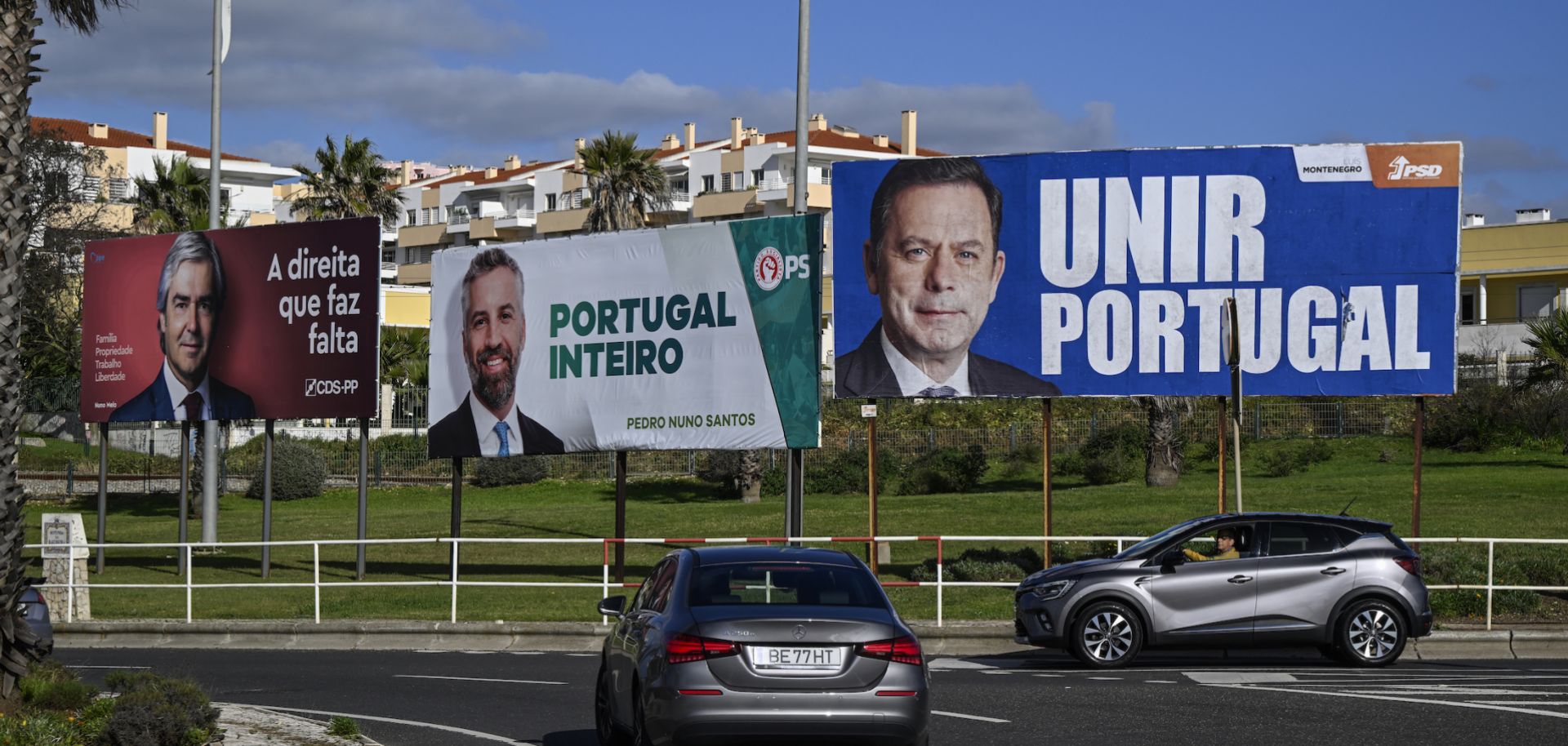
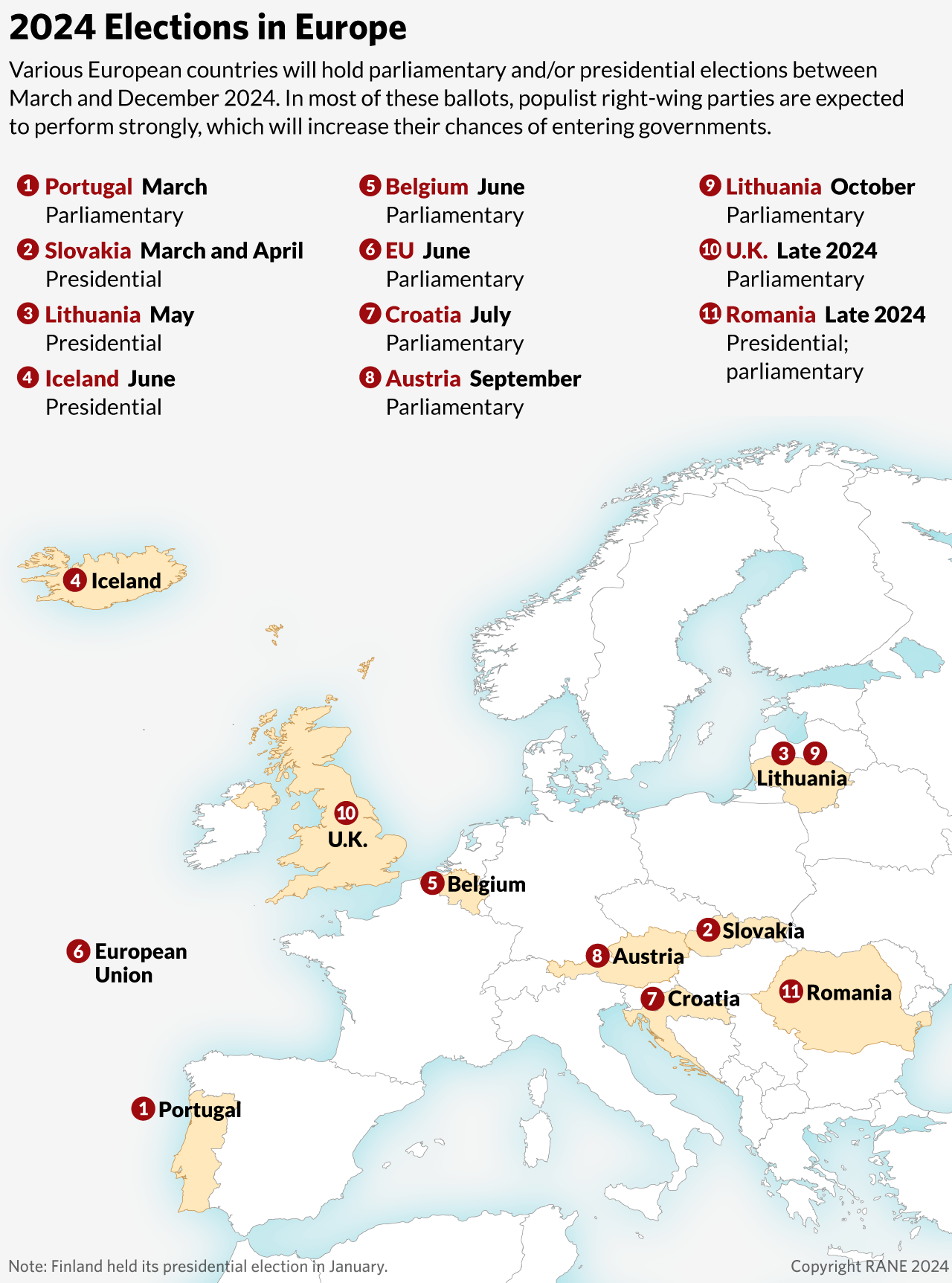
Various European countries will hold elections in 2024, but the votes in Portugal, Belgium, Austria, Romania and the United Kingdom will likely be the most impactful, with potential implications ranging from the rise of right-wing populists to drastic changes in domestic and foreign policy. Between February and December, a number of European countries will hold parliamentary and/or presidential elections (Finland formally kicked off Europe's electoral year with a presidential election in late January). These votes will come on top of the EU-wide elections for the European Parliament in June, making 2024 a year of significant electoral activity in the Continent. While each of these elections is relevant, below we present the ones that will have the greatest domestic and international repercussions, in the order in which they will occur.
Portugal
Portugal's early parliamentary election on March 10 will take place after the country's socialist prime minister resigned in November amid a corruption scandal. Former Portuguese Prime Minister Antonio Costa first took office in 2015 and was re-elected in 2019 and 2022. During his eight years in office, he pursued a policy of fiscal responsibility, reducing the country's fiscal deficit and sovereign debt levels but also increasing the tax burden on households and businesses. The last of his three governments proved to be particularly unstable as successive scandals and internal disputes led to multiple cabinet resignations in early 2023. The final straw for Costa came in November, when the police carried out a series of searches at his official residence and other ministries, and his chief of staff was arrested as a part of a corruption case involving the awarding of contracts for lithium and hydrogen projects. Shortly after these incidents, Costa resigned and announced he would not seek a fourth term. According to opinion polls, the election will be a close race between Costa's Socialist Party, now led by former Minister of Infrastructure Pedro Nuno Santos, and the Democratic Alliance, a coalition of conservative parties led by Luís Montenegro. Notably, the right-wing populist Chega party is polling in the third position.
Even if the populist right enters Portugal's government, a drastic change in domestic or foreign policy is unlikely. Because of Portugal's multi-party parliamentary system, a coalition of several parties will be needed to appoint the country's next government. Three scenarios are possible. First, a ''grand coalition'' between center-right and center-left parties would prevent any radical policy changes (notably, Lisbon would continue the ongoing process of debt reduction), and produce a government that is stable and aligned with the European Union despite ideological differences. Still, the Democratic Alliance may oppose sharing a government with the scandal-plagued Socialist Party. Second, a minority government, led by a center-right or center-left party with parliamentary support from other moderate parties, would produce a somewhat less stable government but a similar degree of policy continuity. The third, and most disruptive scenario, would be a coalition between the Democratic Alliance and Chega. While Montenegro has repeatedly said that he will not form a coalition with Chega, his party and Chega have similar views on issues such as tax cuts, and a precedent in briefly collaborating at the regional level. Chega has criticized the European Union in the past, which means that some friction between Lisbon and Brussels is possible if the party is in power. Still, Chega is more likely to focus on immigration, law and order, and domestic social issues (such as curbing the rights of sexual minorities) if it enters the government as a junior partner.
Belgium
The federal election in Belgium will take place against the backdrop of strong support for nationalist and separatist parties in the Flanders region. Belgium's political system is very fragmented, as around a dozen parties enter the country's federal parliament after every election. Moreover, the Dutch-speaking Flanders region, the French-speaking Wallonia region, and the muti-lingual Brussels-Capital region appoint their own highly autonomous governments. While this system complicates decision-making, it also means that drastic policy changes are rare because consensus among multiple parties along the country's linguistic divide is needed to pass legislation. However, the June 9 federal and regional elections could result in major changes in Flanders, where nationalist parties are polling strongly. While opinion polls suggest that the center-left Socialist Party and the conservative Reformist Movement (both of which are members of the current government led by Prime Minister Alexander De Croo) will come on top in Wallonia, they also suggest that the right-wing populist Vlaams Belang (which wants Flanders to become independent) and the Flemish nationalist New Flemish Alliance (which wants to increase the region's autonomy) will secure the most votes in Flanders.
While Flanders is unlikely to unilaterally secede, the election will raise questions about the future of Belgium's territorial integrity. At the federal level, the election will likely trigger months of negotiations between moderate Wallon and Flemish parties that eventually yield another centrist coalition with a similar policy agenda as the previous government. The main risk associated with the election thus lies in the formation of a secessionist government in Flanders. Vlaams Belang has stated that if it wins the election it will promote a declaration of sovereignty in the Flemish parliament, which would trigger negotiations with the federal government to produce a partition treaty. But to do any of this, Vlaams Belang would first need to find a coalition partner in Flanders because it is not projected to win the election outright, and the New Flemish Alliance is the only viable option. However, the New Flemish Alliance is internally divided about this, as many party members oppose forming a government with the far-right. While a nationalist coalition in Flanders would put the issue of Flemish independence at the center of Belgian politics and raise questions about the country's territorial integrity, even in this scenario Flanders is unlikely to declare independence unilaterally, for fear of political isolation and the negative economic impact such a decision would have.
Austria
Voters' dissatisfaction with moderate parties will likely benefit the populist right in Austria's federal election in the autumn. The past few years have been tumultuous in Austria. The country has had four different chancellors since 2020 amid a series of political scandals and corruption cases, which has only fueled rising popular discontent with mainstream political parties. In addition, support for the governing coalition between the conservative Austrian People's Party (OVP) and the center-left The Greens has plummeted in recent years as a result of various controversial decisions (including a COVID-19 vaccine mandate that the government later abandoned due to widespread popular rejection), along with Austria's high inflation and low economic growth. Against this backdrop, polls suggest that the right-wing populist Freedom Party of Austria (FPO) will come on top in the federal elections in the autumn, with the center-left Social Democratic Party (SPO) and the OVP competing for the second position.
A victory by the FPO could result in a government that is skeptical of helping Ukraine's war efforts and pursues more hawkish policies on migration and law and order issues. While the FPO has been a member of previous Austrian governments, it was always the junior coalition partner and never appointed a chancellor. The 2024 election will thus be the party's best opportunity yet to be the senior member of a coalition (probably with the OVP) and appoint a chancellor. This could create a constitutional crisis, as President Alexander Van der Bellen (a former member of The Greens) has said he will not appoint a far-right chancellor. Moreover, an FPO-led government could result in significant changes in Austria's foreign policy, as the party argues that Vienna should remain neutral in the war in Ukraine (Austria currently contributes financially to EU arms deliveries to Ukraine through the European Peace Facility, something that the FPO opposes); some of FPO's members have also expressed pro-Russia views. This means that Austria could join the likes of Hungary when it comes to blocking, or at least delaying, the provision of additional EU financial or military support for Ukraine. An FPO-led government would also likely push for stricter migration policies (both in Austria and the broader European Union), border controls that would disrupt the movement of people and goods across neighboring countries, and measures that curb the rights of minorities living in the country.
Romania
Romania's parliamentary and presidential elections will happen at a time of unusual political stability for the country. Since late 2021, Romania has been governed by a coalition between the country's two largest parties, the center-left Social Democratic Party (PSD) and the center-right National Liberal Party (PNL). This has given the country an unusual degree of political stability, as Romanian governments tend to be fragile and prone to collapse. Factors including the COVID-19 pandemic, the allocation of billions of euros in EU funds for Romania, and Russia's invasion of Ukraine all motivated traditional rivals PSD and PNL to keep their coalition in place. However, the parties often disagree on issues such as fiscal policy, and years of co-governance have somewhat diluted the PSD and PNL's identities and favored the rise of new political forces. The PNL has been particularly impacted by this, as the United Right Alliance (a coalition of center-right parties) and the right-wing populist Alliance for the Union of Romanians (AUR) are polling strongly and will likely steal votes from the PNL in the parliamentary election in late 2024 (no specific date has been announced). Romania is also scheduled to hold a presidential election in the autumn, which is politically relevant as Romanian presidents are involved in foreign policy and can veto legislation. As incumbent Klaus Iohannis is at the end of his second term and cannot run again, PSD and PNL will likely support their own candidates, creating further friction between them.
Economic risks will increase ahead of the election, while the far-right's entry to the next government could fuel inter-communal tensions. While Romania is one of Europe's fastest-growing economies, it has for years struggled to reduce its budget deficit. This has put the country under the scrutiny of both the European Union (Romania has been under the bloc's Excessive Deficit Procedure, which forces member states to reduce their budget deficits, since 2019) and credit rating agencies (which frequently warn about the potential unsustainability of Bucharest's fiscal policies). Because 2024 is a packed electoral year for the country (in addition to parliamentary and presidential elections, Romania will also participate in the European Parliament elections), Bucharest is unlikely to introduce unpopular spending cuts or tax hikes, and it may actually increase fiscal spending ahead of these ballots. If left unchecked, Romania's budget deficit could make it more expensive for Bucharest to borrow in debt markets, limit the government's ability to respond to economic downturns, and fuel inflation. After the election, the main political risk is associated with AUR potentially entering the government. The party is critical of both the European Union and NATO, but a junior membership in a government would not give them the power to exit either alliance, a decision that would also need support from the president. But while the AUR entering the government would not jeopardize Romania's EU or NATO membership, it could weaken Bucharest's support for Kyiv's war efforts (the party has said that the war in Ukraine ''is not Romania's war''). It would also fuel tensions with ethnic minorities in Romania, as AUR promotes Romanian culture and identity, and is critical of the country's minorities (such as ethnic Hungarians and the Roma people).
The United Kingdom
The United Kingdom will likely hold its general election by the end of the year, with polls suggesting that the center-left Labour could return to power after nearly 15 years of Conservative rule. A succession of scandals, controversial policy decisions and intra-party fighting amid the United Kingdom's cost of living crisis have severely deteriorated the ruling Conservative party's popularity since its landslide electoral victory in 2019, to the point that polls now suggest that the center-left Labour Party has a roughly 20-point lead. While the official deadline for the next general election is January 2025, Prime Minister Rishi Sunak said the vote would take place in the second half of the year. Local elections on May 2 could influence his choice for a date, depending on how the Conservatives perform. The party has been in power since 2010, which means that a Labour victory in the general election could mark significant policy changes after nearly a decade and a half.
A Labour victory would result in a greater state presence in the economy, improved ties with the European Union, and continued support for Ukraine and NATO. In the lead-up to the election, Sunak may promote modest tax cuts to please his Conservative party's electoral base; the Spring Budget, which will be announced in March, will offer an opportunity for this. However, widespread tax cuts are unlikely given that the United Kingdom's fiscal deficit is relatively high at roughly 5% of GDP and national debt levels are close to 100% of GDP. Meanwhile, intra-party disputes will likely continue, especially if the Conservatives perform poorly in the local elections, adding to political and policy uncertainty. While Labour has yet to unveil its full electoral platform, a Labour-led government would likely hike taxes on wealthy individuals and large companies and increase regulation of the private sector. A Labour government would also likely adopt a more ambitious climate policy and increase spending on new green energy infrastructure and industrial subsidies for the production of green technologies. Such a government would not seek to reverse Brexit, though it would probably seek cooperation with the European Union on areas such as defense, trade oversight, financial services, and the regulation of new technologies. Policy continuity vis-a-vis Ukraine would also be likely, as Labour Party Leader Sir Keir Starmer (who would probably serve as prime minister) has repeatedly pledged to continue military and financial support for Kyiv. In addition, Starmer has described Labour's commitment to NATO as ''unshakable,'' though relations with the United States could become tenser if Donald Trump wins another presidential term in November. Finally, U.K.-China relations would likely remain strained because of issues such as Beijing's crackdown on civil liberties in Hong Kong, the treatment of Uyghur Muslims in China's Xinjiang province, and tensions over Taiwan. The new Labour government would thus maintain its predecessor's policy of de-risking from China without severing economic and trade relations.
