
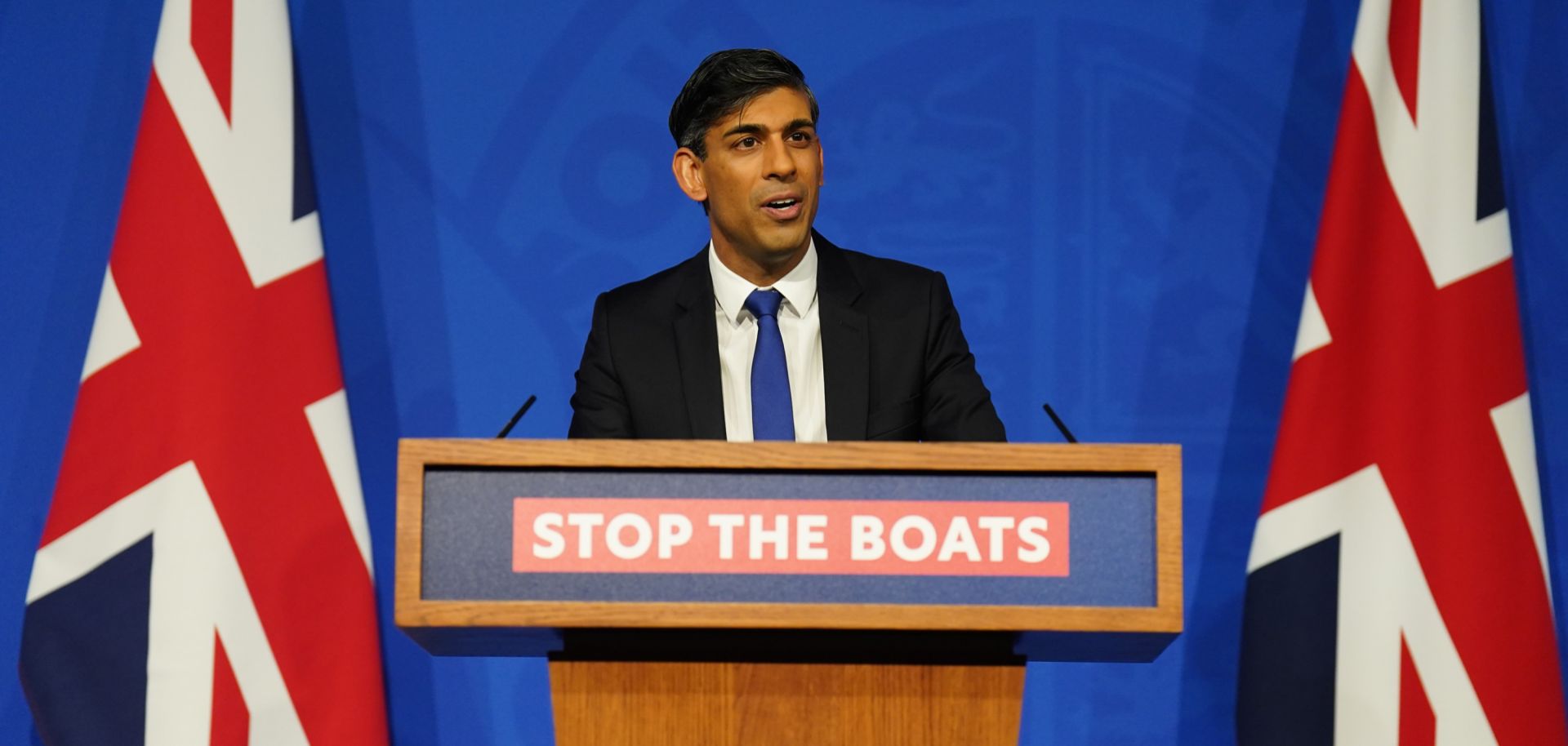
While the U.K. government has survived a first vote on its controversial plan to send migrants to Rwanda, the proposed bill will remain a divisive issue within the ruling Conservative Party in 2024, likely resulting in political turbulence and persistent questions about Prime Minister Rishi Sunak's future. Sunak weathered an internal rebellion within his Conservative party over his flagship migration policy on Dec. 12, with a majority of lawmakers backing in principle the Safety of Rwanda (Asylum and Immigration) bill in its second reading in the lower house of the U.K. Parliament. The bill, the government's emergency legislation to save a divisive plan to relocate asylum seekers to Rwanda, passed with a majority of 44 in the House of Commons despite 37 Conservative lawmakers abstaining, of which at least 29 are believed to have deliberately refused to back the bill. None of them, however, voted against the proposed legislation, as many had threatened to do in the run-up to the vote. Just before the session, backbenchers from five Conservative groups on the right wing of the party, including the European Research Group (ERG) and the New Conservatives, declared their opposition to the bill in its current form, pledging to propose changes to tighten its provisions as it moves through the legislative process and to reject it in its next reading if such changes are not incorporated.
- Unveiled on Dec. 6, the emergency legislation is designed to overcome a Supreme Court ruling that on Nov. 15 declared the government's plan to send asylum seekers to Rwanda illegal on the grounds that asylum seekers risked being re-deported to their home countries and face further persecution. The bill would allow the U.K. government to overlook some domestic human rights laws and ignore temporary injunctions from the European Court of Human Rights to pursue its Rwanda asylum and immigration policy, but without leaving or formally ''disapplying'' the European Convention on Human Rights and leaving migrants the option to appeal against deportation on an individual basis.
- Separately, U.K. Home Secretary James Cleverly signed a new treaty with Rwanda on Dec. 5 that guarantees migrants relocated from the United Kingdom will not be deported to their home countries.
- After a successful vote in its second reading, the bill will now go to the committee stage, giving Conservative lawmakers who want to strengthen the legislation the chance to propose amendments, with further votes scheduled for early 2024.
Tackling irregular migration has become a priority for the Conservatives ahead of the United Kingdom's next general election, but the government's proposed solution to the issue has deeply divided the party. Prime Minister Sunak has been facing growing pressure from his party to come up with measures to reduce illegal immigration, a major concern among voters, especially as the United Kingdom's net migration figures reached record highs over the past year. In fact, migration has become a key electoral issue for the Conservative Party ahead of a general election expected for late 2024, as reducing it was one of five key pledges Sunak set out for his premiership as he took office in October 2022. Sunak thus placed the Rwanda plan at the core of his strategy to fulfill this promise, arguing the prospect of facing deportation would deter migrants from coming to the United Kingdom via irregular means. But the plan has deeply divided the Conservatives; moderates in the ruling party are concerned the move could breach the country's human rights obligations, while right-wing lawmakers have argued the proposed legislation does not go far enough to prevent further legal challenges to deportations. The emergency legislation following the November court ruling was an attempt to strike a delicate balance between the two camps, but critics on the party's right flank continue to criticize the migration bill for being too weak.
- A Dec. 6 YouGov survey found that 20% of U.K. voters believe immigration to be the ''single most important issue'' facing their country, just behind the economy (30%) and above health (13%). Immigration is a priority among Conservative voters, with 66% selecting it as one of the top issues and 38% as the most important issue.
- A Dec. 13 Ipsos survey found that 79% of U.K. voters, including 74% of Conservative supporters, believe their government has done ''a bad job'' on immigration.
- According to recent figures from the United Kingdom's Office for National Statistics, net migration was 672,000 between 2022 and June 2023, slightly up from 607,000 over the same period a year earlier.
While Sunak has averted a potential government crisis, the legislation will see more Conservative infighting in early 2024, keeping a low but persistent risk of a government collapse and early general elections. Although Sunak on Dec. 12 sought to defuse tensions by denying claims that the vote on the Rwanda migration bill was essentially a vote of confidence in his premiership, a defeat would have signaled an open rebellion within the ruling majority that would have significantly weakened his authority, possibly leading to a leadership challenge or even early elections. But while the prime minister narrowly avoided this scenario for now, the draft legislation could still be rejected once it goes back to the Commons for a second vote, as the bill will likely continue to be challenged at the committee stage by right-wing Conservative lawmakers who want to tighten it further. At the same time, efforts by the government to harden the legislation as demanded by the party's right flank could alienate its centrist majority, with several lawmakers warning they would reject any amendments that would breach international law. A tougher bill would also be more difficult to pass through the more moderate House of Lords. The Rwanda bill, and migration in general, will thus remain a source of political turbulence and policy uncertainty in the United Kingdom over the next year, as Sunak tries to appease the hard-liners in his party without irking the more moderate majority ahead of the general election expected in 2024. And while internal rebellions within the ruling Conservative Party are unlikely to succeed in toppling Sunak's government ahead of the election, a government crisis and eventual early elections will remain a possibility for the first half of next year.
- Right-wing members of the Conservative Party have argued the current Rwanda migration bill is not strong enough to achieve its goals, particularly as asylum seekers would still have legal means to appeal against deportation. Sunak promised he would consider amending the bill to appease these concerns in exchange for these right-wing lawmakers' support in the legislation's second reading.
- The Conservative Party's centrist One Nation group, which includes over 100 lawmakers from the ruling party, supported the Rwanda migration bill in its second reading but warned it would reject any amendments that would cause the United Kingdom to breach ''the rule of law and its international obligations.''
