
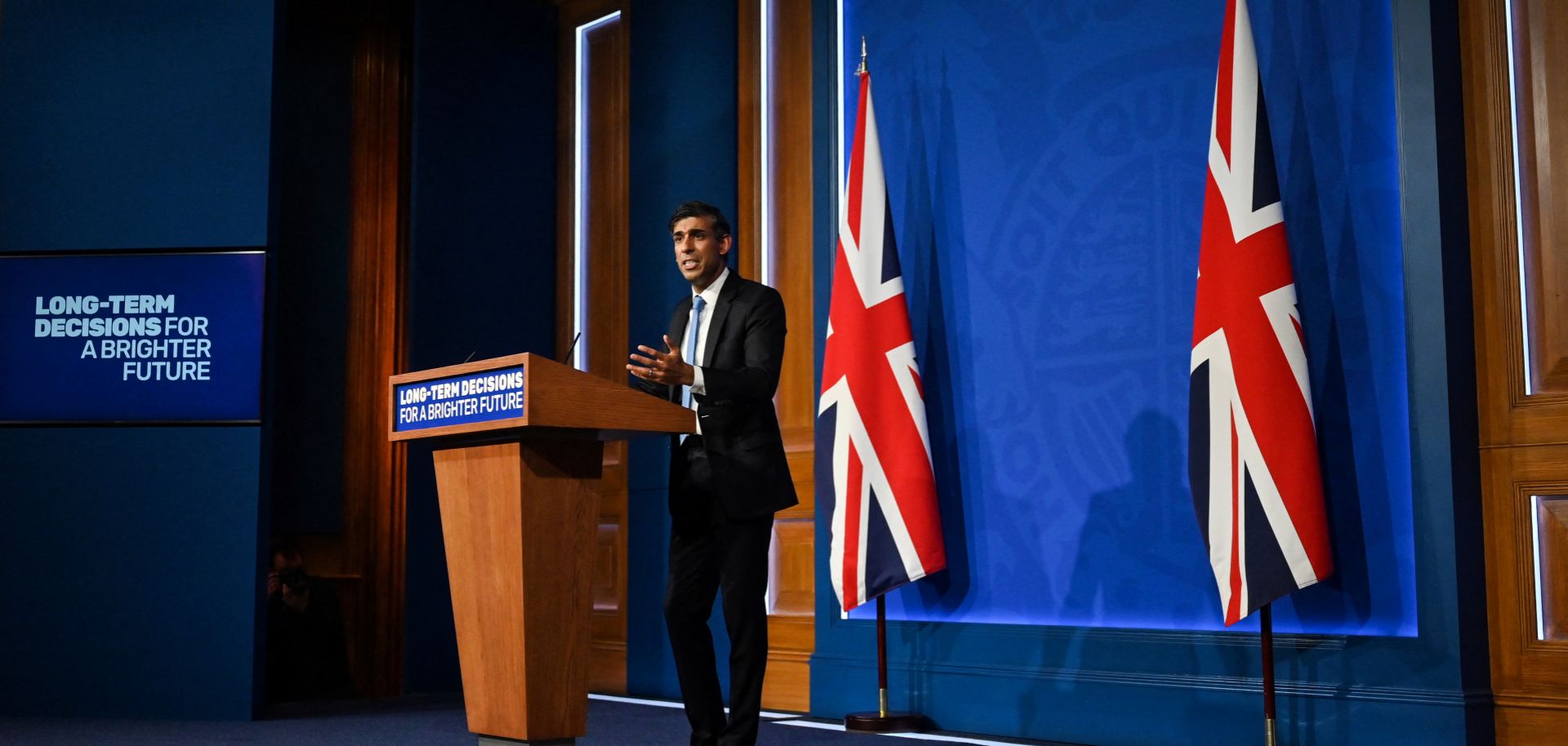
The U.K. government's decision to weaken some of its climate commitments marks a departure from the country's traditional approach to the energy transition, which may backfire politically while adding uncertainty for businesses and investors. U.K. Prime Minister Rishi Sunak announced Sept. 20 plans to roll back a number of key green energy policies, promising a ''more pragmatic, proportionate and realistic approach'' to meet the country's 2050 net-zero target. The prime minister justified the decision by arguing that his government remains committed to the country's climate pledges but will pursue them without imposing unnecessary financial burdens on British households and consumers. Changes include delaying a ban on the sale of new combustion engine vehicles from 2030 to 2035 and weakening a plan to phase out the installation of new gas boilers by 2035. He also pledged to scrap energy efficiency targets for the residential building sector and to not impose taxes aimed at discouraging air travel or eating meat. Additionally, the prime minister promised not to force U.K. citizens to recycle or carpool, although neither is government policy. The move received criticism from the scientific community and climate activists, as well as across the political spectrum in the country, including some senior members of the ruling Conservative Party.
- During his Sept. 20 address, Sunak also announced his government would significantly weaken its plans to phase out the installation of new gas boilers by 2035, setting the target to an 80% phase-out by that date. He also delayed a 2026 ban on off-grid oil boilers to 2035, again aiming for an 80% phase-out instead. This means it will take the United Kingdom longer to cut down natural gas demand (and its reliance on gas imports) over the next decade. Energy efficiency targets and planned insulation requirements for homeowners have also been scrapped.
- Sunak indicated his announcement was only the first of several other consumer-focused policy shifts that he will outline in the coming weeks ahead of the United Kingdom's next general election, which is due by January 2025.
By watering down key climate pledges, the Conservative Party is trying to win back some support ahead of next year's general election. The announcements mark a departure from the Conservative Party's own stance on climate change and the energy transition, as both were central components of the ruling party's 2019 campaign platform. The U-turn comes as the opposition Labour Party has been polling roughly 20 points ahead of the Conservative Party at the national level. Over the past year, the Labour Party has also consistently won local and parliamentary by-elections by capitalizing on recent political and economic turmoil under successive Conservative governments, as well as on the country's stubborn inflation and stagnant economic growth. But on July 20, the Conservative Party unexpectedly won the by-election for the parliamentary constituency of Uxbridge and South Ruislip in the greater London area amid backlash over the recent expansion of the city's controversial Ultra-Low Emission Zone (Ulez) — a key policy of London Mayor Sadiq Khan of the Labour Party. For Sunak and his party, the win suggested climate policies could turn into a potentially favorable terrain of confrontation with Labour ahead of the next general election, as London voters' anger over the local scheme to charge drivers of polluting cars may reflect country-wide opposition to costly climate action. Indeed, this view is supported by recent polling, which indicates support for the country's headline 2050 net zero targets and for scaling up renewable energy remains high, but that support for some of the government's other green policies (such as its ban on new fossil fuel cars) has waned in recent months. The Conservative Party's recent move to weaken its climate pledges is thus a political gamble aimed at closing the gap with Labour before next year's general ballot by accusing the opposition of ignoring the costs of climate policies on struggling households and consumers.
- In a YouGov poll conducted in August, only 36% of U.K. voters said they backed government plans to ban vehicles powered by combustion engines by 2030 — down from 51% in 2021, when the country was preparing to host the U.N. climate conference COP26 in Glasgow, Scotland. That drop in support was particularly sharp among Conservative Party voters, with only 19% saying they backed the ban in August compared with the 41% who said so in 2021. But 72% of all voters surveyed in the latest YouGov poll said they still supported the U.K. government's net zero goal by 2050; 79% also said they supported the new installation of onshore wind farms, while 49% supported tax hikes on long-haul flights.
- The European energy crisis brought on by Russia's invasion of Ukraine in February 2022 also contributed to the change in the U.K. government's calculus on its climate targets and overall energy policy. On July 31, Sunak announced more than 100 new oil and gas licenses for the North Sea to maximize domestic hydrocarbon production and bolster energy security while creating jobs.
- London first introduced its Ultra Low Emission Zone (ULEZ) in a small portion of the city in 2019. The scheme is aimed at reducing London's carbon emissions by forcing drivers of fossil fuel cars who enter the zone to pay a daily charge. In August, the ULEZ was expanded to encompass all of London, sparking widespread backlash.
Despite Sunak's electoral calculations, his updated climate policy could backfire by alienating environmentally conscious Conservative voters. Sunak is presenting the move as a more ''pragmatic'' revaluation of U.K. climate pledges and energy transition policies in light of the complicated economic situation in the country. In the coming months, this will likely evolve into a broader Conservative campaign to present Labour as ''climate zealots'' uninterested in the costs associated with environmental policies on strained households. However, the strategy presents significant risks. Politically, Sunak's anti-green pivot could backfire by creating rifts within his own party and alienating environmentally conscious Conservative voters. From a legal standpoint, environmental groups will also likely challenge Sunak's decision to water down climate commitments as the government is legally bound to lay out in detail how it intends to meet its 2050 net-zero target.
- The U.K. government is legally obligated to specify how it intends to meet the country's 2050 net-zero target under the 2008 Climate Change Act, which sets legally binding ''carbon budgets'' for different sectors of the economy every five years that are meant to work as stepping stones toward carbon neutrality.
- In July 2022, a U.K. court found the government's plans to cut carbon emissions were inadequate and breached national law. The court then ordered the government to re-elaborate its climate policies and publish more details on how it will make sure its climate targets are met. Sunak's new approach will likely result in a similar legal challenge.
- The Climate Change Committee, the U.K. government's independent climate adviser, said the new changes announced by Sunak on Sept. 20 will make it harder for the country to achieve its climate goals, and noted his assertions that the United Kingdom would still meet its 2050 net-zero target were ''wishful thinking.''
Sunak's new changes may also cast doubt on the United Kingdom's commitment to its climate targets, adding uncertainty for businesses and investors in the country. The prime minister's announcement is a break from the country's traditional cross-ideological political consensus on the net-zero agenda, which enabled the United Kingdom to gain a prominent role in the global climate debate and become a leader in the energy transition. A stable and reliable regulatory framework that allows for greater market certainty and consumer confidence is necessary to drive green investment. Rolling back key environmental pledges will thus add new uncertainty for businesses and investors. Against this backdrop, companies that have already invested heavily in green energy innovation based on the United Kingdom's existing targets — like the car manufacturers that had been preparing to adjust production to a fully electric U.K. car market by the end of this decade — may now lose their competitive edge and incentive for new investment. Businesses that haven't yet committed to such green investments may also now be deterred from doing so amid the heightened uncertainty surrounding the country's future climate policy direction, which could, in turn, slow the rollout of green technologies (such as heat pumps) at competitive prices in the country.
- The U.K. automotive industry criticized the government's recent decision to postpone the ban on new sales of combustion engine vehicles to 2035, given the steps already taken by the sector to meet the previous 2030 target.
- Another recent example of the U.K. government weakening a key component of its net-zero agenda was London's decision in July to water down reforms to the country's carbon market by offering more allowances than anticipated to polluting industries between 2024 and 2027. The move saw carbon prices fall to about 47 pounds ($57.5) a tonne — down from almost 100 ($122) pounds a tonne in 2022. Carbon allowances in the United Kingdom are, in turn, now trading at a steep discount compared with those in the European Union, where they are currently trading at around 85 euros ($90.7) a tonne. The discount will give short-term relief to energy-intensive industries in the United Kingdom, though it will come at the cost of potentially incentivizing industrial fossil fuel demand and undermining green investment, as industries' decarbonization strategies depend on robust and predictable carbon prices.
