
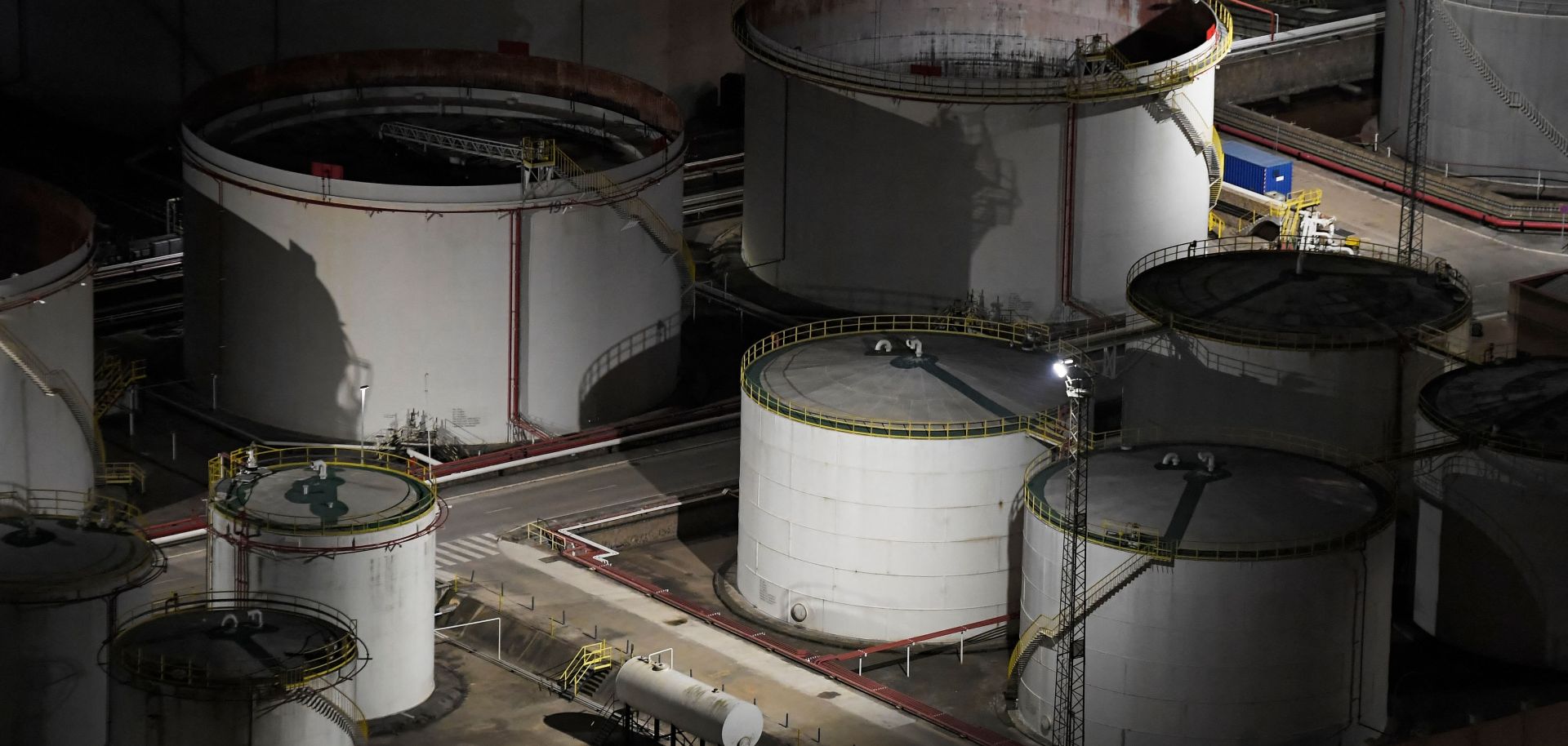
Storage tanks at the facilities of the oil products company Exolum on Dec. 11, 2022, at the port of Barcelona, Spain.
Renewed interest in hydrocarbon investment by international oil companies will trigger more lawsuits from environmental activists and increase pressure from shareholders focused on combatting climate change during the 2023 proxy season. More pressure from judges and investors focused on environmental, social and governance (better known as ESG) could force companies to walk back their investment plans in oil and gas or increase transparency about the climate impact of their activities, increasing the backlash against corporate leadership from investors opposed to a focus on ESG. With the time of year when corporations present their annual earnings drawing to a close, five of the oil and gas industry's six supermajors — BP, Chevron, ExxonMobil, Shell and TotalEnergies — reported record net profits for 2022 totaling nearly $200 billion collectively, with the sixth supermajor, Eni, due to release its annual figures Feb. 23. High oil prices and record liquefied natural gas and natural gas prices drove these record profits. Even though oil and natural gas prices have backed off their 2022 peaks, the 2022 global energy crunch is causing some leading oil and gas companies to refocus investment strategies to maintain a greater share in oil and gas production even as they maintain a public commitment to reducing their emissions footprint. Most notably, BP scaled back its 2030 climate targets, announcing that it would increase investment into oil and gas projects by up to $8 billion by the end of the decade to meet growing demand. Accordingly, BP reduced its target to cut oil and natural gas production by 2030 to 25% from 2019 levels, instead of the 40%-cut target it announced in 2020.
- Norway's Equinor, a company that aims to have 50% of its investment in energy transition technologies by 2030, stressed the need for a "balanced" energy transition given Europe's energy crisis and that its production would be "on par with today" at the end of the decade. Much like its home country, Norway, Equinor has been more aggressive than most oil companies in investing in the energy transition.
Environmental activists, governments and law firms will increase pressure on supermajors to abandon their plans to increase investment in oil and gas, and instead to focus on the energy transition and emissions reduction. In recent months, several supermajors have faced new lawsuits and various accusations related to climate change risk and their emissions standards. European governments are also stepping up efforts to combat greenwashing, or the practice of falsely promoting the sustainability of a product or course of action. The European Union is in the process of drafting a new law that would force companies to become more transparent about their green claims, including whether they are offsetting emissions through the purchase of carbon credits. Although the goal of these investigations differs, many want judges or regulators to force other companies to receive orders like those given in the 2021 Dutch court ruling against Shell forcing the company to cut absolute emissions by 45% by 2030 from 2019 levels. The effectiveness of lawsuits and investigations will vary from jurisdiction to jurisdiction, but as more and more evidence of links between natural disasters and climate emerges in the next five years — as well as any data suggesting oil companies are failing to hit their 2030 targets — judges will issue more verdicts against supermajors, especially if the world hits 1.5 degrees Celsius global warming by 2030, a level the 2015 Paris Agreement has sought to avoid. The U.S. Securities and Exchange Commission is also expected to finalize climate risk disclosure requirements later this year that will force publicly traded oil companies to be even more transparent about risks they face associated with climate change.
- ClientFirst, an environmental law firm turned activist investor in Shell, said it filed a lawsuit Feb. 8 alleging that Shell's 11 board members failed to manage "material and foreseeable" risks of climate change under the British Company Act. One of ClientFirst's lawyers said that the "board is persisting with a transition strategy that is fundamentally flawed, leaving the company seriously exposed to the risks that climate change poses to Shell's future success — despite the board's legal duty to manage those risks."
- Climate activist group Global Witness accused Shell of greenwashing in a complaint filed with the SEC Climate and ESG Task Force, GlobalWitness announced Feb. 1. Global Witness accused Shell of claiming to spend 12% of annual expenditures on "renewables and energy solutions" but only actually spending 1.5% on solar and wind energy. Global Witness argues that Shell is including investment in natural gas as a part of "renewables and energy solutions" and that Shell does not break down the 12% figure into enough detail.
- TotalEnergies was placed under formal investigation for the first time for "greenwashing," French outlet Mediapart reported Jan. 26. The investigation — just one of several similar cases TotalEnergies faces in France — is connected to a 2020 complaint alleging that the company was directly responsible for significant air pollution and "environmental lies."
- In November 2022, 16 Puerto Rican municipalities filed a federal lawsuit against about a dozen oil companies — including Chevron, ExxonMobil and Shell — accusing them of a multibillion "fraudulent marketing scheme" to deceive the public about climate change, violating various U.S. racketeering and antitrust laws, including the 1970 Racketeer Influenced And Corrupt Organizations Act largely used to crack down on Mafia activity, but that also has been used against FIFA, the international soccer governing body.
Supermajors' high profits plus easing concerns about the global energy supply should contribute to a banner year for environmental and climate-related proposals in the 2023 proxy season, not only for supermajors but also a number of other leading companies. Over the last five years, climate-related proposals from shareholders have grown considerably, culminating most visibly in 2021 when activist investor Engine No. 1 successfully used a shareholder proposal to overhaul ExxonMobil's board of directors in order to get the company to take a more proactive approach to climate-related risks to the company. This trend is likely to continue this year after easing a bit in 2022 due in part to concerns about the energy crunch in the wake of the Ukraine war. Activist investor Follow This announced in December 2022 that it had filed resolutions for BP, Chevron, ExxonMobil and Shell to set new broad Scope 3 emissions targets. (Scope 3 emissions cover emissions generated by the use of a company's products in addition to the company's own emissions.) Specifically, Follow This is asking the companies to set medium-term reduction targets for Scope 3 emissions consistent with the Paris Agreement's goal of limiting global warming to well below 2 degrees Celsius above preindustrial temperatures. BP, Chevron and Shell have set Scope 3 emissions targets, but Follow This says the companies' targets do not align with the Paris Agreement.
- In 2022, the number of environmental-related proposals voted on increased significantly, but the percentage of environmental-related proposals that passed declined from 40% in 2021 to 34%, according to the Conference Board, suggesting overall support declined. In both 2021 and 2022, Follow This tabled proposals related to reducing greenhouse gas reduction targets for Chevron, but the percent of shareholders supporting the measure declined from 60.7% in 2021 to 32.6%.
- Non-oil companies are also likely to face significant climate-related proposals from activist investors in 2023. On Jan. 23, activist investor As You Sow, which along with Follow This was the most prolific filer of climate and environmental-related proposals in the 2022 proxy season (from mid-April to mid-June, when most large publicly traded companies host annual meetings for shareholders to review a company's financial performance and vote on issues stated on proxy voting cards), announced it filed resolutions against six banks — Bank of America, CitiGroup, Goldman Sachs, JPMorgan, Morgan Stanley and Wells Fargo — asking each to publish detailed reports on how they planned to align their financing activities with 2030 emissions goals, including specific measures and policies, timelines for implementation, and how each measure would achieve the reductions.
An increase in anti-ESG proposals is also likely this year as a backlash to ESG efforts becomes more vocal, illustrating the heightened reputational risks and the divergent shareholder priorities companies face. Criticism of ESG has been rapidly rising in recent years in the United States, not only from politicians but also anti-ESG investors, and while BP's efforts (and those of other oil companies) to invest more in oil and gas will ease some of their concerns, the number of anti-sustainability and anti-ESG proposals by shareholders is likely to rise. The 2022 proxy season saw 52 anti-ESG proposals tabled. This was double the amount in 2021, according to investor services consultant Georgeson. This trend will probably continue to rise in 2023, particularly as other anti-ESG voices get louder on Capitol Hill, where Republicans have promised to hold hearings on ESG-related investment strategies, and in state governments, such as Florida and Texas. Most anti-ESG proposals fail to pass, but in many cases, that is also the point. Investors working to thwart ESG efforts commonly table a resolution worded similarly to a pro-sustainability proposal, but written in a way to make it unappealing to most shareholders. Anti-ESG investors often hope their proposals fail to reach various threshold requirements set by the SEC for submission, thus making it more difficult for pro-ESG proposals to file similar proposals in the future due to SEC procedural requirements. While many of these proposals fail and can sometimes shield boards from proposals from future votes on sustainability and ESG-related proposals, they can often generate a negative reputational backlash when a company becomes publicly associated with such proposals. Nevertheless, the likelihood of more carefully worded proposals designed to force companies in a different direction is also likely to increase as the anti-ESG backlash gains more traction among different investment groups.
- In 2022, prominent anti-ESG activist investor Vivek Ramaswamy set up Strive Asset Management, backed financially by conservative billionaire Peter Thiel and Republican Sen. J.D. Vance in an attempt to provide an anti-ESG alternative to financial companies like BlackRock that back pro-ESG proposals. Ramaswamy's group publicly announced in October 2022 that it identified opportunities to unlock more profits at Amazon, Apple, Chevron, Citigroup, Disney, ExxonMobil and Home Depot "if liberated from ESG-imposed constraints," and specifically said in December it would focus on Chevron in the 2023 proxy season. It also said that it had worked with an existing shareholder to create a new proposal reversing a 2021 shareholder resolution proposed by Follow This that mandated Chevron set Scope 3 emissions targets.
- The Bahnsen Group, founded in 2022 and whose founder described the ESG movement as an "intellectually and morally bankrupt movement [that] is finally being exposed," has already submitted an anti-ESG proposal at Chevron. The group is proposing Chevron's board create a board committee to evaluate the impact of decarbonization on Chevron. Effectively asking the committee to focus on the negative impacts of following through on more investment into the energy transition, it added that the:
charter should require the committee to engage in formal review and oversight of corporate strategy, above and beyond matters of legal compliance, to assess the company's responses to demands for such decarbonization schedules, including the potential impacts on the Company from flaws in activists' climate models, the possibility that the U.S. will not force decarbonization according to such schedules, thus obviating 'stranded asset' calculations, the possibility that other countries will not adopt similar targets, thus making Company efforts meaningless, concerns about technological or economic infeasibility, and other relevant considerations.
