
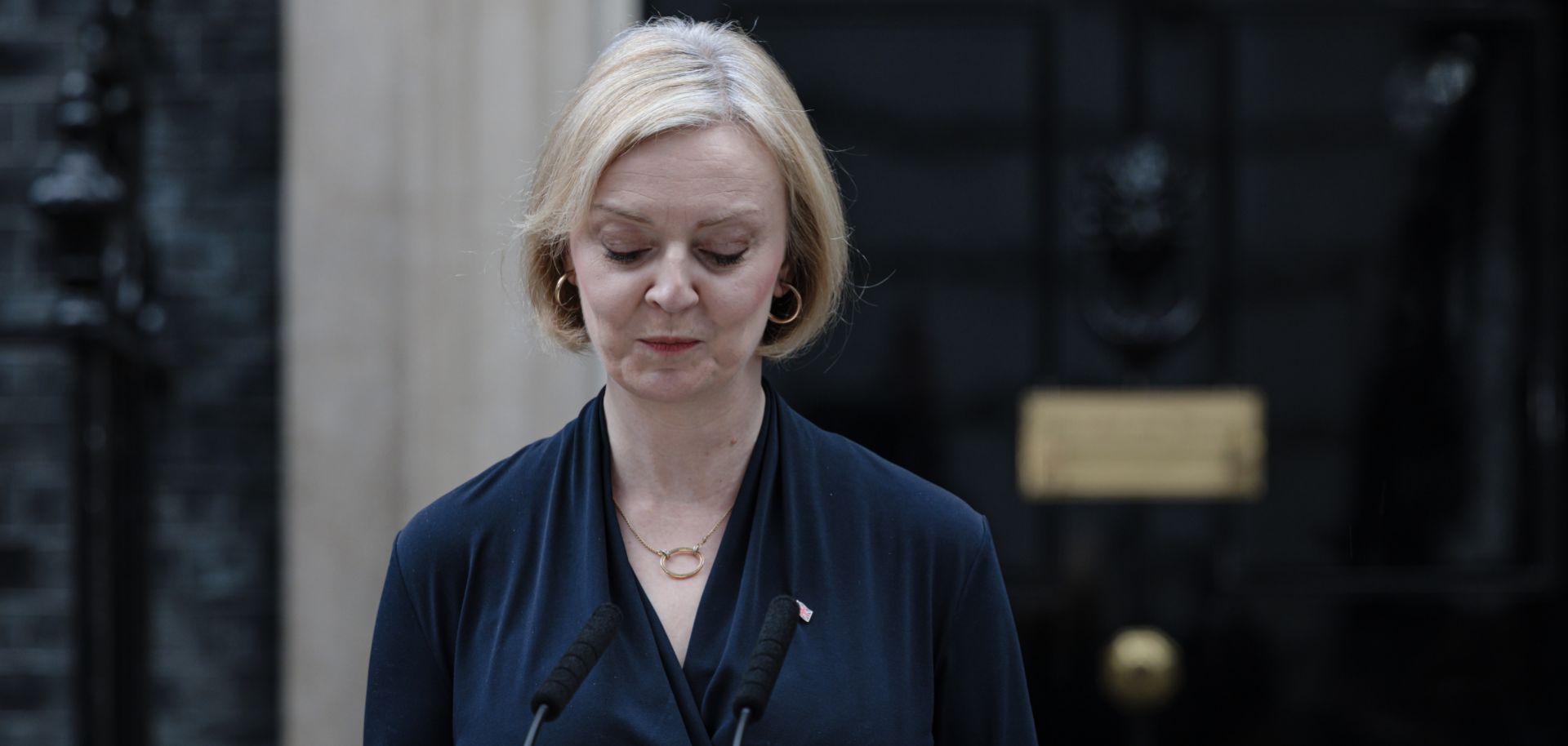
U.K. Prime Minister Liz Truss delivers her resignation speech at Downing Street in London on Oct. 20, 2022.
While U.K. Prime Minister Liz Truss's resignation is meant to reduce uncertainty about Britain's economic policy, the appointment of a new government may not end the disputes within the governing Conservative Party and could, in fact, produce new crises in the future. After less than two months in office, Truss announced her resignation on Oct. 20 and the beginning of a process to elect a new leader for the governing Conservative Party, who will then become the United Kingdom's prime minister. Truss's decision happened after weeks of financial and political turmoil, which began in late September with the announcement of some 43 billion pounds in unfunded tax cuts that generated significant market concerns about the sustainability of the government's economic program. Facing increasing market pressure, Truss was forced to dismantle most of her economic program in early October. But the damage was already done and calls for her resignation grew louder within the Conservative Party, especially as opinion polls showed that the party's popularity was collapsing and that the main opposition Labour Party would win by a landslide if an early general election was held.
- The current phase of political volatility in the United Kingdom began on July 7, when former Prime Minister Boris Johnson announced his resignation amid a series of scandals. This kickstarted a two-month leadership contest within the Conservative Party that resulted in Truss's victory and appointment as prime minister on Sept. 5. Truss campaigned on promises of massive tax cuts and large programs to help British households and businesses pay their energy bills. Her main rival, former Chancellor Rishi Sunak, warned that such a policy would be unsustainable and have inflationary effects.
The Conservative Party's decision to fast-track the appointment of its new leader is meant to reduce uncertainty, but it may not be enough to heal the party's internal fragmentation and end the larger political volatility affecting the country. According to Truss, the Conservative leadership election will be completed ''in the next week,'' which suggests that the party will make the decision internally and not put it to a vote among its members as was the case with her election. The main goal of this change in approach is to avoid a protracted leadership contest that would freeze the government for at least two months at a time of high inflation and severe economic uncertainty. However, this may not be enough to end the divisions within the Conservative Party, which does not have a clear successor to Truss. In recent days, the moderates within the party seem to have gained influence, as exemplified by the recent appointment of centrist Jeremy Hunt as Chancellor to replace Kwasi Kwarteng, who Truss fired on Oct. 14. The negative market reaction to Truss's policies also suggest that the next government will not insist on severe tax cuts at a time of slowing economic growth and high inflation. This means that the next government is likely to follow a policy of fiscal restraint close to the approach adopted when former Chancellor Sunak was in office, which should reassure financial markets. However, a moderate prime minister would probably irritate the right-wing sectors of the Conservative Party that initially backed Truss. As a result, the consensus around the new prime minister may be short-lived and rebellions against him or her could start quickly if he or she fails to deliver positive economic results in the short term, which would trigger additional market volatility.
- On Oct. 20, Sir Graham Brady, the leader of the 1922 Committee within the Conservative Party (which is in charge of organizing leadership contests) said that ''it will be possible to conduct a ballot and conclude a leadership election by Friday the 28th of October. So we should have a new leader in place before the fiscal statement which will take place on the 31st.''
- The Conservative Party has entered a phase of high volatility, where support for its leaders wanes quickly if opinion polls and markets react adversely to policy decisions, and where members of parliament are willing to break party discipline and vote against the government if the prime minister is perceived as weak. This suggests that the ''honeymoon period'' for the new Conservative leader will be very short if opinion polls suggest that the new leader will not perform well in the next general election.
While opposition calls for an early general election will grow louder in the coming weeks, the Conservatives will cling to power to avoid an electoral defeat. After Truss's resignation, the leaders of the Labour Party, the Liberal Democrats, the Green Party and the Scottish National Party called for an early general election to appoint a new government in charge of turning the economy around. However, with the Labour Party currently polling 20-30 points ahead of the Conservative Party, the government is unlikely to dissolve parliament and call for a general election before the January 2025 deadline. While Conservative members of parliament will be willing to boycott their own leader in the House of Commons if they perceive that person as weak, they are unlikely to side with the opposition on a no-confidence vote against the prime minister that would trigger an election where many Conservative lawmakers would lose their seats.
- The Conservatives have a sufficiently large parliamentary majority to prevent even a united opposition coalition from winning a no-confidence vote that would trigger a new election.
