
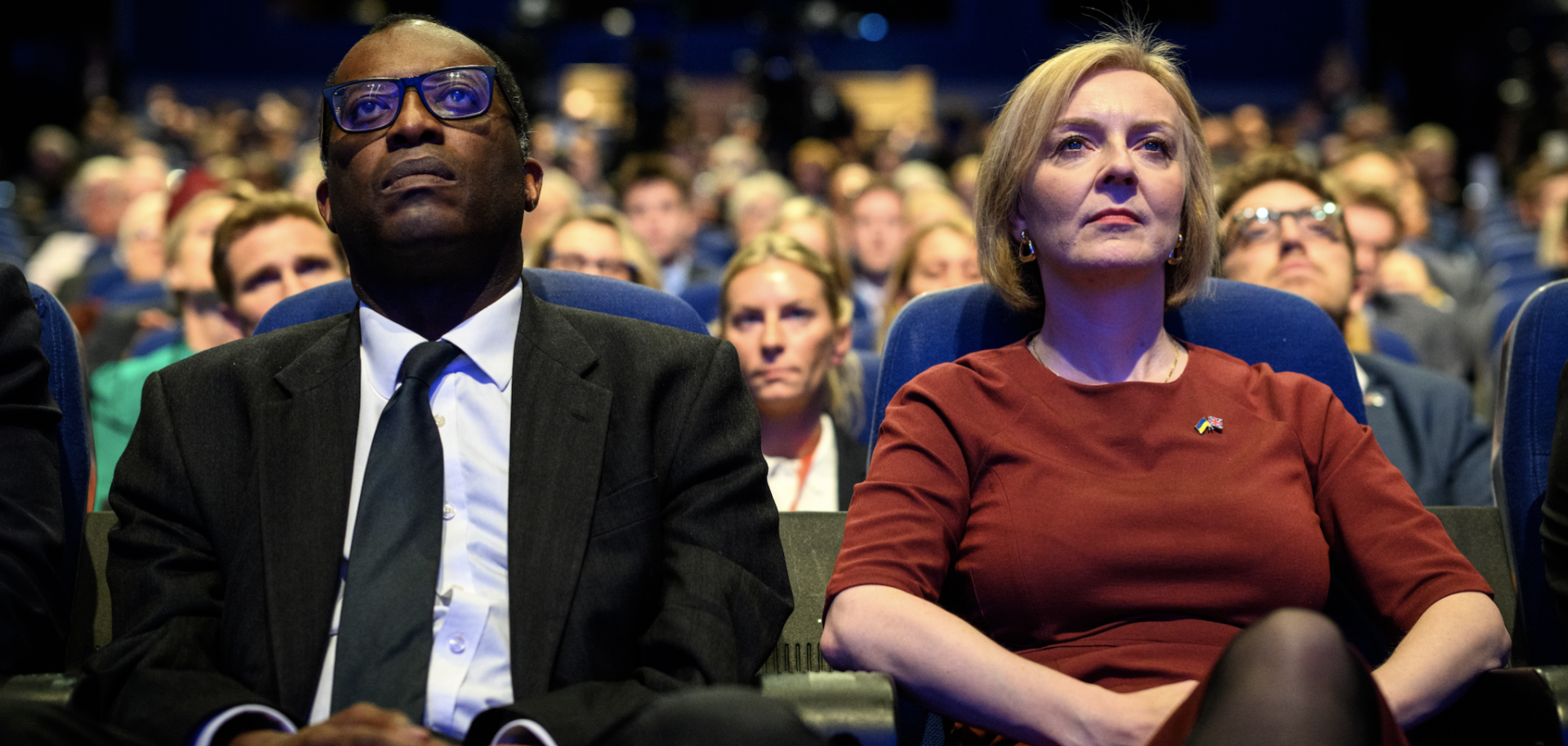
U.K. Prime Minister Liz Truss (right) and then-U.K. Chancellor of the Exchequer Kwasi Kwarteng watch a tribute to Queen Elizabeth II on the opening day of the annual Conservative Party conference on Oct. 2, 2022, in Birmingham, England.
In the United Kingdom, the appointment of a more moderate Chancellor seeks to calm markets and reduce discontent within the governing Conservative Party, but Prime Minister Liz Truss' fight for her political survival will continue to create economic uncertainty and political instability. On Oct. 14, Truss dismissed Chancellor Kwasi Kwarteng and replaced him with former Foreign Secretary Jeremy Hunt. The move to dismiss Kwarteng, who only took office on Sept. 6, follows three weeks of financial turmoil that began on Sept. 23, when Kwarteng announced a ''mini-budget'' that included 43 billion pounds in unfunded tax cuts and a 60 billion pound energy package. The new fiscal strategy rattled global markets and caused the U.K. pound's value against the U.S. dollar to plunge to record lows, forcing the Bank of England to purchase government bonds (known as gilts) to stabilize their price and prevent the collapse of the pension funds holding them.
- The pound had a volatile day vis-a-vis the dollar: the U.K. currency fell after Kwarteng's dismissal, recovered after Hunt's appointment, and then dropped again after Truss' press conference. Gilt yields were also volatile throughout the day as the political events unfolded.
- While Hunt defended tax cuts during his unsuccessful bid for the Conservative Party leadership over the summer, he is seen as a more moderate and less libertarian figure than Kwarteng and Truss, which suggests that his appointment seeks to simultaneously appease financial markets and moderate members of the U.K. Conservative Party.
Truss also announced that she will keep the previous government's plan to increase corporate taxes in 2023, which is meant to reassure markets about the future of state revenue. One of the most controversial aspects of Kwarteng's ''mini-budget'' was a plan to scrap a plan by former Chancellor Rishi Sunak to increase the United Kingdom's corporate tax rate from 19% to 25% in 2023. While Truss praised the plan as a pro-business measure that would generate additional investment and economic growth, the idea raised concerns about the U.K. government's ability to finance public spending (including massive energy consumption subsidies) while simultaneously reducing state revenue through tax cuts. Sunak and other fiscally moderate members of the Conservative Party also warned that the massive tax cuts would exacerbate inflation in the United Kingdom, which is currently at four-decade highs. Truss' Oct. 14 policy u-turn came only days after her government also reversed a plan to scrap the top rate of income tax, which had raised similar concerns about state revenue and led to opposition accusations of the U.K. government benefiting the wealthy.
- Truss became U.K. prime minister on Sept. 5 after winning an internal contest within the ruling Conservative Party. She based her electoral campaign on a promise to significantly cut taxes in order to boost economic growth.
- In early October, the International Monetary Fund warned that while Kwarteng's ''mini-budget'' would accelerate GDP growth, it would also fuel inflation, which reached 10.1% in July before falling slightly to 9.9% in August.
- Despite the criticism against the ''mini-budget,'' on Oct. 12 Truss told the U.K. Parliament on Oct. 12 that she felt raising taxes ''would be wrong at a time when we are trying to attract investment into our country [amid] global crisis.''
In the coming weeks, Truss will struggle to convince financial markets that her erratic economic policy can still reduce inflation and generate growth while also fighting for her political survival. If the Oct. 14 policy u-turns fail to calm markets, Truss may be forced to announce more policy reversals (such as scrapping energy support for high earners), which would send additional signals of an erratic economic policy. In addition, in the coming days, several Conservative lawmakers will likely demand Truss' resignation for fear of the overall state of the U.K. economy and the party's collapsing popularity among voters, which could result in additional volatility in financial markets. According to Conservative Party rules, Truss cannot face a no-confidence vote during the first 12 months of her tenure, but some Conservative members of parliament will push to change the rules to get rid of her. Even without a formal vote of no confidence, senior Conservative lawmakers could effectively force Truss to resign by undermining her leadership to the point where her government is paralyzed. At this point, the dissolution of Parliament and an early general election are very unlikely because polls suggest that such a vote would yield a landslide victory for the opposition Labor Party. This means that the Conservative Party will prefer to change its leader internally instead of risking its place in power by going to an early election.
- The United Kingdom does not need to hold a general election until January 2025. The Labor Party is currently polling between 20-30 points ahead of the Conservative Party. While this will motivate some Conservative members of parliament to replace Truss with a more popular leader, it will also deter them from seeking an early general election.
