
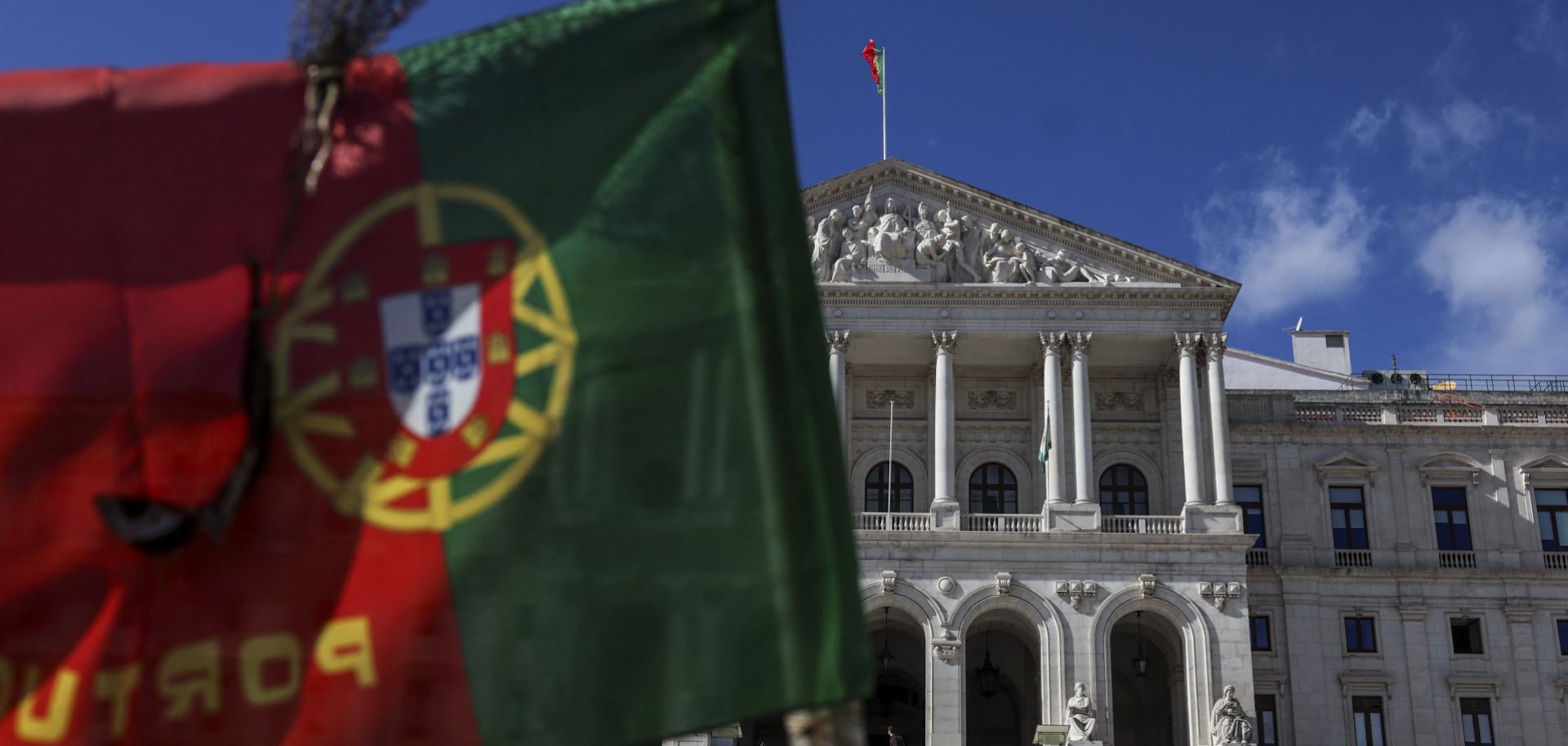
Portugal's ongoing political crisis will increase policy uncertainty in the country, and may also derail lithium and hydrogen projects that are key to the European Union's efforts to gain greater strategic autonomy in producing critical raw materials and renewable energy. Portuguese Prime Minister Antonio Costa resigned on Nov. 7 after police raided his residence, as well as the Ministries of Environment and Infrastructure, as part of a corruption investigation concerning government awards of contracts for lithium exploration concessions in the north of the country and a green hydrogen production project in the port city of Sines. Public prosecutors also detained Costa's chief of staff Vítor Escaria, his personal adviser Diogo Lacerda, and Sines' mayor and Costa's fellow Socialist Party member Nuno Mascarenhas. Costa announced his resignation in a televised speech following a meeting with President Marcelo Rebelo de Sousa, during which he said he would not seek another term as prime minister. After accepting Costa's resignation, Sousa said he had begun the process of dissolving parliament, adding he would provide more detail on what comes next in a Nov. 9 speech.
- In recent years, Costa's government has backed several lithium projects in the country with the goal of carving Portugal a central role in Europe's nascent battery-manufacturing production chain.
- The Portuguese Environment Agency (APA) approved a large open-pit mine in the region of Barroso in May and another mine in the region of Montalegre in September, despite strong local opposition due to the environmental impacts of new lithium mining operations.
Despite a series of scandals affecting the ruling Socialist party, Costa's government had brought exceptional stability and growth to Portugal. Costa first became Portugal's prime minister in 2015 and was re-elected in 2019 and 2022. His successive governments were affected by a series of scandals related to alleged mismanagement and corruption that saw several ministers and senior officials resign over the past few years. The country's ongoing cost-of-living and housing crises had also spurred anti-government demonstrations in recent years, further affecting Costa's popularity. The government's strong parliamentary support had enabled it to navigate these challenges, but Costa's allegedly direct involvement in the latest scandal brought about his downfall. While investigations are ongoing, the prosecutor's office revealed Costa was (at least to some extent) involved in cases of alleged malfeasance, corruption and influence peddling ''to unblock procedures'' related to the lithium exploration concessions in the Romano and Barroso mines, a hydrogen production plant and data center projects in Sines. But despite all the controversies, under Costa's leadership, Portugal enjoyed years of falling public debt and strong economic growth, outperforming many of its European peers thanks to a booming tourism sector and strong foreign investment. Political stability helped increase confidence in the country and its economy, while Costa's fiscal restraint and growth-oriented policy maintained the economy on a sustainable path.
Portugal's next government could be less stable than the outgoing one, especially if it includes the far-right Chega party. However, major changes to the country's economic policies are unlikely due to significant financial constraints. Costa's resignation will likely lead to fresh elections, with President Rebelo de Sousa expected to dissolve parliament and call for an early vote in the coming days. An early election could increase political uncertainty in the country because, according to recent polls conducted before the latest scandal, Costa's Socialist Party (PS) would lose the absolute majority in parliament it secured in 2022 even if re-elected. The current government's absolute majority — an anomaly in a country where coalition governments are the norm — had made it easy for Costa's administration to pass legislation and implement measures needed to continue receiving EU funds key to the country's economic growth and financial stability. If an early election yields a more fragmented parliament and a coalition government, any new administration will have a harder time passing legislation. Moreover, the corruption scandal could fuel anti-establishment sentiments. In particular, polls suggest the biggest beneficiary could be the far-right Chega party, whose popularity has dramatically increased since the 2022 elections. The party is unlikely to gain enough support to govern alone but could make it into government as a junior partner in a coalition government led by the center-right Social Democratic Party (PSD). An alternative scenario would see Costa's PS party remaining in power by forming a coalition government with smaller left-wing parties, but it is unclear whether the party would manage to garner enough seats in parliament to do so in the aftermath of the scandal. But regardless of what government takes over in Portugal, it is highly unlikely that there will be any significant changes to the country's economic and fiscal policies. For one, Portugal's high debt-to-GDP ratio, which stood at 114% in 2022, will severely limit the next government's options in formulating new policies. Moreover, Portugal has vivid memories of the 2011 eurozone crisis, which had a devastating impact on the country's economy, forcing Lisbon to seek a bailout from the European Union and the International Monetary Fund and implement a series of economic austerity measures. Against this backdrop, any new administration will likely observe fiscal discipline and maintain fiscal consolidation efforts.
- President Rebelo de Sousa may also decide not to dissolve parliament, and instead name a new prime minister with the current majority in parliament. But the extent of the ongoing probe would make it politically very difficult to select a candidate from the ruling SP.
- According to the latest polls from Europe Elects, PS would secure 29% of the vote if elections were held today, a sizable drop from the 41.4% that Costa's party secured in the 2022 election.
- The center-right PSD is polling at 26%, down from the 28% of votes it received in last year's election. The far-right Chega party, by contrast, is polling at 13.2%, up from the 7.2% it won in 2022. Following closely behind are the Liberal Initiative and the Left Bloc parties, each polling at 7% share, followed by the left-wing CDU alliance and the Animal Welfare Party, polling at 4.4% and 3.6%, respectively.
- PSD leader Luis Montenegro has so far ruled out forming an alliance with Chega, favoring instead a coalition with PS. But the backlash from the latest corruption probe into the latter could make a coalition with the Socialists politically unpalatable. An eventual PSD-Chega government would probably be less stable than the outgoing government due to the two parties' ideological differences, which could increase uncertainty in the country's future policy direction. However, the PSD's strong pro-EU stance would likely temper Chega's Eurosceptic views, meaning a potential coalition between the two would result in an overall pro-EU government with a socially conservative agenda on issues like migration and minority rights.
- Portugal has built a strong reputation for sound economic and fiscal policies in recent years. The country has made significant progress in reducing its public debt levels, and its long average maturity of debt means that rising borrowing costs also do not pose a significant risk of a financial crisis. Moreover, an effective absorption of EU post-pandemic recovery funds is set to continue supporting economic activity in Portugal over the next few years. Against this backdrop, the current political crisis brought on by Costa's resignation is expected to have little impact on financial markets and on Portugal's sovereign yields.
The scandal could, however, delay the development of major lithium and green hydrogen projects in Portugal, which might disrupt the European Union's broader goal of achieving greater self-sufficiency in the production of critical raw materials for the energy transition. The European Union has been seeking to boost its domestic capacity to produce and refine critical raw materials needed for the net-zero transition, thereby reducing the bloc's reliance on other countries, particularly China, for such supplies. Portugal's large reserves of lithium — an essential ingredient in the batteries used to power electric vehicles (EVs) — are considered critical for achieving this goal, with the Barroso mine currently under development set to become Europe's first large-scale mine to supply battery-grade lithium. Portugal also aims to become a major producer and exporter of green hydrogen, which the European Union views as a crucial component of its future energy mix to achieve carbon neutrality by 2050. Portugal's lithium mines and green hydrogen projects have both received (or have been earmarked for) significant EU funding due to their potential role in Brussels' green initiative. It is unclear what impact, if any, the investigation into the concessions allegedly awarded for lithium mines and hydrogen production will have on these projects, though a substantial delay in their development could affect the European Union's prospect of developing domestic production capacity for both elements. More broadly, the scandal may also raise questions regarding the fairness and transparency of expedited licensing procurement processes for major energy projects across Europe, such as the ones in Portugal, which may trigger a backlash against recent provisions under the European Union's Critical Raw Material Act (CRMA) to reduce the administrative burden and simplify permitting procedures for critical raw materials projects. Though slim, there's a chance this could slow the adoption of such regulations, which are meant to provide a supportive environment for expanding Europe's capacity to produce critical minerals and green technologies, though this is unlikely given the advanced state of negotiations.
- Portugal's lithium reserves, estimated to be the largest in Western Europe, are considered crucial to meeting Europe's growing demand for EVs. The Barroso mine alone is expected to produce enough lithium for 500,000 EV batteries every year throughout its 14-year operational life.
- In 2022, the developers behind the so-called H2 project in Sines announced plans to invest 1 billion euros ($1.08 billion) to build a 500-megawatt green hydrogen and ammonia production plant that is expected to begin operations in 2025. The project was also earmarked for EU funds as an Important Project of Common European Interest.
- Proposed in March by the European Commission, the Critical Raw Material Act (CRMA) is a package of measures aimed at increasing the bloc's access to secure and affordable supplies of critical raw materials. The European Parliament approved the final text of the CMRA on Sept. 14, but intra-EU negotiations between the European Commission, the European Parliament and EU member states to ratify the proposal remain ongoing.
- The European Union relies on supplies from China for green products like photovoltaics, batteries and wind turbines, as well as for metals to produce those products (such as cobalt, lithium and boron).
