
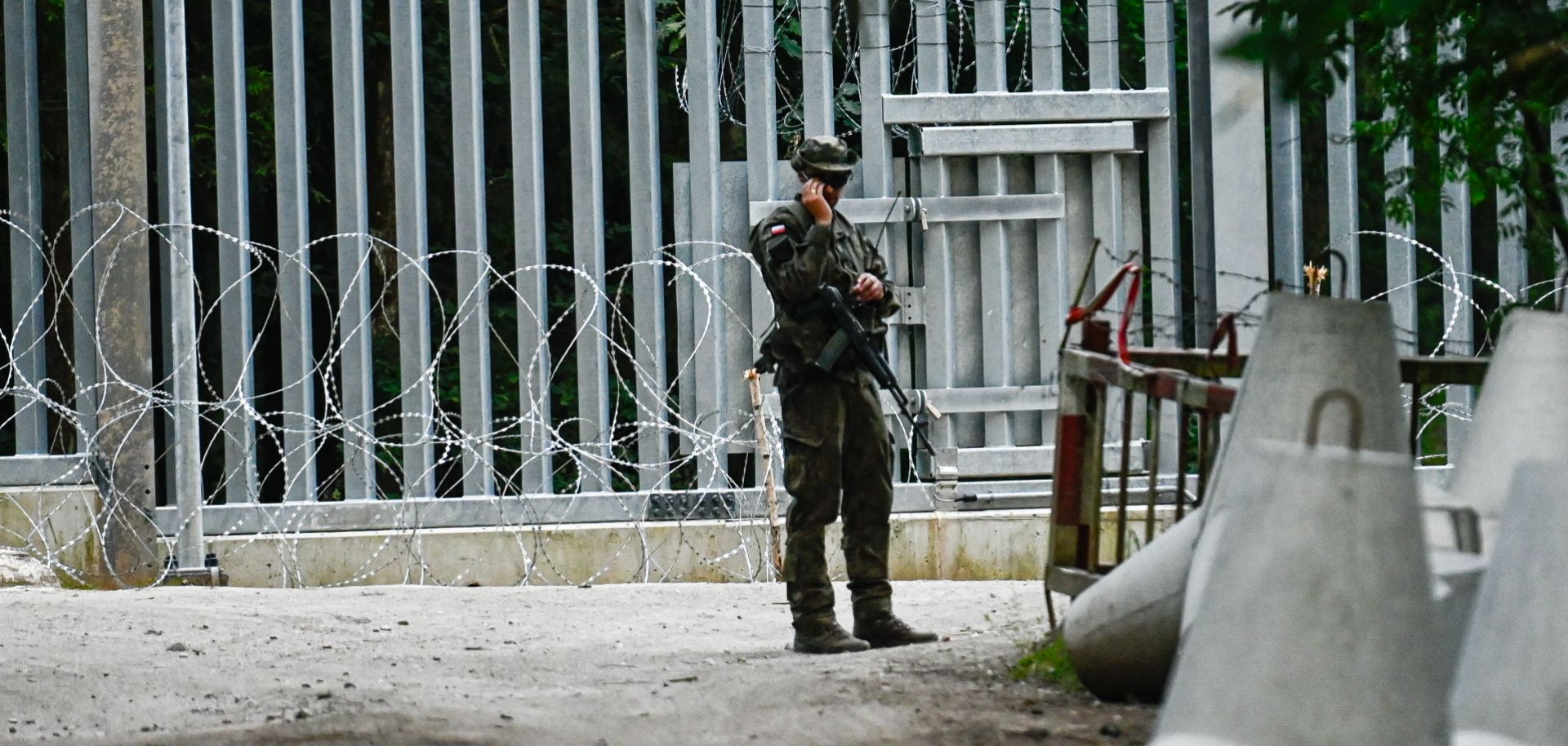
Russia and Belarus' ongoing activities at the Romanian and Polish borders carry a high risk of sparking a crisis with the two NATO members, though if this happens, Bucharest and Warsaw will likely seek de-escalation. In recent days, Poland and Romania have warned their NATO and EU partners about potential Russian and Belarussian aggression in the context of the ongoing war in Ukraine. On Aug. 1, the Polish government accused Belarus of violating Polish airspace with military helicopters and announced it would increase its military presence on its eastern borders. Then on Aug. 2, the Romanian government said that Russia's increased attacks on Ukrainian ports by the Danube River (which separates Ukraine from Romania) were ''unacceptable'' and described them as ''war crimes.'' Poland (which shares land borders with both Russia and Ukraine) and Romania (which shares a land border with Ukraine and Black Sea access with Ukraine and Russia) are two of Europe's most hawkish countries with regard to Russia. They are some of the strongest supporters of sanctions against Moscow and an increased NATO presence in Central and Eastern Europe, which fuels their fears and accusations of potential Russian aggression in the region.
- Poland's relations with Belarus, a close Russian ally, have been tense for years. In mid-2021, Belarus encouraged and assisted migrants from Middle Eastern countries to enter Poland, Lithuania and Latvia, which these countries denounced as an act of hybrid warfare. Polish-Belarusian tensions escalated again in June 2023, when Minsk accepted to host mercenaries from the Wagner group after their failed mutiny in Russia. Belarusian president Alexander Lukashenko later said that some Wagner fighters were keen to enter Poland and ''go on a trip to Warsaw and Rzeszow.'' On July 29, Polish Prime Minister Mateusz Morawiecki said some 100 Wagner fighters were close to the Belarusian city of Grodno near the Polish border, describing the situation as ''increasingly dangerous.''
- In mid-July, Russia withdrew from the Black Sea Grain Initiative, a U.N.-brokered agreement to allow Ukraine to export grains and oilseeds through its Black Sea ports. Since then, Russia has increased its missile attacks on Ukrainian ports at the mouth of the Danube River. On Aug. 2, Russia attacked Ukrainian grain ports and transport infrastructure at Izmail, a city on the Ukrainian-Romanian border.
In the case of Romania, Russian aggression is more likely to occur by accident than by design, which means that if it happens, Bucharest is likely to loudly denounce Moscow but ultimately seek de-escalation. Romania's NATO membership puts it under the military alliance's collective security umbrella. Russia thus knows that military aggression against Romania could trigger a war with NATO, which Moscow wants to avoid. This means that a potential Russian missile attack on the Romanian side of the Danube (which is possible, considering how close to the Ukraine-Romania border Russia's attacks are) is more likely to happen by accident than by design. If a Russian missile accidentally hits a Romanian target, Bucharest would likely protest loudly and denounce it as an act of aggression. Bucharest would also likely call its NATO partners for consultation under Article 4 of the North Atlantic Treaty. However, this would unlikely lead to the triggering of the collective defense clause established in Article 5, as Romania, Western Europe and the United States do not want an open war with Russia — especially one caused by a comparatively minor incident, like a missile falling on the wrong side of the Danube. It would take a much more obvious and undeniably planned act of aggression (such as attacking major infrastructure well within Romanian territory) for NATO to consider using Article 5.
- In November 2022, a missile struck a Polish village near the border with Ukraine, killing two people. Warsaw suggested Russia could be responsible and called for Article 4 consultations with its NATO partners. NATO's reaction to the incident was very cautious, as the alliance did not automatically accuse Russia and called for a proper investigation, which later concluded that the incident had probably been caused by a Ukrainian air defense missile fired by Ukrainian forces in response to Russia's air raids on Ukrainian energy infrastructure. This episode demonstrated NATO's caution regarding unexpected events and spillover from the war along NATO member states' borders.
- In addition to the Black Sea, Romania is also concerned about the increased potential of Russian destabilization efforts in neighboring Moldova, which is home to the pro-Russian breakaway region of Transnistria that hosts Russian troops. Romania supports Moldova's pro-EU government and worries that if pro-Russian political forces take control of the country, Moldova could turn into a Belarus-like situation.
In Poland's case, aggression from Belarus or Russia has a higher chance of escalation because it is less likely to be an accident; however, Russia and NATO would still seek to avoid a war. Should Wagner forces, and especially Belarussian military forces, enter Poland's territory, the probability of escalation would be higher than in the case of a missile accidentally hitting Romania, because it would be the result of an active decision by Wagner, Minsk, Moscow or all three of them. A potential goal of such an incursion would be to fabricate a threat that would force Poland (and possibly other NATO states) to redirect their focus from helping Ukraine militarily to improving their own security. In the case of Wagner, Minsk and Moscow could still argue that the mercenaries acted without their consent, but in the case of the Belarussian military, there would be no such plausible deniability. In either case, Poland would almost certainly request Article 4 consultations with its NATO partners. Article 5 conversations would also be possible, though an incursion limited in scale and scope (such as Wagner or Belarussian troops briefly entering Poland's territory and then returning to Belarus) would be unlikely to trigger a military response from NATO because the alliance would probably not consider it severe enough to justify a war with Russia and/or Belarus. Still, an incursion into Poland could result in a confrontation with Polish border troops (particularly as Warsaw is increasing its military presence at the border), which would carry the risk of further escalation. Such a scenario would require a much stronger de-escalation effort from both sides, with a higher risk of events spinning out of control, even if a full-on NATO-Russia war remains improbable as a result.
- Since the beginning of Russia's war in Ukraine, Poland has repeatedly accused Moscow of acts of unconventional aggression, including cyber attacks against Polish state institutions and private businesses, as well as disinformation campaigns. However, because Poland is unable to directly prove that the Russian government was behind these events, combined with the fact that so far, these acts of aggression have not disrupted any essential Polish infrastructure or resulted in casualties, this means that Poland and NATO do not see it as justification to trigger Article 5 and retaliate against Russia.
